
 By Culture Expert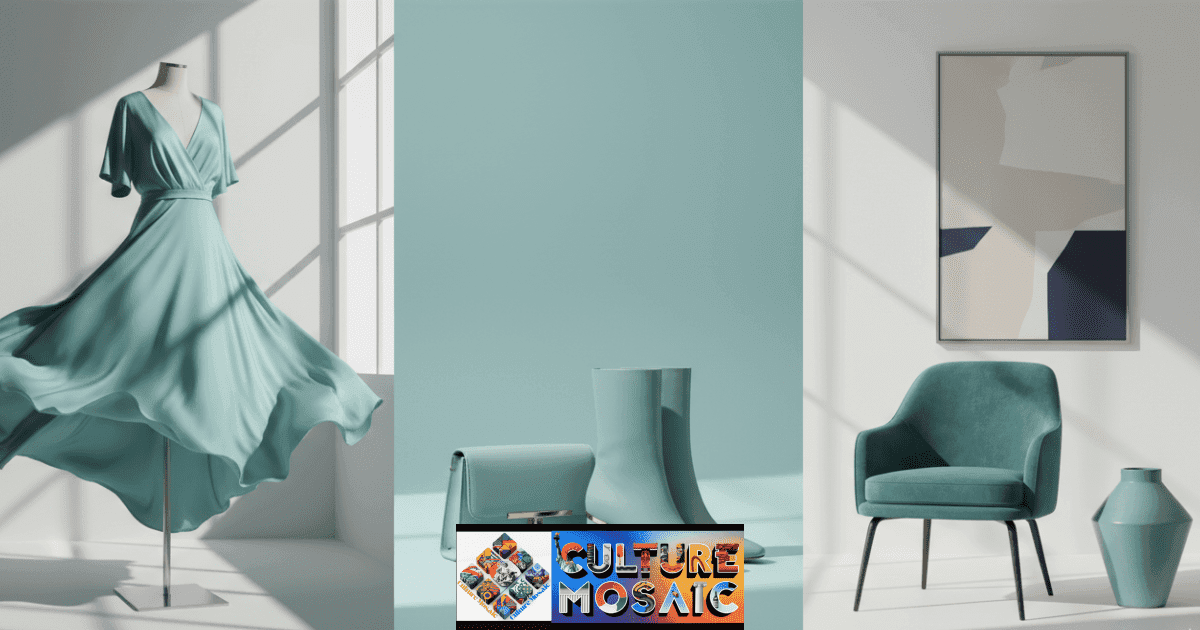

The colour of the season 2026 — Aqua Haze — expressed across fashion, accessories, and interior objects. Image: Culture Mosaic.
What the Colour of the Season 2026 Says About Who We Are Right Now
Aqua Haze isn’t just a pretty shade. It’s a mood, a cultural marker, and — if the forecasters are right — the tone that will define how we dress, decorate, and express ourselves in 2026. I’ve been watching this one build for two years. Here’s why it matters.
The Colour of the Season 2026: A Quick Overview
Every year, the fashion and design industry waits for the moment when a single hue crystallises out of thousands of runway looks, mood boards, and retail reports. For 2026, that moment has arrived. The colour of the season 2026 — broadly identified across forecasting agencies as a cool, mineral aqua-blue-green — arrived quietly. No fanfare. Just a slow, quiet dominance.
It shows up on a silk evening dress in motion, in the leather of a structured clutch bag, in the upholstery of a velvet armchair. Same colour. Completely different conversations. That’s what makes the colour of the season 2026 so worth paying attention to.
Why Aqua Haze? Understanding the Name Behind the Colour of the Season 2026
Naming a colour is its own art form. “Aqua Haze” captures something specific — it’s not turquoise, not teal, not seafoam. It sits slightly cooler than all of those, with a faint grey mineral quality, like shallow coastal water over limestone. The name itself does real cultural work. “Aqua” grounds it in nature and water. “Haze” suggests something soft, slightly obscured, not shouting. For a moment in culture when many of us are exhausted by maximalism, that quietness is the point.
I’ve been watching Fashion 2026 trend cycles for long enough to know that the colour of the season rarely arrives by accident. It’s a response — to the visual noise of the previous cycle, to socio-economic anxiety, to where our collective emotional temperature sits. In 2026, that temperature reads as: restrained, thoughtful, leaning toward nature.
The Cultural and Societal Forces Shaping the Colour of the Season 2026
Colour doesn’t emerge from a vacuum. The colour of the season 2026 is shaped by at least three cultural forces working in concert.
First, there’s the environmental turn. Sustainability is no longer a niche concern — it’s structural. Designers across the industry are drawing palettes from natural systems: ocean gradients, glacial melt, river sediment. Aqua Haze belongs to that lexicon. It’s visually associated with clean water, coastal ecology, and the biomimicry movement that’s been building in both fashion and architecture. If you want to understand how this connects to the textiles conversation specifically, the piece on Water Footprint of Global Threads and Textiles is worth reading alongside this one.
Second, there’s digital fatigue. After years of hypersaturated digital-first visuals — designed to grab attention on a small phone screen — there’s a growing consumer appetite for tones that feel analogue, physical, breathable. Aqua Haze looks better in real life than on a screen. That’s not an accident.
Third, and most interesting to me, is the emotional register of 2026. The collective psychological mood right now is one of cautious hope after prolonged uncertainty. Aqua — historically connected to calmness, clarity, and healing across many cultural systems — resonates precisely because it doesn’t ask too much of you. It’s aspirational without being aggressive.
“Aqua Haze looks better in real life than on a screen. That’s not an accident — it’s the colour equivalent of logging off.”
What Forecasters Are Saying About the Colour of the Season 2026
I’ve been cross-referencing predictions from Pantone, WGSN, and several independent trend consultancies over the past eighteen months, and the convergence is striking. The colour of the season 2026 sits in a broader 2026 palette that forecasters are calling “Restorative Naturals” — a family of hues pulled from water, stone, and early-morning light.
Alongside Aqua Haze, you’ll see warm sand, bleached terracotta, soft sage, and — the wildcard — a deep amber that functions as a grounding accent. This palette tells a story: we’re reaching for the outdoors, for elemental textures, for colours that connect us to something older and slower than the current news cycle.
How the Colour of the Season 2026 Compares to Previous Years
Viva Magenta, which dominated 2023, was a declaration — loud, warm, uncompromising. Peach Fuzz in 2024 was a retreat into softness, almost apologetically gentle. Last year’s direction was dualistic, celebrating contrast. The colour of the season 2026 continues the softening trajectory but adds a clarity and coolness that the previous two cycles lacked. It has more backbone than peach. Less theatre than magenta. Think of it as the palette growing up.
The Colour of the Season 2026 on the Runway: What Designers Did With It
Runway collections from the most recent Fashion Week cycles give us the clearest read on how the colour of the season 2026 is being interpreted by designers who are actually making clothes.
The most striking applications were in fluid, full-length silhouettes — the kind of dress that catches air when the model walks, creating movement and depth in the colour. In that context, Aqua Haze shifts from pale to rich to almost luminescent depending on how the fabric catches light. Designers working with Somatic Textiles have been particularly effective here — materials that respond to the body’s warmth and movement amplify the colour’s layered quality.
In tailoring, the colour reads differently — more architectural, more deliberate. A structured blazer or wide-leg trouser in Aqua Haze makes a statement that’s genuinely modern: calm authority. Not the cold power of charcoal grey. Something more alive.
How the Colour of the Season 2026 Appears in Accessories
Accessories are where you can really track a colour’s commercial traction. The shift from runway to handbag is a significant one — it says a brand has enough confidence in the hue to anchor a buyable, high-margin product around it.
Aqua Haze is appearing in leather goods with real conviction in 2026. Structured clutch bags, ankle boots with block heels, belt bags. The leather finish changes the colour somewhat — it deepens slightly, takes on a slight sheen that reads more sophisticated than the same hue in fabric. The gold hardware visible on several key pieces this season is a smart contrast choice: it warms the coolness of the colour without competing with it.
The Colour of the Season 2026 in Home Interiors
One of the most interesting things about the colour of the season 2026 is its crossover appeal into interiors. This doesn’t always happen — some seasonal fashion colours are too directional or too trend-specific to translate into a sofa or a wall. Aqua Haze is different.
In upholstered furniture, it works brilliantly. Velvet especially — the pile catches the light in a way that gives the colour real depth and richness. In ceramics (the vase on the right of the cover image is a perfect example), it takes on a matte, organic quality that feels artisanal and grounded. As a wall colour, it would work best in rooms with strong natural light; in dim rooms it can read too cold.
The interior design story connects to a broader shift identified in the Poetcore Heritage Fashion movement — a turn toward environments that feel considered, layered, and resistant to disposability. Aqua Haze, applied to objects made with care and materials that age well, fits squarely into that aesthetic.
The Psychology Behind the Colour of the Season 2026
Colour psychology is often oversimplified — “blue means calm, red means danger” — but the depth of cultural and psychological associations around blue-green families is genuinely interesting and worth taking seriously. The Psychology of Color in Design literature is extensive on this point.
Blue-green hues consistently test well for emotional associations including: clarity, introspection, natural connection, and a kind of restrained optimism. None of these are the dominant emotions of anxiety or over-stimulation that have characterised parts of the last several years. The colour of the season 2026 is, in this reading, a collective prescription — not just an aesthetic choice but a statement about what we need.
Why the Colour of the Season 2026 Works Across Skin Tones
This is practical, and it matters commercially. Aqua Haze sits in a range that works surprisingly well across a wide range of complexions. Its grey-tinted coolness prevents it from washing out deeper skin tones the way some pale hues can, and its softness prevents it from overwhelming fair ones. This broad wearability is one reason it has gained traction not just on European runways but in markets across South Asia, East Africa, and the Americas.
The Colour of the Season 2026 and the Lucky Colours Tradition
For many communities, seasonal colour is inseparable from cultural and symbolic meaning. The colour of the season 2026 arrives at an interesting moment in relation to traditions around Lucky Colors to Wear for New Year’s 2026 — across multiple cultural frameworks, aqua and blue-green tones carry associations with protection, prosperity, and clarity of purpose. The fact that the commercial fashion cycle and these older symbolic traditions are pointing in the same direction this year is either a coincidence or evidence that colour meaning runs deeper in our culture than we usually acknowledge. I lean toward the latter.
How Brands Are Using the Colour of the Season 2026 in Their Identity
Beyond fashion and interiors, the colour of the season 2026 is making inroads into branding and visual identity. Technology companies, wellness brands, and premium consumer goods are all reaching for this register — they want the associations of nature, calm, and refined intelligence that Aqua Haze carries.
This is a significant shift from the 2022–2023 cycle, when branding was dominated by bold, high-contrast primary colour schemes. The move to Aqua Haze in brand design is a statement of tone: we’re not here to grab your attention by force. We’re here to earn it through quality and restraint.
The Colour of the Season 2026 in Digital and Social Media Aesthetics
There’s a counter-intuitive aspect to the colour of the season 2026 in the digital context. As I mentioned earlier, it photographs slightly less vividly than saturated hues. On Instagram or TikTok, it doesn’t “pop” in the same way as a punchy coral or a vivid chartreuse. And yet it’s working. Why?
I think the answer is that audiences are increasingly sophisticated about visual authenticity. A colour that looks more interesting in person than in a photo is actually more desirable in a culture saturated with heavily filtered content. The colour of the season 2026 rewards physical engagement — you have to be there to get the full effect. That’s a form of luxury.
The Colour of the Season 2026 for Designers: Practical Palette Guidance
If you’re a designer working out how to incorporate the colour of the season 2026 into a collection or product line, here’s what the evidence from both runway and retail suggests.
Lead with Aqua Haze in your hero pieces — the ones that anchor the visual story. Support it with warm sand or ecru for softness, and deep navy for contrast and grounding. Use warm metal finishes (gold, brushed bronze) rather than cool ones (silver, chrome) as hardware or trim — they bridge the gap between the coolness of the blue-green and the warmth of the skin or the room. And work with textile structures that give the colour dimensionality — velvet, satin, brushed leather, and handwoven linens are all yielding beautiful results this season.
The broader Fashion Trends 2026 picture positions Aqua Haze not as a standalone statement but as the central axis of a palette. It anchors an entire colour story, which means your supporting choices matter as much as the hero hue itself.
What the Colour of the Season 2026 Gets Wrong — and What That Tells Us
I don’t think any single colour prediction is ever the whole story. The colour of the season 2026 is the dominant cultural signal, but it sits alongside real countercurrents: a resurgent appetite for deep, almost theatrical earth tones in some corners of the industry; a continuing interest in raw, undyed natural fibres that resist the colour system entirely; and a persistent minority taste for the maximalist, chromatic excess of Y2K-inflected dressing.
What that tells me is that 2026 isn’t a monochromatic moment — it’s a moment of gentle consensus, with dissenting voices at the edges. The colour of the season 2026 is the median, not the mean. Most people are drawn to its calm. Some are running in the opposite direction. Both responses are meaningful.
The Lasting Legacy of the Colour of the Season 2026
The most significant seasonal colours don’t just define a year — they shift how we think about a whole category of hue. Aqua and blue-green tones are likely to hold cultural resonance well beyond 2026 because the underlying drivers — environmental consciousness, the desire for calm, the value of the analogue and tactile — are structural rather than cyclical. The colour of the season 2026 may well be the beginning of a longer aesthetic chapter, not just a moment.
There’s something almost optimistic in that reading. A colour that asks us to slow down, to look more carefully, to notice how light changes in the real physical world — that’s not a bad thing to carry forward.
Frequently Asked Questions: Colour of the Season 2026
What is the colour of the season 2026?
The colour of the season 2026 is broadly identified as Aqua Haze — a cool, mineral blue-green that sits between aqua and teal with a slight grey undertone. It appears across fashion, accessories, and interiors this season, anchored by forecasters including Pantone and WGSN.
Why is Aqua Haze the colour of the season 2026?
Aqua Haze reflects the cultural moment of 2026 — a collective appetite for calm, natural connection, and restrained optimism after years of maximalist visual culture. It resonates with the environmental turn in design and the growing preference for analogue, tactile experiences.
How can I wear the colour of the season 2026?
The colour of the season 2026 translates beautifully into full-length gowns, structured outerwear, and leather accessories. Pair it with warm neutrals like ecru and sand, or contrast it against deep navy. It works across skin tones and reads as both sophisticated and fresh.
What other colours complement the colour of the season 2026?
Best pairings for the colour of the season 2026 include warm sand, soft ivory, dune, burnished copper, and deep navy. Warm gold hardware amplifies rather than competes with the hue. Avoid cool grey or stark white, which can flatten its soft mineral quality.
Will the colour of the season 2026 work for interiors as well as fashion?
Yes — one of the most notable features of the colour of the season 2026 is its strong cross-category appeal. It performs exceptionally well in upholstery, ceramics, wall treatments, and decorative objects, particularly in spaces with strong natural light.