
 By Culture Expert
Quick Summary
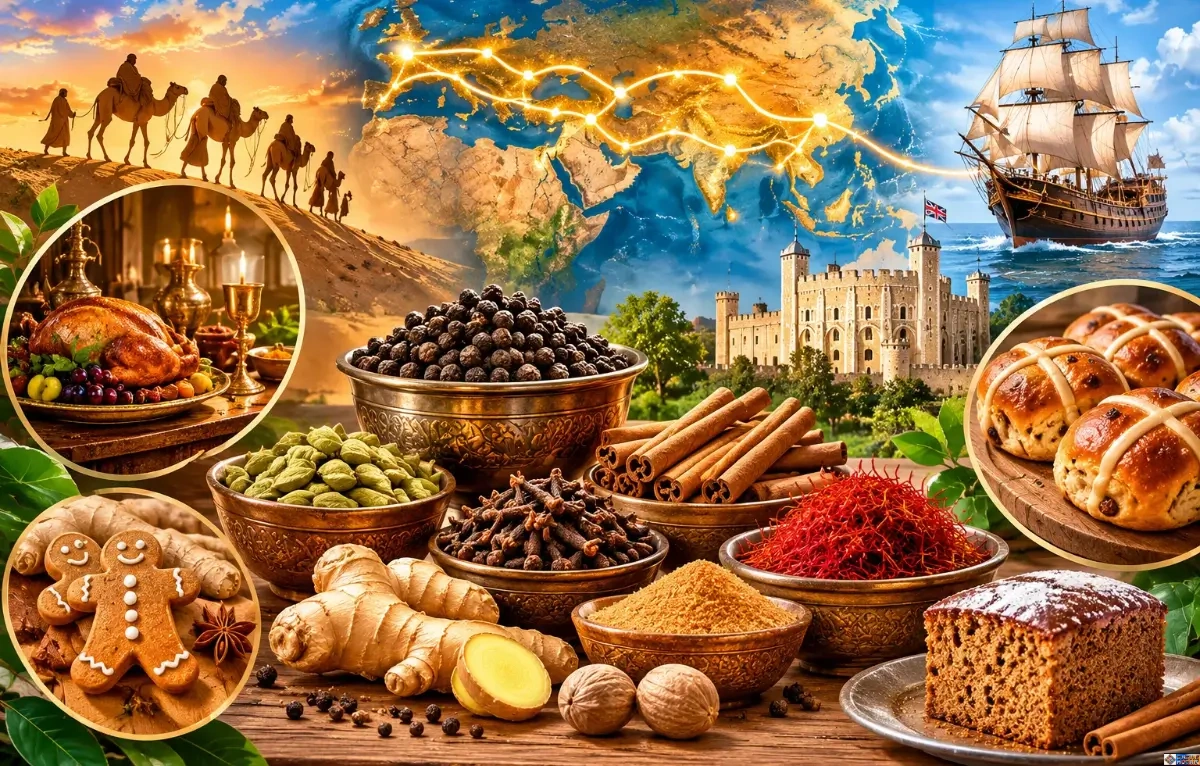
Silk Road spices in British food are far from a modern novelty. Black pepper, ginger, cinnamon, cloves, nutmeg, and saffron arrived in Britain across more than a millennium of sea and overland trade. Originally rare status symbols for noble medieval feasts, these exotic seasonings eventually evolved into everyday British baking staples—shaping classic dishes from hot cross buns and Yorkshire parkin to festive bread sauce.
Is British Food Really Bland? Let’s Settle It
“British food is bland.” You’ve heard it. Maybe you’ve said it.
I think it’s one of the laziest verdicts in food writing, and it collapses the moment you open a spice jar. Cloves in the bread sauce. Nutmeg on the custard tart. Ginger holding up a bonfire-night parkin. None of those plants grows in a British field. Every one of them arrived on a long, expensive, sometimes bloody road from somewhere else.
That’s the story worth telling, and it’s the one Culture Mosaic keeps coming back to: food history is migration history. Below, I’ll walk through which spices arrived, when, who could afford them, a what they still do on a British plate. If you’ve ever wondered why your Christmas kitchen smells the way it does, stay with me. The answer is stranger than you’d expect.
What Does “Silk Road” Actually Mean for Spices?
A small honesty check first. The term “Silk Road” was coined in 1877 by the German geographer Ferdinand von Richthofen. Medieval traders never used it. And many spices travelled by sea, not overland, via Indian Ocean ports, the Red Sea, and then Venetian and Genoese merchants. Peter Frankopan’s history, The Silk Roads, treats the whole network, land and sea, as one connected system. I find that framing more accurate than the romantic image of a single camel track.
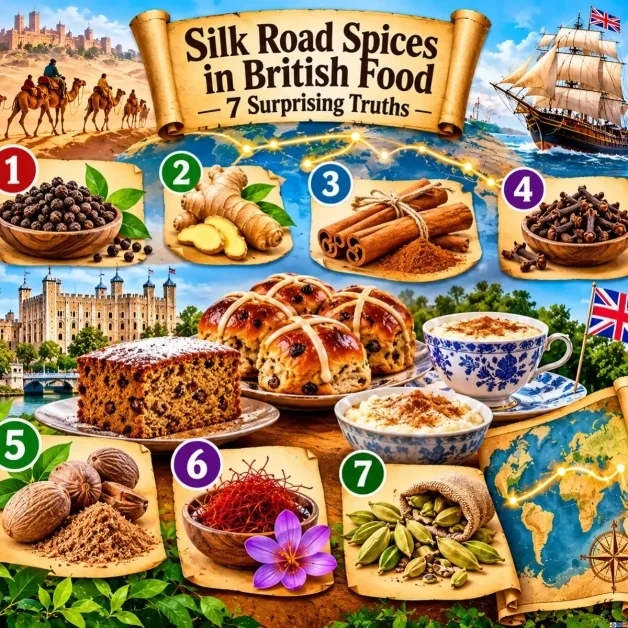
So when I say “Silk Road spices,” I mean the great Eurasian trade web that fed spices into Europe. Not one road. A thousand hands passing one peppercorn along.
What spices were on the Silk Road, and where did they come from?
Here is the quick reference. I’ve added the British dish that I’d argue each spice defines.
| Spice | Origin Region | British Cooking Arrival | Defining British Dish |
|---|---|---|---|
| Black Pepper | Malabar Coast, India | Roman era; widely used medieval period | Cumberland Sausage |
| Ginger | Asia (India, China, SE Asia) | Early medieval; Anglo-Saxon medical texts | Yorkshire Parkin |
| Cinnamon | Sri Lanka (Ceylon); China (Cassia) | Medieval period | Hot Cross Buns |
| Cloves | Maluku (Moluccas) Islands, Indonesia | Medieval period | Classic Bread Sauce |
| Nutmeg & Mace | Banda Islands, Indonesia | Late medieval to Tudor era | Egg Custard Tart |
| Saffron | Persia & Eastern Mediterranean | Medieval (later grown in Essex) | Cornish Saffron Buns |
| Cardamom | Western Ghats, India | Mainstream via 20th-century diaspora | British Curry House Classics |
One caveat. Dates are fuzzy, because kitchens leave fewer records than courts do.
When Did Exotic Spices First Arrive in Britain?
Earlier than most people guess. Pepper was already moving through Roman trade networks, and Roman cookery writing leans on it heavily. Ginger and pepper both appear in Anglo-Saxon medical recipes, which tells you spices entered Britain as medicine before they entered it as dinner.
Then the Middle Ages turned the tap on. By 1180, London had a guild of Pepperers, an ancestor of the Worshipful Company of Grocers. Think about that. An entire trade body, built around a single dried berry.
How Did Medieval British Cooking Use Asian Spices?
Lavishly. And on purpose.
The best window we have is The Forme of Cury, a cookery roll compiled around 1390 by the master cooks of Richard II. Spices run through it like a thread through cloth. Pepper, ginger, cinnamon, cloves and saffron show up in dishes of meat, fish and fruit alike. Spiced wine called hippocras was a fashionable finish to a feast. In grand households, a ceremonial course of spices and sweet wine closed the meal, a ritual that belongs with the broader customs in dining rituals.
Why so much? Partly flavour. Partly medicine, since medieval physicians believed spices balanced the body’s humours. And partly theatre. A dish heavy with spice announced that its host could afford the road behind it. If you’re curious about how cooks of the period actually worked, the methods are covered in heritage cooking techniques, and the humble mortar that crushed those spices has its own story in ancestral cookware history.
The Six Spices, One at a Time
Pepper came first and stayed longest. It crossed from India through Roman and then medieval trade, and by the Middle Ages it was so valued that it served as a form of payment, which is where the idiom “peppercorn rent” comes from. It was the spice of the wealthy, yet it filtered down fastest. Today, its defining British role is the Cumberland sausage, whose coarse, peppery bite earned it protected geographical status. Local lore ties the county’s port of Whitehaven to the spice trade, though I’d treat the exact chain of events as tradition rather than proof.
Ginger arrived early and stayed affordable, relatively speaking. Medieval cooks pounded it into sauces and sweet pastes, and the gingerbread tradition grew from there. Its modern masterpiece is Yorkshire parkin, an oat-and-treacle cake that gets stickier and better after a few days in the tin.
Cinnamon was a luxury of the feast table, then slowly became the soul of the spiced bun. A cinnamon-led hot cross bun is a Good Friday habit now. Once, it was a small act of wealth.
Cloves were rarer and sharper. They came from tiny islands most medieval Britons couldn’t have found on a map. Their defining British job is humble and perfect: an onion studded with cloves, steeping in milk for bread sauce, the most underrated thing on a Christmas plate.
Nutmeg demands a story, and I’ll tell it below, because it changed the map of North America. In the kitchen, it’s the dusting on an egg custard tart. Grate it fresh. The difference is not subtle.
Saffron, the most expensive of all by weight, coloured and perfumed medieval feasts. It grew in Essex, where Saffron Walden took the crop into its very name, and it lives on in Cornish saffron buns, golden and faintly medicinal in the best way.
Who Could Afford Spices? Class, Cost and Status
Here’s where I’ll take a stand. The usual line is that spices were “worth their weight in gold.” That’s a cliché, and it flattens a more interesting truth. Spice use was graded by class long before it was gated by price.
In medieval noble households, spices were displayed, gifted and consumed in bulk. Merchants and townspeople used smaller quantities, often of cheaper spices such as ginger and pepper. The poorest cooks mostly went without, or used local flavourings like herbs, mustard and verjuice.
Then supply changed. As Dutch and English trading companies built maritime routes in the 17th century, volumes rose and costs eased. Over the 18th and 19th centuries, spices drifted from the banquet hall to the baker’s shelf. The Victorian pantry gave us “mixed spice,” a blend that typically includes cinnamon, nutmeg, cloves and ginger. Often it also includes allspice, which is a plot twist: allspice is native to the Caribbean and Central America, not Asia. British baking is quietly a world map.
Did the British Colonise for Spices?
Partly, yes. The English East India Company received its royal charter on 31 December 1600, and its first great goal was a share of the East Indies spice trade. The Dutch got there first and fought hard to keep their grip. Violence followed, including the Amboyna killings of 1623.
Nutmeg gives us the most startling footnote. In 1667, under the Treaty of Breda, England gave up its claim to the tiny nutmeg island of Run and in effect kept New Amsterdam, later renamed New York. Read that twice. A nutmeg island for Manhattan. For the company’s long-term future, the real pivot came when it shifted weight toward Indian textiles and, eventually, territory. Spices opened the door. Empire walked through it.
From Mincemeat to Masala: The Later Spice Wave
Spice history did not stop in the Tudor kitchen. Hannah Glasse’s 1747 The Art of Cookery includes a recipe “to make a currey the Indian way,” proof that Indian-style cooking was reaching English middle-class kitchens by the mid-18th century. In 1810, Sake Dean Mahomed opened the Hindoostane Coffee House in London. Veeraswamy, which opened in 1926, is often cited as Britain’s oldest surviving Indian restaurant.
Then came the dish that tells the whole story in one bowl. Coronation chicken was created for the 1953 coronation lunch, a creamy, lightly curried, fruit-flecked chicken salad. Fancy? Yes. Silly? Maybe. Pure British? Absolutely.
The next waves of South Asian, Caribbean and other communities rewrote British menus again, bringing cardamom, cumin, chilli and allspice to centre stage. The kitchens of Caribbean families, explored in African diaspora food culture, are part of this same story. So are the sauces on your table: Worcestershire sauce, launched by Lea & Perrins in 1837, counts cloves and tamarind among its ingredients. That deep savoury punch is a close cousin of the principles in ancestral umami techniques.
What Symbolic Meaning Did Spices Carry?
Wealth, first. Then devotion, then comfort. A spiced bun on Good Friday, a clove-studded ham at Christmas, a parkin on Bonfire Night: these are rituals that ride on flavour. Some tradition-writers link mince pie spices to the gifts of the Magi. That’s a charming folk explanation, and I’d call it folklore, not documented history.
What I’m more certain about is the emotional pull. A whiff of nutmeg or clove can drop you into a childhood kitchen faster than any photograph. That’s the territory of somatic seasoning and somatic food memory, and it’s why food rituals travel so stubbornly. For a wider lens, see food rituals in different cultures.
What Classic British Dishes Rely on Silk Road Spices Today?
This is the shortlist I’d put on a “Silk Road spices in British food menu”:
- Cumberland sausage with mash (black pepper)
- Roast with bread sauce (cloves, nutmeg, pepper). I’ve laid out the origin of the roast itself in How did the Sunday roast tradition start?
- Hot cross buns (cinnamon and mixed spice)
- Yorkshire parkin (ginger)
- Egg custard tart (nutmeg)
- Cornish saffron buns (saffron)
- Mince pies and Christmas pudding (a whole spice cabinet)
- Coronation chicken and the curry-house classics (turmeric, cumin, cardamom)
The spice logic in the tagine tradition is a distant cousin to all of this. For a side-by-side with a very different spice culture, have a look at How to Cook Traditional Moroccan Tagine.
Silk Road spices in British food recipes: start with bread sauce
It takes ten minutes of effort and delivers the whole history in a spoonful.
- 1 onion, halved
- 4 to 6 whole cloves
- 500 ml whole milk
- 1 bay leaf
- 100 g fresh white breadcrumbs
- 25 g butter
- Fresh nutmeg, a few gratings
- Salt and white or black pepper
- 2 tablespoons double cream (optional)
Press the cloves into the onion. Warm it with the milk and bay leaf, then let it sit off the heat for 30 minutes so the milk takes on the flavour. Remove the onion and bay leaf, stir in the breadcrumbs, and cook gently until thick. Finish with butter, cream, nutmeg, salt and pepper. Good butter makes a real difference here, and heritage European butter varieties is worth a read if you want to go deeper. More recipes from around the globe sit in traditional recipes from around the world.
Silk Road Spices in British Food: Where to Buy Them
Three standard suggestions, then one odd one.
- Buy whole spices, not pre-ground. Whole nutmeg, whole cloves and whole peppercorns keep their perfume far longer.
- Try South Asian and Middle Eastern grocers. Prices are usually lower and turnover is higher, so stock is fresher.
- Look for reputable online spice merchants that state the origin and harvest date.
- The wildcard: grow your own saffron. Saffron crocus corms are sold by UK garden suppliers, and the plant flowers in autumn. You’ll get a tiny harvest, a lot of patience, and a very good story.
If you want another take on this subject, silk road spices in british food is covered in a separate piece on The World on a Plate.
Frequently Asked Questions
1. Which Silk Road spices influenced traditional British cooking?
Black pepper, ginger, cinnamon, cloves, nutmeg, mace and saffron did the heaviest lifting. Medieval cooks used them across meat, fish, fruit and wine dishes, as The Forme of Cury shows. Many of those flavours survive today in baking and festive food: mince pies, Christmas pudding, hot cross buns, parkin, bread sauce and custard tarts.
2. When did exotic spices first arrive in Britain?
Pepper was moving through Roman trade networks, and ginger and pepper both appear in Anglo-Saxon medical texts. By 1180, London had a guild of Pepperers, so a thriving spice trade was clearly established in the medieval period. Exact arrival dates for each spice are hard to pin down, because kitchen records are scarce.
3. What country introduced gunpowder to Silk Road trade?
China. Gunpowder was developed there and spread westward along trade and conquest routes, reaching Europe by the 13th century. The English friar Roger Bacon wrote about it around 1267. It’s a useful reminder that the same roads that carried cloves and pepper also carried technology, and weapons.
4. Did the British colonise for spices?
Spices were a major motive for early English overseas trade. The East India Company was chartered in 1600 to take part in the East Indies spice trade, but Dutch dominance in the islands pushed the company toward India, where textiles and later territory became more important. Spices opened the door, but they were far from the whole story of empire.
5. What spices are used in British cuisine today?
The historical core remains pepper, ginger, cinnamon, cloves, nutmeg and saffron. Modern British cooking has added cardamom, cumin, coriander seed, turmeric, chilli and allspice, largely through South Asian and Caribbean communities. Mixed spice, curry powder and garam masala are now ordinary supermarket items.
One Last Thing
Next time you grate nutmeg over a custard tart, stop for a second. That small brown seed once helped decide who would own Manhattan. It’s sitting in your kitchen drawer now, next to the tea towels. Not bad for something we call plain.
Sources and Further Reading
Please verify editions and check links before publication.
- Hieatt, Constance B. and Butler, Sharon. Curye on Inglysch: English Culinary Manuscripts of the Fourteenth Century (Including The Forme of Cury). Early English Text Society, 1985. A surviving roll of The Forme of Cury is held at the John Rylands Library, University of Manchester.
- Freedman, Paul. Out of the East: Spices and the Medieval Imagination. Yale University Press, 2008.
- Frankopan, Peter. The Silk Roads: A New History of the World. Bloomsbury, 2015.
- Collingham, Lizzie. Curry: A Tale of Cooks and Conquerors. Oxford University Press, 2006.
- Milton, Giles. Nathaniel’s Nutmeg. Hodder & Stoughton, 1999.
- Davidson, Alan. The Oxford Companion to Food. Oxford University Press (entries on spices, ginger, nutmeg, saffron and pepper).
- Glasse, Hannah. The Art of Cookery Made Plain and Easy, 1747.
- Worshipful Company of Grocers, company history (origins in the medieval Pepperers’ guild).
- Saffron Walden Museum, Essex, collections and local history on saffron cultivation.
- UK Government, protected geographical food and drink names register (Cumberland sausage).
- British Library and John Rylands Library, medieval cookery manuscript collections.