
 By Culture Expert
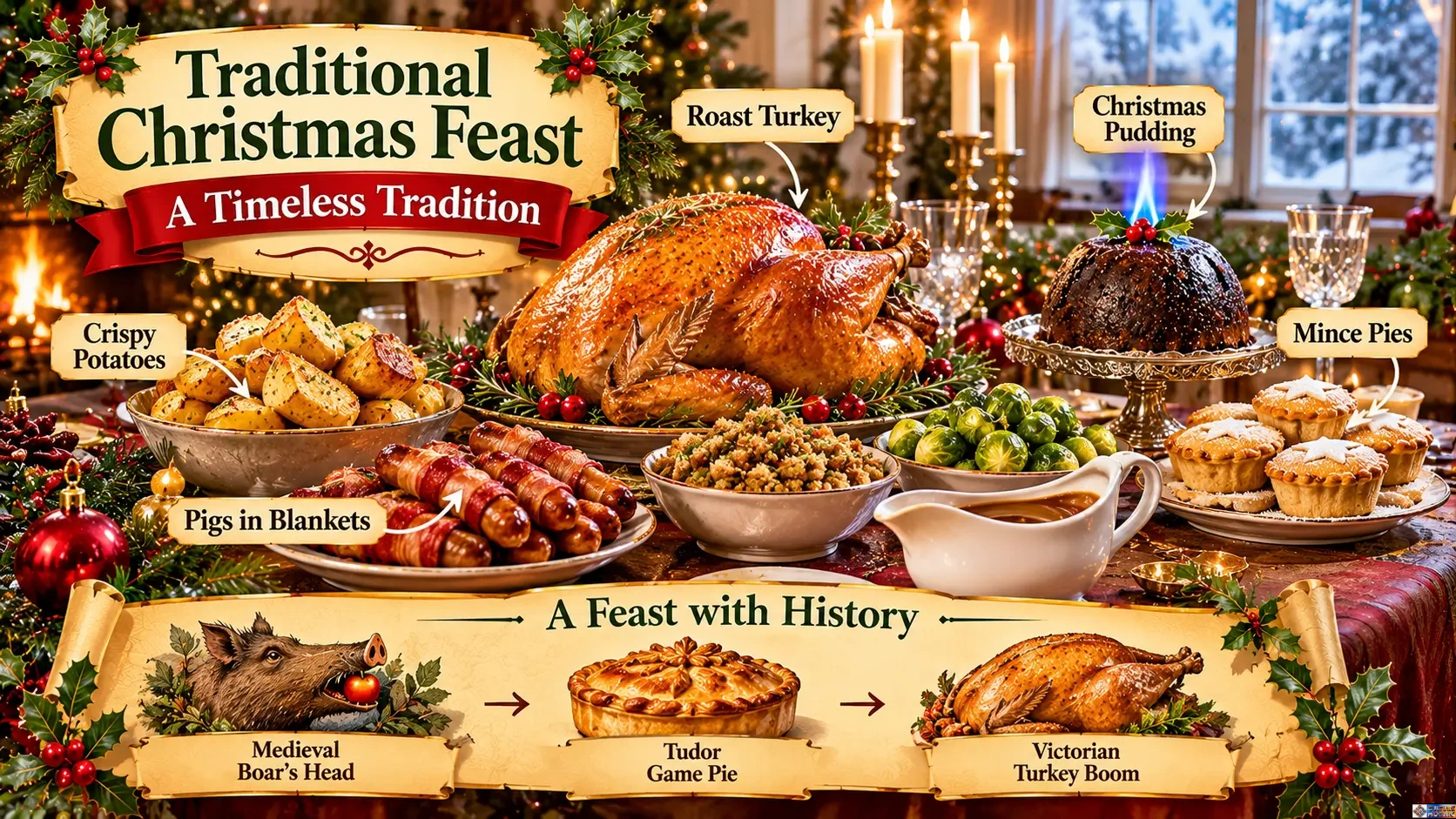
Quick Summary A traditional Christmas feast in the UK centres on roast turkey (or goose), roast potatoes, pigs in blankets, stuffing and gravy, then Christmas pudding and mince pies. Underneath sits centuries of change: medieval boar’s head and peacock, a Tudor game pie, a Victorian turkey boom, and Christmas Eve suppers from Poland to Southern Italy. This guide to the traditional Christmas feast gives you the history, the current UK top ten, a full menu and a serving order. |
You type “traditional Christmas feast” into a search bar late at night, hoping for one clean answer. What comes back is fifty recipes, three arguments about sprouts, and no explanation of why any of it exists.
That’s the pain. Christmas dinner carries more expectation than any other meal of the year. You’re feeding people you love, usually a mix of ages and tastes, while a quiet voice insists there’s a “proper” version you’re meant to be cooking. There isn’t. There never was.
What exists is a pattern, and the pattern has a history. A traditional Christmas feast is a big shared meal built from a handful of parts: a roast bird, something crisp and golden from the oven, a dark fruity pudding, a drink with spice in it, and a gesture that tells everyone they’re welcome. Know where each part came from and you cook it with more confidence. You can also bend it to suit your household without losing the feeling.
This guide to the traditional Christmas feast covers the medieval roots, the Victorian turkey boom, today’s UK top ten, Christmas Eve feasts abroad, and a menu with a serving order. If the wider story appeals, Culture Mosaic keeps a whole shelf on it, and its guide to Global Christmas Customs pairs well with this one.
One date to note now. Stir-up Sunday, the traditional day for mixing the Christmas pudding, falls on 22 November this year, and Christmas Day is Friday 25 December. A pudding made this month has weeks to mature. Start early and your whole traditional Christmas feast gets easier.
1. What Is a Traditional Christmas Feast, Really?
Strip away the tinsel and a traditional Christmas feast is surprisingly simple. Abundance, shared. That’s the whole idea. The menu has shifted century by century, but the instinct hasn’t moved an inch.
English Heritage makes a point I find oddly reassuring. In medieval England the Christmas table often looked much like the tables of other big feasts, Easter and Whitsun among them. What changed at Christmas was effort. Monasteries and castles produced spectacular dishes, while in peasant homes the feast might simply mean larger portions and more to drink. Same impulse, different budgets.
The history of UK Christmas dinner is really a history of what people could afford and what impressed the neighbours, and every traditional Christmas feast was a snapshot of both. Tudor cooks sent game pies and exotic birds to the table. The Victorians, nudged along by Dickens and by the royal family, tidied Christmas into something close to the version we know now. I’ve followed that shift in more detail in When Did Modern Christmas Traditions Begin, and the longer backstory sits in historic Christmas traditions UK.
The timeline below shows how recent some “ancient” customs really are.
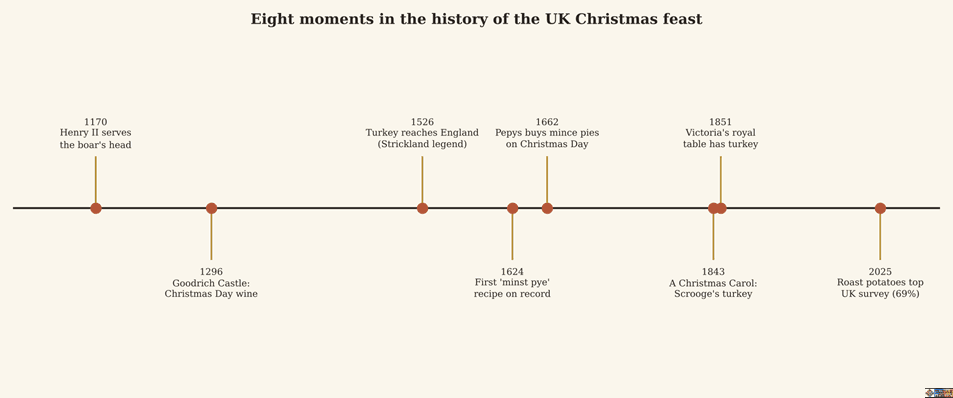
So what counts as a traditional Christmas feast today? My working definition has four parts: a roast centrepiece, a pile of crisp and savoury trimmings, a boozy fruit-and-spice finish, and one act of hospitality, whether that’s an extra chair, a shared wafer or a plate sent next door. Get those four right and your traditional Christmas feast is done. The rest is detail.
2. Christmas Food the Medieval Way: Peacock, Boar’s Head and Brawn
English Heritage’s account of a traditional Christmas feast in medieval England reads like a banquet designed by a theatre company. Five highlights of that traditional Christmas feast stand out.
Peacock. The bird wasn’t simply roasted. Cooks skinned it with its feathers intact, roasted the carcass with the neck propped upright, then re-fitted the skin at the table. It was a dish for the eyes, and the meat itself was reportedly not much admired. Wealthy households loved it anyway, partly because the peacock sat at the centre of a famous medieval romance, Vœux du paon.
Boar’s head. The heart of the elite feast, and not just a roasted head. It was prepared over weeks, probably as the elaborate outer shell of a pork-pie-style filling. Food historian Peter Brears has described one method: skin removed from a pig’s head, stuffed in layers with cured meat, fatty bacon, salt and spices, wrapped, then simmered for five hours on a bed of carrots, parsnips and onions.
At the table it wore a coat of warm lard darkened with ash, ears held up with rosemary, tusks fitted in. English Heritage dates the tradition at least to 1170, when Henry II was serving it to his son in the ceremonial role of sewer, and by the fifteenth century it had its own song, the Boar’s Head Carol.
Brawn. A prized, fatty cut, boned, bound, boiled very soft and preserved in ale, cider, wine or vinegar. It was usually served alongside the boar’s head, and Chaucer links it with Christmas.
Pies. Often so large that the pastry was a serving vessel rather than a food. The filling was eaten, the crust discarded, sometimes handed to paupers at the gate. Some pies were shaped as castles or topped with pastry flames. If you like the sculptural side of festive cooking, Christmas folk art traditions picks up the same impulse in other crafts.
Drink. Wine for the wealthy, ale for nearly everyone else. English Heritage records 2½ sesters of wine drunk at Goodrich Castle on Christmas Day 1296, somewhere between 84 and 120 modern bottles, which probably says more about the size of the crowd than the state of the guests. The spiced wine hippocras arrived at the end of the meal with wafers.
What does a medieval traditional Christmas feast teach a modern cook? Three things. Spectacle matters. Meat, fruit and spice have always belonged together, which is why mince pies exist. And almost everything on this table was prepared days or weeks ahead, which is exactly how a sane Christmas Day works now.
My wildcard for any traditional Christmas feast: bring back hippocras. Warm red wine, ginger, cinnamon, a little honey, thin wafers or shortbread alongside. It sits quietly at the end of a heavy meal, and nobody has to wrestle a boar.
3. How Turkey Won the Traditional Christmas Feast Centrepiece
The turkey’s route into the traditional Christmas feast is part history, part legend. The usual account credits a Yorkshire merchant, William Strickland, with bringing the first birds to England around 1526. His family later added a turkey cock to their coat of arms, thought to be the oldest surviving artistic image of the bird in European history, according to the University of Reading’s Museum of English Rural Life. His descendant Richard Marriott, however, has said there’s no real evidence Strickland introduced it at all.
Then there’s Henry VIII. He’s often named as the first monarch to eat turkey at Christmas, but BBC Countryfile Magazine notes it was almost certainly in a game pie, not the whole roast we picture.
For centuries, goose held the crown at the traditional Christmas feast of ordinary families. Dickens knew it: the Cratchits sit down to a goose in A Christmas Carol (1843), and Scrooge’s gift of a bigger turkey is the generous gesture that closes the story. The Museum of English Rural Life adds that royal turkey on the table in 1851 helped fashion catch on. Many Victorian families, lacking ovens of their own, took their bird to a baker or pub to be cooked. One newspaper account suggests turkey only overtook goose after the Second World War, so I’d treat “the Victorians ate turkey” as a half-truth.
How I’d cook it, and how the Food Standards Agency says to do it safely. The FSA is clear on the basics. Defrost a frozen bird in the fridge, on the bottom shelf, never at room temperature, and allow three to five days for a whole turkey. Don’t wash it. Roast at 180°C (160°C fan): 45 minutes per kg plus 20 minutes under 4.5kg, 40 minutes per kg for 4.5 to 6.5kg, 35 minutes per kg above that. Goose wants 200°C (180°C fan) at 35 minutes per kg. Check the thickest part with a probe: 70°C for two minutes, or 75°C for 30 seconds.
My own additions are about flavour, not safety. Salt the skin the night before and leave the bird uncovered in the fridge so the skin dries and crackles. Tuck butter and thyme under the breast skin. Rest the bird under foil for a good half hour while you finish the gravy and the potatoes. That rest is the difference between juicy and merely cooked.
Goose, honestly, is the better eating, richer and darker, and the fat is a gift to your roast potatoes. I’d choose it for a smaller table every time. At a big traditional Christmas feast, turkey still wins on sheer size.
4. Top 10 Christmas Foods: What Sits on a Traditional Christmas Feast Plate Today
Here’s the part where tradition meets the polling station. Instantprint’s 2025 survey of 2,000 UK adults produced this top ten of traditional Christmas feast food. Alongside it I’ve set a 2021 Radio X poll for the same foods.
Top 10 Christmas foods in UK surveys. Figures show the share of respondents choosing each item; the two polls used different samples and questions.
| Rank | Christmas dinner item | 2025 survey (instantprint) | 2021 poll (Radio X) |
|---|---|---|---|
| 1 | Roast potatoes | 69% | 60% |
| 2 | Turkey | 51% | 56% |
| 3 | Stuffing | 48% | 53% |
| 4 | Pigs in blankets | 46% | 51% |
| 5 | Gravy | 44% | 56% |
| 6 | Yorkshire puddings | 41% | 38% |
| 7 | Carrots | 38% | 51% |
| 8 | Parsnips | 36% | 42% |
| 9 | Cranberry sauce | 29% | 36% |
| 10 | Brussels sprouts | 27% | 51% |
The pollsters, question wording and samples differ, so read the direction, not the decimals. Even so, the shape is striking.
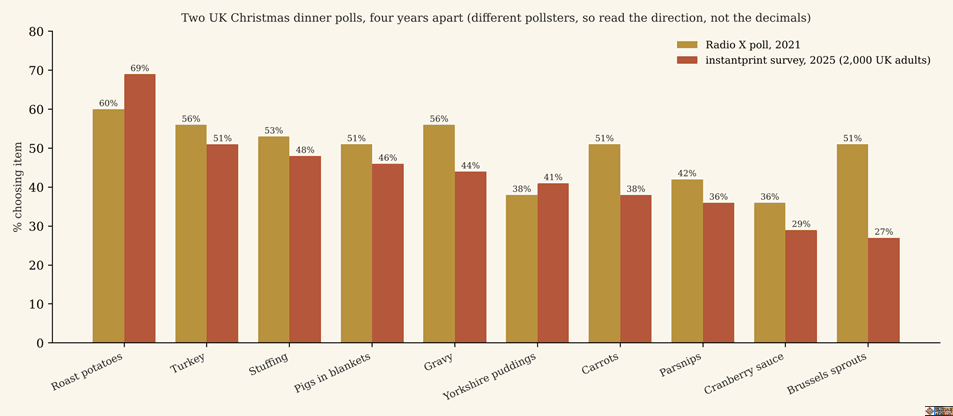
Roast potatoes widened an already healthy lead, turkey and gravy slipped, and Brussels sprouts fell from 51 per cent to 27. A separate 2025 YouGov survey for Pasta Evangelists found pigs in blankets the preferred meaty trimming at 62 per cent, with roast potatoes the top item overall at 82 per cent. Different question, same winner. My reading: at the modern traditional Christmas feast, the star isn’t the bird. It’s the potato.
Here’s how to treat the top traditional Christmas feast food properly.
Roast potatoes. Use a floury variety, parboil until the edges blur, steam dry, shake hard in the pan, then roast in very hot goose fat or oil, turning once. About 1.5kg feeds six. The rough edges are the crunch.
Stuffing and pigs in blankets. Both are meat wrapped in something. That’s why they work. Make stuffing the day before, bake it separately so it crisps, and roll the pigs in blankets tight so they don’t unspool.
Gravy. Roux from the pan juices, good stock, a splash of something fortified. Make it ahead and finish with the resting juices.
Brussels sprouts. Please stop boiling them. Shave them raw, fry hard with chestnuts or bacon, or roast cut-side down. Boiled sprouts earned the bad reputation. The vegetable didn’t.
5. Classic Mince Pies and Pudding: The Sweet End of a Traditional Christmas Feast
Pudding and pie are where traditional Christmas feast history sits closest to the surface, because both started out as meat.
Pudding. History.com traces the Christmas pudding to “plum pottage”, a savoury early-fifteenth-century dish heavy on meat and root vegetables. “Plum”, incidentally, once meant raisins, currants or prunes, which explains why plum pudding has no plums. Over time the meat dropped out, the fruit and spirits piled in, and the Victorians turned it into the national dessert of the traditional Christmas feast.
The last Sunday before Advent became Stir-up Sunday, named after a prayer that begins “Stir up, we beseech thee, O Lord”, and the day when families stirred the mixture and made a wish. This year that’s 22 November. Feed the pudding a little brandy as it ages, then steam it for a long reheat on the day and flame it at the table.
Classic mince pies. The earliest recorded reference to a small “minst pye”, according to Historic UK, comes from a 1624 recipe. Tudor and medieval mince pies were savoury and not always round, often filled with lamb or veal. Meat vanished from the filling only in the late Victorian and early twentieth century, though suet usually remains. Samuel Pepys, as it happens, bought mince pies on Christmas Day in 1662.
The Cromwell myth. You’ve probably heard that Oliver Cromwell banned mince pies. He didn’t. The Puritans did move against Christmas observance, but the ordinances of the period never name them, and both The Ferret’s fact-check and English Heritage call the ban a myth. The story is a rumour that refused to die, and it still turns up at every traditional Christmas feast.
For pastry that stays crisp, use cold butter, chill the dough properly and don’t overfill. Vent the lids, brush with egg and dust with sugar. Mincemeat made weeks ahead mellows nicely.
My wildcard: serve a warm mince pie with a sliver of mature cheese. Fruit cake and cheese is an old British pairing, and the salt makes the spice louder.
6. Christmas Eve Food Traditions Around the World
If the UK traditional Christmas feast peaks on the 25th, much of the world peaks the night before. That contrast is the best proof that “traditional” depends on where you’re sitting.
Poland: Wigilia. The supper begins when the first star appears. Families break and share the opłatek wafer, trading good wishes, and sit down to a meatless table. The usual count is twelve dishes, for the twelve Apostles, though some families prefer an odd number for luck. Carp, barszcz (beetroot soup) with uszka dumplings and pierogi are regulars. Hay often goes under the tablecloth to recall the manger. Wigilia is a traditional Christmas feast built on restraint, not scarcity: no meat, no rush. Most movingly, an empty place is set for an unexpected guest or an absent loved one, as the Polish Museum at the University of Warsaw and Culture.pl both describe.
Italy: the Feast of the Seven Fishes. A Southern Italian Christmas Eve fast-then-feast, now best known in its Italian-American form, built on seafood rather than meat.
Mexico and Latin America: Noche Buena. For many households the Christmas Eve meal is the biggest of the season, with the holiday running on to Epiphany on 6 January.
Traditional Christmas feast traditions compared across five cultures.
| Tradition | Where | When | Defining foods | What it means |
|---|---|---|---|---|
| UK Christmas dinner | United Kingdom | 25 December | Roast turkey or goose, roast potatoes, pigs in blankets, pudding, mince pies | Abundance, shared at home |
| Wigilia | Poland | 24 December, after the first star | Twelve meatless dishes: carp, barszcz with uszka, pierogi | Twelve Apostles; an empty place for the unexpected guest |
| Feast of the Seven Fishes | Southern Italy and Italian-American homes | 24 December | Seafood across seven dishes after a day of fasting | Christmas Eve vigil: fast, then feast |
| Noche Buena | Mexico and wider Latin America | 24 December | The season’s biggest meal, varying by region | Family gathering before Christmas Day |
| Caribbean Christmas | English-speaking Caribbean and diaspora | 25 December and the season | Black cake, sorrel, glazed ham | Plum pudding reimagined with rum and browning |
For more on how these customs spread, see Unusual Christmas traditions around the world and the grounding in faith in Religious Festivals in the World. Across the Atlantic the table changes again, as Top US Christmas Foods shows, and Best Christmas Celebrations in US covers the gatherings around it.
7. Multicultural Christmas Dinner Ideas for a UK Table
Britain’s tables have never been one thing, and the best multicultural Christmas dinner ideas don’t replace the traditional Christmas feast. They sit beside it.
Take Caribbean black cake. According to NPR, it likely evolved from the plum-pudding recipes British colonisers brought to the West Indies in the eighteenth century. Cooks soak dried fruit in rum and wine for weeks or even months, blend it, and darken the batter with burnt-sugar “browning”. It’s dense, dark and glorious. It’s also the traditional Caribbean wedding cake, a link I explore in winter wedding Christmas traditions. Its history is entangled with the sugar economy and the labour behind it, and I think that’s worth saying out loud. Sorrel, the deep-red hibiscus drink spiced with ginger, is the usual partner.
More of this cross-pollination is covered in multicultural Christmas traditions. Here are my favourite ways to build it into your own traditional Christmas feast menu.
Start with beetroot soup. A Wigilia-style barszcz before the roast is meatless, deep red and festive, and it makes the turkey feel like a second act.
Swap one trimming. Goose-fat roast potatoes with smoked paprika, sprouts with chestnuts and chilli, or a spiced red cabbage in place of cranberry sauce. Keep the shape, change the flavour.
Add a Christmas Eve fish supper. Smoked salmon, prawns, a baked white fish. It lightens the 25th and borrows the Seven Fishes spirit.
Wildcard: Put black cake on the table beside the pudding, and pour sorrel over ice with a twist of orange. Nobody will remember the pudding was ever alone.
8. A Traditional Christmas Feast Menu: Your Order of Service
Here’s the traditional Christmas feast menu, course by course, with the reason each dish earns its place.
Traditional Christmas feast menu: course by course, with the reason each dish earns its place.
| Course | Dish | Why it’s there | Key ingredients | Method and serving |
|---|---|---|---|---|
| Welcome | Mulled wine, hippocras or sorrel | Echoes medieval spiced wine and Caribbean sorrel | Red wine or hibiscus, ginger, cinnamon, orange | Warm gently, never boil; serve in small cups |
| Starter | Smoked salmon or beetroot barszcz | Borrows Christmas Eve fish and Wigilia customs | Salmon, lemon, rye; beetroot, stock | Serve light, cold or in small hot cups |
| Main | Roast turkey or goose | A Tudor status dish and a Dickensian staple | Bird, butter, thyme, lemon, salt | Dry-brine overnight; roast to FSA times; probe 70°C for 2 minutes; rest 30 minutes |
| Trimmings | Roast potatoes, pigs in blankets, stuffing, parsnips, sprouts | The UK’s current favourites | Floury potatoes, goose fat, chipolatas, bacon | Roast hot and crisp; pass in bowls |
| Gravy | Pan-juice gravy | Binds the plate together | Pan juices, flour, stock, fortified wine | Make ahead; finish with the resting juices |
| Pudding | Christmas pudding, flamed | Descended from plum pottage; made on Stir-up Sunday | Dried fruit, suet, spice, brandy | Steam ahead; reheat; light warm brandy at the table |
| Sweet extras | Classic mince pies and black cake | A meat-and-fruit past; a Caribbean cousin of the pudding | Pastry, mincemeat; rum-soaked fruit | Serve pies warm; slice black cake thin |
| Close | Cheese, tea or coffee | Fruit cake and cheese is an old British pairing | Mature cheese, crackers | Offer quietly and linger |
Suggested order of serving for the traditional Christmas feast.
- A welcome drink: mulled wine, hippocras-style spiced wine or sorrel, with nibbles.
- A light starter: smoked salmon, soup, or beetroot barszcz.
- The carved bird, presented whole before it’s cut.
- Trimmings passed hot around the table. Keep waiting dishes hot; the FSA’s catering guidance is 63°C or above.
- A pause. A walk, a game, a reset.
- The pudding, flamed, with brandy butter or custard.
- Mince pies, cheese and black cake with tea or coffee.
- Leftovers into the fridge within two hours of cooking, as councils and the FSA advise.
Countdown to Friday 25 December 2026. Stir-up Sunday on 22 November is the start line for the whole traditional Christmas feast. Around the 20th, a large frozen bird moves to the bottom shelf of the fridge. On the 24th you par-boil potatoes, make stuffing and gravy base, and salt the turkey. On the day, the bird goes in first and everything else bends around it.
If you want a single recipe to anchor your traditional Christmas feast recipes, make it the roast potatoes in section 4. Every guest will notice if they’re good, and almost nobody will notice anything else.
9. The Spirit of the Traditional Christmas Feast: Why It Outlasts the Menu
Every dish in the traditional Christmas feast has been argued over, swapped or abandoned at some point. Peacock vanished. Mince pies lost their meat. Turkey crept up on goose. What never changed is the point of the thing.
Dickens understood that. His Cratchit goose is small and hard-won, and it’s the happiest table in the book. Scrooge’s bigger turkey matters because of what it says, not what it weighs. In Poland the empty chair makes the same argument: set a place anyway. Even medieval peasants, with no peacock in sight, stretched a bit further to feed the people at their door.
That generosity keeps the traditional Christmas feast alive in neighbourhood meals and community kitchens, which I’ve looked at in UK community Christmas initiatives and civic Christmas traditions. If you’d like to see the feast as the Victorians painted it, Famous Christmas Artwork is a good start, and Classic Christmas Themed Events shows where to take the gathering next.
Cook the potatoes properly. Make the pudding this month. Then count the chairs, and add one.
Frequently Asked Questions
What is the traditional food of Christmas?
There’s no single answer, because a traditional Christmas feast looks different in every country. In the UK the traditional food of Christmas is roast turkey or goose with roast potatoes, stuffing, pigs in blankets, gravy and vegetables, followed by Christmas pudding and mince pies. In Poland it’s the twelve meatless dishes of Wigilia, in Southern Italy and Italian-American homes it’s the Feast of the Seven Fishes, and in the Caribbean it’s black cake and sorrel. Historically, medieval England feasted on boar’s head, peacock, brawn and great pies.
What are traditional Christmas traditions?
Food-wise, the best-known traditional Christmas feast traditions are Stir-up Sunday pudding-making, the flamed pudding and the shared Christmas Eve or Christmas Day meal. More broadly, the Museum of English Rural Life notes that the Victorian royal family helped popularise Christmas cards, the indoor decorated tree and turkey for dinner. Carols, gift-giving and an extra place for a guest are older or more widespread customs, depending on the household.
What’s on a traditional Christmas dinner in the UK?
A typical UK traditional Christmas feast plate holds roast turkey, roast potatoes, stuffing, pigs in blankets, gravy, Yorkshire puddings, carrots, parsnips, cranberry sauce and Brussels sprouts. That’s almost exactly the top ten from the 2025 instantprint survey of 2,000 UK adults, led by roast potatoes at 69 per cent. Dessert is usually Christmas pudding with brandy butter or custard, alongside mince pies.
What are some traditional British Christmas food traditions?
Traditional Christmas feast food traditions in Britain start with making the pudding on Stir-up Sunday, flaming it with brandy and serving mince pies. Others are older: Queen’s College, Oxford, still keeps a boar’s head feast and carol, the Yorkshire Christmas Pie descends from medieval “great pies”, and mulled wine echoes the spiced wine hippocras. Pigs in blankets are a newer arrival that has become essential.
Why do we eat turkey at Christmas?
Turkey reached England in the sixteenth century and became a status dish for the traditional Christmas feast, with Henry VIII often credited as the first monarch to eat it at Christmas, though probably in a pie. Goose remained the common choice for generations. Dickens’s A Christmas Carol and the royal family’s 1851 turkey helped it look aspirational, and its size suits big families. By the twentieth century it was the default centrepiece.
Sources
- English Heritage. “Christmas Food: The Medieval Way.” https://www.english-heritage.org.uk/christmas/medieval-christmas-food/
- Museum of English Rural Life, University of Reading. “Why do we eat turkey at Christmas?” (2022). https://merl.reading.ac.uk/blog/2022/12/why-do-we-eat-turkey-at-christmas/
- BBC Countryfile Magazine. Turkey at Christmas history. https://www.pressreader.com/uk/bbccountryfile-magazine/20201112/282690459698136
- Countryfile. “Why we eat turkey at Christmas.” https://www.countryfile.com/wildlife/christmas/why-we-eat-turkey-at-christmas
- Tastes of History. “A Brief History of Food: Turkey at Christmas.” https://www.tastesofhistory.co.uk/post/a-brief-history-of-foods-turkey-at-christmas
- Food Standards Agency. “Let’s talk turkey: Christmas food hygiene” (last updated 17 November 2025). https://www.food.gov.uk/science/microbiology/lets-talk-turkey
- instantprint. “The UK’s Ultimate Christmas Dinner Revealed 2025.” https://www.instantprint.co.uk/printspiration/be-inspired/the-uks-ultimate-christmas-dinner-revealed-2025
- Radio X. “UK poll reveals Brits’ perfect Christmas dinner” (2021). https://radiox.co.uk/news/uk-perfect-christmas-dinner-revealed-poll
- Nub News. “Pigs in blankets overtake turkey as UK’s Christmas dinner favourite, survey finds” (YouGov for Pasta Evangelists, 2025). https://richmond.nub.news/news/local-news/pigs-in-blankets-overtake-turkey-as-uks-christmas-dinner-favourite-survey-finds-280575
- History.com. “The History of Christmas Pudding.” https://www.history.com/news/the-holiday-history-of-christmas-pudding
- Waitrose. “Stir-up Sunday” (22 November 2026). https://www.waitrose.com/ecom/content/seasonal/christmas/stir-up-sunday
- Historic UK. “Mince Pies.” https://www.historic-uk.com/CultureUK/Mince-Pies/
- CooksInfo. “Mincemeat.” https://www.cooksinfo.com/mincemeat
- The Ferret. “Claim Christmas mince pies illegal Cromwell false.” https://www.theferret.scot/claim-christmas-mince-pies-illegal-cromwell-false/
- English Heritage. “Recipe for real mince pies.” https://english-heritage.org.uk/visit/inspire-me/blog/blog-posts/recipe-for-real-mince-pies
- Culture.pl. “The 12 Dishes of Polish Christmas.” https://culture.pl/en/article/the-12-dishes-of-polish-christmas
- Polish Museum, University of Warsaw. Wigilia traditions. https://muzeumpolonii.uw.edu.pl/?p=5730
- The Philadelphia Inquirer. Wigilia and the Feast of the Seven Fishes (23 December 2025). https://www.inquirer.com/food/polish-restaurants-philadelphia-traditions-wigilia-christmas-eve-20251223.html
- Matador Network. “Christmas dinner around the world.” https://matadornetwork.com/read/christmas-dinner-around-world
- Salon. “Dickens, refrigeration and New World turkey: Behind the decline of the traditional Christmas goose.” https://salon.com/2020/12/25/dickens-refrigeration-and-new-world-turkey-behind-the-decline-of-the-traditional-christmas-goose
- Leinster Leader. “Just why do we eat turkey at Christmas time?” https://www.leinsterleader.ie/news/just-why-do-we-eat-turkey-at-christmas-time-8113713
- Food Standards Agency. “Christmas food hygiene.” https://www.food.gov.uk/print/pdf/node/288
- GOV.UK. “Cooking food safely.” https://www.gov.uk/food-hygiene-businesses/cooking
- Coventry City Council. “Christmas food safety advice.” https://www.coventry.gov.uk/food-safety/christmas-food-safety-advice
- inkl (Scotsman group). “How to defrost and cook turkey on Christmas Day amid food safety warnings.” https://www.inkl.com/news/how-to-defrost-and-cook-turkey-on-christmas-day-amid-food-safety-warnings
- onin.london. “Pigs in Blankets and Roasties are the UK’s Favourite Christmas Dinner Must-Haves” (YouGov for Pasta Evangelists, 2025). https://onin.london/?p=59881
- Your Home Style. “When to make your Christmas pudding.” https://www.yourhomestyle.uk/christmas/when-to-make-christmas-pudding
- The History Girls. “A brief history of mince pies.” https://the-history-girls.blogspot.com/2016/12/a-brief-history-of-mince-pies-by.html
- Wikipedia. “Christmas in Poland.” https://en.wikipedia.org/wiki/Christmas_in_Poland
- WLRN. “For many Caribbean immigrants it wouldn’t be Christmas without black cake.” https://www.wlrn.org/2017-12-21/for-many-caribbean-immigrants-it-wouldnt-be-christmas-without-black-cake
- Essence. “Holiday dishes of the African diaspora.” https://essence.com/news/holiday-dishes-african-diaspora
- NPR. “For Many Caribbean Immigrants, It Wouldn’t Be Christmas Without Black Cake.” https://www.npr.org/sections/thesalt/2017/12/21/572288401/for-many-caribbean-immigrants-it-wouldn-t-be-christmas-without-black-cake
HowStuffWorks. “Black cake.” https://recipes.howstuffworks.com/black-cake.htm