
 By Marcus J. Holloway
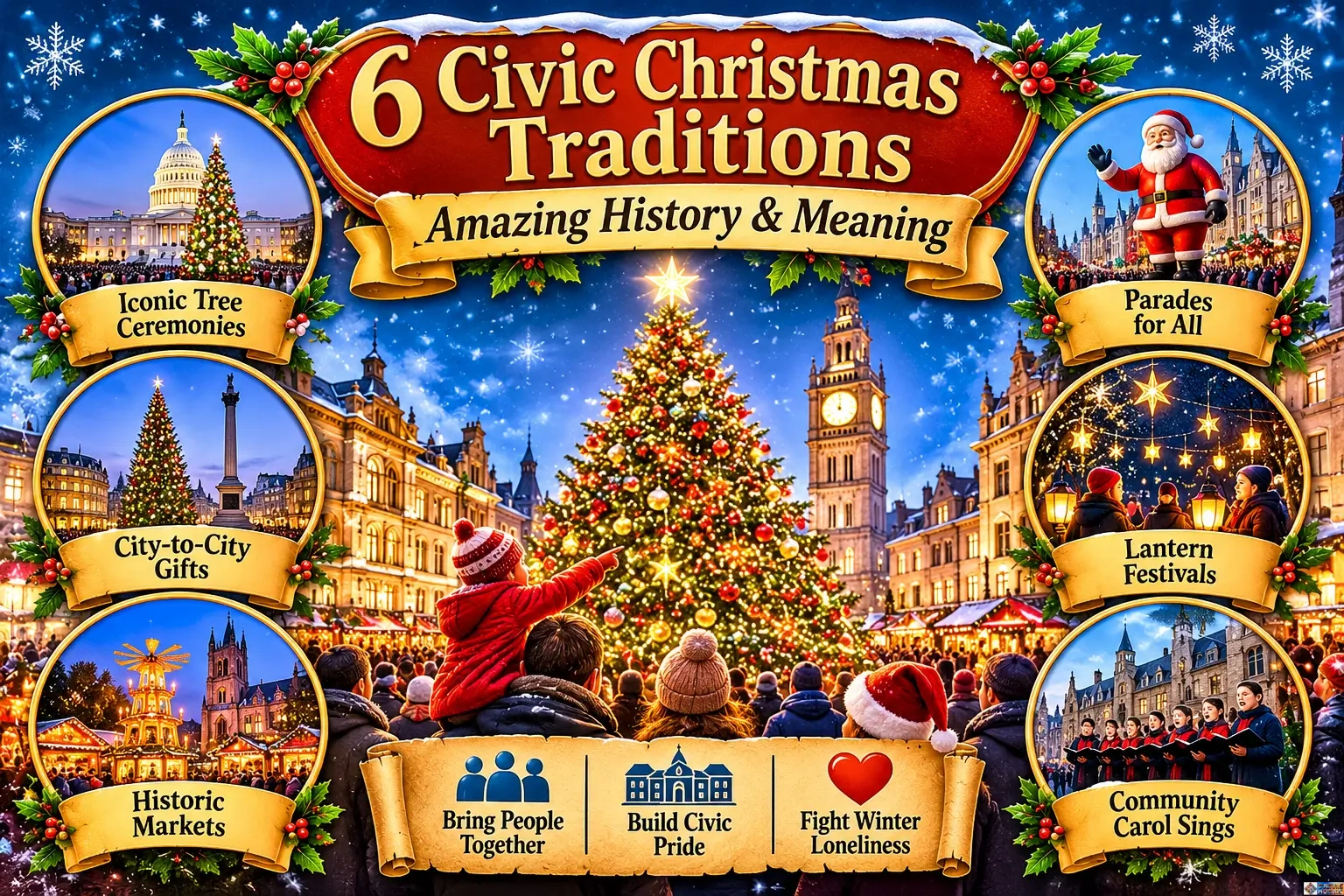
Written for readers curious about town squares, council-run light switch-ons, and the long history of cities throwing a party for everyone. Updated November 2026.
Quick Summary
- What they are: Civic Christmas traditions are public, community-held celebrations such as tree lightings, parades, markets, carol sings and lantern contests. They are run by or with a city, town or community group, and they are open to anyone who turns up.
- Why they matter: They turn squares, parks and high streets into shared living rooms, which is exactly where lonely winters get a little less lonely.
- Where they began: Medieval market licences (Dresden’s 1434 Christmas market is the best-documented example) and, much later, 20th-century civic tree ceremonies such as Washington, D.C. in 1923 and Oslo’s gift to London in 1947.
- The honest catch: Many beloved “civic” traditions started as marketing. Toronto’s Santa Claus Parade and Gävle’s giant goat were both built to bring shoppers in. They became civic because communities took them over.
- Why councils pay for them: Partly for footfall and local business, partly for civic pride. The evidence on the economic payoff is genuinely mixed, and councils argue about it every year.
- What to do now: Most switch-ons and parades happen between mid-November and early December. Check your own council’s events page this week.
The Problem: Winter Is Lonely, and Our Public Spaces Are Quiet
December is supposed to be the warmest month of the year. For plenty of people it is the opposite: short days, tight budgets, and a calendar full of events that cost money or require an invitation.
A civic Christmas tradition is the counter-offer. Nobody checks a ticket at the edge of a town square. You stand in the cold with your neighbours, count down from ten, and a tree or a street lights up. For about ten minutes you belong to the same crowd as everyone around you.
That sounds small. The history below suggests it has rarely been small to the people who built these events.
This guide covers three layers, in the order most readers ask about them: the physical civic space, the social glue, and the municipal history behind it all. To go deeper, read about Christmas culture traditions and classic Christmas themed events, or browse more at Culture Mosaic.
What Counts as a “Civic” Christmas Tradition?
A tradition is civic when the public, not a private household or a single church, is the host. Three tests help:
- Public space. It happens in a square, harbour, park or street.
- Public access. It is free or close to it, and open to everyone.
- Public stewardship. A council, town charter body, chamber of commerce or neighbourhood association organises or backs it.
That makes it different from a religious service (which belongs to a congregation) and from a purely commercial event (which belongs to a business). Real traditions blur the lines, as you will see.
Layer 1: The Physical Civic Space
Town squares work because they are the one place a whole community can already find without being told where to go. Christmas simply gives them a reason to fill up.
Washington, D.C.: the National Christmas Tree
The tree on the Ellipse near the White House was lit on Christmas Eve 1923, when President Calvin Coolidge pressed the button. According to the National Park Service, the idea was pushed by the Community Center Department of the D.C. public schools, and the tree was lit with 2,500 electric bulbs donated by the Electric League of Washington. A tree donated by Middlebury College in Vermont served as the first one, and a community sing followed with a church choir.
It is a useful reminder that even the most “national” tradition began with local school organisers and local volunteers. The ceremony later grew into the “Christmas Pageant of Peace” in 1954, and every president since 1923 has taken part, according to the Park Service. For more American examples, explore the best Christmas celebrations in the US.
London: a tree that is also a thank-you note
The tree in Trafalgar Square has been a gift from the city of Oslo to the people of London every year since 1947. A plaque at the site describes it as “a token of Norwegian gratitude” for London’s help in the war years. It is typically a Norway spruce more than 20 metres tall, cut in Norway in November and shipped across the sea.
This one is civic in the purest sense. It is a gift between two cities, a diplomatic gesture made public so that anyone walking past can read it.
Dresden: the market square as a calendar
Dresden’s Striezelmarkt is documented from 1434, when Frederick II, Elector of Saxony, authorised a one-day market just before Christmas for meat and food ahead of the festive meal. It now runs for around four weeks and draws an estimated 2.5 million visitors a year. It is widely billed as Germany’s oldest Christmas market. Nuremberg’s market is often argued to be the oldest, but it is usually dated to the 16th century, so Dresden holds the earlier documented claim.
The market even has a small social-conscience detail: wooden “Striezel children” figurines were created in 1930 to honour the poor children who once sold goods at the market.
Layer 2: Social and Community Cohesion
Civic events cannot cure loneliness on their own, and I have not found a single definitive study proving they do. What the case histories show is more modest and more believable: these events create low-stakes reasons to be in the same place.
Look at what the events below actually ask of participants.
Toronto: the parade that began as a sales pitch
The first Toronto Santa Claus Parade, on 2 December 1905, was one float carrying Santa from Union Station to the Eaton’s department store, sponsored by Eaton’s. It was marketing, plain and simple. Historian Steve Penfold’s book A Mile of Make-Believe traces how it became a fixture of the city’s calendar anyway. Eaton’s ended its sponsorship in 1982, and the parade carried on without it. Today it is usually held in November, and its history page says it ends with Santa’s arrival, as it always has.
The lesson for planners is real: a tradition can start commercial and still become civic once the public treats it as theirs.
San Fernando, Philippines: neighbourhoods compete, the whole city wins
The Giant Lantern Festival (Ligligan Parul) in San Fernando, Pampanga, is a contest between villages (barangays) to build the most spectacular rotating Christmas lantern. Its roots are traced to the religious lubenas devotion in nearby Bacolor and to the 1904 move of the provincial capital to San Fernando, though some accounts date the first contest to 1908. Electricity arriving in 1931 allowed much larger lanterns.
The contest is organised with the city government, and a single giant lantern can cost roughly US$11,000 to $16,000 to build, according to CNN Travel. CNN also reports that the festival went ahead in 1995 despite typhoon-driven mudslides. That is what civic identity looks like when it is working: a community deciding it will still show up.
Newport Beach, California: a harbour as a parade route
The Newport Beach Christmas Boat Parade traces back to a lighted boat parade on 4 July 1908, led by Venetian gondolier John Scarpa. It later became a Christmas event run by the Commodores Club of the Newport Beach Chamber of Commerce and now features up to around 150 boats. Local reporting describes it as free to watch from the shoreline. It was cancelled in 2020, a reminder that civic traditions are fragile. Read more in the Newport Beach Christmas Boat Parade guide.
Carols in the open air
Community carol singing is the cheapest civic ritual there is: you need a crowd and a song sheet. In 1923 the Washington tree lighting ended with a community sing, and carol groups regularly gather at the Trafalgar Square tree. For the wider story of singing together, see Glad Voices of Christmas.
A note on ice rinks: public rinks are common in winter programmes, but I could not verify a solid origin story for them in this research, so I have left them out rather than guess.
Layer 3: Local Municipal History
From charter markets to council programmes
Medieval rulers licensed markets and fairs, and the Dresden decree of 1434 is a clear Christmas example. Over the following centuries, markets, church feasts and guild celebrations shaped public winter life. For the British side of that story, start with historic Christmas traditions in the UK and the overview of Christmas festival history.
Victorian Christmas: when the tree went public
The Victorians did not invent Christmas, but they reshaped it. An engraving of Queen Victoria, Prince Albert and their children around a decorated tree was published in the Illustrated London News on 23 December 1848 and caused a sensation. Royal Museums Greenwich notes it inspired middle-class families to copy the scene. Albert also reportedly sent decorated trees to schools in Windsor and to local army barracks, an early example of the royal household giving the tree a public job. English Heritage has a good primer on Victorian Christmas traditions, and the Victoria and Albert Museum covers the same ground from the object side.
Victorian Christmas: quick facts you can check
- The famous tree engraving appeared in 1848.
- Albert had grown up with German tree customs.
- Henry Cole’s “first Christmas card” is often grouped with the tree as a Victorian trendsetter.
- Dickens wrote a story called “A Christmas Tree” by 1850.
- Trees reached schools and barracks as well as homes.
- Magazines and newspapers, a new mass medium, spread the fashion.
- Many ideas treated as “ancient” are, in practice, under 200 years old.
The 20th century: switch-ons and gifts between cities
Trafalgar Square’s tree (1947) and Washington’s tree (1923) belong to a wave of organised civic Christmas ceremonies. They sit alongside the council-run town-centre light switch-ons familiar across the UK today. For modern examples, see UK community Christmas initiatives.
Lesser-Known (and Gloriously Odd) Local Traditions
Gävle, Sweden: the giant straw goat
Gävle has built a giant straw Yule goat in Castle Square since 1966. It was the idea of local advertising consultant Stig Gavlén, intended to draw shoppers to the southern part of the city. The first goat was about 13 metres tall and weighed about three tonnes, and it burned down on New Year’s Eve 1966. Smithsonian Magazine reported in 2016 that it had met a fiery end 35 times in 50 years, while city officials treat the arson as unwelcome rather than part of the tradition.
Reports say the city has covered roughly one-third of the cost, with local merchants paying the rest. It is a rare tradition where the “will it survive?” suspense became the point. More oddities like it are collected in unusual Christmas traditions around the world and global Christmas customs.
Dresden’s giant stollen
Every year a giant Christmas stollen is baked for the Striezelmarkt and paraded through the streets by horse and cart before being sliced and shared with visitors. Food is the oldest civic glue there is. For recipes and food stories, try Christmas celebration foods and the Christmas cooking list.
Side-by-Side: Six Civic Traditions Compared
This table is my own comparison, built only from the sources listed at the end.
| Tradition | Place | First Documented | Who Started It | Main Civic Purpose |
|---|---|---|---|---|
| Striezelmarkt | Dresden, Germany | 1434 | Elector Frederick II of Saxony | Seasonal trade and food for townspeople |
| National Christmas Tree | Washington, D.C., USA | 1923 | D.C. school organisers, with President Coolidge | National gathering, community singing |
| Trafalgar Square Tree | London, UK | 1947 | City of Oslo | Gratitude between cities |
| Santa Claus Parade | Toronto, Canada | 1905 | Eaton’s department store | Retail promotion that became a civic ritual |
| Gävle Goat | Gävle, Sweden | 1966 | Local business promoter Stig Gavlén | Draw visitors and shoppers to the city |
| Ligligan Parul | San Fernando, Philippines | 1904 or 1908 | Religious lantern customs, later community contests | Neighbourhood pride and identity |
What the pattern shows: four of the six began with a commercial or trade motive, one with diplomacy, and one with religious devotion. Almost none began as “community building” in the abstract. Community was what grew around them.
Why Do Local Councils Fund Christmas Light Switch-Ons?
The short answer is footfall plus pride. Council papers often frame switch-ons as a way to start the festive trading season and raise activity in town centres. A Tameside Council report, for example, describes switch-on events as key annual moments in each town. Kirklees Council has noted that some authorities fully fund festive lights while others only partly fund them.
The money is not trivial. The Yorkshire Post reported that Leeds spent about £573,000 on lights and decorations in 2017, including around £76,000 on the switch-on event, while Rotherham maintained a budget of about £44,000.
And the economic case is debated. In Harrogate, a business improvement district reported in 2024 that 60% of surveyed businesses felt switch-on events did not increase their footfall or spend, and the event was not held that year. Elsewhere in the same area, Ripon and Knaresborough councils continue to fund theirs through local precept. A 2023 Freedom of Information request noted that several English councils had announced they would not turn on lights that year to save money.
So the fair answer is: councils fund them because residents value them and because many believe they help local business, but the evidence of the business benefit is mixed, and the funding model (council tax, business levy, sponsorship) varies by town.
How Do Cities Balance Secular Civic Events With Religious Traditions?
Mostly by letting both sit in the same space. Examples from the research:
- Washington’s 1923 ceremony included a choir-led community sing and a re-enactment of the wise men’s journey nearby.
- San Fernando’s lantern contest grew out of devotion and processions but is run today as a city-supported competition.
- Dresden’s striezel bread originated in Advent fasting, and the market is now a general public festival.
- Toronto’s parade, by contrast, was commercial from day one.
Cities typically keep the civic event inclusive (anyone can attend) while the religious services stay separate. For the faith side of the story, see Christmas religious stories and religious festivals in the world.
Civic Christmas Traditions for KS2 Learners (Simple Version)
Short and friendly, for children and teachers.
- A civic tradition is something a whole town or city does together.
- A market is a place where people sell things. Dresden has had a Christmas market for nearly 600 years.
- A gift between cities can be a tree. Every year Oslo in Norway sends London a big Christmas tree to say thank you.
- Some traditions are new. Gävle’s straw goat only started in 1966.
- Traditions can change. Toronto’s parade began with one float and now has many.
What Civic Christmas Traditions Teach Us
Three things stand out across all these stories.
- Origins are messy. Trade, diplomacy and faith all show up, and the “pure” community festival is mostly a myth.
- Ownership matters more than origin. Eaton’s started the parade, but Toronto kept it. Gävle’s merchants started the goat, but the whole city worries about it.
- They need people to keep them alive. Funding cuts, cancellations and arguments about cost show these events survive only while someone, whether a council, a chamber of commerce or a barangay, decides they are worth it.
Your Next Step
These events are not guaranteed to be there next year. Most run on tight budgets and volunteer energy, and the Harrogate example shows how quickly a switch-on can disappear.
- Go to one. Search “[your town] Christmas lights switch-on 2026” and check the council or town-centre website for the date.
- Ask your council how the event is funded and whether volunteers are welcome.
- Bring someone who might not otherwise go, such as an older neighbour or a new arrival.
A note on evidence: I have not run my own poll or interviews for this guide, and I have not invented any, so all figures above come from the sources listed below. If you want original data, a short survey of your own town’s attendees or a council freedom-of-information request on event budgets would be a strong next project.
Share Your Town’s Tradition
How does your local town square celebrate the winter season? Share your community’s unique holiday rituals in the comments below.
❓ Frequently Asked Questions
Related Reading
- Famous Christmas artwork
- Top US Christmas foods
- Art of Christmas Gala
- Christmas background designs
- What’s open on Christmas Day 2025 (check the date, as this page refers to last year)
Sources
Washington, D.C.
- National Park Service, History of the National Christmas Tree and 1923 National Christmas Tree
- U.S. National Archives, Prologue blog on the 100th anniversary of the tree lighting
- Forest History Society, National Community Christmas Tree Records, 1923–1954
London
- Wikipedia, Trafalgar Square Christmas tree (with citations to BBC News and Greater London Assembly)
- AP via Religion News Service, Norway donates a Christmas tree to London every year
- Norwegian Arts UK, Trafalgar Square Christmas Tree: From Oslo to London
Dresden
- Aleteia, Europe’s oldest Christmas market is almost 600 years old
- Outlook Traveller, A Guide to Dresden’s Striezelmarkt
- Islands, Europe’s Oldest Continuously-Operating Christmas Market
Toronto
- The Santa Claus Parade, The History of the Parade
- Ontario Heritage Trust, Santa Claus Parade plaque background paper
- Steve Penfold, A Mile of Make-Believe: A History of the Eaton’s Santa Claus Parade (University of Toronto Press, 2016); see also Canada’s History review
Gävle
- Smithsonian Magazine, For 50 Years, This Swedish City Has Celebrated Christmas Season With a Giant Straw Goat
- Wikipedia, Gävle goat
San Fernando
- CNN Travel, San Fernando: Christmas Capital of the Philippines
- Philippine News Agency, Giant Lantern fest: Brightest Christmas stars on parade
- Wikipedia, Giant Lantern Festival
Newport Beach
- Visit Newport Beach, 12 Decades of Newport Beach
- Newport Beach Christmas Boat Parade, History
- Wikipedia, Newport Beach Christmas boat parade
Victorian Christmas
- English Heritage, Victorian Christmas traditions
- Royal Museums Greenwich, Victorian Christmas
- Victoria and Albert Museum, Victorian Christmas traditions
- Illustrated London News, 23 December 1848, p. 409–410, via Doing History in Public
Council funding of lights and switch-ons
- The Stray Ferret, No Christmas lights switch-on in Harrogate again
- Yorkshire Post, Councils spend more on their festive lights
- Tameside Council, Christmas Lights 2022 report
- Kirklees Council, Festive Lights and Decorations (2004)
- Royal Borough of Windsor and Maidenhead, FOI 196501-422846 on town-centre Christmas lights
Figures were checked against these sources in November 2026. Dates and costs for 2026 events should be confirmed with the organisers.