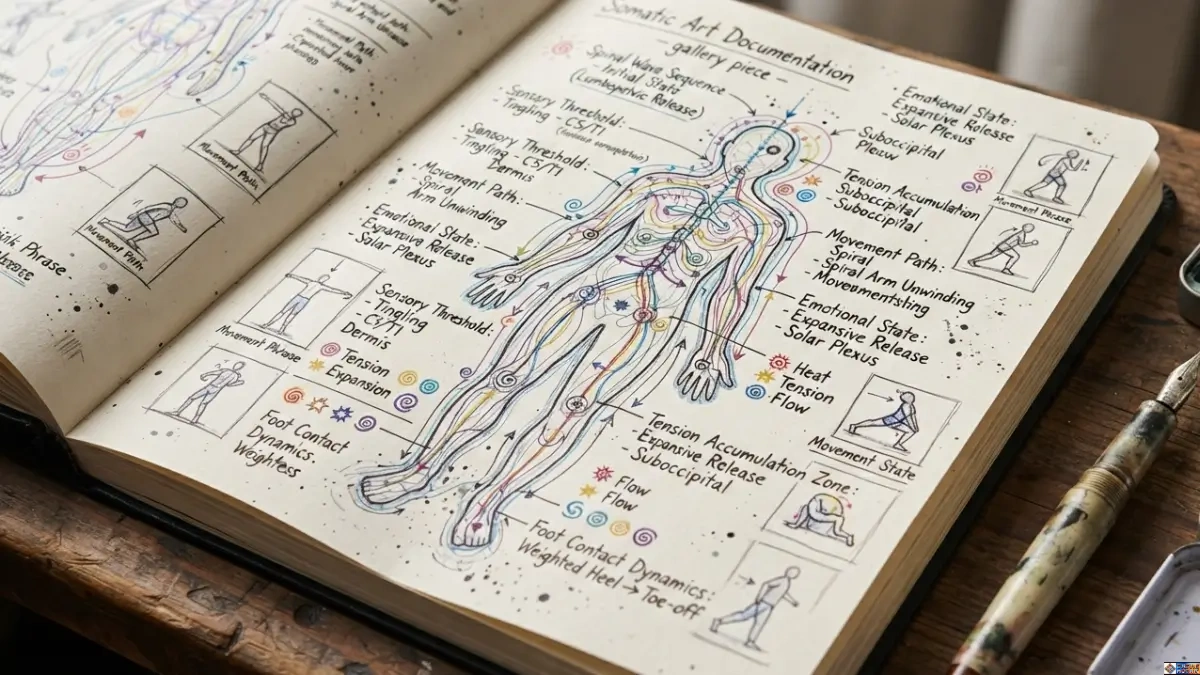
There is a moment, standing in an old building or walking the edge of an industrial wasteland, when the place does something to your body before your mind has caught up. Your chest tightens. Your fingers feel the cold in the concrete. Your eyes read the rust before you have thought a word about it. Somatic Art Documentation is the practice of catching that moment and giving it a permanent physical form.
It is not simply sketching a view or photographing a wall. It is using the body as the primary recording instrument, and the resulting artwork as an archive of sensory and emotional data that no camera can fully replicate. Think of it as bridging the Sensory Ghost of a place with a tangible object that can outlive the original site. This article walks you through the theory, the tools, and the steps to begin your own practice.
What Is Somatic Art Documentation?
Somatic Art Documentation is the systematic recording of the physical and felt experience of an environment through a creative medium. The word somatic refers to the body, and in this context, it means that the artist’s nervous system, muscles, and sensory perception are the primary data-collection tools.
Where traditional landscape documentation prioritises accuracy of appearance, Somatic Art Documentation prioritises accuracy of sensation. The question is not “what does this place look like?” but “what does this place feel like inside a body that is present within it?”
The resulting works, whether rubbings, paintings, relief prints, or digital biometric visualisations, function as what researchers in embodied cognition call Material Memory. The artwork holds the experience in a form that can be returned to, studied, and shared.
The Body as the First Archive
Haptic Perception in Creative Recording

Before a single mark is made, the artist’s body has already begun its documentation. Haptic perception, the combined sense of touch, pressure, temperature, and proprioception, assembles a portrait of a space that vision alone cannot produce. The grain of a weathered brick under your fingertips carries geological time in a way that a photograph cannot convey.
Muscle memory is the other side of this coin. The speed and pressure of a brushstroke, the angle of a chisel, the hesitation in a hand drawing a blind contour: these are somatic responses to the environment. They are not decorative choices. They are data.
[ TECHNIQUE LOG: 001 ] — FORENSIC TOOLS FOR SOMATIC DOCUMENTATION
01 / Blind Contour Mapping
Draw the edge of a surface without looking at your paper. Your hand tracks what your eyes and fingertips feel simultaneously. The resulting line is a direct transcript of haptic perception. Distortions are not mistakes; they are honest recordings of where sensory attention was concentrated.
02 / Rubbing / Frottage
Place paper against a surface (brick, corroded metal, carved stone) and rub graphite or wax across it. The texture transfers directly with zero interpretation. Frottage is the purest form of Somatic Art Documentation: the body acting as the press, and the site as the printing plate.
A trained practitioner of Somatic Art Documentation learns to read their own physical responses as information. Tension in the shoulders near a site with industrial trauma. Lightness in the hands at a place with long ritual history. These signals direct the mark-making process and become encoded in the final work.
Case Study: The Topographic Canvas
Material Memory and Site-Specific Pigment
Consider an abandoned industrial lot on the edge of a city. The ground holds decades of oil spill, rust bleed, and weed growth. A conventional documentary photograph captures its appearance. A work of Somatic Art Documentation does something different.
The artist walks the site first without making anything. They allow the environment to register physically: the acrid smell, the particular cold of concrete in shade, the softness underfoot where the ground has subsided. Only then does the recording begin.
In one documented approach, the artist collected rainwater pooled in a rusted drum and used it as a dilutant for pigment. They pressed paper against the buckled floor to take rubbings of the surface pattern. They mixed powdered iron oxide from the corroded structure into gesso to create a ground for the final painted canvas. The result is not a picture of the place. It is made from the place. This is what Material Memory means in practice: the artwork carries the chemistry of the site within its physical substance.
Color choices in this approach are not aesthetic preferences. They emerge from the site’s own palette: the orange of rust, the grey-green of lichen on brick, the almost-black of pooled water against asphalt. The somatic documentation of emotional register, whether the place carries the energy of trauma, labour, abandonment, or ritual, is then translated into the compositional structure: fragmented or whole, tightly contained or expanding outward.
Somatic Art Documentation in 2026: The Digital Layer

LiDAR, Biofeedback, and the New Forensic Palette
The practice has expanded considerably with the arrival of accessible sensor technology. Modern artists working in Somatic Art Documentation now have access to tools that extend the body’s recording capacity in ways that would have been impossible a decade ago.
LiDAR scanning, originally developed for surveying and autonomous vehicles, allows an artist to produce a precise three-dimensional point cloud of any surface. Applied to a building interior or an eroded landscape, LiDAR captures the exact topography of a space, including the micro-variations in surface texture that hands and eyes alone might miss. Some practitioners refer to this as skinning a building: pulling the dimensional texture from its walls as a data layer that can be visualised, printed, or projected.
Biofeedback art takes the somatic dimension literally. An artist wears a heart rate monitor, a galvanic skin response sensor, or an accelerometer while walking a mnemonic path, a route through a space that carries historical or personal significance. Their physiological data is recorded in real time and later translated into visual form: a line that quickens and broadens where the heart rate spiked, a field of colour that deepens where the body registered stress. The resulting Somatic Data Visualisation is a portrait of the body’s encounter with the environment, an inner landscape mapped against an outer one.
These digital methods are not replacements for traditional somatic techniques. They are extensions of the same underlying logic: the body knows things that the eye alone does not register, and Somatic Art Documentation exists to make that knowledge visible.
Key Principles of Effective Somatic Art Documentation
What Separates Documentation from Decoration
Not every piece of art made in response to a landscape constitutes Somatic Art Documentation. The distinction lies in intentionality and method. Several principles define genuine practice:
• Presence before production. The artist must spend time in the site with full sensory attention before any mark-making begins.
• The body as instrument. Physical responses, tension, ease, discomfort, curiosity, are treated as data rather than background noise.
• Material connection. Where possible, materials from the site itself are incorporated into the work.
• Interpretive honesty. The emotional register of the space, whether that is trauma, celebration, or ambiguity, is not flattened or prettified.
• Archival intent. The finished work is understood as a document, not merely an expression.
Best Practices for Preserving Somatic Artworks
Archiving Works That Contain Living Materials
Works created through Somatic Art Documentation often contain materials, earth, organic pigments, rusted metal, pooled water, that are inherently unstable. Preserving these works requires a different approach to standard art conservation.
Document the materials used at the time of creation with as much specificity as possible: the origin of the earth pigment, the chemical composition of the surface rubbings if known, the date and weather conditions when site-specific water was collected. This metadata is as important as the visual record of the work itself.
For works incorporating organic material, consult a paper conservator before sealing or varnishing, as conventional conservation treatments can accelerate the degradation of unconventional substrates. Some practitioners choose to allow controlled deterioration, arguing that the work’s own decay is part of its somatic truth.
Digital components, biofeedback data, LiDAR point clouds, sound recordings, should be archived in open formats with checksums and stored across multiple platforms. The raw data files are part of the artwork, not merely supporting documentation.
Tools and Materials: A Practical Overview
Building Your Somatic Documentation Kit
Beginning a practice of Somatic Art Documentation does not require expensive equipment. The most essential tools are attention and a willingness to allow the body to lead the work. Beyond that, a core kit typically includes:
• Graphite sticks and wax crayons in a range of hardness for frottage and blind contour work.
• Thin Japanese tissue and heavier cartridge paper for rubbings.
• Small collection jars for gathering site materials: earth, water, ash, sand.
• A field journal for logging somatic responses: brief notes on physical sensations, not interpretations.
• A voice recorder for capturing immediate verbal responses before the analytical mind intervenes.
• A smartphone with a LiDAR sensor, available on recent mobile devices, for capturing surface topology.
LOG 070.A: The Somatic Art Audit
A Step-by-Step Framework for Your First Documentation

The following framework guides artists through the core stages of a complete Somatic Art Documentation project.
| Step | Forensic Goal | Creative Output |
|---|---|---|
| 01: The Trace | Capture the surface scar; the physical texture of the site. | Graphite rubbing of stone, brick, or corroded metal. |
| 02: The Palette | Match the site’s emotional hue and felt color register. | Site-specific color field study using site-derived pigment. |
| 03: The Echo | Record the acoustic volume and resonant quality of the space. | Visual sound-wave mapping or hand-drawn waveform. |
| 04: The Body Log | Capture physiological responses during the site visit. | Heart rate or skin response data-visualization overlay. |
| 05: The Archive | Compile and preserve all materials, data, and records. | Documentation dossier: physical works + digital metadata. |
Ethical Considerations in Somatic Art Documentation
Working with Sites of Trauma and Cultural Memory
Not every site is neutral ground. Some spaces carry the weight of historical trauma: former sites of forced labour, places of communal grief, landscapes altered by violence or disaster. Working with such sites requires care that goes beyond artistic sensitivity.
Before beginning any documentation project at a site with significant cultural or historical meaning, research its history thoroughly. Consult with communities who hold a relationship with the space. Be transparent about your intentions and the expected use of the resulting works.
Somatic Art Documentation at trauma sites is not voyeuristic if handled with integrity. The purpose is to honour the felt weight of a place, to make a permanent record of what the body knows when it stands in that space. That is a worthwhile act. But it requires humility and a willingness to hear objections.
[ PROTOCOL LOG: ETHICS ]
CHECKLIST FOR SENSITIVE SITE DOCUMENTATION
MANDATORY: Complete before beginning any Somatic Art Documentation project at a culturally or historically significant site.
-
01 / Site History Verified
Have you researched the site’s documented history, including events of trauma, displacement, or significant cultural use? -
02 / Community Consultation Completed
Have you consulted with individuals or groups who hold an active relationship with this space? -
03 / Intent Declared
Is the purpose transparent? Have you communicated how the resulting works will be used, published, or exhibited? -
04 / Objection Protocol in Place
Do you have a clear process for pausing or stopping the project if a stakeholder raises a legitimate concern? -
05 / Material Handling Reviewed
If collecting material, have you considered the implications of removing physical matter from a culturally significant place?
Teaching Somatic Art Documentation
Integrating the Practice into Art Education
The principles of Somatic Art Documentation translate directly into educational practice. Students who learn to attend to their own physical responses, and to treat those responses as information rather than noise, develop a relationship with their own creative process that goes beyond technique.
A useful starting exercise is a blind contour session in an outdoor location. Students draw the edges of their immediate environment without looking at the paper, then discuss what they noticed in their body during the process. The conversation that follows almost always reveals a richness of sensory data that students had not previously known how to articulate or value.
More advanced curricula can incorporate frottage mapping of an entire neighbourhood, site-specific pigment extraction, and eventually simple biofeedback capture using freely available smartphone apps. The goal is to establish the habit of treating the body as a collaborator in the documentary process rather than simply a vehicle for technical skill.
Frequently Asked Questions About Somatic Art Documentation
What exactly does somatic mean in the context of art?
Somatic refers to the body and its felt experience. In art, a somatic approach means that the physical sensations of the body, touch, proprioception, muscle tension, breath, are treated as primary sources of information that shape the creative process.
Do I need professional training to begin Somatic Art Documentation?
No formal training is required to start. The foundational techniques, frottage, blind contour drawing, field journaling, are accessible to anyone with basic art materials and a willingness to pay sustained attention to their physical experience in a space.
How is Somatic Art Documentation different from landscape painting?
Landscape painting primarily records visual appearance. Somatic Art Documentation records the full sensory and emotional experience of inhabiting a space, using the body as the instrument of measurement. The resulting work may or may not look like the site; that is not the primary criterion.
Can digital tools be used in Somatic Art Documentation?
Yes. LiDAR scanners, biofeedback sensors, sound recording equipment, and data-visualisation software all extend the body’s natural recording capacity. Digital tools are not replacements for somatic attention; they are additional layers within the same documentary framework.
How should finished works be stored and preserved?
Works containing organic or site-derived materials should be documented with detailed materials records at the point of creation. Consult a conservator before applying conventional treatments. Digital components should be archived in open formats across multiple platforms, with raw data files treated as integral parts of the artwork.
Art is the only archive that can store a ghost.
Continue the Dossier
This article is part of the Culture Mosaic archive of somatic and mnemonic practice. Explore the connected dossiers:
Dossier No. 069: Mnemonic Landscape Analysis
Dossier No. 071: The Somatic Interior
Fragmented Collage with Visible Seams
About the Author
This article was written for Culture Mosaic, an independent archive dedicated to the intersection of place, body, and creative practice. Culture Mosaic publishes ongoing research into somatic methodologies, mnemonic landscape analysis, and material memory, working with practitioners across the visual arts, architecture, and environmental humanities. To explore the full dossier series or to contribute your own documentation practice, visit culturemosaic.co.uk.