
 By Dr. Julian Thorne
Quick Summary
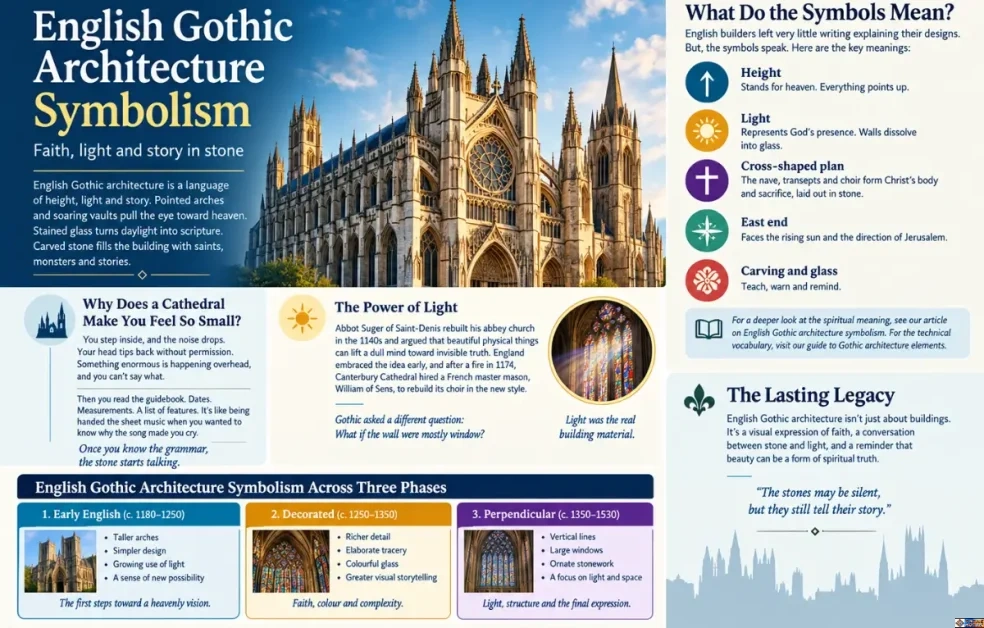
English Gothic architecture symbolism is a language of height, light and story. Pointed arches and soaring vaults pull the eye toward heaven. Stained glass turns daylight into scripture. Carved stone fills the building with saints, monsters and stories. English builders developed this language in three broad phases: Early English (c. 1180–1250), Decorated (c. 1250–1350) and Perpendicular (c. 1350–1530). Each phase gave the same faith a different mood. Dates are approximate, and historians draw the lines in slightly different places.
Why Does a Cathedral Make You Feel So Small?
You step inside, and the noise drops. Your head tips back without permission. Something enormous is happening overhead, and you can’t say what.
Then you read the guidebook. Dates. Measurements. A list of features. It’s like being handed the sheet music when you wanted to know why the song made you cry.
I think that gap is the real problem with how we look at these buildings. We treat them as monuments to admire. Their makers built them to be read. Once you know the grammar, the stone starts talking.
What Are the Symbolic Meanings of Gothic Architecture?
The short answer comes first, as promised.
- Height stands for heaven. Everything points up.
- Light stands for God’s presence. Walls dissolve into glass.
- The cross-shaped plan (nave, transepts, choir) is Christ’s body and sacrifice, laid out in stone.
- The east end, where the altar sits, faces the rising sun and the direction of Jerusalem.
- Carving and glass teach, warn and remind.
Here is the honest caveat. English builders left very little writing explaining what their designs meant. Most of what we say is interpretation, informed by a few precious texts and by the way the buildings behave. Any writer who claims certainty about every symbol is selling you something. For a good overview of the spiritual reading, this piece on English Gothic architecture symbolism is worth your time. If you want the technical vocabulary first, our guide to Gothic architecture elements covers it. I’ve also set out the wider definition in What Defines Gothic Architecture?.
Light Was the Real Building Material
The best-documented idea comes from France. Abbot Suger of Saint-Denis rebuilt his abbey church in the 1140s and wrote about it afterwards. His argument, in my paraphrase, was that beautiful physical things can lift a dull mind toward invisible truth. Suger leaned on the writings of Pseudo-Dionysius, who described divine reality as radiant light.
England caught the idea early. After a fire in 1174, Canterbury Cathedral hired a French master mason, William of Sens, to rebuild its choir in the new style. The story of that leap is in How Did Gothic Architecture Begin?. The theology behind it is in How Did Gothic Architecture Reinforce Christianity.
Think about what the old Romanesque style did with a wall: thick, dark, protective. Gothic asked a different question. What if the wall were mostly window? That was a theological bet as much as an engineering one.
English Gothic Architecture Symbolism Across Three Phases
Forget dry chronology. Each phase wants you to feel something different.
| Phase | Approx. dates | Signature look | The intended feeling | Places to see it |
|---|---|---|---|---|
| Early English | c. 1180–1250 | Tall, narrow lancet windows; plain, crisp lines | Clarity, order, calm | Salisbury Cathedral, Wells Cathedral, Lincoln Cathedral |
| Decorated | c. 1250–1350 | Flowing “curvilinear” tracery; ogee arches; dense vault patterns | Abundance, movement, wonder | Exeter Cathedral, Lincoln’s Angel Choir, York Minster |
| Perpendicular | c. 1350–1530 | Strong vertical lines; huge windows; fan vaults | Confidence, grandeur, royal power | Gloucester Cathedral, King’s College Chapel, Bath Abbey |
Early English is the sober one. Salisbury, begun in 1220, went up fast and in a single, disciplined style, and that gives it a rare unity. Its lancets are often read as reflecting the Trinity when grouped in threes, though that’s a modern reading rather than a documented intention.
Decorated is the show-off. Tracery begins to curve and flicker like flame or leaf. Vaults sprout extra ribs that carry no structural load and exist to delight. I find this the most emotionally generous phase, a style that wants you to look at it for a long time. Our guide to English Gothic vaulting types shows how far those ribs went.
Perpendicular is the one only England invented. The lines run straight up, the windows swell, and the vaults fan out like stone fountains. King’s College Chapel in Cambridge, begun in 1446 for Henry VI, has a fan vault completed in 1515. Henry VII’s chapel at Westminster Abbey has pendants that hang like frozen chandeliers. I’d argue this phase is as much about power as prayer. Faith and monarchy share the same ceiling.
For more on what sets the English version apart, see English Gothic Architecture Characteristics and Gothic vs. Romanesque Architecture.
The Five Key Elements, and What Each One Says
| Element | Its practical job | Its symbolic job |
|---|---|---|
| Pointed arch | Directs weight downward; allows taller openings | Aspiration; hands pressed in prayer |
| Ribbed vault | Channels the roof’s weight to specific points | A canopy of heaven; order over chaos |
| Flying buttress | Carries the roof’s thrust outside the walls | Strength made visible, then hidden behind beauty |
| Traceried window | Holds glass in slim stone frames | The soul’s opening to divine light |
| Spire and pinnacles | Weight and finish on towers and buttresses | A finger pointing at God |
Here’s my stand. The best thing about Gothic is that the structure is the metaphor. The buttress does the heavy lifting outside so the wall can turn to light inside. That is a theological idea, and it is also just physics. The technical side is explained in our Flying Buttress Definition in Art and Gothic architecture key features, and the wider picture in What Is Gothic Art and Architecture?
Stories in Stone and Glass
Sculpture and glass carried the narrative load.
The west front of Wells Cathedral was once crowded with hundreds of statues of saints, kings and biblical figures, arranged like a stone congregation. At Norwich Cathedral, roughly a thousand carved roof bosses illustrate stories from the Bible, so you can read scripture by tilting your head back. In the Angel Choir at Lincoln, a small carved imp has become a local legend.
Canterbury Cathedral holds some of the finest surviving medieval stained glass in Britain, including windows telling the miracles of Thomas Becket.
Gargoyles are worth a note. They were water spouts first, carrying rain away from the walls. Popular explanations say they represent evil driven out of the church, but the evidence for a single intended meaning is thin, and I’d rather tell you that than repeat a tidy myth.
The old claim that glass was the “Bible of the poor” traces back to Pope Gregory the Great, who wrote around 600 that images teach those who cannot read. It’s a real source. But it’s also incomplete. Windows also advertised donors, guilds and prestige, and educated clergy read them too.
Sacred Geometry: What We Know and What We Don’t
Medieval masons worked from geometry: circles, squares and triangles, set out with compass and straightedge. That is documented. What the proportions meant is where scholars argue.
Erwin Panofsky, in Gothic Architecture and Scholasticism (1951), proposed that cathedral design mirrored the orderly logic of scholastic philosophy. Otto von Simson’s The Gothic Cathedral (1956) argued for a metaphysics of light and number. Later historians have pushed back, pointing out that the parallels can be overstated.
My take: the geometry is real, and the deeper numerology is often over-read. Not every triple is a Trinity. But when you stand under a well-proportioned vault, the sense of harmony is hard to dismiss, and I don’t think medieval builders were indifferent to it.
Where to See English Gothic Cathedrals in the UK
If you want examples of Gothic architecture in the UK, start with Salisbury for Early English purity and Exeter for Decorated richness. York Minster and Lincoln are a pair of giants. Gloucester shows Perpendicular at its beginning. Westminster Abbey, rebuilt by Henry III from 1245, has the tallest medieval nave in England at roughly 31 metres. Bath Abbey carries a west-front image inspired, according to tradition, by a dream of Bishop Oliver King: angels climbing a ladder to heaven.
English Gothic Revival Architecture: The Style Comes Back
The style didn’t die. It got a second career.
Horace Walpole began remodelling Strawberry Hill in the 1740s as a playful Gothic fantasy. After fire destroyed the old Palace of Westminster in 1834, Charles Barry, with A. W. N. Pugin’s detail, built the new Houses of Parliament in Gothic dress. Pugin argued that Gothic was a moral architecture. John Ruskin, in The Nature of Gothic (1853), praised the free, imperfect hand of the medieval carver.
So the symbolism shifted. Medieval Gothic pointed to heaven. Victorian Gothic pointed to national identity, tradition and virtue. Same arches, different sermon.
The Wildcard: Hunt for the Mason’s Marks
Here is my weird suggestion. Skip the grand view for ten minutes and look at the stones. Many medieval masons cut a small personal mark into the blocks they finished, apparently to identify their work for payment. You can find them in cathedral walls and stairwells: little arrows, crosses, zigzags.
They’re signatures from people who never expected to be remembered. After all the talk of heaven, it’s a strangely moving reminder that human hands built this.
Frequently Asked Questions
Next time you walk into a cathedral, don’t start with the guidebook. Start with the ceiling, then the glass, then the stones under your hand. For more stories like this one, explore Culture Mosaic.
Sources
- Suger, On the Abbey Church of St.-Denis and Its Art Treasures, ed. and trans. Erwin Panofsky, Princeton University Press (2nd ed., 1979).
- Panofsky, Erwin. Gothic Architecture and Scholasticism. Archabbey Press, 1951.
- von Simson, Otto. The Gothic Cathedral. Princeton University Press (Bollingen Series), 1956.
- Frankl, Paul, and Paul Crossley. Gothic Architecture. Yale University Press (Pelican History of Art), 2000.
- Rickman, Thomas. An Attempt to Discriminate the Styles of English Architecture, 1817.
- Ruskin, John. The Nature of Gothic (from The Stones of Venice), 1853.
- Gregory the Great, letter to Serenus of Marseille (Registrum epistolarum, XI.10), c. 600.
- Canterbury Cathedral: canterbury-cathedral.org (history and stained glass).
- Salisbury Cathedral: salisburycathedral.org.uk.
- Westminster Abbey: westminster-abbey.org.
- Historic England: historicengland.org.uk (listing entries for the cathedrals named).
- UNESCO World Heritage Centre: whc.unesco.org (Durham, Canterbury, Westminster).
- Victoria and Albert Museum: vam.ac.uk (Gothic Revival collections).