
 By Dr. Julian Thorne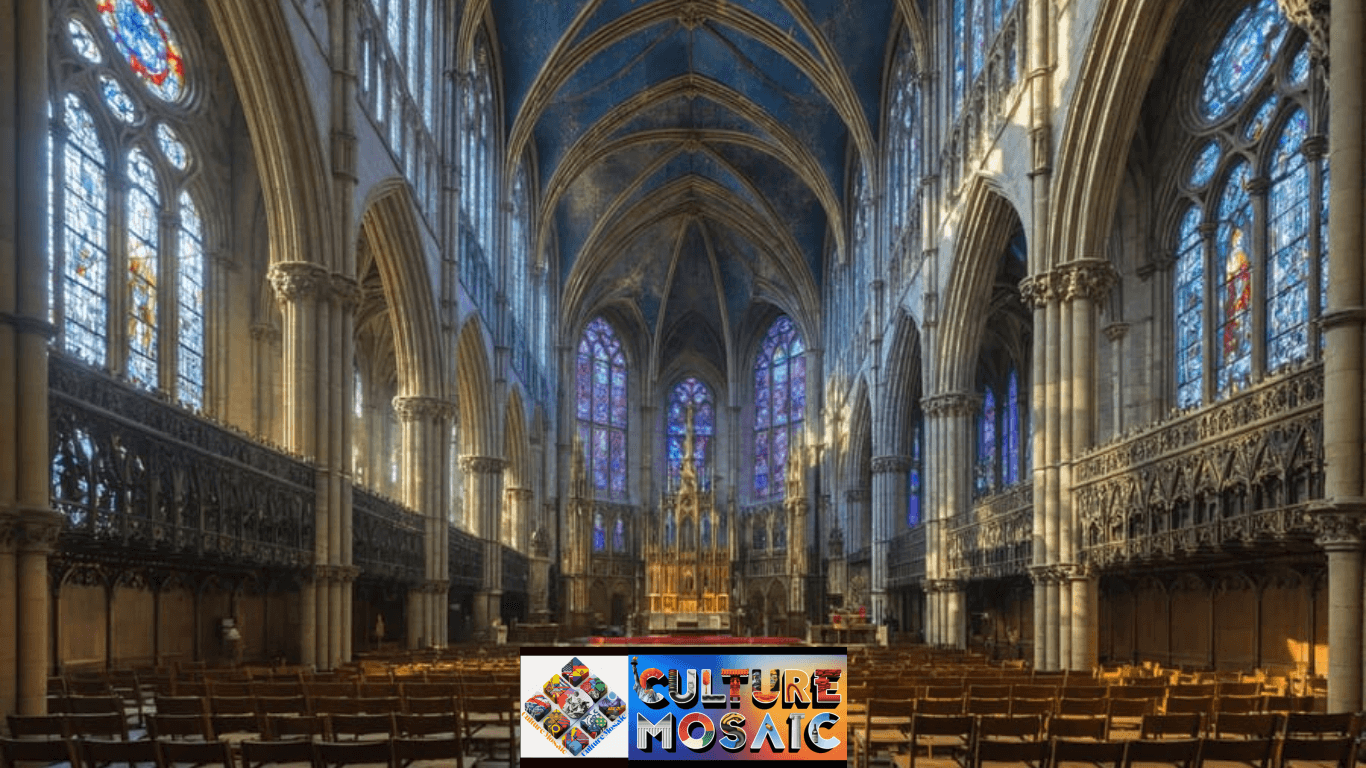
How Did Gothic Architecture Reinforce Christianity? I still remember the first time I stood inside Chartres Cathedral as a graduate student, neck craned back, watching afternoon light pour through the rose window and land in blue and red pools on the stone floor. I wasn’t prepared for it. Nobody ever really is. And that, I’ve come to believe after twenty years of studying medieval churches, was exactly the point.
Here’s the problem so many visitors run into. They walk through a Gothic cathedral, they take a photo of the pointed arches, they admire the stained glass, and they leave without ever grasping why the building looks the way it does. They treat it like old, impressive scenery. A backdrop. What they miss is that every soaring vault, every shaft of colored light, every carved saint above the door was placed there on purpose, by people who believed architecture itself could preach a sermon.
That gap between looking at a cathedral and actually understanding it bothers me, honestly. It’s a bit like listening to a symphony with the sound turned down. You get the shape of the thing without the meaning. So let’s fix that. In this piece, I want to walk through how did Gothic architecture reinforce Christianity, feature by feature, using the same lens I use when I take students through Chartres, Notre-Dame, and Saint-Denis. By the end, you won’t just recognize a Gothic cathedral. You’ll be able to read one.
What Influenced Gothic Architecture
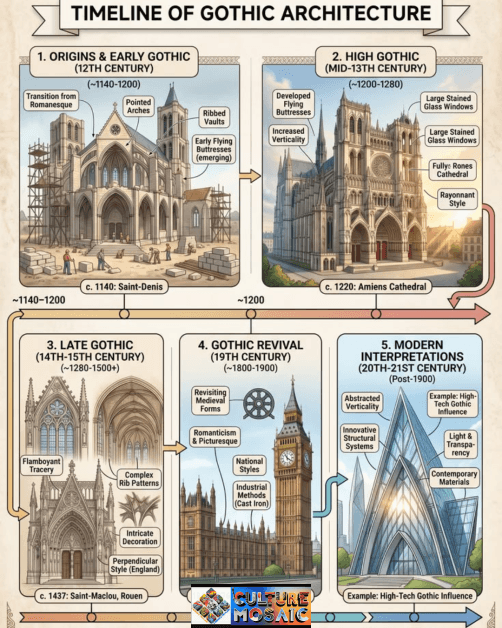
Gothic building didn’t appear from nowhere. It grew out of a very specific set of pressures in twelfth-century France: booming towns, wealthier bishoprics, better engineering knowledge borrowed from Roman and Islamic building traditions, and a theological mood that prized light as a symbol of God. Romanesque churches, the style that came before, were solid and dim, built around thick walls and small windows because the technology of the day demanded it. Masons hadn’t yet solved the problem of how to hold up a tall stone roof without equally thick walls underneath it.
The breakthrough came from a Benedictine abbot named Suger, who rebuilt the choir of the Basilica of Saint-Denis just outside Paris between 1140 and 1144. Suger wasn’t only an administrator. He was steeped in the mystical writings attributed to Pseudo-Dionysius, which described divine truth as a kind of radiant light that the human mind could only approach gradually. Suger decided his church should make that idea physical.
He wanted worshippers bathed in colored light the moment they walked in, so he pushed his masons toward thinner walls, taller windows, and a new combination of pointed arches and ribbed vaults that could carry weight down to slender piers instead of solid masonry. You can read more about the wider context in this piece on Gothic Architecture and Its Significance, which traces how quickly the style spread once Saint-Denis proved it could work.
There’s also an intellectual current running underneath all of this that’s worth knowing about. Twelfth-century cathedral schools, the forerunners of medieval universities, were developing scholastic theology, a method of reasoning that broke complex ideas into clear, logical, hierarchical parts.
The art historian Erwin Panofsky famously argued that Gothic architecture shares that same habit of mind: a cathedral’s structure is broken into clearly articulated parts, nave, transept, choir, chapel, each subordinate to the whole in a way that mirrors how a scholastic argument moves from premise to premise toward one unified conclusion. I find that parallel genuinely persuasive. Whether or not the masons themselves sat in on theology lectures, the building and the era’s dominant way of thinking were clearly breathing the same air.
Who Actually Built These Cathedrals
It’s easy to talk about “Gothic architecture” as if it designed itself. In reality, a bishop or abbot supplied the vision and the money, often raised through donations and taxes on the surrounding town, while a master mason, frequently anonymous to us now, worked out the engineering on the ground, quite literally by trial and error.
Construction dragged on for generations; Chartres took roughly sixty years, Cologne Cathedral took over six hundred. A Gothic cathedral wasn’t handed down from on high. It was built, slowly and expensively, by a community that believed the effort itself was worship.
What Culture Does Gothic Architecture Represent
Gothic architecture belongs, first and foremost, to Latin Christian Europe of the High and Late Middle Ages, but it isn’t a single national style. It began in the Île-de-France region around Paris and then rippled outward into England, the Holy Roman Empire, Spain, and Italy, each region bending it to local taste.
English Gothic favored long naves and elaborate fan vaulting. German Gothic pushed toward single soaring towers. Spanish builders layered in Moorish decorative influence. What ties all of these regional cousins together is a shared cultural commitment: the conviction that a church building should be a physical argument for the Christian faith, understandable to a nobleman and a farmer alike, since most of the congregation could not read a word of Latin.
Why Is It Called Gothic Architecture
This is one of my favorite bits of architectural trivia because the name is, frankly, an insult. Renaissance writers, especially the artist and biographer Giorgio Vasari in the 1500s, despised the medieval style. Vasari and his contemporaries idolized the clean proportions of ancient Rome and Greece, and they blamed the “barbarous” Goths, the Germanic tribes associated with Rome’s fall, for corrupting good taste with pointed arches and elaborate stonework.
So they slapped the label “Gothic” on it as a slur, roughly equivalent to calling it vandal architecture. Medieval builders never used that word themselves. They called their own work Opus Francigenum, or French work, with evident pride. The insult stuck for three centuries until the Romantic movement of the 1700s and 1800s rehabilitated Gothic as something noble rather than crude, and the name never changed back.
Gothic Style Of Art And Architecture Developed By
If Gothic architecture has a single point of origin, it’s Abbot Suger and the choir he rebuilt at Saint-Denis. Historians debate how much credit belongs to Suger personally versus the unnamed master masons who actually solved the engineering, but Suger is the figure who wrote it all down and gave the project its theological purpose, which is why art historians consistently trace the style back to him. From Saint-Denis, the ideas spread to Sens, Laon, and eventually to the enormous cathedral campaigns at Chartres, Reims, and Paris’s own Notre-Dame. Within roughly a century, what began as one abbot’s experiment had become the default way an ambitious diocese built its cathedral.
How Gothic Architecture Reinforced Christian Belief, Feature by Feature
Now for the heart of it. I think the clearest way to answer how did Gothic architecture reinforce Christianity is to walk through the individual features, because each one carries its own piece of doctrine.
Verticality and the upward gaze. Gothic naves stretch improbably high, some over 140 feet, and that height wasn’t vanity. It was meant to pull the eye, and with it the soul, up toward heaven. Standing under those vaults, you physically cannot help looking up, which is precisely the posture medieval theology wanted from a worshipper.
Light as divine presence. Following Suger’s lead, later builders punched ever larger openings into their walls and filled them with stained glass. This wasn’t decoration for its own sake. Medieval theologians, drawing on that same Pseudo-Dionysian tradition, treated light as the closest physical analogy to God’s own nature, something you could see everywhere yet never fully hold. For a deeper dive into how this idea shaped actual window design, I’d point you toward Gothic Stained Glass Windows History, which covers the technical and symbolic sides in far more depth than I can here.
The pointed arch and structural rigor. It’s easy to see the pointed arch as purely decorative, but it does real structural work, directing weight downward more efficiently than a rounded Romanesque arch and allowing far taller, thinner walls. Theologically, medieval writers also read the arch’s upward point as an image of hands raised in prayer, a reminder that the building itself was meant to be seen as praying alongside the congregation.
The flying buttress and outward strength. Perhaps no single feature says “Gothic” faster than the flying buttress, that elegant stone arm reaching from the wall to an external pier. Functionally, it took the outward thrust of the vaulted ceiling and carried it safely to the ground, which freed the walls themselves to be thin and glass-heavy. If you want the full engineering story, Flying Buttress Definition in Art breaks down exactly how these structures redirected forces that would otherwise have cracked the walls apart. Symbolically, many medieval commentators saw the buttress as a picture of the wider Church holding up and protecting individual believers.
The cruciform floor plan. Walk the full length of most Gothic cathedrals and you’re tracing the shape of a cross, with the long nave as the vertical beam and the transept arms as the crossbar. Worshippers moved through the literal body of Christ every time they walked to the altar, whether they consciously thought about it or not.
Sculpture, portals, and the Bible in stone. The west facades of cathedrals like Chartres and Notre-Dame are crowded with carved saints, prophets, and scenes from Judgment Day, arranged with real theological logic rather than as random decoration. For a population that was overwhelmingly unable to read, these tympanums and doorway carvings functioned as an illustrated catechism, teaching Scripture and warning of consequences before a single word of the Mass had been spoken.
Relics, pilgrimage, and sacred geography. Many great Gothic churches were built specifically to house relics, fragments of saints’ bodies or objects tied to their lives, and the entire building was often designed to funnel pilgrims past those relics in an orderly, awe-inspiring procession. The architecture wasn’t separate from devotion; it was a machine built to produce it.
Gothic Architecture Key Points
Here’s a short list if you just need the essentials before your next cathedral visit:
- Origin: developed at the Basilica of Saint-Denis under Abbot Suger between 1140 and 1144.
- Structural trio: pointed arches, ribbed vaults, and flying buttresses working together to allow taller, thinner, light-filled walls.
- Theological core: light and height as physical stand-ins for divine presence and the soul’s ascent toward God.
- Visual teaching tool: sculpture and stained glass functioned as a Bible for a largely illiterate population.
- Floor plan: the cruciform layout physically mapped worshippers onto the body of Christ.
- Name origin: coined as an insult by Renaissance critics who blamed the “barbarian” Goths for the style.
- Spread: from the Île-de-France outward across England, the Holy Roman Empire, Spain, and Italy, each adapting it regionally.
And here’s the slightly odd bonus point most articles skip: several Gothic builders deliberately left small asymmetries in their floor plans, a column a few inches off center, a chapel angled slightly wrong, because absolute perfection was considered a trait that belonged to God alone. A cathedral was supposed to gesture toward heaven, not claim to already be there.
Why This Still Matters
I’ll be honest with you. I’ve watched too many people walk past all of this without ever being told what they’re looking at, and it genuinely bothers me, the way it would bother a friend to watch you miss the ending of a great film because you left the room. You don’t have to be religious to feel the effect of a Gothic nave pulling your eyes upward, or to sense that the light falling through six-hundred-year-old glass was designed, with real skill and real intention, to make you feel small in the best possible way.
I’ll admit something else, too. Early in my career I thought of Gothic cathedrals mostly as engineering puzzles, clever solutions to the problem of holding up stone. It took years of standing in these buildings, watching visitors go quiet without quite knowing why, before I understood the engineering was never the point. It was the means. The point was the feeling in your chest when the ceiling disappears into shadow and the windows glow like something not entirely of this world. Once you see that, every cathedral afterward becomes a little more legible.
If you’d like to keep tracing this thread, I’ve written a companion piece called What Is Gothic Art and Architecture that widens the lens from cathedrals alone to painting, sculpture, and manuscript illumination from the same period. Between the two pieces, you’ll leave with a far richer answer to how did Gothic architecture reinforce Christianity than a quick internet search would ever give you, and honestly, that richer understanding is the whole reason I still do this work. You can find further reading like this on Culture mosaic, where I and other contributors cover the history behind the buildings people walk past every day.
How Did Gothic Architecture Reinforce Christianity?
01How did Gothic architecture reinforce Christianity in a single sentence?
02What is the single most important structural feature of a Gothic cathedral?
03Why do Gothic cathedrals have so many stained glass windows?
04Is Gothic architecture only found in churches?
05How long did the Gothic period last, and did it end abruptly?
Citations and Further Reading
Panofsky, Erwin. Gothic Architecture and Scholasticism. Archabbey Press, 1951.
Catholic Encyclopedia. “Gothic Architecture.” New Advent, newadvent.org/cathen/06665b.htm.
National Geographic. “A cathedral in Paris gave birth to Gothic architecture (It’s not Notre Dame).” nationalgeographic.com.
TheArtStory. “Gothic Art and Architecture Overview.” theartstory.org/movement/gothic-art-and-architecture/.
Aleteia. “Why is Gothic art called ‘Gothic’?” aleteia.org, June 23, 2022.
Basilique de Saint-Denis / Tourisme93. “Abbot Suger, a Key Figure and the originator of Gothic art.” uk.tourisme93.com.
America Magazine. “How did Gothic architecture reinforce Christianity.” americamagazine.org, July 5, 2010.