
 By Dr. Julian Thorne
Quick Summary
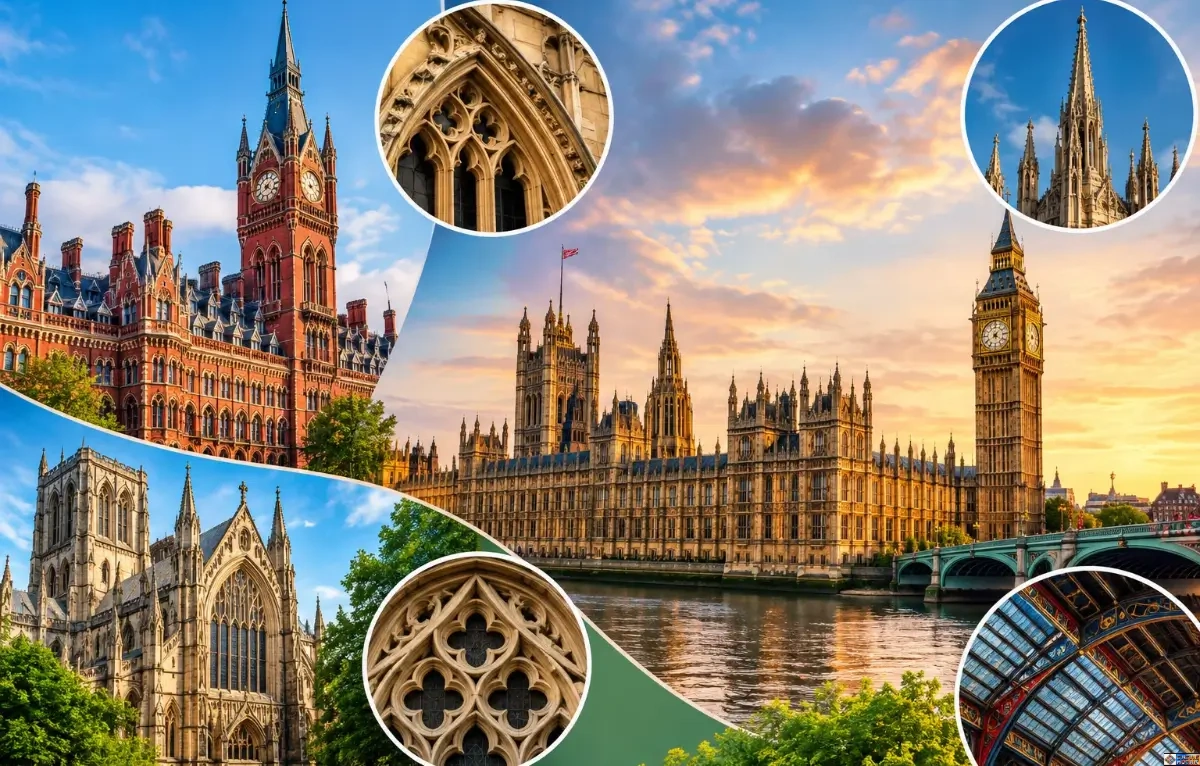
Gothic Revival architecture UK is the movement that dressed Britain in medieval clothes between the 1740s and the early 1900s. Pointed arches. Steep gables. Spires, pinnacles, stone lace. It began as a rich man’s hobby at Strawberry Hill, became a moral crusade under A.W.N. Pugin, and peaked in High Victorian giants like the Palace of Westminster and St Pancras. A quick test for your next walk: if a “medieval” building has razor-sharp machine-cut stone, bands of red and black brick, or an iron roof hiding inside, it’s Victorian. Not 1250.
Why You Can’t Tell Old Gothic From New Gothic (Yet)
You’ve seen the Houses of Parliament on a postcard. Maybe you’ve crossed Westminster Bridge with a coffee going cold in your hand and thought, what a gloriously old building. Here’s the awkward part. It isn’t. Most of what you’re admiring was built after Queen Victoria came to the throne.
That gap between what we think we’re looking at and what’s really there is the whole problem. Britain is crowded with Gothic buildings, and most are not medieval. Guidebooks blur the two. Plaques hedge. You end up nodding politely at a church or a town hall without knowing why it looks the way it does, or who wanted it that way.
I’d like to fix that. This guide walks through the history, the people, the features and the best places to see them. By the end, you’ll read Gothic Revival architecture UK the way a historian does: at a glance, and with a little thrill. For the medieval original, Culture mosaic has a full run of earlier pieces, and I’ll point to the best ones as we go.
9 Astonishing Truths About Gothic Revival Architecture UK
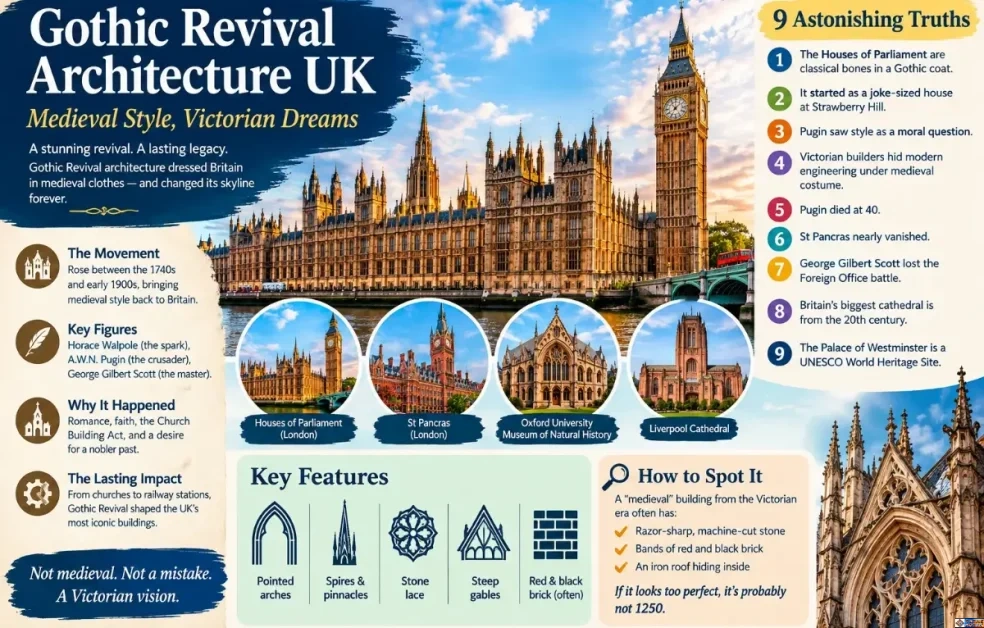
- The Houses of Parliament are classical bones in a Gothic coat. Charles Barry drew the orderly, symmetrical plan; Pugin supplied the medieval detail.
- The whole thing started as a joke-sized house. Horace Walpole’s villa at Twickenham was a plaything, not a manifesto.
- Pugin argued that style was a moral question. Bad buildings, he said, made bad societies.
- Victorian builders hid modern engineering under medieval costume. The Oxford University Museum of Natural History has a Gothic face and a glass-and-cast-iron roof.
- Pugin died at 40. He packed an astonishing amount of work into a very short life.
- St Pancras nearly vanished. It survived a demolition threat in the 1960s and was listed Grade I in 1967.
- George Gilbert Scott lost the great Foreign Office battle. He wanted Gothic; the government insisted on Italianate.
- Britain’s biggest cathedral is a twentieth-century Gothic building. Liverpool Cathedral was begun in 1904 and finished in 1978.
- The Palace of Westminster is a UNESCO World Heritage Site, and its repair bill is one of the most argued-over numbers in British public life.
What Is Gothic Revival Architecture in the UK?
It’s the deliberate return to medieval Gothic design by architects who were living in a very un-medieval world. Railways. Steam. Factory chimneys. The builders weren’t confused about the century. They chose the past.
That choice is what separates it from the real thing. Medieval Gothic grew out of the 12th century and the stonemasons’ craft; its pointed arches and ribbed vaults solved real structural problems. The revival borrowed the look, and sometimes the logic, centuries later. If you want the original in full, What Is Gothic Art and Architecture? covers it, and How Did Gothic Architecture Begin? goes back to the first experiments in France.
For a quick outside overview, the Wikipedia entry on Gothic Revival architecture UK is a handy starting map, though it leans on the medieval English story. Treat it as background, not the destination.
Why Did the Gothic Revival Happen in Britain?
Picture a northern mill town in the 1830s. Coal smoke over everything. Rows of cheap brick houses. Churches that couldn’t hold the crowds, and a sense among many thinking people that something had been lost. That’s the pain at the root of this story, and a lot of Victorians felt it.
Several currents ran together.
Romance came first. Walpole’s novel The Castle of Otranto (1764) and the historical fiction of Walter Scott made the Middle Ages feel glamorous, even safe. Faith came second. The Church Building Act of 1818 released a million pounds for new churches, and many were built in a thin, cheap Gothic. Then the Oxford Movement of the 1830s and the Cambridge Camden Society (founded 1839, later the Ecclesiological Society) pushed for something stricter: churches that looked and worked like medieval ones, with the 14th-century “Decorated” style as their gold standard.
Then came a stroke of dramatic luck. In October 1834 fire gutted the old Palace of Westminster. The competition that followed required a Gothic or Elizabethan design. That single rule put Gothic on the biggest stage in the country.
If you want the faith angle in more depth, I’ve covered it in How Did Gothic Architecture Reinforce Christianity.
Pugin: Architecture as a Moral Argument
Augustus Welby Northmore Pugin converted to Catholicism in 1835 and, I’d say, treated architecture as a form of conscience. His book Contrasts (1836) set a lovely medieval town beside a grim industrial one and let the pictures do the shouting. True Principles of Pointed or Christian Architecture (1841) boiled his creed down to two rules: don’t add a feature without a reason, and let ornament grow out of the construction itself.
Whether you agree with him or not, you can’t ignore the force of it. Pugin made Gothic feel like the only honest option.
Ruskin: The Joy of the Imperfect Hand
John Ruskin came at it from a different angle. In The Seven Lamps of Architecture (1849) and “The Nature of Gothic” in The Stones of Venice (1853), he praised the rough, human, slightly wonky carving of medieval craftsmen and attacked the soulless repetition of factory work. His ideas fed straight into the Arts and Crafts movement, and into buildings like the Oxford museum.
Gothic Revival Architecture UK History: Five Phases
The movement wasn’t one style. It changed its mind every generation.
Strawberry Hill is the story’s opening scene. Walpole bought a modest house at Twickenham in 1747 and spent decades turning it into a Gothic fantasy of battlements and fan-vaulted ceilings (in lath and plaster, not stone). It reopened to visitors in 2010 after a major restoration. Fonthill Abbey, James Wyatt’s towering folly for William Beckford, collapsed in 1825. A warning about ambition and bad foundations.
By the High Victorian years, the mood had hardened. Architects mixed in ideas from France, Italy and Germany. Brick turned stripy. Surfaces glowed with tile and carved stone. I think this is the period that most visitors really mean when they say “Victorian Gothic,” and it’s the richest.
Who Was the Most Important Architect of the Movement?
I’ll take a stand: Pugin. Not because he built the most, but because he changed what everyone else believed. Barry gets his name on the Palace of Westminster; Pugin gave it its soul, down to the wallpaper, the tiles and the inkwells. Rosemary Hill’s biography God’s Architect makes this case at length, and I find it persuasive.
But the movement had a crowded cast.
Butterfield deserves a special mention. To my eye, All Saints on Margaret Street, a church squeezed into a tight London plot and blazing with patterned brick and tile, is one of the most thrilling interiors the movement ever produced. Some critics have called it overbearing. I call it alive.
Gothic Revival Architecture Characteristics and Features
So what should you actually look for? These are the markers I’d teach a beginner first.
Pointed arches and lancet windows. The signature shape. Tall, narrow lancets and larger pointed windows filled with stone tracery.
Steep roofs and gables. Sharp pitches, often with carved bargeboards on houses, and busy skylines of chimneys, turrets and pinnacles.
Spires, pinnacles and crockets. The upward thrust. Decorative stone leaves and finials give the outline that jagged, sprouting look.
Ribbed vaults. Sometimes real stone, often plaster. For the medieval versions and how they differ, see English Gothic vaulting types.
Polychromy. Stripes and patterns of coloured brick and stone. This is a High Victorian giveaway, and it’s very rare in true medieval English work.
Encaustic tiles and stained glass. Patterned floors and jewel-bright windows, both revived and industrialised in the 19th century.
Truth to materials, in theory. Pugin and Ruskin wanted honest construction. In practice, many buildings hide iron, steel or concrete behind the stone.
The medieval toolkit these designers were borrowing from is laid out in Gothic architecture elements and Gothic architecture key features. If you want a feel for the regional flavour they copied, try English Gothic Architecture Characteristics. And for the flying buttress, that most recognisable of Gothic devices, there’s Flying Buttress Definition in Art. Worth noting: the revivalists rarely needed true flying buttresses, because Victorian walls and roofs were built differently. When you spot one on a Victorian church, ask yourself whether it’s doing any work.
Gothic Revival vs Gothic Architecture: What Is the Difference?
The simplest answer: Gothic was a living building tradition. Gothic Revival was a conscious revival of it. The table shows how that plays out.
And a mood difference I can’t resist adding. Medieval Gothic feels like it grew. Revival Gothic feels like it was argued for.
For more on how the medieval form took shape, see What Defines Gothic Architecture?, Gothic vs. Romanesque Architecture and Gothic Architecture and Its Significance.
Gothic Revival Architecture UK Examples: Where to See Them
Here’s the part where you put the guide down and go. These are the buildings I’d rank highest, across England, Scotland and Wales.
Palace of Westminster, London. Barry and Pugin’s masterpiece, begun after the 1834 fire. Look up at the Elizabeth Tower. Its design is credited to Pugin, and a long conservation programme finished in 2022; the team behind it, Purcell, won a 2025 RIBA London Award. The palace’s wider repair is still unresolved: Parliament’s Restoration and Renewal Client Board published costed proposals in February 2026, and the National Audit Office’s June 2026 update stressed that delay carries a price. Check Parliament’s own pages for the latest.
St Pancras, London. Scott’s red-brick Midland Grand Hotel rises in front of William Barlow’s astonishing iron train shed. It was threatened with demolition in the 1960s, listed Grade I in 1967, and reopened as a hotel in 2011. If you only visit one Victorian Gothic building, I’d send you here. It’s free to admire from the concourse.
Strawberry Hill House, Twickenham. The origin story. Fussy, theatrical, gloriously impractical. The restoration brought back colours that startle first-time visitors.
Royal Courts of Justice, London. Street’s Gothic palace for the law, opened by Queen Victoria in 1882, a year after his death.
Manchester Town Hall. Waterhouse’s civic cathedral, completed in the 1870s. Proof that Gothic could do municipal pride.
All Saints, Margaret Street, and Keble College, Oxford. Butterfield’s showpieces. Dark, bright, patterned, intense.
St John’s College Chapel (Cambridge) and Exeter College Chapel (Oxford). Scott’s collegiate Gothic, the latter modelled on the Sainte-Chapelle in Paris.
University of Glasgow main building and St Mary’s Episcopal Cathedral, Edinburgh. Scott in Scotland. The Glasgow building crowns Gilmorehill with a spire you can see from across the city.
Cardiff Castle and Castell Coch, Wales. Burges, working for the Marquess of Bute, turned Roman and medieval ruins into jewel-box fantasies.
Symbolism matters here too. Gothic’s meaning for medieval worshippers is unpacked in English Gothic architecture symbolism, and its play of stone and glass in Gothic cathedral architecture light and shadow. Many revival architects were chasing exactly those effects.
Victorian Gothic Revival House: Features to Spot
Gothic wasn’t only for the grand and the sacred. It spread into schools, vicarages, villas and country houses. Here’s how to recognise a Victorian Gothic Revival home on an ordinary street:
- Steep gables with decorative bargeboards
- Pointed-arch or lancet windows, often with coloured glass in the stair window or front door
- Tall, sculpted chimney stacks
- Bands or patterns of coloured brick
- A pointed porch, and encaustic tiles underfoot in the hall
- An asymmetrical plan, because Gothic cared more about the inside than a neat front
For grander examples, Tyntesfield in Somerset (National Trust) is a huge Victorian Gothic country house, while Burges’s Knightshayes in Devon shows the style in a more eccentric key. And Pugin’s own home, The Grange in Ramsgate, is the pocket manifesto: a modest-sized house built as an argument for how to live. You can stay in it, via the Landmark Trust.
Modern Gothic Revival Architecture UK: Decline and Afterlife
The fall was not sudden. Fashions shifted in the late 19th century, and the First World War drained the money and the mood. Modernists in the 1920s and ’30s treated Victorian Gothic as an embarrassment, and by the 1960s many fine buildings faced the wrecking ball. Euston’s great Doric arch was demolished in 1961–62. That loss helped galvanise campaigners, including the poet John Betjeman, and the Victorian Society (founded in 1958) became a powerful voice for saving what remained. St Pancras’s survival is their most famous victory.
But Gothic Revival never fully died. Giles Gilbert Scott, grandson of George Gilbert, designed Liverpool Cathedral from 1903, and it was completed only in 1978. It’s the clearest example I can name of “modern Gothic revival architecture UK” in the strict sense: a building of the 20th century that still thinks in pointed arches. Guildford Cathedral, begun in 1936, echoes the same idea in simplified form.
Today the revival lives on in a different way. Its biggest buildings are being repaired, studied and reopened. The Palace of Westminster is at the centre of the debate. Whatever happens next, I don’t think Britain will ever stop looking at those spires and feeling something it can’t quite name. Not nostalgia exactly. More like unfinished business.
How to See Gothic Revival Architecture UK for Yourself
You don’t need a grand plan. A few ideas, in order of effort:
- Look up at your own town’s station, town hall or oldest school. Chances are there’s a pointed window. Check whether it’s on the National Heritage List for England, run by Historic England. Cadw does the same job in Wales and Historic Environment Scotland north of the border.
- Go to Heritage Open Days in September. Free access to buildings that are normally closed, including a lot of Victorian churches and civic halls.
- Book Strawberry Hill, Tyntesfield or Cardiff Castle and spend a proper afternoon on one building.
- The weird one: find a Victorian cemetery chapel or lodge. They’re often forgotten, usually locked, and they’re a favourite habitat of the pointed window. You’ll learn the style faster from a small, odd building than from a famous one.
Here’s the call I’d make if I were you: pick one building from this list this month. Seasons change what you see. Scaffolding goes up and comes down. Funding rises and falls. Some of these places won’t look the same in ten years.
Frequently Asked Questions
What is the difference between Gothic and Gothic Revival architecture?
Gothic architecture is the medieval style that flourished from around the 12th century to the 15th, built by master masons with real load-bearing stone and flying buttresses. Gothic Revival architecture is the 18th- to early 20th-century reuse of that style by trained architects. The look is similar, but the revival often hides iron or steel frames, uses brighter colours, and was driven by ideas about faith, nation and morality as much as by structure. For a Victorian building, a good clue is machine-sharp stone, bold brick patterns and an obviously modern interior.
Why did the Gothic Revival happen in Britain?
Several things lined up. Romantic writers made the Middle Ages glamorous. The Church of England needed many new churches, and the Oxford Movement and Cambridge Camden Society demanded that they look authentically medieval. Pugin and Ruskin argued that Gothic was morally and artistically superior to classical or factory-made design. And the 1834 fire at Westminster, followed by a competition that called for a Gothic or Elizabethan design, put the style at the centre of national life.
What are the key features of a Victorian Gothic Revival home?
Look for steep gables with carved bargeboards, pointed-arch or lancet windows, tall chimneys, patterned brickwork and a pointed porch. Inside, expect encaustic tiles in the hall, stained glass on the stairs and dark timber. The plan is usually asymmetrical, with rooms arranged for use rather than for a symmetrical front. Good places to see the style are Tyntesfield, Knightshayes and Pugin’s own house, The Grange.
Who was the most important architect of the movement?
A.W.N. Pugin is the best answer if you mean the movement’s thinker and spiritual leader. His writings and detailed designs shaped everyone who came after, even though Charles Barry was the lead architect at the Palace of Westminster. If you mean sheer output, George Gilbert Scott built or restored hundreds of buildings. Butterfield, Street, Burges and Waterhouse each pushed the style in distinct directions.
Did the Gothic Revival ever really end?
The fashion faded by the early 20th century, as modernism and the First World War shifted tastes. But Giles Gilbert Scott’s Liverpool Cathedral (begun 1904, completed 1978) shows the tradition carrying on well into the modern era, and the movement’s buildings are now some of Britain’s most protected. In that sense, the revival never ended; it moved from the building site to the conservation team.
Sources
- Pugin, A.W.N. Contrasts (1836).
- Pugin, A.W.N. The True Principles of Pointed or Christian Architecture (1841).
- Ruskin, John. The Seven Lamps of Architecture (1849).
- Ruskin, John. The Stones of Venice, vol. 2, “The Nature of Gothic” (1853).
- Walpole, Horace. The Castle of Otranto (1764).
- Clark, Kenneth. The Gothic Revival: An Essay in the History of Taste (1928).
- Brooks, Chris. The Gothic Revival (Phaidon, 1999).
- Hill, Rosemary. God’s Architect: Pugin and the Building of Romantic Britain (Allen Lane, 2007).
- National Audit Office. Restoration and Renewal of the Palace of Westminster: 2026 Update, HC 32 (June 2026): https://www.nao.org.uk/reports/restoration-and-renewal-of-the-palace-of-westminster-2026-update/
- UNESCO World Heritage Centre. Palace of Westminster and Westminster Abbey including Saint Margaret’s Church: https://whc.unesco.org/en/list/426
- Historic England. National Heritage List for England: https://historicengland.org.uk/listing/the-list/
- Strawberry Hill House and Garden: https://www.strawberryhillhouse.org.uk/
- Heritage Open Days: https://www.heritageopendays.org.uk/
 Culture Expert