
 By Culture Expert
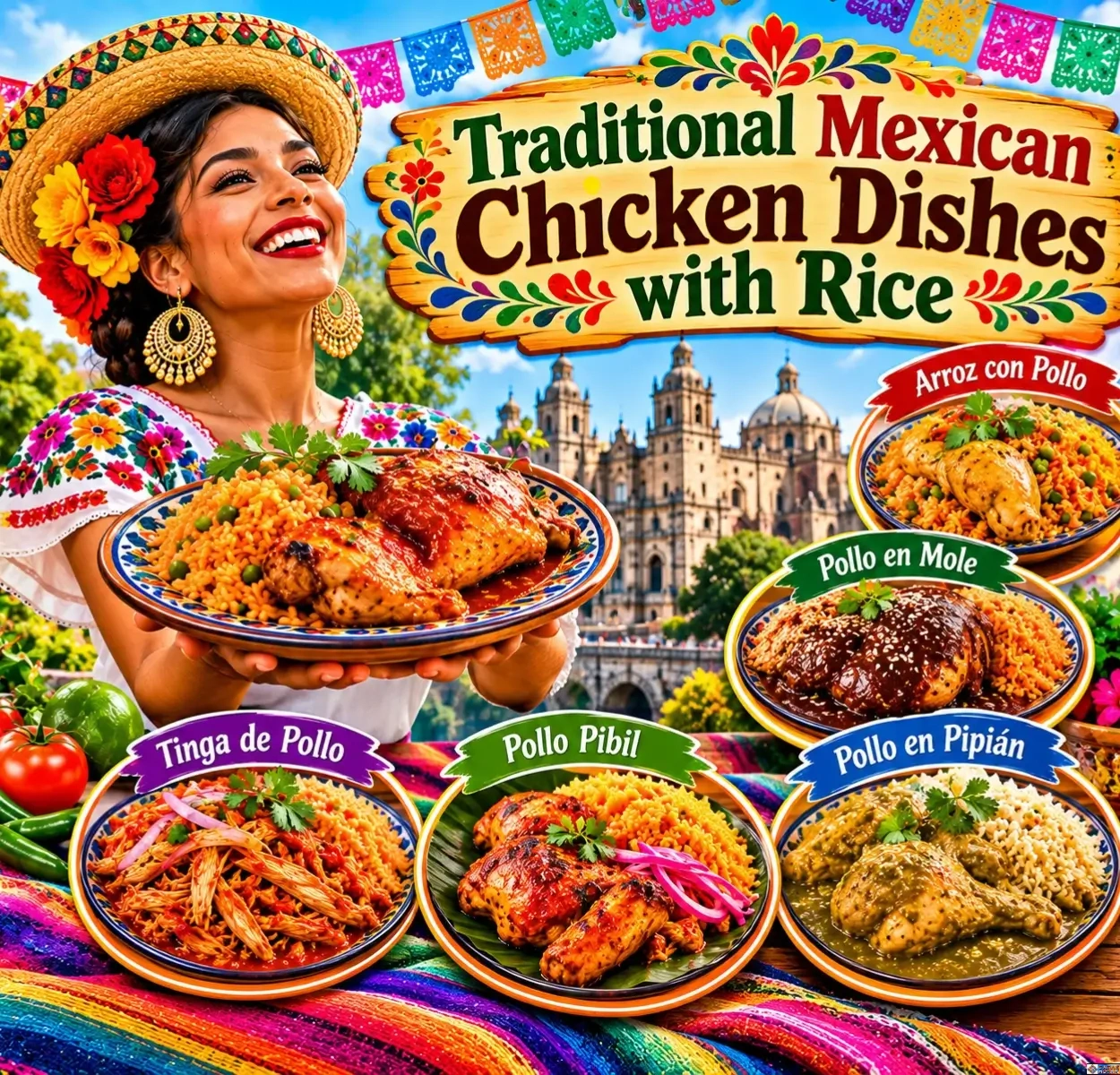
The Mexican dish most people mean by “chicken and rice” is arroz con pollo, but Mexico’s real answer is a broader family of heritage dishes featuring chicken cooked with or served beside classic arroz rojo (red rice).
- ✔ Core Traditional Dishes: Arroz con pollo, pollo en mole with red rice, tinga de pollo, Yucatecan pollo pibil, and pollo en pipián or mole verde with green rice.
- ✔ Culinary Heritage: Rice arrived via the Spanish in the 1500s and was transformed through indigenous chiles, tomatoes, garlic, and grain-toasting techniques.
- ✔ The 3 Pillars of Mexican Rice: Long-grain white rice, ripe tomatoes, and oil—complemented by onion, garlic, and rich stock.
In this guide, discover each dish’s regional origins, key ingredients, rice integration methods, and practical chef tips.
Why Traditional Mexican Chicken Dishes with Rice Feel So Confusing
Type the phrase into a search box and you’ll get one-pot dinners, sheet-pan bakes, burrito bowls and slow-cooker shortcuts. They are fine weeknight food. But if you wanted to know what Mexican cooks actually put on the table, it’s hard to tell where the tradition ends and the trend begins.
That is the pain point: recipes that borrow Mexican flavors without telling you where they came from, so you can’t tell what makes a dish this dish. Is red rice just rice with tomato sauce? Is mole poblano a chocolate dessert on chicken? Is tinga supposed to be soupy?
This guide to traditional Mexican chicken dishes with rice fixes that. Think of it as a walk through five regional kitchens, with enough technique that you can cook each dish at home and understand why it tastes the way it does. If you cook by following the “why,” you won’t need to hunt for a new recipe every time you want Mexican chicken and rice. You’ll know how to build one.
A note on method: I haven’t included invented anecdotes, fake reviews or made-up polls. Where I mention evidence, it is published history, food-writing or heritage documentation, linked in the Sources list at the end. For more on the wider culture, see our guides on what are 20 Mexican foods and the importance of food in Mexican culture.
What is the Mexican dish with chicken and rice called?
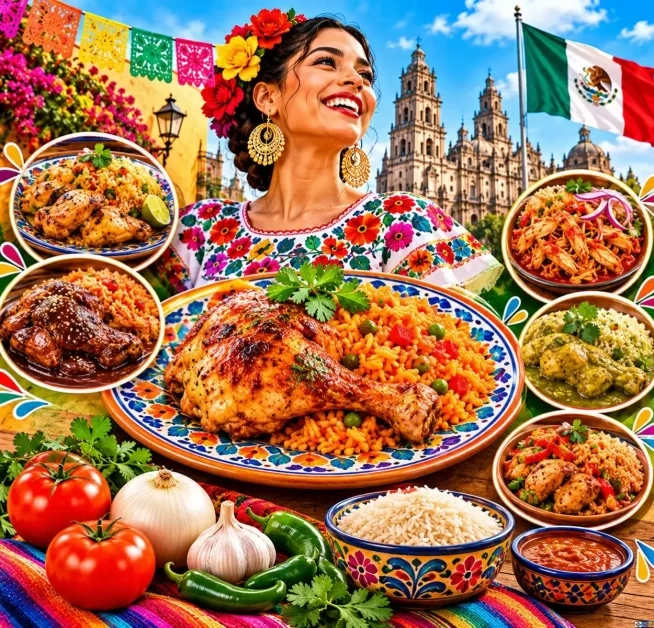
The short answer is arroz con pollo, literally “rice with chicken.” In Mexican kitchens the name covers two slightly different ideas, and knowing the difference helps you read any recipe:
- Arroz con pollo: the rice and chicken cook together in one pot, so the rice drinks up the chicken’s juices and the tomato base.
- Pollo con arroz: the chicken is a dish in its own right (in mole, pipián, tinga or a chile marinade) and rice is served beside or beneath it to catch the sauce.
Both count as traditional Mexican chicken dishes with rice. The second group is where the most distinctive regional dishes live, so this guide covers both. Food writers note that some versions of arroz con pollo in Mexico are little more than arroz a la mexicana with chicken added, while others are bolder, with chorizo or pork in the pot [13].
If you’re searching for the classic one-pot idea, you’ll also find it called Mexican chicken and rice, Mexican chicken and rice bake, or a Mexican chicken and rice bowl. Those are modern packaging for the same logic: seasoned rice plus chicken, with tomato, chile and cilantro doing the flavoring. If you like the wider picture of Hispanic home cooking, see our overview of Hispanic cultural foods.
How Rice Joined Traditional Mexican Chicken Dishes: A Short History
Rice is not native to Mexico. It came with the Spanish in the early 1500s, and the usual account says it entered through the Gulf port of Veracruz, whose warm, wet climate suited it [3, 4]. Another account holds that rice also arrived from Asia on the Manila galleons that crossed the Pacific to Acapulco [13]. Some scholars go further and argue that West African farmers, brought to Mexico’s Gulf coast in the sixteenth century, shaped how rice was grown there; that argument is debated, but it is a reminder that Mexican rice has more than one root [14].
The Spanish had learned to grow rice from the Moors, and the word arroz comes from Arabic [3]. In Mexico the grain met local ingredients. Tomatoes took the place of expensive saffron in everyday rice, and each region cooked rice with what grew nearby [3]. That is why Veracruz has arroz a la tumbada, a soupy seafood rice [3, 4], while Michoacán has morisqueta, plain rice served with other dishes [3].
This matters for the recipes below, because it explains the pattern. Mexican cuisine as recognized by UNESCO in 2010 rests on a deep, community-based food chain of corn, beans, chile and other native foods [1, 7]. Rice is a later arrival that cooks adopted and made unmistakably Mexican. Think of it as a Spanish grain wearing Mexican clothes: toasted, tomato-red, and served next to the old staples.
For more context on how this fits the bigger story of Mexican food, read heritage cooking techniques and the history behind traditional recipes from around the world.
Mexican Rice Basics for Traditional Mexican Chicken Dishes with Rice
What are the 3 ingredients needed to make Mexican rice? Cooks count differently, but the practical answer is: long-grain white rice, ripe tomato, and a flavorful liquid such as chicken stock. A little oil for toasting the rice, plus onion and garlic blended with the tomato, finishes the base. That is the whole logic of arroz rojo.
The method is what makes it Mexican. In most Mexican rice recipes the dry grains are sautéed in oil first, before any liquid goes in [3]. Toasting coats each grain so it stays separate rather than turning gluey. Then the blended tomato mixture and stock go in, the pot is covered, and the rice steams on low heat. If you want the technique of a respected Mexican-cooking teacher, Rick Bayless publishes his own method for red tomato rice [18].
Three rices appear again and again on the plates in this guide:
A useful rule from the table: if the chicken has a rich, complex sauce (mole), plain or lightly seasoned rice lets the sauce talk. If the chicken is simple (roast, grilled), a flavorful rice does more of the work.
If you enjoy the culture of cooking vessels and techniques behind dishes like these, you may like our piece on ancestral cookware history.
1. Arroz con Pollo: the one-pot classic
Origin and region. Arroz con pollo is found across Latin America and is often described as a relative of Spanish paella; Mexico’s version is its own, built with tomato and chile [13]. One food writer sums up the story this way: rice came across the Pacific, chicken came from Europe, and Mexican tomatoes and chiles tied them together [13].
Key ingredients. Bone-in chicken pieces, long-grain rice, tomato, onion, garlic, stock, and often peas, carrots or a poblano or bell pepper. Some cooks add a little chipotle for smoke or chorizo for richness [13].
Technique. Brown the chicken in oil first, then set it aside. Toast the rice in the same pot until golden, which is how Mexican rice is traditionally started [3, 12]. Add the blended tomato mixture and stock, nestle the chicken back in, cover, and cook on low until the liquid is absorbed.
How the rice is integrated. Fully. This is the dish where rice and chicken cook together, so the grains pick up the chicken’s flavor. It is a one-pot Mexican chicken and rice dinner, and the origin of the many “easy Mexican chicken and rice” recipes online.
One authentic tip. Do the browning properly. The browned bits left in the pot and the toasted rice are the flavor foundation; skipping either gives you pale, flat rice.
Thighs or breast? Bone-in thighs and drumsticks are the traditional choice because they stay juicy while the rice steams. If you use breast, add it late so it doesn’t dry out [13]. Whatever you use, cook chicken to an internal temperature of 165°F (74°C), the USDA’s safe minimum for poultry [11].
If the “one-pot” idea appeals to you across cultures, compare it with the slow-cooked traditional Moroccan tagine, another dish where the pot is part of the recipe.
2. Pollo en Mole Poblano: the celebration plate
Origin and region. Puebla. The famous story says Sor Andrea de la Asunción, a Dominican nun at the Convent of Santa Rosa, created mole poblano in the late 1600s to honor a visiting dignitary [9]. Historians treat that tale as legend; what is solid is that Puebla’s convent kitchens shaped much of the cooking Mexico now calls its own, and that mole is far older than any single kitchen, with roots in pre-Hispanic sauces [8, 9]. Mexico has hundreds of regional moles, and mole poblano is the best known [8].
Key ingredients. A long list: dried chiles such as ancho, mulato and pasilla, plus nuts, seeds, spices, dried fruit and a little Mexican chocolate. Mole poblano commonly has 20 or more ingredients [19]. It was originally served over turkey; chicken is common today [8, 9].
Technique. Each ingredient is toasted or fried separately, ground, then simmered together with stock until it forms a thick, dark sauce. It is a patient process, which is why mole is traditionally a feast-day dish [9]. The chicken is simmered on its own first, and the poaching broth goes into the sauce.
How the rice is integrated. Served on the side, or under the chicken, so the plain grains can soak up sauce. Puebla-style plates are commonly shown with rice and tortillas [8]; red rice and white rice are both used.
One authentic tip. Taste for balance, not for chocolate. Chocolate is a supporting note. If it tastes like a dessert, the chiles and spices are underweighted. Also, mole improves after a night in the fridge, so make it a day ahead.
A shortcut, honestly labeled. Authentic mole is a big project. Many Mexican families buy mole paste from a market and thin it with stock, then focus their effort on cooking the chicken and rice well. That is a legitimate tradition, not a cheat.
If you’re curious about how Mexican food connects to ritual and community, read our guide on dining rituals and food rituals in different cultures.
3. Tinga de Pollo: smoky shredded chicken from Puebla
Origin and region. Tinga is eaten across central and southern Mexico and is presumed to be from Puebla. The first known published recipe appears in the 1881 cookbook La cocinera poblana [10].
Key ingredients. Shredded chicken in a sauce of tomato, chipotle chiles in adobo, and sliced onion, with garlic as a common addition [10]. The chipotle (a smoke-dried jalapeño) gives the dish its signature smoky heat.
Technique. Poach the chicken in water with onion and garlic, then shred it and keep the broth. Cook sliced onion until soft, blend tomato with chipotle, add the sauce to the onion, then stir in the chicken with a little broth and simmer until the flavors come together.
How the rice is integrated. Tinga is most often served on a tostada, usually with refried beans, avocado, crumbled cheese and crema [10]. Many families also serve it as a main plate with rice and beans on the side [20]. Rice here acts as a cooling, mild partner to the chipotle’s heat.
One authentic tip. Let it rest. Tinga tastes better after sitting so the shredded chicken absorbs the smoky tomato sauce. Control the heat by how many chipotles and how much of their adobo you use, and scrape out the seeds if you want it milder.
Why this one is perfect for weeknights. It uses pantry ingredients and one pan, and it reheats well. For a hands-on way to explore Puebla-adjacent street food, see how to make Mexican street tacos al pastor.
4. Pollo Pibil: Maya earth-oven chicken from the Yucatán
Origin and region. The Yucatán Peninsula. Pib is the Maya word for an underground oven, and cooking in a pib is described as one of the most important Maya practices still in use [6]. Food writer Karen Hursh Graber notes that pollo pibil is said to have been invented at the Convento de la Asunción in Muná, and that the nearby town of Ticul is known for pollo ticuleño, chicken baked in banana leaves in the pibil tradition [5]. Treat the convent origin as local lore.
Key ingredients. Chicken marinated in recado rojo, a paste of achiote (annatto seed), garlic and spices, loosened with naranja agria (sour orange). Achiote was used by the Maya as both a flavoring and a red colorant [6]. The chicken is wrapped in banana leaves.
Technique. Marinate for several hours, wrap tightly in softened banana leaves, and cook slowly until the meat is tender. Traditionally that is underground; modern kitchens use a covered pot or oven [5, 6]. If you cannot find sour oranges, a mix of orange and lime juice approximates the acidity.
How the rice is integrated. On the side. Plain white rice, warm tortillas and pickled red onions are the classic partners. The rice is a mild bed for the acidic, earthy chicken juices. Related Yucatecan achiote dishes such as cochinita pibil are also eaten with rice [6].
One authentic tip. Don’t skip the sour acidity, and don’t open the wrapped parcel early. The banana leaf traps steam and perfumes the meat. Pickled red onion on top cuts the richness.
5. Pollo en Pipián Verde: green pumpkin-seed sauce
Origin and region. Pipián is a pre-Hispanic sauce built on ground pumpkin seeds (pepitas), eaten in central and southern Mexico and served with poultry and other meats [16, 17]. It is simpler than mole, with the nutty flavor of the seeds in front [16].
Key ingredients. Toasted pumpkin seeds, tomatillos, green chiles and fresh herbs, with chicken poached in broth. Pipián verde always contains pumpkin seeds, which is what separates it from some other green moles [21]. Rick Bayless’s version builds it from the poaching liquid, herbs, tomatillos and pumpkin seeds [15].
Technique. Poach the chicken, toast the seeds gently without scorching, blend everything with the broth, then simmer until the sauce is thick and velvety before returning the chicken [21, 22].
How the rice is integrated. Served beside or under the chicken. White or green rice both work, and Mexican white rice with warm tortillas is a common pairing [22].
One authentic tip. Toast the seeds just until they start to pop and smell nutty; scorched seeds make the sauce bitter. Add the sauce to the pot gradually and keep it at a gentle simmer so it does not split.
Pibil and pipián show how much range traditional Mexican chicken dishes with rice have when the sauce changes. For another culture’s approach to marinade and slow cooking, compare with traditional Moroccan couscous.
Traditional Mexican Chicken Dishes with Rice, Side by Side
Which should you cook first? Start with arroz con pollo to learn the rice, move to tinga for a fast weeknight win, then try pipián. Save mole and pibil for a weekend when you have time to enjoy the process.
Easy versions: one-pot, bake, bowl, thighs and breast
Searches like easy Mexican chicken and rice, Mexican chicken and rice bake, one pot Mexican chicken and rice, Mexican chicken thighs and rice and Mexican chicken breast recipes all point to the same need: a dinner that works on a Tuesday. Here is how the traditional logic maps to each:
- One pot: this is arroz con pollo. Brown, toast, add the tomato base and stock, cover.
- Bake: the same dish finished in a covered oven dish. Use hot stock and a tight lid or foil so the rice steams rather than dries.
- Bowl: pile red rice, shredded tinga or pibil, beans, avocado and pickled onion into a bowl. It’s tinga’s tostada logic in a different container.
- Thighs: the best choice for rice cooked with the chicken. They stay juicy.
- Breast: works if added late or sliced thin; check that it reaches 165°F (74°C) [11].
These are modern adaptations of old ideas, and they’re a good way in. Just remember that the flavor comes from the same few moves: toast the rice, build a tomato or chile base, and let it rest.
What are 5 popular Mexican dishes for dinner? For chicken and rice, the five above. For a wider answer that includes tacos, enchiladas and more, see our list of what are 20 Mexican foods.
How to Serve Traditional Mexican Chicken Dishes with Rice
A Mexican table is built around balance: something rich, something fresh, something to scoop with. Around any of the dishes above, these partners are common:
- Warm corn tortillas, to scoop sauce and rice together.
- Beans, either frijoles de la olla or refried.
- A squeeze of fresh lime and a handful of chopped cilantro.
- Sliced avocado, crumbled fresh cheese or crema for the spicy dishes.
- Pickled red onions with the Yucatecan dishes.
The pairing of rice and corn tortillas can surprise newcomers, but it follows the same idea as the rest of the cuisine: a mild starch to carry strong sauces. Mexican cuisine’s own heritage is communal, a food chain people cook and eat together, which UNESCO cited in 2010 when it recognized it [1, 7]. The meal is meant to be shared. If that idea speaks to you, explore somatic food memory and the commensal architecture of shared vessels.
Your next step
Pick one of these traditional Mexican chicken dishes with rice and cook it this week. If you’ve never made Mexican rice, begin with arroz rojo and plain roast chicken. If you want to impress guests, try tinga, because it can be made a day ahead and gets better. Either way, you’ll be cooking a living tradition, not just following a trend. When you’re ready for more, browse our Mexican chicken, rice and heritage cooking library at Culture Mosaic, or take a detour into Filipino cuisine, which shares its own colonial-era food history with Mexico through the same Pacific trade routes [13].
Culture Mosaic also covers USA famous dishes, Italian culinary traditions and African diaspora food culture if you want to keep following food across borders.
Frequently Asked Questions
Sources
Numbers match the bracketed references in the text. Several are cookbook or food-writing sources rather than academic ones; where history is legend, the text says so. I did not verify every page in full, so check any citation you plan to republish.
- UNESCO, Traditional Mexican cuisine: ancestral, ongoing community culture, the Michoacán paradigm (Intangible Cultural Heritage list, inscribed 2010).
- Domenici, D. (2018), Gastropolitiche messicane: il processo di riconoscimento UNESCO e l’idea di nazione, Storicamente 14. Academic background on the UNESCO recognition.
- MexConnect, article on rice in Mexican cuisine (history, tomato for saffron, regional rice dishes).
- Martínez, Z. (2001), “Rice,” in Zarela’s Veracruz.
- Hursh Graber, K., The cuisine of the Yucatan: a gastronomical tour of the Maya heartland, MexConnect.
- Culture Trip, Yucatecán Cuisine: Unique Mexican Fare With Ancient Maya Roots.
- University of Arizona Cooperative Extension (2016), az1699: mole and traditional Mexican cuisine.
- Mexico News Daily, State by plate: three cheers for Puebla food.
- The Tablet, Holy Mole: sauce a divine mix of Mexican history, legend and flavor.
- Tinga (dish), Wikipedia (cites the 1881 La cocinera poblana).
- CIDRAP News (2006), USDA: 165 degrees is magic number for safe poultry; see also USDA FSIS safe-temperature guidance at foodsafety.gov.
- UTSA Libraries, Arroz con Pollo, Los Barrios Family Cookbook (2002).
- BellaOnline, Mexican Rice with Chicken – Arroz con Pollo.
- Africana Studies blog, West Africa and the Origin of Mexican Rice Cultivation and Rice Gastronomy. A scholarly argument, not settled history.
- WTTW, Rick Bayless’s Pollo in Pipián Verde.
- SBS Food, Pollo en pipián verde.
- Kiwilimón, Pipián, a Pre-Hispanic Dish with a Rich History.
- Rick Bayless, Red Tomato Rice (Arroz Rojo).
- TableJourney, Mole poblano (typical ingredient list).
- Sanborns, Tinga de pollo: historia, origen y datos (serving styles).
- Honest Food, Pipián verde.
- Maricruz Avalos, Pipián verde (green mole).