
 By Dr. Marcus Hale
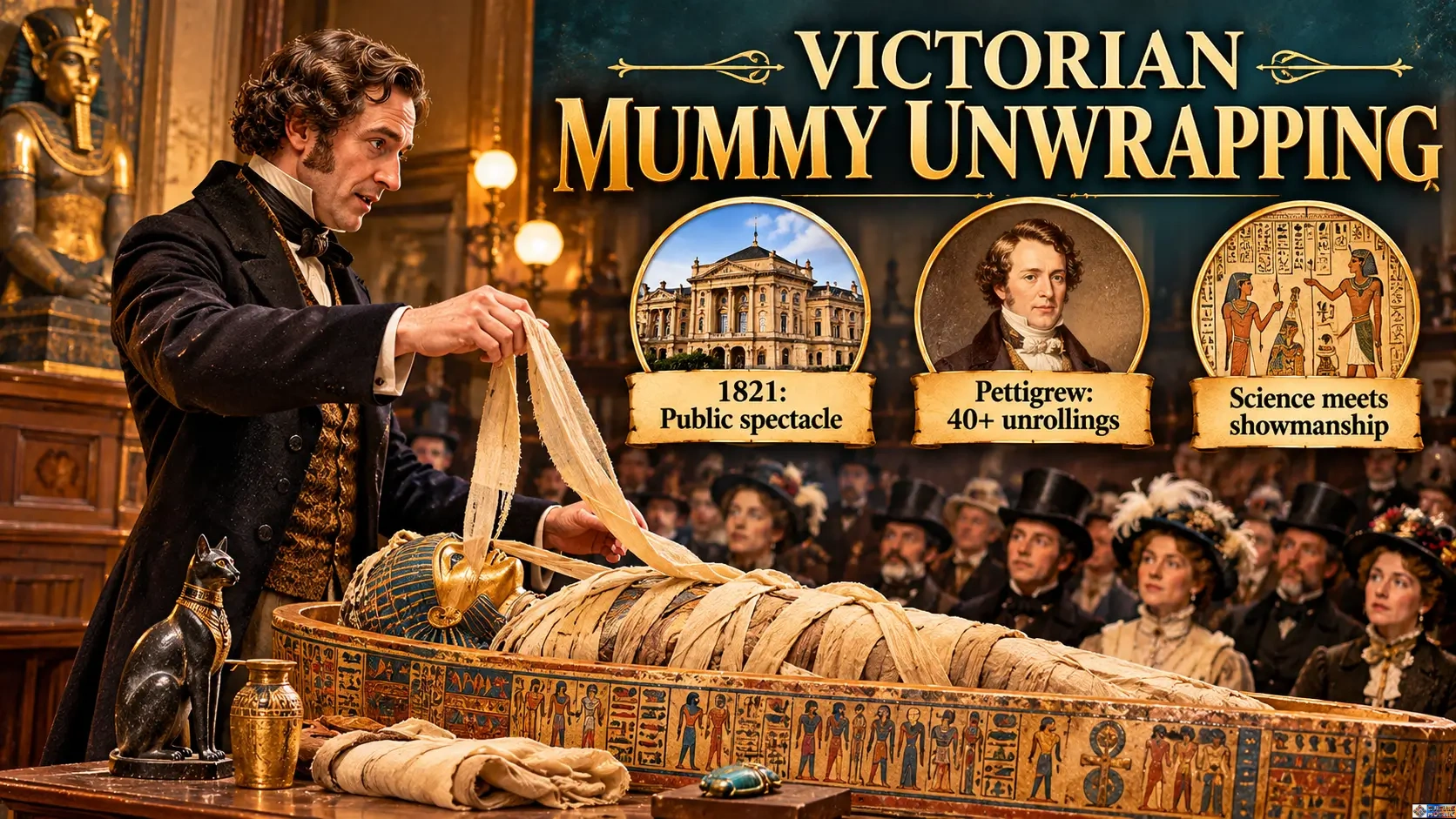
Victorian mummy unwrapping was a ticketed public spectacle in Britain from about 1821, when Giovanni Belzoni staged one at London’s Egyptian Hall. Surgeon Thomas “Mummy” Pettigrew made it fashionable in the 1830s and probably unrolled more than forty mummies in his career. It was science and showmanship in the same breath. It was not, on the evidence I can find, a Christmas ritual, and I know of no reliable account of guests eating a mummy at a party.
The genuinely grisly truths are mummy powder as medicine and mummy brown as paint. Both are documented below, along with a fictional period report of one unrolling and a modern look at what mummification really smelled like. That is the short answer on Victorian mummy unwrapping; the long one is better.
Search for Victorian mummy unwrapping and you land in a swamp. A documentary clip says one thing, a Wikipedia stub another, and a Reddit thread insists the guests ate the dead for dessert. I think that is the real problem: the story of Victorian mummy unwrapping is so strange that everyone repeats the strangest version. You deserve the documented one.
So here is the promise. Seven facts about Victorian mummy unwrapping, each tied to a named person, a dated event or a source you can check. Some will make you wince. One or two will make you look differently at a tube of paint. And the Christmas fact is more complicated than the headline suggests, which is exactly why it comes last.
If you have repeated the “mummy dinner party” line yourself, you are in good company. It turns up in plenty of popular retellings of Victorian mummy unwrapping. The real record is better, and worth getting right before the next retelling.
1. Why Were the Victorians So Obsessed With Mummies?
Because Egypt had become reachable, and because a mummy delivered four thrills in one parcel: antiquity, death, empire and suspense. Travel came first. By 1833 the Trappist abbot and aristocrat Ferdinand de Géramb could write that returning from Egypt without “a mummy in one hand and a crocodile in the other” would hardly be respectable (Atlas Obscura). He was half joking. Only half.
Fiction piled on. Jane Loudon’s novel The Mummy! appeared in 1827, and Edgar Allan Poe’s comic story “Some Words with a Mummy” followed in 1845. Readers arrived at Victorian mummy unwrapping already primed.
There is a darker engine under it, and I would rather name it. Britain in the early 1830s was newly argumentative about who owned a dead body, because the Anatomy Act of 1832 had turned dissection into a national quarrel. My reading is that a mummy slipped neatly through that gap: dead, foreign, ancient and nobody’s neighbour. You could cut one open and the only complaint came, later, from historians.
Victorian mummy unwrapping only makes sense once you see that appetite, and the appetite was bigger than any one lecturer. If you want the basics first, my companion piece What Is Mummy in History? starts from what a mummy actually is.
2. Did the Victorians Have Mummy Unwrapping Parties?
Yes, with one correction that matters. The best-documented Victorian mummy unwrapping events were ticketed lectures in hospitals and learned societies, not cosy parlour games. The party version of Victorian mummy unwrapping exists too, but it rests on thinner evidence.
Victorian mummy unwrapping began as a sales pitch. In 1821 the former circus strongman and excavator Giovanni Belzoni unrolled a mummy at the Egyptian Hall in Piccadilly to publicise his exhibition, which recreated rooms from the tomb of Seti I (his queen has her own story in Seti I Wife). For the first time, opening a mummy was sold as public entertainment instead of private science (Angela Stienne, UCL). That is the true start of Victorian mummy unwrapping as a business.
Then came Thomas Joseph Pettigrew, a London surgeon and antiquarian soon nicknamed “Mummy” Pettigrew. In spring 1833 he staged his first unrolling at Charing Cross Hospital, using a mummy bought at Sotheby’s for £23. Months later he repeated the feat at the Royal Institution, and on 15 January 1834 he did it again at the Royal College of Surgeons. Reviewing the field in the London Review of Books, Thomas Jones notes that Pettigrew probably unwrapped over forty mummies in all.
His format became a template for Victorian mummy unwrapping everywhere. A lecture on Egyptian embalming came first, then the unrolling, with Egyptian objects set about the stage and scraps of linen or small amulets passed along the benches. Later he took the performance into private houses, which is where the “party” reputation comes from (Monocle; Atlas Obscura).
The reviews of Victorian mummy unwrapping were mixed, which I find reassuring. The Lancet was unimpressed by the 1834 evening, yet the event is described as a sell-out, and Pettigrew’s History of Egyptian Mummies (1834) was, according to Yale’s Peabody Museum, the first scientific analysis of Egyptian funerary practice in English.
Nor did every show go to plan. At the Royal Institution the wrappings had turned into a bituminous mass; Pettigrew and his assistant pulled out some two hundred yards of bandage before switching to the head. Elsewhere a skull turned out to be packed with sand, and a supposed princess proved to be a man. The gap between showmanship and fact is where Victorian mummy unwrapping really lives.
To picture what the audience was pulling apart, read Ancient Egyptian mummification process history. It covers what lay beneath those bandages.
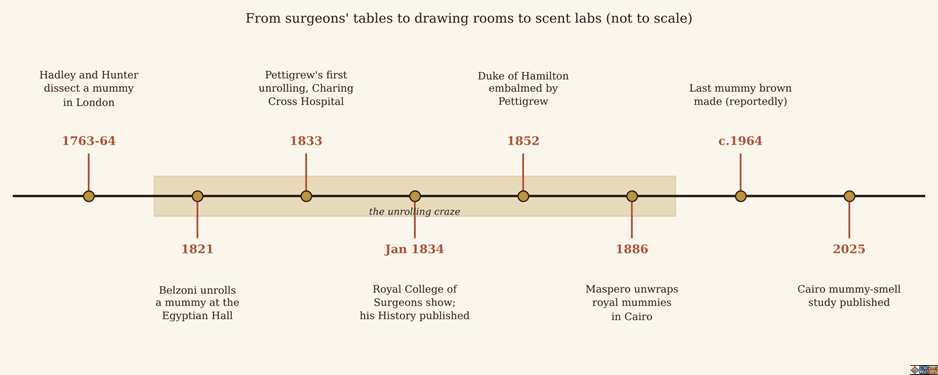
Figure 1. Original timeline: how the unrolling craze fits into a longer history (dates from the sources listed below).
3. Has a Mummy Ever Been Unwrapped? How Victorian Mummy Unwrapping Changed the Science
Many, and not only in Victoria’s reign. In the 1760s the surgeons John Hadley and John Hunter dissected a mummy in front of a small audience of medical men, and Hunter’s work on a mummy foot reached print in the Royal Society’s Philosophical Transactions in 1764 (Stienne). That was science, with no ticket office. Victorian mummy unwrapping was the loud middle chapter of a longer story.
By 1886 an engraving shows Gaston Maspero’s unwrapping of royal mummies in Cairo being prepared as a public event, and from 1900 the anatomist Grafton Elliot Smith worked on Cairo’s mummies as a professor (Stienne). The mood shifted from theatre to anatomy. Even so, the mummy at Pettigrew’s famous 1834 evening is described as a 21st Dynasty mummy, roughly a thousand years before Christ; for how that sits against the typical mummy, see How Old Are Most Egyptian Mummies?.
Tutankhamun’s mummy was unwrapped and examined in 1925, a late echo of Victorian mummy unwrapping. What later CT and DNA work suggested about his death is set out in How Did King Tut Die and Why.
Table 1. Victorian mummy unwrapping compared with modern virtual unwrapping
The successor is virtual unwrapping Egyptian mummies, in which scanners do the peeling. I think it beats Victorian mummy unwrapping on every count except the gasp, and the gasp, I will argue below, was never the honest part.
4. What Did Mummification Smell Like? The Question Victorian Mummy Unwrapping Left Hanging
Better than you would guess. In February 2025 a team from University College London and the University of Ljubljana, working with the Egyptian Museum in Cairo, published the first combined chemical and sniff-panel study of mummy odour in the Journal of the American Chemical Society, almost two centuries after Pettigrew’s first Victorian mummy unwrapping. They tested nine mummies, from the New Kingdom to the Byzantine period. The most common descriptors from the trained sniffers were woody, spicy and sweet; “stale” and “rancid” turned up less often (American Chemical Society).
The sources are the embalmers’ own ingredients: conifer resins, gum resins such as myrrh and frankincense, and waxes. The researchers also separated those from later intruders such as conservation chemicals and pesticides, which matters, because a Victorian museum shelf was not a neutral place.
Whatever a room smelled like at a Victorian mummy unwrapping, the chemistry is now measurable. I would love to give you an audience member’s verdict on the scent. I have not found a reliable one, so I will not invent it. What I can say is that resin is why the linen so often came off in stiff, dark sheets rather than soft rolls. I find the 2025 result oddly moving. The “tomb stink” of popular fiction sits badly against a smell the embalmers designed to be pleasant, since pleasant odours were linked to divinity and purity in Egyptian thought.
For the materials and methods behind that perfume, see Ancient Egyptian Mummies Preservation Techniques and, for the first desert burials that came before embalming, Where Were Ancient Egyptian Mummies First Buried?. The rites around the body are covered in Ancient Egyptian burial customs.
5. Victorian Mummy Medicine: Were Mummies Really Eaten?
Here the answer is a grim yes, but not the one the party stories promise. The medicine trade ran alongside Victorian mummy unwrapping, and the two are often confused. Powdered mummy, called mumia, was a common remedy from roughly the twelfth to the seventeenth centuries, prescribed for everything from wounds to coughs, and apothecaries kept it in labelled jars (Ripley’s; Museum für Hamburgische Geschichte vessel). It lingered into the Victorian era. One account says the powder was mixed with alcohol or chocolate; another claims parents sprinkled it into children’s porridge. Treat the specifics as folklore until you see a prescription.
As for mummy eating parties in the 19th century, I can find no contemporary account of guests eating a mummy for amusement at a Victorian mummy unwrapping or any other dinner. What is documented is medicine, and a trade that was running short: in 1898 a writer named Buchner complained in Scientific American that real mumia was becoming scarce (JSTOR Daily). So, how many mummies were eaten in the Victorian era? Nobody knows. Anyone quoting a number is guessing.
Animals suffered too. A cat cemetery at Beni Hasan, uncovered in 1888, was shipped to Liverpool in 1890 and sold by weight as fertiliser, according to Monocle’s reporting. Why Egyptians mummified cats in the first place is told in Ancient Egyptian animal mummies, and the stranger side of their afterlife imagery in the companion note on green mummies Egyptian afterlife facts.
Table 2. Victorian mummy unwrapping myth check
6. Victorian Mummy Paint: What Did Victorians Do With Mummy Dust?
They painted with it. Victorian mummy paint, sold as mummy brown or Egyptian brown, was a rich, transparent, bituminous pigment made from ground mummy flesh mixed with white pitch and myrrh. Raymond White of the National Gallery’s Scientific Department describes it as parts of an Egyptian mummy ground in a drying oil such as walnut (JSTOR Daily). Delacroix, Burne-Jones and Alma-Tadema are all thought to have used it.
The best story is the Burne-Jones one. Rudyard Kipling, his nephew, recalled that Lawrence Alma-Tadema told the painter what mummy brown really was, having seen a mummy at a colourman’s before it was ground. Burne-Jones fetched his tube and buried it in the garden, children assisting (National Geographic; Winsor & Newton). The details vary between tellings, so I hold the scene loosely, but the horror is on the record.
Victorian mummy unwrapping and mummy paint grew from the same appetite for mummies. The paint trade ended not through conscience but supply. The maker of the pigment reportedly ran out of mummies around 1964 (Smithsonian Magazine; Ripley’s). I think that last fact is the most Victorian thing in this article, and it happened in the Beatles era.
7. Where Christmas Fits in Victorian Mummy Unwrapping (and Where It Doesn’t)
This is the fact I promised would disappoint. The dated Pettigrew unrollings I can document fall in spring 1833 and January 1834. No source I found ties Victorian mummy unwrapping to Christmas Day or Christmas Eve. If an article tells you otherwise without naming an event, be wary.
The link between Christmas and Victorian mummy unwrapping is mood, not calendar. Victorian Christmas was the season of ghost stories: Dickens put spirits at the centre of A Christmas Carol in 1843, and Jerome K. Jerome was still mocking the Christmas Eve ghost-telling habit in Told After Supper (1891). A winter evening, gaslight, a hushed room and a body in bandages belonged to the same appetite for a pleasant shiver. That, to my mind, is the real overlap, and it is a genuine one.
The tomb-curse legend, a later invention that fed on Victorian mummy unwrapping and everything around it, is dissected in Secrets of the Mummy’s Tomb.
A Night at Great Russell Court: A Victorian Mummy Unwrapping Report (Invented)
Everything in this section is invented: the newspaper, the lecturer, the venue and the mummy. The props, the argument and the unease are drawn from the record above. It imagines how a mid-Victorian newspaper would have reported a Victorian mummy unwrapping in 1853.
THE METROPOLITAN CHRONICLE AND LITERARY INTELLIGENCER | Friday, 11 February 1853
THE UNROLLING OF THE LADY TASHEPENMUT
A Public Lecture at the Bloomsbury Philosophical Institution, Great Russell Court
It is not often that the gentlemen of this metropolis are invited to attend the funeral of a lady dead above two thousand eight hundred years; yet such was the singular summons issued, last evening, by the Bloomsbury Philosophical Institution, and so eagerly was it obeyed that the porters were obliged to turn away some hundreds of persons who had come without a ticket. By half past seven every bench in the theatre was filled, and the gallery, we are assured, groaned under a weight of fashion and curiosity such as it has seldom been asked to bear.
The room was lit by gas, which hissed in its brackets and threw upon the company that sallow, trembling light by which all things appear a little dead already. Upon the lecturer’s table, spread with a white cloth, lay the object of the evening: a painted coffin, its lid removed, and within it, swathed to the chin in linen the colour of old tea, the mummy of one Tashepenmut, a chantress in the temple of Amun at Thebes. Behind her hung a canvas of the Nile at sunset, lent by a member; and about the table were disposed a row of jars, a scarab, a surgeon’s case, a rule, and a basin.
Mr. Josiah Aldersey, F.S.A., whose treatise on the funeral rites of the Egyptians is known to every reader of the learned journals, took the platform at eight precisely. He is a spare man, somewhat bent, who speaks with the dry exactness of one accustomed to being corrected, and he began by acquainting us with the history of his subject.
The lady, he told us, was procured in the spring of 1851 by Captain Edmund Hallam, late of the Bombay service, from a dealer at Gurna, on the western bank of Thebes, who professed that she had lain in a shaft tomb with some forty companions, all of them dependants of the priestly houses of Karnak. The Captain paid, it was said, a sum upon which a Gurna family might live a twelvemonth; he has since made over the coffin to the Institution, and the body to the cause of Science.
A reading of the painted inscription followed, in which the lady was styled Chantress of Amun and Mistress of the House, and was promised, by the kindness of Osiris, bread, beer, and a good burial. A murmur of amusement passed along the benches at the word beer, and I observed that Mr. Aldersey, who had evidently foreseen it, allowed the murmur to run its course before he proceeded.
The operation began at a quarter past eight. The linen had been steeped in resin, and as the first strip was lifted there passed through the theatre a breath of heavy, sweetish perfume, like a church long shut up, with something beneath it that was neither sweet nor sacred. It was the smell, said the lecturer, of cedar-gum and bitumen and nearly three thousand years of patience. A lady in the front row put her handkerchief to her face and did not take it away for the remainder of the evening.
Mr. Aldersey and his assistant, a young surgeon named Mr. Pelham, set to work upon the head. The bandages came away in dark strips, a hand’s breadth at a time, each with a small dry crackle, as of leaves under a boot, and fell upon the cloth in a drift of brown flakes, which the company was invited to handle. Specimens were accordingly passed along the benches, and I remarked a gentleman of the clergy turning his fragment over and over between finger and thumb, with an expression I could not read.
Between the layers, as the lecturer had predicted, lay a number of small amulets: a heart-scarab of green stone, a pair of eyes in the Horus form, and a little figure of Isis in blue glaze, which Mr. Aldersey held up to the gas that all might see it. At the sight of the glaze there was a general leaning forward, and I believe that had the lecturer proposed at that moment to distribute the whole collection among the audience, he would have been in some danger.
At length the face was bared. A thin gilding, much worn, lay upon the brow, and beneath it were features of an astonishing composure: the nostrils pinched, the lips drawn a little back from teeth worn level by the sand and grit of bread ground upon stone. A murmur went through the room, and was succeeded by a silence which lasted, I should judge, a full half-minute. It was, I think, the only honest moment of the evening, for no one in that company was thinking of Science.
Mr. Aldersey thereupon resumed his notes. The brain, he reminded us, had been drawn away through the nostrils by an instrument of bronze; the body had been opened by an incision in the left flank; the whole had been laid in salt for some weeks, and anointed, and bound. The lady, from the teeth and the closing of the skull, was a woman of some forty years, and was not, as the playbill had somewhat extravagantly promised, a princess. There was laughter at this, and some applause.
It would be unjust to pretend that all present were at their ease. A correspondent signing himself “Pro Pietate” had written to this journal on Tuesday to ask what we should say if a party of Egyptian gentlemen were to purchase a London pauper from the workhouse, and unwrap her for a shilling a head in Cairo.
Mr. Aldersey answered the objection before it was made. “I do not dissemble,” said he, “that I handle the dead. I assert only that this lady is of no more use to knowledge in her wrappings than she was in her shaft, and that what is learnt here tonight will be learnt by nobody if I do not learn it.” There was applause. There was also, I am bound to report, a dissentient hiss from the gallery, and the Chairman begged for order.
A little before ten the proceedings closed. The lady was laid back in her case, and a sheet drawn over her face, and the company, which had come in so briskly, went out into Great Russell Court by twos and threes, with the curious, hushed look of persons leaving a house in which there has been a death. The street lamps seemed a good deal yellower than usual. We confess to a feeling, as we write, that we have been present at something very learned and something not quite decent, and are unable to say which of the two drew the larger crowd.
† Editorial aside, from a modern desk. Tashepenmut never lived, but thousands of women like her did, and each was moved from a Theban shaft to a London table without a word of consent from her or her descendants. What the Victorian audience called curiosity, we would call extraction. Today’s museums treat mummies as people first and specimens second, and scanning has made the knife unnecessary. I do not think the Victorians were villains. I think they were thrilled, and that thrill, in Victorian mummy unwrapping as anywhere, is exactly the thing to distrust.
Where to Meet a Mummy Today (Three Sensible Ideas and One Odd One)
You cannot attend a Victorian mummy unwrapping now, and you would not want to. You can still meet the material properly. Three ordinary routes first. The British Museum’s Egyptian galleries in London hold the headline mummies. Manchester Museum has a major Egyptology collection and has been part of CT-scanning work on animal mummies. And the Egypt Centre at Swansea University, a teaching museum, has also taken part in scan studies of animal mummies. Check opening times before you travel, because galleries close for redisplay.
The odd route: look up Harvard Art Museums’ Straus Center pigment collection online, where a sample of mummy pigment made by Charles Roberson and Co. is recorded. It is a small brown smear in a catalogue, and it is the single most unsettling object in this whole story. Then go back to a Pre-Raphaelite painting and look at the browns.
One more thought, and then I will stop. Victorian mummy unwrapping was a wish to see inside a stranger. The Victorians wanted to see inside a stranger. We can finally do it without hurting her. Whether we should is the question that has outlived the gaslight.
Frequently Asked Questions About Victorian Mummy Unwrapping
Did the Victorians have mummy unwrapping parties?
Yes. Victorian mummy unwrapping in public began with Giovanni Belzoni at London’s Egyptian Hall in 1821 and became a craze through the surgeon Thomas Pettigrew, who staged them in hospitals, learned societies and later private houses from 1833. The best-documented events were ticketed lectures with a scientific frame. Drawing-room versions are real but less well recorded, so be careful with sources that describe them in great detail.
Has a mummy ever been unwrapped?
Many have, long before and after Victorian mummy unwrapping. Surgeons dissected a mummy in London in the 1760s, Pettigrew probably unwrapped more than forty in his career, and Gaston Maspero unwrapped royal mummies in Cairo in the 1880s. Tutankhamun’s mummy was examined in 1925. Today scientists prefer CT scanning, which gives a virtual unwrapping while leaving the bandages and the person untouched.
What did the Victorians do with mummy dust?
Two main things, neither of them a party trick. For centuries powdered mummy, or mumia, was sold as medicine and kept by apothecaries, and it lingered into the Victorian age. Artists also bought it as mummy brown, a pigment made from ground mummy mixed with resin or pitch. Burne-Jones is said to have buried his tube once he learned its origin, and production reportedly ended around 1964.
How many mummies were eaten in the Victorian era?
There is no reliable figure. Mummy powder was a documented medicine, and writers around 1898 were already complaining that supplies were running short, but no source I have found counts the mummies consumed. The popular picture of Victorian mummy unwrapping as a dinner where guests ate the mummy is not backed by a contemporary account I can find, so treat any specific number as a guess.
What did mummification smell like?
Unlike Victorian mummy unwrapping, which left the smell unrecorded, a 2025 study of nine mummies in the Egyptian Museum in Cairo, published in the Journal of the American Chemical Society, found they smelled mostly woody, spicy and sweet, with some “stale” or “rancid” notes. The scents come largely from conifer resins, myrrh, frankincense and waxes used by embalmers. The researchers also separated later contaminants such as pesticides from the ancient odours.
Sources and Further Reading
- Ripley’s Believe It or Not!, “Mummy Unwrapping Parties of the Victorian Era” (popular source supplied for the focus keyword) https://www.ripleys.com/stories/mummy-unwrapping-parties-of-the-victorian-era
- Atlas Obscura, “Victorian Party People Unrolled Mummies For Fun” https://assets.atlasobscura.com/articles/victorian-party-people-unrolled-mummies-for-fun
- Thomas Jones, “Necrophiliac Striptease”, London Review of Books, vol. 36, no. 3 (academic review essay) https://lrb.co.uk/v36/n03/thomas-jones/necrophiliac-striptease
- Yale Peabody Museum, Echoes of Egypt, “Mummy-Mania” (museum source on Pettigrew’s History of Egyptian Mummies) https://echoesofegypt.peabody.yale.edu/node/246
- Angela Stienne (UCL), article on mummy unrolling, via the CORE repository (Belzoni 1821; Hadley and Hunter; Maspero; Elliot Smith) https://core.ac.uk/download/267013931.pdf
- T. J. Pettigrew, A History of Egyptian Mummies and an Account of the Worship and Embalming of the Sacred Animals by the Egyptians (London, 1834) (primary source)
- Strlic, M. et al., Journal of the American Chemical Society, 13 February 2025 (mummy odour study), DOI 10.1021/jacs.4c15769 https://doi.org/10.1021/jacs.4c15769
- American Chemical Society news release, “Scientifically sniffing ancient Egyptian mummified bodies” https://www.eurekalert.org/news-releases/1074442
- JSTOR Daily, “When Artists Painted With Real Mummies” (cites National Gallery scientist Raymond White) https://daily.jstor.org/when-artists-painted-with-real-mummies
- National Geographic, on mummy brown, Delacroix and the Kipling anecdote https://www.nationalgeographic.com/history/article/mummy-art-painting-delacroix-pigment-ancient-Egypt
- Winsor & Newton, “Mummy Brown” (paint-maker’s history) https://uk.winsornewton.com/blogs/articles/mummy-brown
- Smithsonian Magazine, “Ground Up Mummies Were Once an Ingredient in Paint” https://www.smithsonianmag.com/smart-news/ground-mummieswere-once-ingredient-paint-180950350/
- Monocle, “The legacy of mummy mania in Europe” (journalistic source; Duke of Hamilton, mumia, cat fertiliser) https://monocle.com/culture/society-how-we-live/legacy-of-mummy-mania-in-europe/
- Harvard Art Museums, Straus Center pigment collection (mummy pigment, Charles Roberson and Co.), search the online collection https://harvardartmuseums.org/
 Culture Expert