
 By Culture Expert
Quick Summary Traditional wedding dress symbolism is a visual language. Colour signals luck, purity or status. Embroidery records family, place and hope for children. Fabric shows wealth and who made it. White is the odd one out: it became the Western default only after Queen Victoria’s 1840 wedding. Red, gold and deep blue carry older and wider meanings across Asia, Africa and the Middle East.
Why does a wedding dress mean so much?
You open a search bar, type “what does my wedding dress mean”, and get a wall of lookalike lists. White equals purity. Done. It’s a thin answer for a garment people cry over, inherit, argue about and sometimes keep for sixty years.
I understand the frustration. Most of us sense that a wedding dress carries more weight than fabric should. We just lack the vocabulary to read it.
So here is the fix. This guide decodes traditional wedding dress symbolism through colour, thread, fabric and accessories, across a handful of cultures, and then brings it back to practical choices you might make today. If you want the wider context first, our companion piece on Traditional Wedding Dress Cultural Meaning is a good warm-up, and the home page of Culture Mosaic shows where it sits among our heritage coverage.
What is the symbolism of a wedding dress?
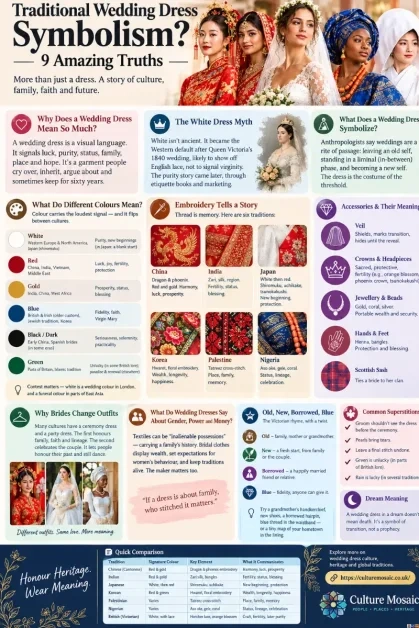
Anthropologists have a tidy answer. Arnold van Gennep, writing in 1909, described weddings as a rite of passage with three stages: separation from an old status, a threshold in between, and incorporation into a new one. Victor Turner later called that middle stage “liminal”. The dress is the costume of the threshold. You put it on as one social person and take it off as another.
That’s why the same garment can say very different things. In one culture it announces a bride’s family wealth. In another it promises fertility, or marks her village, or shows she is ready to join her husband’s household. A traditional wedding dress symbolism guide that stops at “white means pure” has skipped the most interesting 95 per cent.
I think the best way to read any bridal garment is to ask three questions. What is it saying to the guests? What is it saying about the families? And what is it asking the bride to become?
Why are wedding dresses white? The Queen Victoria story
White feels ancient. It isn’t.
For most of European history a bride wore her best dress, whatever the colour. Blue, red, grey and green were all common, and a dress that could be worn again was simply sensible. Rich brides sometimes wore white or silver earlier, and Mary, Queen of Scots is often cited as one, but it was a royal flourish, not a rule.
Then came 10 February 1840. Victoria married Prince Albert in a white satin gown trimmed with Honiton lace from Devon and an orange-blossom wreath. The Royal Collection Trust records the dress and its lace. Historians generally argue that she chose white to show off English lace, a struggling craft, rather than to advertise virginity. The purity reading came afterwards, pushed along by etiquette books and women’s magazines. Vicki Howard’s study of the American bridal industry traces how white became a commercial and moral standard through the nineteenth and twentieth centuries.
My view? The purity story is half true and mostly marketing. White stuck because it was expensive to keep clean, which made it a statement of money first and morals second. If you want the full tour, I’ve laid it out in Why Wedding Dresses Are White.
What do different wedding dress colours symbolize?
Colour carries the loudest signal, and it flips between cultures. This table is my own synthesis from the sources listed at the end. Treat the meanings as widely reported traditions, not universal laws.
| Colour | Where it appears | What it usually signals |
|---|---|---|
| White | Western Europe and North America (from the 1800s), Japan (shiromuku) | Purity or new beginnings; in Japan also a blank start in a new household |
| Red | China, India, Vietnam, parts of the Middle East | Luck, joy, fertility, protection |
| Gold | India, China, West Africa | Prosperity, status, blessing |
| Blue | Older British and Irish custom, Jewish tradition, Korea | Fidelity, faith, sometimes the Virgin Mary |
| Black or dark | Early Chinese ritual dress, Spanish brides in some eras | Seriousness, solemnity, practicality |
| Green | Parts of Britain (as an unlucky colour), Islamic tradition | Unlucky in some British lore; paradise and renewal elsewhere |
Notice the oddity. White is the colour of weddings in London and the colour of funerals in parts of East Asia. Context is the whole game. For the broader pattern, see cultural wedding dress motifs and our guide to Global bridal wear traditions.
How do different cultures use embroidery to tell a story?
Thread is memory. Here are six traditions where stitching does the talking.
China: dragon, phoenix and red. Ritual texts describe dark wedding garments in early dynasties, but red took over and stayed. Cantonese brides traditionally wear the qungua, a red set embroidered in gold with dragons and phoenixes. The phoenix stands for the bride, the dragon for the groom, and together they promise harmony. It’s hard, heavy, glittering work.
India: zari, silk and region. A red Banarasi or Kanjivaram sari carries gold zari, metallic thread that is partly decoration and partly bank account. Gujarat’s red bandhani gharchola, traditionally given by the groom’s family, shows how clothing seals an alliance. In Bengal, a red-bordered sari sits beside white shell and red coral bangles. Red points to Shakti, the female creative power, and to fertility.
Japan: the white kimono and its horn-hider. The shiromuku is white from head to toe. A popular explanation says white can be dyed in the colours of the groom’s family, and while that reading is widely repeated, treat it as folk interpretation. Many brides later change into a red or gold uchikake, because red wards off bad luck. The tsunokakushi headpiece is said to hide a bride’s “horns” of jealousy, which tells you a lot about expected behaviour.
Korea: hwarot and the painted dots. By custom, Joseon-era commoner brides were allowed to borrow the hwarot, a ceremonial robe otherwise tied to royal women, embroidered with peonies, lotuses and cranes. Wealth, longevity and marital happiness are all stitched into one sleeve.
Palestine: tatreez as a map. A thobe’s cross-stitch pattern often identifies a village or region, and brides traditionally gathered an embroidered trousseau with their female relatives. Common motifs include cypress trees, palms and stars. UNESCO added Palestinian embroidery practices to its intangible heritage list in 2021, which says plenty about how much cultural weight sits in a thread.
Nigeria: aso oke, gele and coral. Yoruba brides wear hand-woven aso oke, strip cloth woven on narrow looms and sewn into wide panels, with a sculpted gele headtie. Igbo brides often wear coral beads that signal family status. The sound, the sheen and the volume are all part of the message.
For deeper stitching lore, our piece on Ancient Ethnic Heritage Symbols is a natural next stop, and Traditional Clothing Styles maps the garments around them.
What accessories do brides wear, and what do they mean?
Accessories finish the sentence the dress starts.
The veil. Roman brides wore the flammeum, a flame-coloured veil. In Jewish tradition the groom lifts the bride’s face covering in the badeken, echoing the story of Jacob and Leah in Genesis 29. Veils shield, mark transition, and hide the bride until the moment of reveal.
Crowns and headpieces. The Chinese phoenix crown, the Japanese tsunokakushi and the Victorian orange blossom wreath all frame the head as sacred. Orange blossom, associated with fertility and purity, was a Victorian favourite.
Jewellery and beads. Gold in South Asia, coral in West Africa and silver in many mountain communities all work as portable wealth. A bride carries her security on her body.
Hands and feet. Henna in North Africa, the Middle East and South Asia, and bangles in India, carry protection and blessing. The details travel from fingertip to ankle.
Scottish brides sometimes wear a sash in a family tartan, a thread that ties a bride into a clan story. If heritage textiles hold your attention, What is Heritage Fashion and Geographic Fingerprinting of Heritage Fibers show how fibres themselves carry place.
Wedding dress for the ceremony: why brides change outfits
Many cultures treat the ceremony dress and the party dress as separate jobs. The ceremony garment speaks to family, faith and lineage. The reception outfit speaks to the couple. A Cantonese bride may wear the qungua for the tea ceremony and a white gown for the banquet. A Japanese bride may move from shiromuku to uchikake to a Western dress.
I like this. It lets people honour ancestors and still dance. And it quietly undercuts the idea that one “right” bridal outfit exists, an idea that Western bridal shops tend to promote. For anyone planning a blended event, multicultural wedding attire is the practical companion to this section.
What do wedding dresses say about gender, power and money?
This is the uncomfortable layer, and I think a guide that skips it is dodging.
Annette Weiner’s work on cloth in the Pacific argued that textiles can be “inalienable possessions”, objects whose value comes from carrying a family’s history rather than a price tag. A bridal textile fits that description neatly. It moves from one household to another, and it carries obligations with it.
Other scholars note that bridal clothes also display family wealth and set expectations for female behaviour. Otnes and Pleck, in their study of lavish American weddings, argue that the spectacle sells a fantasy of romance while quietly reinforcing ideas about femininity. Simon Charsley’s research on British weddings shows how the wedding industry shaped, and sometimes invented, what looked like “tradition”.
Meanwhile, textile makers rarely get credit. Work on Somatic Textiles and Regenerative Textile Traditions points to how cloth holds the body knowledge of the people who made it. I think that deserves more attention in bridal conversations. If a dress is about family, who stitched it matters.
Culture and Fashion pulls these threads together in broader terms.
Old, new, borrowed, blue: who gives the bride what?
The rhyme is Victorian English, usually traced to the later nineteenth century, and often ends “and a sixpence in her shoe”. Traditions vary, but the commonly repeated version goes like this.
- Something old links the bride to her family. It often comes from a mother or grandmother.
- Something new looks forward. Families or the couple often supply it.
- Something borrowed is traditionally lent by a happily married friend or relative, to pass on her luck.
- Something blue stands for fidelity. Anyone can give it.
Ideas worth stealing: a grandmother’s handkerchief stitched into the hem, new shoes in a colour you’ll wear again, a borrowed hairpin from an aunt, and blue thread sewn inside the waistband.
And the wildcard? Slip a tiny map of the street where you both grew up into the lining. Nobody will see it. You’ll know.
What are some superstitions associated with wedding gowns?
British and American folklore is generous with these. A few of the most common:
- The groom shouldn’t see the dress before the ceremony. A popular explanation says this started in arranged marriages, to stop a nervous groom changing his mind, though the origin is debated.
- Pearls are said to bring tears.
- Some brides leave a final stitch undone until the last moment.
- Green is considered unlucky in parts of British lore.
- Rain on the day is lucky in several traditions.
Folklore is not law. I’d treat these as small rituals that add texture, not rules to obey.
Wedding dress dream meaning: does it mean death? Some dream dictionaries claim a dream of wearing a wedding dress can foretell death or change. There’s no scientific evidence behind that. The reading comes from the dress marking the end of one life stage, and from white’s link with mourning in some cultures. Think of it as a symbol of transition, not a prophecy.
Modern traditional wedding dress symbolism: honouring heritage today
Today, modern traditional wedding dress symbolism often means mixing. A British bride might wear a white gown with a family tartan sash. A couple with Nigerian and Scottish roots might wear aso oke for the ceremony and a tailored gown for the party. For inspiration, browse Modern Cultural Wedding Dresses and Latest Trends in Bridal Wear.
My firm view: borrowing another culture’s ceremonial garment as a fashion look, without an invitation or context, is a mistake. If a tradition isn’t yours, ask a family member or a maker from that community, pay them properly, and credit them. If it is yours, wear it loudly.
Practical routes depend on budget and size:
- Cost: How Much Are Wedding Dresses UK? sets realistic UK price ranges, and Affordable Wedding Dresses Europe covers cheaper options across the continent.
- Renting: Where Can I Rent Wedding Dresses explains hire as a lower-waste option.
- Fit: Plus Size Wedding Dresses offers fit-first advice.
- Style: What Wedding Dresses Are in Style, Best Sexy Wedding Dresses and Fashion 2026 show what’s current, while Colour of the Season 2026 helps match a palette.
Trends date fast, which is a nice warning. 2016 Fashion Trends High School, Y2K Fashion and Poetcore Heritage Fashion each show how quickly a look can age or return. Symbolism lasts longer than silhouettes. That’s the point of choosing meaning first.
Here is a quick comparison to take away.
| Tradition | Signature colour | Key element | What it communicates |
|---|---|---|---|
| Chinese (Cantonese) | Red and gold | Dragon and phoenix embroidery | Harmony, luck, prosperity |
| Indian | Red and gold | Zari silk, bangles | Fertility, status, blessing |
| Japanese | White, then red | Shiromuku, uchikake, tsunokakushi | New beginning, protection |
| Korean | Red and green | Hwarot, floral embroidery | Wealth, longevity, happiness |
| Palestinian | Varies by region | Tatreez cross-stitch | Place, family, memory |
| Nigerian | Varies | Aso oke, gele, coral | Status, lineage, celebration |
| British (Victorian) | White, with lace | Honiton lace, orange blossom | Craft, fertility, later purity |
The loveliest thing about a wedding dress is that it never says just one thing. Pick the layer you want it to speak.
Frequently Asked Questions
1. What is the symbolism of a wedding dress?
A wedding dress marks a change of social status. It uses colour, fabric and decoration to signal luck, purity, wealth or family ties, depending on the culture. In anthropology it’s read as the costume of a rite of passage, worn while a person moves from one social role to another.
2. What do different wedding dress colours symbolize?
White suggests purity or new beginnings in Western and Japanese traditions. Red signals luck, joy and fertility across China, India and much of Asia. Gold means prosperity, blue often means fidelity, and green is unlucky in some British lore. Meanings shift with place and period, so check the specific tradition.
3. What are some superstitions associated with wedding gowns?
Common ones include the groom not seeing the dress before the ceremony, pearls bringing tears, leaving a stitch undone until the last minute, and green being unlucky. Many originate in Victorian British and American folklore. They are customs, not rules, and most families treat them lightly.
4. What is the cultural and historical significance of traditional dresses?
Traditional dresses record identity. Embroidery can name a village, colour can show a family’s beliefs, and fabric can reveal wealth or craft skills. They also pass between generations, which is why textiles such as aso oke, tatreez and Honiton lace are protected or celebrated as heritage.
5. Who gives the bride something old, something new, something borrowed, something blue?
There’s no fixed rule. The tradition usually says the old item comes from family, the new from the couple or relatives, the borrowed item from a happily married friend or relative, and the blue item from anyone. Most modern brides simply collect each from people they love.
Sources and further reading
- Royal Collection Trust. Records on Queen Victoria’s 1840 wedding dress and Honiton lace. https://www.rct.uk
- Victoria and Albert Museum. Wedding dress and textile collections. https://www.vam.ac.uk
- The Metropolitan Museum of Art, Costume Institute. Bridal and ceremonial dress collections. https://www.metmuseum.org
- UNESCO Intangible Cultural Heritage. Entry on Palestinian embroidery practices (inscribed 2021). https://ich.unesco.org
- Van Gennep, Arnold. The Rites of Passage (1909; English translation, University of Chicago Press, 1960).
- Turner, Victor. The Ritual Process: Structure and Anti-Structure (Aldine, 1969).
- Weiner, Annette B. Inalienable Possessions: The Paradox of Keeping-While-Giving (University of California Press, 1992).
- Howard, Vicki. Brides, Inc.: American Weddings and the Business of Tradition (University of Pennsylvania Press, 2006).
- Otnes, Cele C., and Elizabeth H. Pleck. Cinderella Dreams: The Allure of the Lavish Wedding (University of California Press, 2003).
- Charsley, Simon. Rites of Marrying: The Wedding Industry in Britain (Manchester University Press, 1991).
- Genesis 29 (Jacob, Leah and the veiling of the bride).