
 By Culture Expert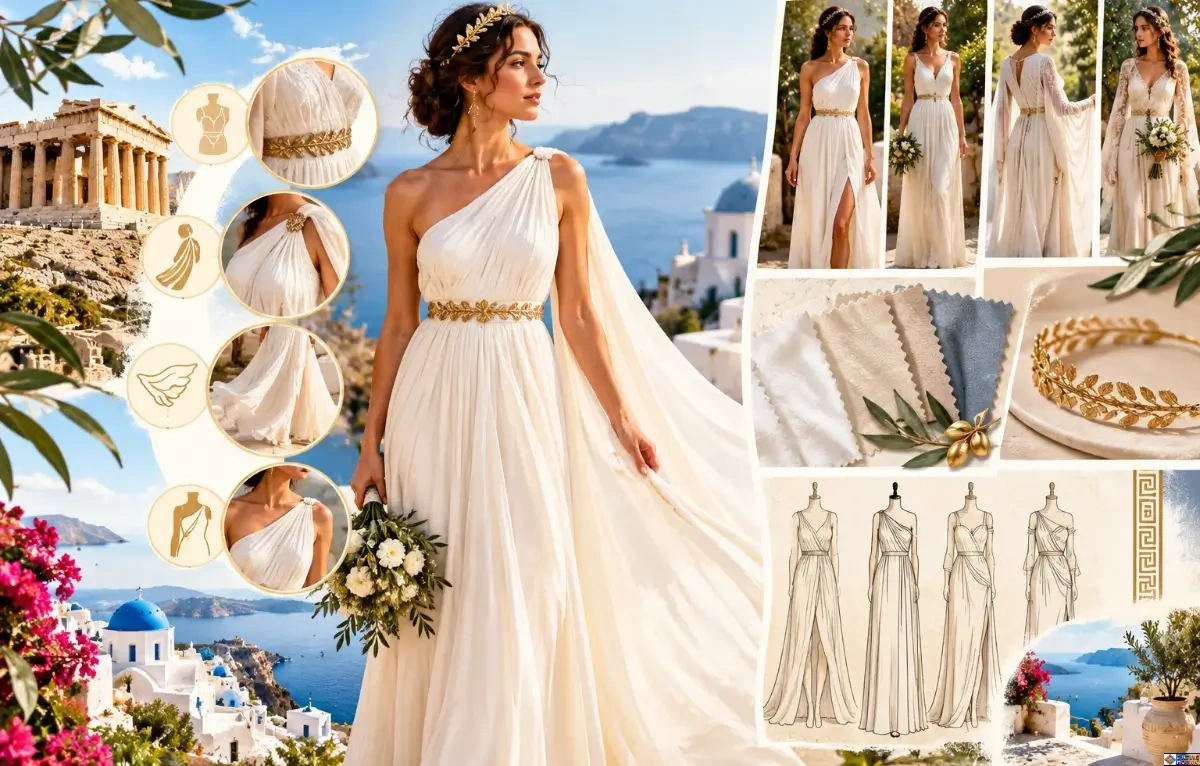
The Problem With Searching “Greek Goddess”
You type it in. Two hundred near-identical white dresses come back.
Some are gauzy tubes with a gold belt. Some are heavy satin ballgowns with one pleat. Some are neither and have a little Greek key border stitched on as an afterthought. It’s exhausting, and it makes a lovely idea feel like a gimmick.
I understand the frustration. The label is stretched over too many dresses. So let’s pin it down.
What Defines a Modern Greek Style Wedding Dress?
Look for these four things:
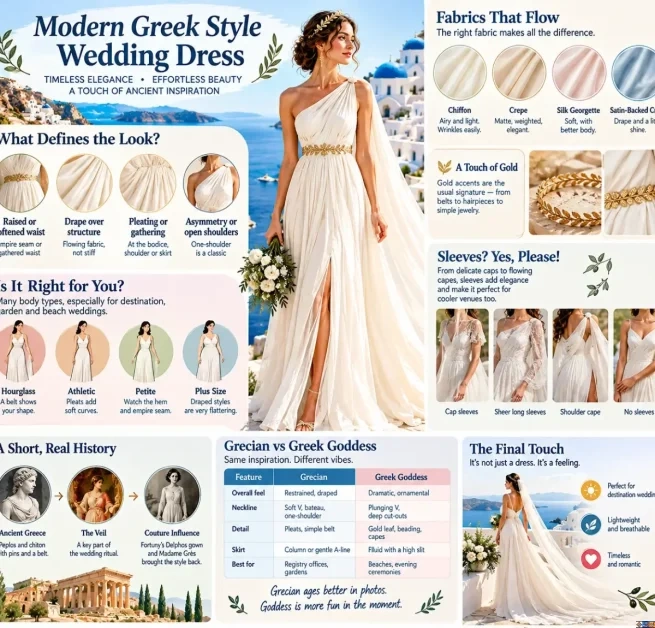
- A raised or softened waist. Usually an empire seam just under the bust, or a gathered, belted waist.
- Drape over structure. Fabric falls rather than stands.
- Pleating or gathering. Often at the bodice, the shoulder, or the whole skirt.
- Asymmetry or open shoulders. The one-shoulder neckline is the shorthand for the whole look.
Everything else (the gold, the cape, the crown) is dressing on top of that foundation.
A Short, Real History
The idea traces to ancient clothing, though not as literally as shops suggest. Greek women wore the peplos, a rectangle of heavier wool pinned at the shoulders and belted. They also wore the chiton, a lighter, often linen garment pinned along the arms. Both relied on pins and a belt, and on how the cloth hung.
For weddings specifically, the surviving evidence is mostly vase painting and texts. Scholars have written on both, including Oakley and Sinos on the Athenian wedding and Llewellyn-Jones on the veiled bride. The veil mattered. Ceremonial unveiling was part of the ritual.
The modern silhouette came later, and from couture. Mariano Fortuny’s pleated silk Delphos gown (introduced in the early 1900s) borrowed from classical sculpture. Madame Grès then spent decades draping jersey and silk into pleated gowns that looked carved. When you try on a Grecian gown today, you’re wearing their idea of Greece, filtered through the twentieth century.
I find that more interesting than the myth. It’s a living design lineage, not a costume. If you like this kind of thread, Culture Mosaic has more on traditional clothing styles and culture and fashion.
Grecian vs Greek Goddess: The Actual Difference
There’s no official rulebook. In how shops use the words:
| Feature | “Grecian” | “Greek Goddess” |
|---|---|---|
| Overall feel | Restrained, draped | Dramatic, ornamental |
| Neckline | Soft V, bateau, one-shoulder | Plunging V, deep cut-outs |
| Detail | Pleats, a simple belt | Gold leaf, beading, capes |
| Skirt | Column or gentle A-line | Fluid with a high slit |
| Best for | Registry offices, gardens | Beaches, evening ceremonies |
My blunt take: Grecian ages better in photos. Goddess is more fun in the moment.
Fabric Is the Whole Game
A pleated gown is only as good as its cloth. Here’s how I’d rank the options.
Chiffon. The classic. Airy and light. It also wrinkles, tears, and goes see-through if it’s single-layered.
Crepe. Matte, weighted, and quietly expensive-looking. It skims instead of floats. For a first-time shopper, this is the safest bet.
Silk georgette. Softer than chiffon, with better body. Costs more.
Satin-backed crepe. Gives drape and a little shine without the ballgown stiffness.
Wildcard: ask about washed silk or linen-silk blends for a summer ceremony. Slightly crumpled on purpose, a little rumpled by the sea air. It looks lived-in rather than ironed, and I love that.
Do These Dresses Have Internal Support?
Often yes, and you should check. A good Grecian gown hides:
- A bonded or boned inner bodice
- Sewn-in cups or space for a bra
- A waist stay, so the seam doesn’t ride up
- A lining that stops the skirt clinging
If a dress has none, it will need alterations or a different undergarment strategy. Ask before you fall in love.
Can a Greek Goddess Dress Have Sleeves?
Yes. Absolutely. You can find:
- Flutter or cap sleeves
- Sheer long sleeves in lace or tulle
- A modern greek style wedding dress with sleeves in the form of a shoulder cape, which drifts rather than clings
Sleeves also take the dress to cooler weather and traditional venues. Look at what wedding dresses are in style for how designers are mixing coverage with softness.
Are Grecian Wedding Dresses Flattering for All Body Types?
Honestly? Not all of them, and anyone who says otherwise is selling.
- Hourglass: A defined belt shows the shape. Good.
- Athletic or straight: Pleating at the bodice adds soft curves.
- Petite: Watch the hem and the empire seam. Too long and you disappear.
- Large bust: Needs real support. A raised empire seam can sit awkwardly, so try before you buy.
- Plus size: Very workable. Pick matte crepe, a structured inner layer, and adjustable straps. Avoid single-layer chiffon on the midsection. My advice is to browse plus size wedding dresses with the construction questions above in mind.
How to Style It: Hair, Makeup, Accessories
I’d keep this simple. The dress already has a lot going on.
Hair: A low braided crown, or loose waves pinned back on one side. Soft, slightly undone.
Makeup: Dewy skin, bronze or warm peach tones, a muted lip. Think late afternoon light.
Accessories: A thin gold leaf crown, or small gold earrings and nothing else. Flat sandals if the venue is sand or grass.
Wildcard: skip the veil and wear a deep cobalt shawl over your shoulders for the ceremony. It’s unexpected, it photographs beautifully against white, and it nods to the old wrap-and-pin idea of dress.
Greek Orthodox weddings use stefana, a pair of crowns joined by a ribbon, placed on the couple during the service. If you want the ritual rather than the costume, that’s the real detail.
Where and When to Wear It
Best suited to:
- Beach and island weddings: The fabric loves wind.
- Gardens and vineyards: Looks natural outdoors.
- Evening ceremonies: Gold catches candlelight.
Less suited to a cold, formal cathedral unless you add sleeves or a wrap. On a UK budget, how much are wedding dresses UK is a sensible reality check, and where can I rent wedding dresses is worth a look for a gown you’ll wear once. Brides on a tighter budget might also like affordable wedding dresses Europe.
A Note on White and Symbolism
If white feels like a given, it isn’t. It’s a relatively modern convention, as why wedding dresses are white explains. Plenty of cultures read colour and cloth differently, covered in traditional wedding dress symbolism and global bridal wear traditions. A pale gold, ivory, or champagne Grecian gown is just as correct.
Seven Facts, Quickly
- The style comes from couture, not archaeology.
- Fabric weight matters more than the neckline.
- “Grecian” is restrained; “Greek goddess” is dramatic.
- Sleeves are completely possible.
- Hidden support separates a good dress from a flimsy one.
- It suits many bodies, but not every cut suits every body.
- A modern greek style wedding dress looks best when you pick one hero detail.
The Moment That Decides It
Try one on. Walk across the room. Turn once, fast.
If the skirt follows you a half-second later, like water, you’ve found the right one. If it sticks, drags, or goes flat, keep looking. Book your fitting before peak season fills the diary, because the good ones go early. You can also browse modern cultural wedding dresses and latest trends in bridal wear for side-by-side ideas. For the wider story, see this guide to modern greek style wedding dress traditions.
Frequently Asked Questions
Sources and Further Reading
(Verify URLs and add links before publishing.)
- Oakley, John H., and Rebecca H. Sinos. The Wedding in Ancient Athens. University of Wisconsin Press, 1993.
- Llewellyn-Jones, Lloyd. Aphrodite’s Tortoise: The Veiled Woman of Ancient Greece. Classical Press of Wales, 2003.
- Metropolitan Museum of Art, Heilbrunn Timeline of Art History: essays on ancient Greek dress.
- Metropolitan Museum of Art, Costume Institute collection: Fortuny “Delphos” gowns.
- Palais Galliera, Paris: exhibition Madame Grès, la couture à l’œuvre (2011).
- Greek Orthodox Archdiocese of America: material on the Sacrament of Marriage and the crowning (stefana).