
 By Culture Expert
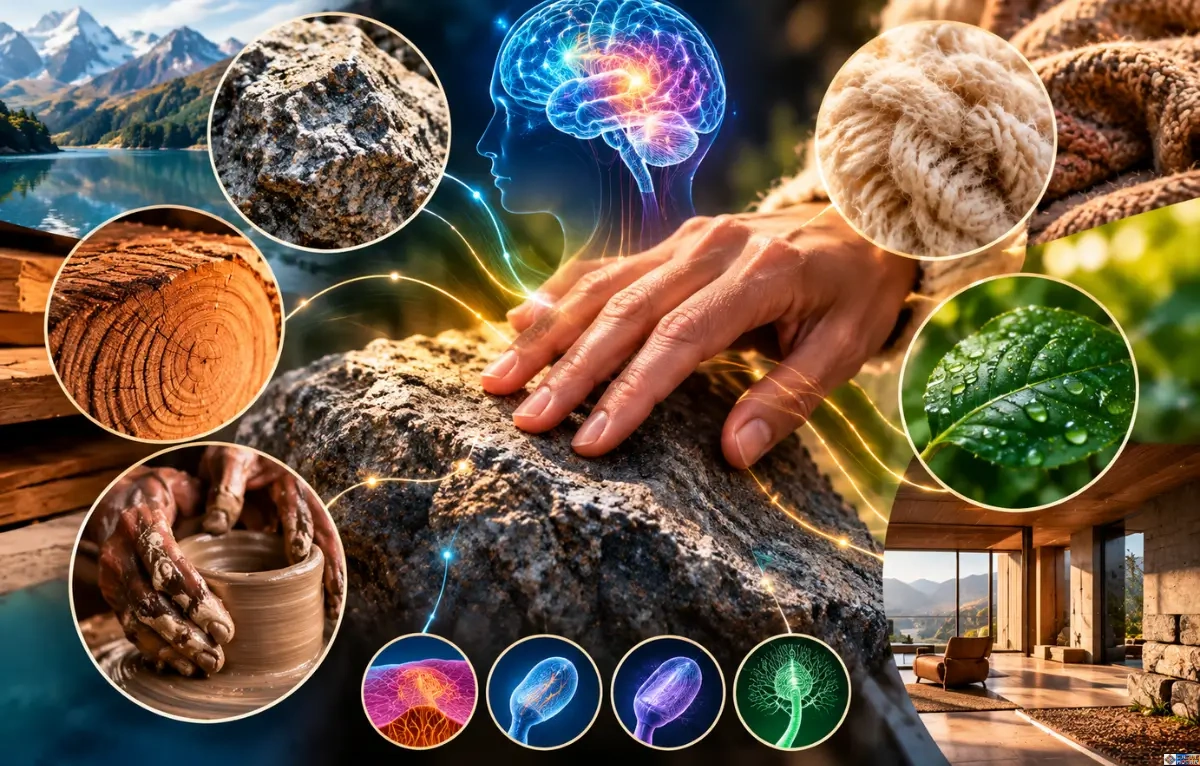
Haptic resonance is the felt response your skin and brain produce when a natural, unprocessed material meets your touch, and it shapes art, craft, architecture and design more than most people notice.
Quick Summary
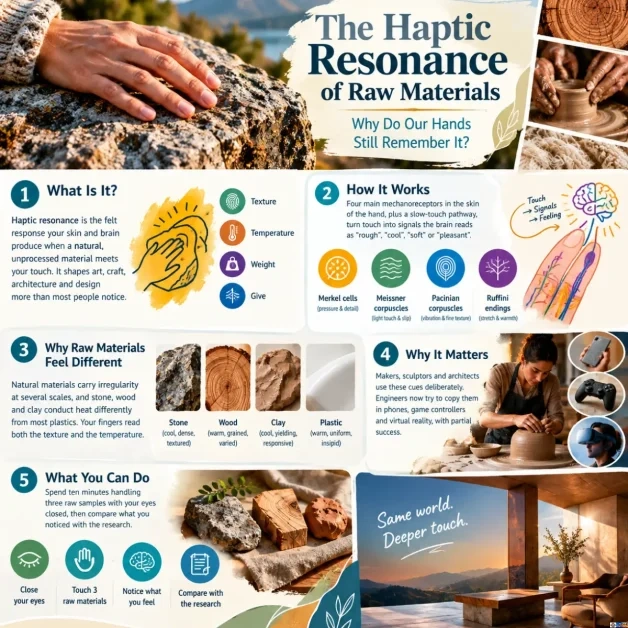
- What it is: The Haptic Resonance of Raw Materials describes how the texture, temperature, weight and give of unprocessed matter (clay, stone, timber, raw fibre) set off a bodily and emotional response through touch. “Haptic resonance” is a working term from art and design, not a formal unit in physics or neuroscience.
- How it works: Four main types of mechanoreceptors in the skin of the hand, plus a separate slow-touch pathway, turn friction, vibration, pressure and warmth into signals that the brain reads as “rough”, “cool”, “soft” or “pleasant” (Johnson & Hsiao, 1992; McGlone et al., 2014).
- Why raw materials feel different from plastics: Natural materials tend to carry irregularity at several scales at once, and stone, wood and clay conduct heat differently from most polymers. Your fingers read both.
- Why it matters: Makers, sculptors and architects use these cues deliberately. Engineers now try to copy them in phones, game controllers and virtual reality, with partial success.
- What you can do: Spend ten minutes handling three raw samples with your eyes closed (a method is in the practice section below), then compare what you noticed with the research summarised here.
This article is published for Culture mosaic readers who want a clear, source-backed route into the topic. Every factual claim points to a source in the list at the end, and where the evidence is thin, the text says so.
The problem: a world that looks right but feels wrong
Most of what we see each day arrives through glass. Screens flatten wood, wool and stone into the same smooth, cool, silent surface. Even the objects we do hold, such as phone cases, laminate counters and moulded chairs, are often engineered to feel uniform.
If you have ever picked up a hand-thrown bowl and felt something settle in you that a catalogue photo could not deliver, you already know the gap. Architect Juhani Pallasmaa argued in The Eyes of the Skin that modern building culture privileges the eye and starves the other senses (Pallasmaa, 1996). Anthropologist Tim Ingold makes a related case for thinking with materials rather than only about them (Ingold, 2013).
The frustration is real for several groups at once:
- Artists and sculptors who find that a digital sketch never predicts how clay will drag, slump or crack.
- Interior designers whose samples look identical on screen but feel nothing alike in the hand.
- Product teams who struggle to explain why “premium” is felt before it is seen.
- Curious readers who sense that touch matters but cannot name why.
The good news: there is a body of research, and a long craft tradition, that explains the effect and shows how to work with it. The rest of this article walks through it, from skin receptors to museum galleries to the vibration motor in your pocket. If you want a studio-side companion, see Tactile Minimalism Art Techniques for a restrained, surface-first approach.
What exactly does “haptic resonance” mean?
Haptic resonance is the felt echo a material leaves in your body and mood when you touch it. It combines two things that science usually studies separately.
- Haptic perception. “Haptic” comes from the Greek haptesthai, “to touch”. Psychologists distinguish passive touch (something presses on you) from active touch (you move your hand to explore), and they find that active touch is far richer. James Gibson made this case in 1962, and Susan Lederman and Roberta Klatzky later catalogued the hand movements people use to judge materials: sliding a fingertip for texture, pressing for hardness, resting a palm for temperature, lifting for weight, and wrapping the hand round for shape (Gibson, 1962; Lederman & Klatzky, 1987).
- Emotional and cultural meaning. The same cues carry associations. Cool smooth stone can feel calm or austere. Raw wool can feel homely or scratchy depending on where you grew up and what you expect.
So “resonance” here is partly a metaphor: the material does not vibrate in your hand like a tuning fork (although fine vibration from sliding is a real part of texture sensing). The word points to the way a surface answers your touch and the way that answer lingers.
In practice, three layers are involved:
Creative practices that centre these layers include Haptic Sculpting Rituals and the surface-first methods in Tactile Abstract Art Techniques.
What are the main human receptors that decode material texture?
The hairless skin of the fingertip carries four main types of mechanoreceptor, and each listens for something different. Textbook neuroscience groups them by how fast they adapt and how wide an area they cover (Johnson & Hsiao, 1992; Purves et al., 2001).
Two more systems matter for raw materials:
- Thermoreceptors register how fast heat leaves your skin, which is why metal and stone feel colder than wood at the same room temperature.
- C-tactile afferents are slow, unmyelinated nerve fibres in hairy skin that respond best to gentle stroking at skin temperature and are linked to the pleasant side of touch rather than to precise discrimination (Olausson et al., 2002; McGlone et al., 2014; Ackerley et al., 2014). They are not found in the fingertip pad, so they speak more to forearm and face than to a potter’s fingertips.
The system is astonishingly sensitive. In one study, people could detect a fine wrinkle pattern on an otherwise smooth surface with an amplitude of only about 13 nanometres (Skedung et al., 2013). Fingerprints also appear to help by shaping the vibrations that reach the receptors as you slide across a surface (Scheibert et al., 2009).
For artists who want to record how a surface feels as well as how it looks, Somatic Art Documentation is related reading on documenting art through the body.
Why do raw materials feel fundamentally different than plastics?
Because touch judges a few measurable dimensions at once, and raw materials tend to vary on all of them. Multidimensional-scaling studies, where people sort real samples by feel, keep finding the same core axes: rough versus smooth, hard versus soft, warm versus cold, and sticky versus slippery (Hollins et al., 1993; Bergmann Tiest & Kappers, 2006; Okamoto et al., 2013).
A useful physical idea for the warm-versus-cold axis is thermal effusivity, a measure of how quickly a material draws heat from your skin. Stone and metal pull heat away quickly and feel cold. Wood pulls it away slowly and feels warmer, even at the same room temperature. Many plastics sit near wood on this scale, so temperature alone does not separate “natural” from “synthetic”. Texture and variation do more of the work.
The table below compares general tendencies. Individual products vary widely, and a textured, hand-finished polymer can fool the fingers more than a polished stone.
The sound row matters more than it seems. When you slide a finger over a surface, you also hear it, and research on texture perception finds that sound and touch are combined in judging roughness (Jousmäki & Hari, 1998). Raw materials give consistent, informative cues across senses, which is part of why they read as “honest”.
If you are curious about the materials-chemistry side, the field sometimes called organic haptics sits where polymer science, biology and design meet: researchers try to give synthetic or bio-derived materials the layered, responsive feel of natural ones. It is an active area rather than a settled one, so treat any claim that a synthetic surface is “indistinguishable” from a natural one with caution.
Material studies: the tactile qualities of clay, stone, timber and raw fibre
Each raw material has a signature “voice” in the hand. The descriptions below come from material properties and the craft literature, not from a personal test, and they are generalisations.
A few patterns across the table:
- Process stays in the surface. Tool marks, finger marks and growth rings tell your fingers how the object was made. That is the “unprocessed” quality people respond to.
- Weight is a message. A small stone that is heavier than you expect registers instantly through your muscles and tendons, before any thought arrives.
- Change over time. Clay dries, wood moves, wool felts. Handling itself is a conversation with the material.
For related reading on nature-linked folk art, see Biophilic Folk Art Aesthetics.
Materiality and cultural heritage: a short history of touch in raw material art
People have made meaning from the feel of raw matter for as long as there have been objects. A few well-documented threads show how.
- Marks you can feel. The prehistoric Japanese Jōmon period takes its name from the cord-marked patterns pressed into its pottery. The surface records the maker’s tool and gesture, and museum collections such as those of the British Museum and the Victoria and Albert Museum hold ceramics and textiles where the touch of the maker is still legible.
- The unknown craftsman. In the early twentieth century, the Japanese thinker Sōetsu Yanagi argued that everyday objects made by anonymous hands carry a beauty that celebrated art can miss (Yanagi, 1972). This is a useful counterweight to a culture that often asks who is the most famous artist and forgets the makers behind the objects we actually hold.
- Studio pottery. Bernard Leach’s A Potter’s Book (1940) carried East Asian ideas of material honesty into Western studio craft (Leach, 1940).
- Wabi-sabi. The Japanese aesthetic of imperfection, age and austerity is often explained through touch: rough, worn, uneven surfaces valued over flawless ones (Koren, 1994).
- Architecture of the senses. Pallasmaa’s critique in 1996 helped push architects to ask what a building feels like to a hand, a foot and a cheek, not only how it photographs (Pallasmaa, 1996).
The common thread is that raw materials were never neutral. They carried place (this stone, that clay), process (how it was shaped) and community (who taught the maker). Touching them reconnects the user with all three.
That is why heritage craft and raw textiles keep reappearing in contemporary practice: they are one of the few reliable ways to put history under the fingertips.
Why do natural materials evoke emotional responses in art?
Short answer: touch is wired for feeling as well as for facts, and natural textures tend to sit in a range that people find calming. The honest long answer is that the evidence is promising but mixed, so here is what is solid and what is still open.
What is well supported
- Touch has two jobs. A fast system identifies what you are holding, and a slower, affective system tied to C-tactile fibres helps mark touch as pleasant or not (McGlone et al., 2014).
- Contact with nature can ease stress. Roger Ulrich’s 1984 hospital study found that patients with a view of trees recovered differently from those facing a brick wall (Ulrich, 1984), which helped launch the biophilic design movement summarised in Terrapin Bright Green’s 14 Patterns of Biophilic Design (Browning et al., 2014).
What is promising but still developing
- A review of the wood-and-stress literature finds hints that wood in indoor spaces can support wellbeing, while noting that study quality varies (Burnard & Kutnar, 2015).
- Small laboratory studies on touching wood versus materials like metal, tile or acrylic report calmer physiological responses to wood, but samples are small and results should not be treated as universal (Ikei et al., 2017).
Why it may happen (a working explanation, not a proven law)
Natural textures contain structured variation: not perfectly regular, not random. The brain appears to process that kind of complexity with less effort than harsh, repetitive or chaotic patterns. That is the core claim behind neuro-aesthetics applied to natural textures, and it is why designers talk about Neuro-Aesthetic Wall Art; for a home-décor take on the idea, see Neuro-Aesthetic Wall Art.
Touch also never works alone. Colour, light and sound change how a surface feels before your hand arrives, and a short guide to The Psychology of Color in Design is a good companion for thinking about that cross-sense effect.
For people who use making as a way of processing feeling, Art Therapy Power of Artistic Expressions explores how hands-on creation can support emotional expression. It is not a substitute for professional care if you are struggling.
Unprocessed materials in contemporary sculpture and modern art installations
Contemporary artists often choose raw material precisely because it cannot be mistaken for a digital image. Two documented examples show different ways of doing it.
- Antony Gormley’s Field series. Field for the British Isles (1993) consists of tens of thousands of small hand-pressed terracotta figures made with the help of community members in St Helens, England. The clay holds the pinch and squeeze of many hands, so the work is as much a record of touch as an image (Tate press release).
- Wolfgang Laib’s pollen and milk-stone works. Laib gathers pollen and uses marble and milk in installations that depend on fragility, scent and fine texture. The material is the message (MoMA showed Laib’s work in 2013: exhibition page).
- Ask for a handling session. Some museums and craft collections offer supervised handling of objects or samples. It is worth asking, because holding a thing is a different kind of looking.
The museum “do not touch” rule is a real constraint on haptic art. Conservation limits are why some institutions run supervised handling sessions or touch tours and why many artists now build touchable pieces, or provide documented samples, so audiences can feel what a photograph cannot carry.
Ideas for making touch part of a piece:
- Make the seams visible. Fragmented Collage with Visible Seams is related reading on exposed joins and layered edges, which invite the hand along a surface.
- Explore related practice. The Art of Human Distillation is a further read on how makers think about process and material.
- Document the feel. Pair finished work with a short tactile note (weight, temperature, surface) so viewers who cannot touch the object still get a sense of it.
The central point: in installation work, material is not decoration. It sets the tempo of attention, slows the viewer down and makes them aware of their own body in the room.
How do engineers program the feel of raw materials into digital devices?
They cannot yet reproduce a full material, so they fake the parts of it that fingertips are most sensitive to: vibration, friction and, in a few prototypes, warmth. Haptics engineering is a practical response to the receptor map above (Hayward et al., 2004).
Two honest caveats:
- Real surfaces engage all four receptor types, thermal sensing and muscle feedback at once. Devices usually address one or two.
- Researchers measure “realism” with small panels of volunteers, so reported gains should be read as lab results, not guarantees about shipping products.
The design lesson flows back the other way. Engineers who study natural surfaces find they have to capture variation and micro-irregularity, which is the same quality artists prize. That makes raw materials a benchmark for haptic technology as well as a source of inspiration.
The solution: how to use haptic resonance in art, design and manufacturing
Start by treating touch as data you can collect, then design for it on purpose. Here is a method anyone can try, followed by what teams can do at scale.
A ten-minute haptic practice (for makers and curious readers)
- Pick three raw samples with different natures: for example a piece of clay or plaster, a small stone, and an offcut of timber or a swatch of raw wool.
- Close your eyes and use the five movements researchers describe: slide for texture, press for hardness, rest your palm for temperature, lift for weight, wrap your hand for shape (Lederman & Klatzky, 1987).
- Write words, not judgements. “Cool, fine grit, heavy” beats “nice”.
- Add one feeling word for each sample, then one memory or place if it comes.
- Open your eyes and note what changed. Vision often dominates, and the gap is informative.
- Repeat in a week. Handling changes some materials, and your attention changes too.
Writing these notes down is also a form of record-keeping; Somatic Art Documentation and The Bio-Art Beginner’s Lab are related reads for people who want to bring this kind of attention into a studio routine, while 5 Bio-Art Mistakes and Mindful Bio-Art Projects are further reading on avoiding pitfalls and building a slower practice.
What designers and manufacturers can do
If you take one thing from this article, take this: the materials around you are already speaking. The only choice is whether you listen on purpose.
Frequently Asked Questions
1. What is haptic resonance in design?
It is a design shorthand for the way a material’s tactile qualities (texture, temperature, weight, give and sound) produce a felt response that lasts beyond the moment of touch. It is not a formal scientific term. Designers use it to argue that a surface should be chosen for how it will feel under the hand as well as how it looks in a render. The underlying perception research, on which dimensions people use to judge materials, is well established (Hollins et al., 1993; Okamoto et al., 2013).
2. Do natural materials really reduce stress?
The evidence points in a helpful direction but is not conclusive. Studies of nature views and biophilic design report benefits for wellbeing (Ulrich, 1984; Browning et al., 2014), and reviews of wood in interiors suggest similar trends while warning about study quality (Burnard & Kutnar, 2015). Small touch experiments report calmer responses to wood than to some synthetic surfaces (Ikei et al., 2017). Treat these as reasons to try natural materials, not as medical claims.
3. Why does clay feel so different from stone?
Two main reasons: water and density. Wet clay is plastic because its tiny flat particles slide over thin films of water, so it yields to pressure. Stone is dense, rigid and, because it conducts heat well, feels cold quickly. Your fingertips pick up the give, the slip, the weight and the temperature almost at once, and the brain merges them into “soft and living” versus “hard and ancient”.
4. Can screens ever feel like real materials?
Partly. Electrovibration, ultrasonic friction control and recorded-texture playback can suggest roughness, edges or slipperiness on glass (Bau et al., 2010; Winfield et al., 2007; Culbertson et al., 2014). None yet reproduces the full mix of pressure, vibration, warmth and weight in a real stone or timber. Expect convincing hints, not perfect copies, for the near future.
5. How can I use haptic resonance in my own art practice?
Begin with the ten-minute practice above, then pick one material and vary one property at a time, such as finish, thickness or temperature. Record what changes in a short tactile note, and consider offering a touch sample with finished work. If you work with seams, layers or collage, Tactile Abstract Art Techniques and Haptic Sculpting Rituals are practical places to continue.
Sources and how this article was built
This article draws on published research and well-known books. It contains no original interviews, surveys or reader testimonials, and the material descriptions are generalisations from the cited literature. Check journal details and links before publication, since pages move.
Perception and neuroscience
- Gibson, J. J. (1962). Observations on active touch. Psychological Review, 69(6), 477–491.
- Lederman, S. J., & Klatzky, R. L. (1987). Hand movements: A window into haptic object recognition. Cognitive Psychology, 19(3), 342–368.
- Johnson, K. O., & Hsiao, S. S. (1992). Neural mechanisms of tactile form and texture perception. Annual Review of Neuroscience, 15, 227–250.
- Purves, D., et al. (2001). Neuroscience (2nd ed.), chapter on somatic sensation. Sinauer Associates.
- Olausson, H., et al. (2002). Unmyelinated tactile afferents signal touch and project to insular cortex. Nature Neuroscience, 5, 900–904.
- McGlone, F., Wessberg, J., & Olausson, H. (2014). Discriminative and affective touch: sensing and feeling. Neuron, 82(4), 737–755.
- Ackerley, R., et al. (2014). Human C-tactile afferents are tuned to the temperature of a skin-stroking caress. Journal of Neuroscience, 34(8), 2879–2883.
- Skedung, L., et al. (2013). Feeling small: exploring the tactile perception limits. Scientific Reports, 3, 2617.
- Scheibert, J., et al. (2009). The role of fingerprints in the coding of tactile information probed with a biomimetic sensor. Science, 323, 1503–1506.
- Jousmäki, V., & Hari, R. (1998). Parchment-skin illusion: sound-biased touch. Current Biology, 8(6), R190.
Material perception
- Hollins, M., et al. (1993). Perceptual dimensions of tactile surface texture: A multidimensional scaling analysis. Perception & Psychophysics, 54, 697–705.
- Bergmann Tiest, W. M., & Kappers, A. M. L. (2006). Analysis of haptic perception of materials by multidimensional scaling and physical measurements of roughness and compressibility. Acta Psychologica, 121, 1–20.
- Okamoto, S., Nagano, H., & Yamada, Y. (2013). Psychophysical dimensions of tactile perception of textures. IEEE Transactions on Haptics, 6(1), 81–93.
Wellbeing and biophilic design
- Ulrich, R. S. (1984). View through a window may influence recovery from surgery. Science, 224, 420–421.
- Browning, W. D., Ryan, C. O., & Clancy, J. O. (2014). 14 Patterns of Biophilic Design. Terrapin Bright Green.
- Burnard, M. D., & Kutnar, A. (2015). Wood and human stress in the built indoor environment: a review. Wood Science and Technology, 49, 969–986.
- Ikei, H., Song, C., & Miyazaki, Y. (2017). Physiological effects of touching wood. International Journal of Environmental Research and Public Health, 14(7), 801.
Haptic technology
- Hayward, V., et al. (2004). Haptic interfaces and devices. Sensor Review, 24(1), 16–29.
- Winfield, L., Glassmire, J., Colgate, J. E., & Peshkin, M. (2007). T-PaD: Tactile pattern display through variable friction reduction. Proceedings of World Haptics 2007.
- Bau, O., Poupyrev, I., Israr, A., & Harrison, C. (2010). TeslaTouch: electrovibration for touch surfaces. Proceedings of UIST 2010.
- Culbertson, H., Unwin, J., & Kuchenbecker, K. J. (2014). Modeling and rendering realistic textures from unconstrained tool-surface interactions. IEEE Transactions on Haptics, 7(3), 381–393.
Art, craft and heritage
- Leach, B. (1940). A Potter’s Book. Faber & Faber.
- Yanagi, S. (1972). The Unknown Craftsman: A Japanese Insight into Beauty. Kodansha International.
- Koren, L. (1994). Wabi-Sabi for Artists, Designers, Poets & Philosophers. Stone Bridge Press.
- Pallasmaa, J. (1996). The Eyes of the Skin: Architecture and the Senses. Academy Editions (3rd ed., Wiley, 2012).
- Ingold, T. (2013). Making: Anthropology, Archaeology, Art and Architecture. Routledge.
- Tate: Antony Gormley, Field (press release)
- MoMA: Wolfgang Laib exhibition, 2013
- British Museum and Victoria and Albert Museum collections (general references for handled ceramics and textiles)
 Dr. Julian Thorne