
 By Culture Expert
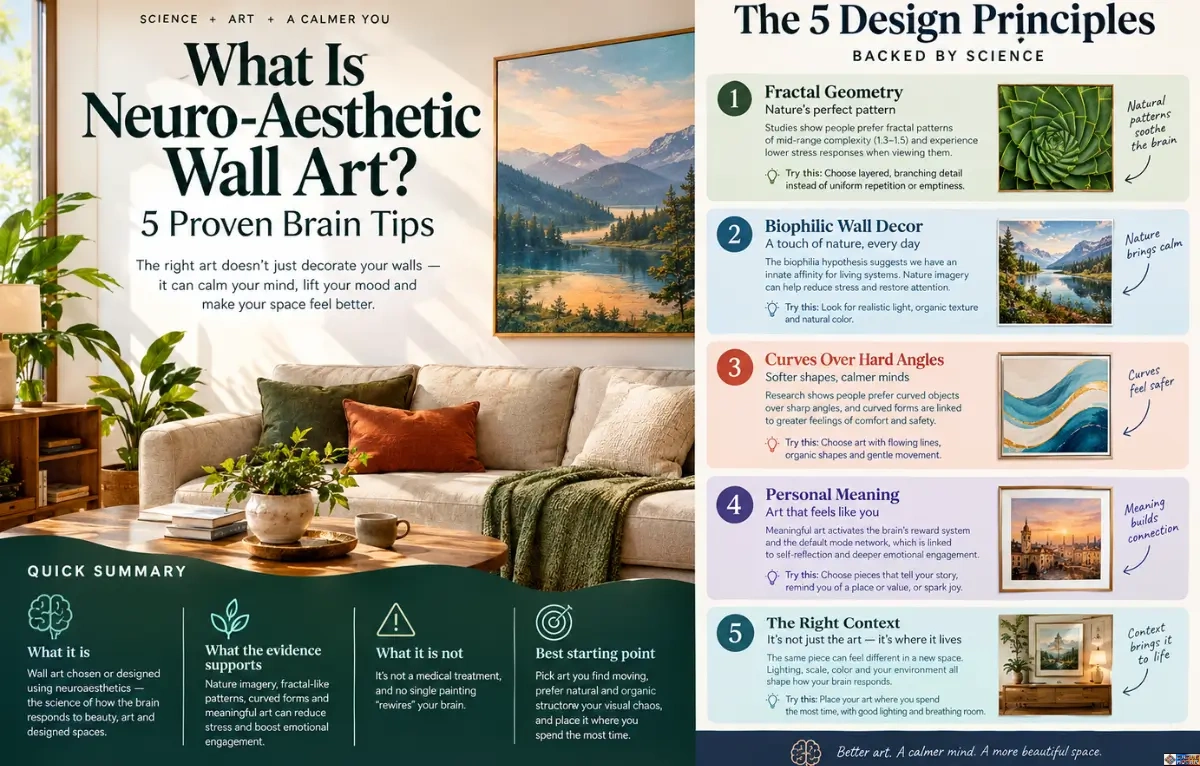
Quick Summary
- What it is: Neuro-Aesthetic Wall Art is wall art chosen or designed using findings from neuroaesthetics, the science of how the brain responds to beauty, art, and designed spaces.
- What the evidence supports: Nature imagery, moderately complex fractal-like patterns, curved forms, and personally meaningful art are linked to preference, lower stress responses, and stronger emotional engagement in published studies.
- What it is not: It is not a medical treatment, and no single painting “rewires” your brain. Neuroaesthetics is a young field with real debates, covered below.
- Best starting point: Pick art you find moving, favor natural and organic structure over visual chaos, and place it where you spend the most time.
The Problem: Rooms That Look Fine but Feel Wrong
Many people have a room that is technically finished: the sofa matches, the paint is on-trend, and the frames are straight. Yet the space feels flat, cluttered, or faintly tiring.
If that sounds familiar, you are not being fussy. Environments shape attention and mood, and research on biophilic interior design and neuro-aesthetics has made that point increasingly hard to ignore. Most decor advice stops at “does it match?” and never asks “how does the brain read this?”
The Empathy: Why Generic Decor Leaves You Cold
Walls are the largest surfaces we look at every day. A mass-produced print chosen only to fill a gap gives your eyes nothing to settle on. A harsh, high-contrast pattern can do the opposite and make them work. Either way, you live with the result for hours.
That is where the science comes in.
The Solution: What Is Neuroaesthetics?
Neuroaesthetics studies how the brain perceives, evaluates, and responds to art and beauty. The term was popularized by neurobiologist Semir Zeki, whose book Inner Vision (1999) argued that artists, in their own way, explore the brain’s visual systems. Later reviews, such as Chatterjee and Vartanian (2014), framed the field as a bridge between perception, emotion, and reward.
Three findings matter most for wall art:
- Beauty engages the reward system. Kawabata and Zeki (2004) found that activity in the medial orbitofrontal cortex tracked how beautiful people rated paintings.
- Deeply moving art engages the “inner” brain. Vessel, Starr, and Rubin (2012) reported that the most moving artworks activated the default mode network, a set of regions linked to self-reflection.
- Context matters. Visual features, personal meaning, and setting all shape the response. Art is not a pill with a fixed dose.
What Kind of Art Can Be Considered Neuro Art?
There is no official definition, so it helps to separate two meanings:
- Brain-informed art: works designed or selected using perceptual research. Examples include fractal-based compositions, nature-inspired imagery, and calming color and form.
- Brain-generated or brain-themed art: works that visualize neural data or depict the brain, such as EEG-based pieces and neuroscience illustrations.
Most people searching for neuroscience wall decor, brain wall art, or neuroscience inspired wall art want one of these. If you want art designed for the brain rather than merely about it, the first category is your target.
The Science of Seeing: Five Design Principles
1. Fractal Geometry in Home Decor
Fractals are patterns that repeat at different scales, like branches, coastlines, and clouds. Physicist Richard Taylor and colleagues found that people tend to prefer fractal patterns of mid-range complexity (a fractal dimension of roughly 1.3 to 1.5), and Spehar et al. (2003) showed this preference across natural, mathematical, and human-made images. Taylor and colleagues also reported lower physiological stress responses when viewing such patterns, with figures as large as 60% in some measures. Those studies were small, so treat the numbers as promising rather than definitive.
Try this: Choose abstract or natural compositions with layered, branching detail rather than uniform repetition or total emptiness.
2. Biophilic Wall Decor
Wilson’s biophilia hypothesis (Kellert and Wilson, 1993) proposes an inborn affinity for living systems. Two classic findings are often cited in support:
- Ulrich (1984) found that hospital patients with a window view of trees recovered with fewer pain-medication doses than those facing a brick wall.
- Kaplan’s Attention Restoration Theory (1995) argues that natural scenes let directed attention rest.
Nature imagery on a wall is not the same as a window. It is a gentle echo of those effects, and it works best when it feels real: believable light, organic texture, and natural color.
3. Curves Over Hard Angles
Bar and Neta (2006) found people preferred curved objects over sharp-angled equivalents, and suggested sharp contours may carry a subtle sense of threat. Architectural neuroscience work (Coburn, Vartanian, and Chatterjee, 2017) points the same way, linking curvilinear spaces with higher preference. Soft, flowing forms in art can support a calmer room.
4. The Complexity Sweet Spot
Berlyne’s classic work on arousal suggested that interest peaks at moderate complexity: too simple is boring, too chaotic is stressful. Fernandez and Wilkins (2008) found that some high-contrast, repetitive stripe-like patterns are visually uncomfortable, and that certain famous artworks share those features. For a bedroom or workspace, avoid dense, high-contrast, repeating grids.
5. Personal Meaning Beats Formulas
Research reviewed by Mastandrea, Fagioli, and Biasi (2019) links art engagement to aesthetic emotion and well-being. A work that carries your memories, your landscape, or your heritage will usually move you more than a “scientifically optimal” print. This is where culture and craft come in. Art that tells a story engages more than the visual cortex.
Quick Comparison: Which Art Style Fits Which Room?
Suggested visual for your page: a simple diagram plotting “visual complexity” (low to high) against “interest and calm,” with the sweet spot highlighted in the middle.
Texture, Touch, and the Whole Body
Vision is only part of the story. Art with real surface depth invites a bodily response. You can explore this through tactile abstract art techniques, tactile minimalism art techniques, and the haptic resonance of raw materials. For the making side, haptic sculpting rituals and somatic art documentation show how process itself can become mindful practice.
Why Is Neuroaesthetics Controversial?
An honest guide has to include this. Critics raise several points:
- Reductionism. Conway and Rehding (2013) argued that the field risks oversimplifying beauty, which is shaped by culture, history, and individual taste.
- Weak generalization. Many studies use small samples, lab images, and Western participants.
- Brain scans are not explanations. A region “lighting up” does not by itself tell us why a work moves us.
- Over-selling. Commercial claims often outrun the evidence.
Pearce et al. (2016) offer a balanced review, supporting the field’s promise while calling for better methods. Take the sensible middle path: use the science as a guide, not a guarantee.
Is Brainwave Art Real?
Yes, in a specific sense. Brainwave art uses EEG (electroencephalography) signals to drive visuals or sound. A famous early example is Alvin Lucier’s Music for Solo Performer (1965), which used a performer’s alpha waves to trigger percussion. Today, artists and designers turn EEG data into images and animations.
What it does not do is read your mind or diagnose anything. Brainwave art is an artistic interpretation of electrical signals, not a medical test.
The Psychology of Interior Design: A Practical Checklist
For mindful interior styling, try this:
- Start with one focal piece. One strong work per wall beats a crowd of small ones.
- Match intensity to the room’s job. Calm, organic pieces suit rest spaces, while richer, more stimulating works suit social areas.
- Use natural color and light. Earthy, muted palettes with believable shadows tend to read as restful.
- Mind the hanging height. Center art near eye level so you can actually engage with it.
- Add one tactile or handmade element to give your senses something real.
- Rotate rather than accumulate. Novelty keeps attention alive, and so does the occasional rehang.
- Trust your own response. If a piece calms you, keep it. If it irritates you, move it.
For living-art inspiration, see the bio-art beginner’s lab, 5 bio-art mistakes, mindful bio-art projects, and biophilic folk art aesthetics. If you enjoy art with honest imperfection, look at fragmented collage with visible seams and the art of human distillation. And for the bigger cultural question of what makes an artist matter at all, read who is the most famous artist?
Social Proof: What the Wider Evidence Says
I have not invented testimonials or surveys. Here is what published, checkable evidence shows:
- The WHO Regional Office for Europe’s scoping review (Fancourt and Finn, 2019) examined more than 3,000 studies and concluded that arts engagement is associated with benefits for health and well-being.
- Studies on nature views and fractal patterns, listed in the sources below, consistently point toward restorative effects.
If you publish this article, you can add real first-hand material, such as your own reader survey or a documented before-and-after of a room. That is the strongest trust signal, and it has to come from real data.
Don’t Let Another Year of Blank-Feeling Walls Go By
You spend years of your life looking at the same few walls. Choosing what hangs there is one of the cheapest, most reversible ways to change how a space feels. Pick one wall this week and swap in one piece that is organic, moderately detailed, and personally meaningful. Notice how you feel after a few days. That small experiment is where the science becomes yours.
Frequently Asked Questions About Neuro-Aesthetic Wall Art
1. What is neuro-aesthetic wall art, in simple terms?
It is wall art selected or created with an understanding of how the brain responds to visual features such as nature imagery, fractal-like complexity, curves, and color. The goal is to make spaces feel calmer, more engaging, or more emotionally resonant. It draws on real research but is best treated as design guidance rather than a guaranteed effect.
2. Does neuroscience-inspired wall art really reduce stress?
Some studies show lower physiological stress responses when viewing mid-complexity fractal patterns and natural scenes, and nature exposure has a long research record. However, many studies are small and lab-based, so effects in a real home will vary. Art can support a calming environment, but it is not a substitute for medical or mental-health care.
3. What colors and patterns are best for a calm room?
Natural, muted palettes and organic, curved forms are generally associated with restfulness, and moderate complexity tends to be preferred over extremes. Avoid dense, high-contrast stripes and repeating grids in spaces where you want to relax. Your own reaction matters most, so test a piece before committing.
4. How is biophilic wall decor different from neuro-aesthetic wall art?
Biophilic decor focuses on connecting spaces to nature through plants, natural materials, and nature imagery. Neuro-aesthetic wall art is broader, applying research on perception and emotion that includes, but is not limited to, nature. In practice they overlap heavily, which is why many neuro-aesthetic pieces look natural and organic.
5. Is neuroaesthetics scientifically reliable?
It is a legitimate and growing field, but it has real limits. Critics warn against reducing beauty to brain activity and point to small samples and limited cultural diversity. Reliable use means treating findings as helpful tendencies, staying alert to marketing exaggeration, and keeping your own taste at the center.
Sources and Further Reading
- Bar, M., & Neta, M. (2006). Humans prefer curved visual objects. Psychological Science, 17(8), 645–648. doi:10.1111/j.1467-9280.2006.01759.x
- Berlyne, D. E. (1971). Aesthetics and Psychobiology. Appleton-Century-Crofts.
- Chatterjee, A., & Vartanian, O. (2014). Neuroaesthetics. Trends in Cognitive Sciences, 18(7), 370–375. doi:10.1016/j.tics.2014.03.003
- Coburn, A., Vartanian, O., & Chatterjee, A. (2017). Buildings, beauty, and the brain. Journal of Cognitive Neuroscience, 29(9), 1521–1531. doi:10.1162/jocn_a_01162
- Conway, B. R., & Rehding, A. (2013). Neuroaesthetics and the trouble with beauty. PLoS Biology, 11(3), e1001504. doi:10.1371/journal.pbio.1001504
- Fancourt, D., & Finn, S. (2019). What is the evidence on the role of the arts in improving health and well-being? A scoping review. WHO Regional Office for Europe, Health Evidence Network synthesis report 67.
- Fernandez, D., & Wilkins, A. J. (2008). Uncomfortable images in art and nature. Perception, 37(7), 1098–1113.
- Kaplan, S. (1995). The restorative benefits of nature. Journal of Environmental Psychology, 15(3), 169–182.
- Kawabata, H., & Zeki, S. (2004). Neural correlates of beauty. Journal of Neurophysiology, 91(4), 1699–1705. doi:10.1152/jn.00696.2003
- Kellert, S. R., & Wilson, E. O. (Eds.) (1993). The Biophilia Hypothesis. Island Press.
- Lucier, A. (1965). Music for Solo Performer (primary historical reference for EEG-driven art).
- Mastandrea, S., Fagioli, S., & Biasi, V. (2019). Art and psychological well-being. Frontiers in Psychology, 10, 739. doi:10.3389/fpsyg.2019.00739
- Pearce, M. T., et al. (2016). Neuroaesthetics: The cognitive neuroscience of aesthetic experience. Perspectives on Psychological Science, 11(2), 265–279. doi:10.1177/1745691615621274
- Spehar, B., Clifford, C. W. G., Newell, B. R., & Taylor, R. P. (2003). Universal aesthetic of fractals. Computers & Graphics, 27(5), 813–820.
- Taylor, R. P., et al. (2011). Perceptual and physiological responses to Jackson Pollock’s fractals. Frontiers in Human Neuroscience, 5, 60. doi:10.3389/fnhum.2011.00060
- Ulrich, R. S. (1984). View through a window may influence recovery from surgery. Science, 224(4647), 420–421. doi:10.1126/science.6143402
- Vessel, E. A., Starr, G. G., & Rubin, N. (2012). The brain on art. Frontiers in Human Neuroscience, 6, 66. doi:10.3389/fnhum.2012.00066
- Zeki, S. (1999). Inner Vision: An Exploration of Art and the Brain. Oxford University Press.
 Dr. Julian Thorne