
 By Culture Expert
Quick Summary
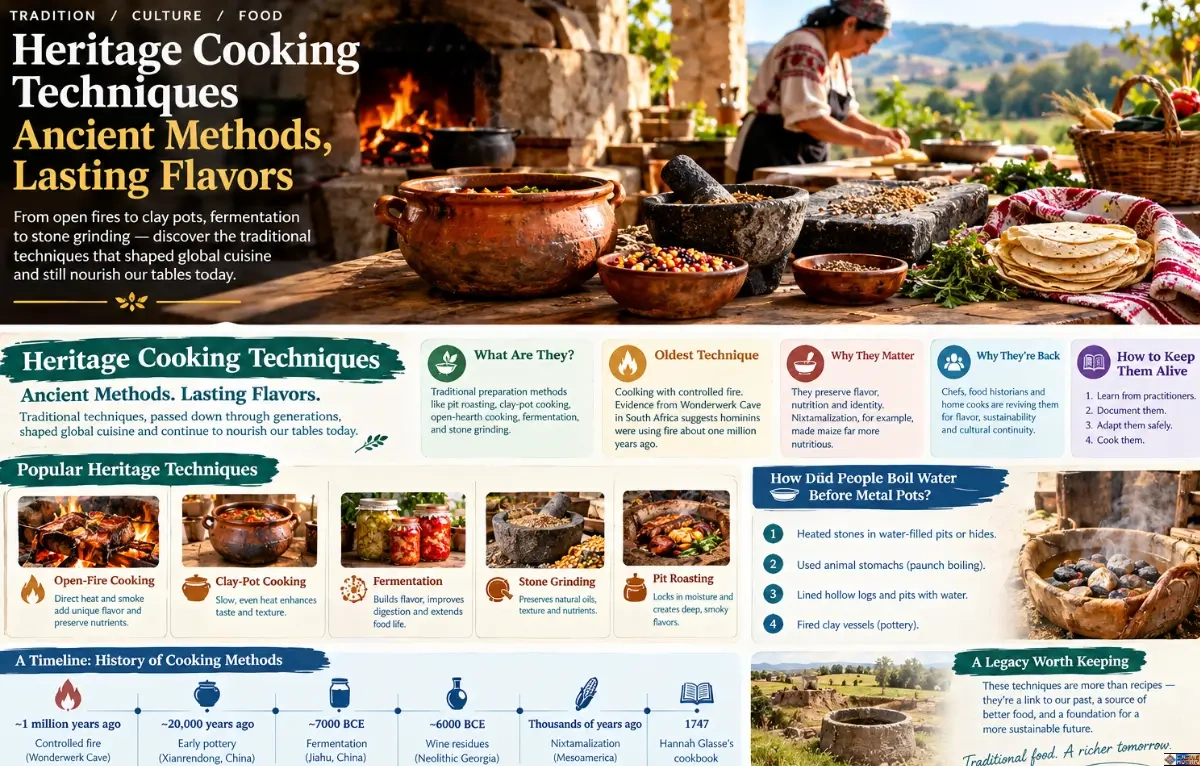
- What they are: Heritage cooking techniques are traditional preparation methods passed down through communities, such as pit roasting, clay-pot cooking, open-hearth cooking, fermentation, and stone grinding.
- Oldest technique: Cooking with controlled fire. Evidence from Wonderwerk Cave in South Africa suggests hominins were using fire about one million years ago.
- Why they matter: They preserve flavor, nutrition, and identity. Nixtamalization, for example, made maize far more nutritious.
- Why they’re back: Chefs, food historians, and home cooks are reviving them for flavor, sustainability, and cultural continuity.
- How to keep them alive: Learn them from practitioners, document them, adapt them safely, and cook them.
The Problem: Recipes Survive, but the Hands Disappear
Most of us have tasted something once, at a grandmother’s table or a village festival, that we’ve never quite found again. You can copy the ingredient list, but the dish is different. What’s missing is usually the technique: how long the fire burned down, how the clay pot was seasoned, how the cabbage was pressed.
That loss is real. A recipe records what went into the pot, while a technique records how a community understood food, fire, time, and each other. When the last person who knows how to tend an earth oven or judge a ferment by smell is gone, the knowledge often goes with them.
The good news is that these methods can be learned, documented, and adapted. This guide covers what heritage cooking techniques are, where they came from, how they differ around the world, and how to carry them into a modern kitchen.
Most food traditions are also tied to shared habits of eating. Our pieces on Culture Mosaic explore that side, including dining rituals and food rituals in different cultures.
What Is the Oldest Known Cooking Technique?
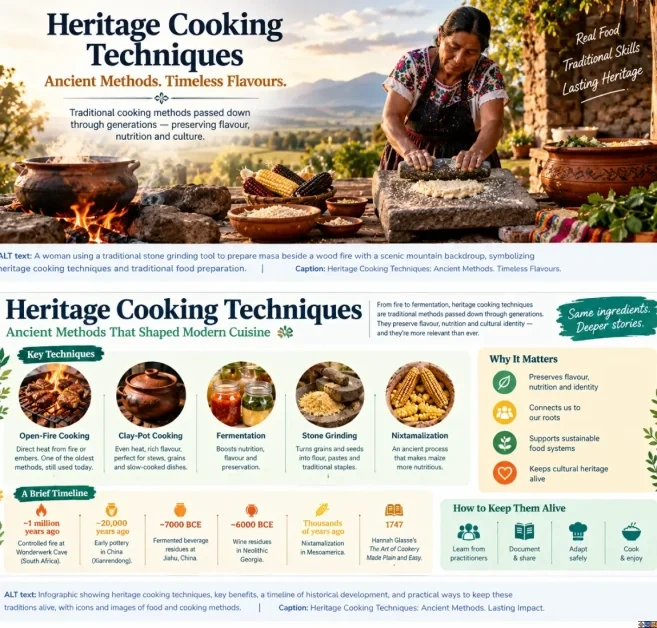
The oldest cooking technique is cooking with fire, whether roasting food directly in the embers or over flame. Researchers analyzing sediments at Wonderwerk Cave in South Africa found burned bone and plant ash consistent with controlled fire about one million years ago (Berna et al., 2012). Primatologist Richard Wrangham’s “cooking hypothesis” argues that cooked food helped shape human evolution, though scholars still debate how early habitual cooking began.
Roasting came first because it needs no container. Boiling required a vessel, and that is where ingenuity comes in.
How Did Ancient People Boil Water Before Metal Pots Existed?
Ancient cooks had several clever solutions, and many are still used:
- Stone boiling. Stones are heated in a fire, then dropped into water held in a hide-lined pit, a wooden trough, or a bark or basketry container. The water heats without the container touching flame.
- Paunch boiling. An animal stomach holds water and food. As long as liquid is inside, the membrane doesn’t burn over a moderate fire.
- Hollowed logs and pits. Lined depressions were filled with water and heated with hot rocks.
- Fired clay. Pottery is very old. Charred food residues in fragments from Xianrendong Cave in China date to roughly 20,000 years ago (Wu et al., 2012), and lipid analysis of Japanese Jōmon pottery points to cooking aquatic foods (Craig et al., 2013).
Bronze Age Ireland offers a striking example. Thousands of fulacht fiadh (burnt mounds) are thought to be the remains of water-filled troughs heated with hot stones, used for cooking, though archaeologists still discuss their exact functions. Vessel design is its own field, and our piece on ancestral cookware history goes further.
A Timeline: History of Cooking Methods
| Approx. date | Development | Why it matters |
|---|---|---|
| ~1 million years ago | Controlled fire at Wonderwerk Cave (South Africa) | Earliest widely cited evidence of fire use in a cave setting |
| ~20,000 years ago | Early pottery in China (Xianrendong) | Boiling and simmering in a durable vessel |
| ~7000 BCE | Fermented beverage residues at Jiahu, China | Early evidence of intentional fermentation |
| ~6000 BCE | Wine residues in Neolithic Georgia | Early winemaking in clay vessels |
| Thousands of years ago | Nixtamalization in Mesoamerica | Alkaline maize processing improved nutrition and texture |
| 1747 | Hannah Glasse, The Art of Cookery Made Plain and Easy | Snapshot of British hearth cookery |
| 1796 | Amelia Simmons, American Cookery | One of the first American cookbooks |
| 1940s | Microwave cooking developed | Rapid, electronic heating |
| 1970s | Sous vide developed in professional kitchens (France) | Precision-temperature cooking |
| 2010s–today | UNESCO recognizes food traditions; chefs revive Indigenous methods | Heritage becomes a living movement |
Traditional Cooking Methods Around the World
Earth Ovens: Cooking with the Ground Itself
What are earth ovens, and are they still used today? An earth oven is a pit lined with hot stones or embers. Food is wrapped, covered with leaves and earth, and slow-cooked by trapped heat and steam. They are absolutely still used.
- Polynesia and the Pacific: the imu (Hawaii) and umu (Samoa and elsewhere).
- Aotearoa New Zealand: the Māori hāngī, still central to gatherings.
- Yucatán, Mexico: the pib, used for dishes like cochinita pibil.
- Ireland: the possible role of fulacht fiadh, described above.
The principle is the same everywhere. Enclosed heat and moisture make tough meat tender and root vegetables sweet.
Clay-Pot Cooking
A conical clay tagine lets steam rise, condense on the cooler lid, and drip back onto the food. That is why a slow tagine stays so tender with so little liquid. See our walkthrough on how to cook traditional Moroccan tagine. Couscous, steamed in stages above the stew, has its own craft. UNESCO inscribed the knowledge and practices of couscous production and consumption in 2020 (a joint listing by Algeria, Mauritania, Morocco, and Tunisia). Explore the traditional Moroccan couscous recipe or authentic Moroccan couscous.
Open-Hearth and Spit Roasting
Before the cast-iron range spread in the 1800s, most European and colonial American cooking happened at the hearth, with pots on cranes, Dutch ovens buried in coals, and meat turned on spits. Cooks like Hannah Glasse and Amelia Simmons wrote for this world, when temperature was judged by hand, eye, and experience.
Vertical Roasting and Cultural Exchange
Techniques travel with people. Tacos al pastor is commonly traced to Lebanese immigrants who brought shawarma-style spit roasting to Mexico, where it met local chiles and pineapple. Try how to make Mexican street tacos al pastor, and see what are 20 Mexican foods and the importance of food in Mexican culture for more.
Nixtamalization: A Technique That Changed Human Health
Mesoamerican cooks simmered maize with wood ash or lime (calcium hydroxide). This loosens the hull, improves dough-making, and makes niacin more available. Researchers documented this in Science in 1974 (Katz, Hediger & Valleroy), noting that populations relying on untreated maize risked pellagra. Nixtamalization is a real example of heritage technique functioning as applied nutrition science. It also underlies the tortillas in Hispanic cultural foods.
Why Did Ancient Cultures Rely So Heavily on Fermentation?
Fermentation solved several problems at once:
- Preservation: acids, alcohol, and salt discourage spoilage when refrigeration didn’t exist.
- Flavor: it builds sour, savory, and umami notes. See ancestral umami techniques and ancestral umami cooking.
- Nutrition and digestibility: it can break down some compounds in grains and legumes.
- Community: many ferments were made collectively. UNESCO recognized kimjang (kimchi-making) in South Korea in 2013 as a shared tradition, and separately recognized a related tradition in North Korea in 2015.
For deeper dives, read ancestral fermentation techniques, ancestral fermentation rituals, traditional sauerkraut fermentation, and the science in the biochemistry of salt-glaze fermentation.
A safety note: traditional fermentation works because of controlled salt, acidity, and temperature. Follow tested guidelines, such as those from the University of Georgia’s National Center for Home Food Preservation, especially for low-acid foods.
Modern Methods of Cooking vs. Heritage Techniques
| Feature | Heritage technique | Modern technique |
|---|---|---|
| Heat source | Wood, charcoal, embers, hot stones | Gas, electric, induction, microwave |
| Control | Judged by senses and experience | Thermostats, probes, timers |
| Time | Often slow (hours to days) | Often fast, or precisely timed |
| Vessel | Clay, stone, cast iron, leaves, earth | Steel, non-stick, vacuum bags |
| Knowledge passed by | Apprenticeship and family | Books, courses, videos, manuals |
| Strength | Deep flavor, cultural meaning | Consistency, safety, convenience |
| Weakness | Skill-dependent, harder to standardize | Can feel disconnected from tradition |
Neither is “better.” The best cooks borrow from both. Sous vide, for instance, gives the precision that a long braise once took years of experience to judge.
20 Types of Cooking Methods
| # | Method | Type |
|---|---|---|
| 1 | Roasting | Dry heat |
| 2 | Baking | Dry heat |
| 3 | Grilling | Dry heat |
| 4 | Broiling | Dry heat |
| 5 | Barbecuing | Dry heat/smoke |
| 6 | Smoking | Dry heat/smoke |
| 7 | Sautéing | Fat-based |
| 8 | Pan-frying | Fat-based |
| 9 | Deep-frying | Fat-based |
| 10 | Searing | Dry heat |
| 11 | Boiling | Moist heat |
| 12 | Simmering | Moist heat |
| 13 | Poaching | Moist heat |
| 14 | Steaming | Moist heat |
| 15 | Blanching | Moist heat |
| 16 | Braising | Combination |
| 17 | Stewing | Combination |
| 18 | Sous vide | Precision moist heat |
| 19 | Pit/earth-oven cooking | Heritage, trapped heat |
| 20 | Fermenting and curing | Preservation/transformation |
Regional Snapshots: Living Food Heritage
- Italy: Techniques like hand-shaping pasta and wood-fired baking are tied to place. Explore Italian pasta shapes and sauces, what is the history of Italian cuisine, and Italian culinary traditions. UNESCO recognized the art of the Neapolitan pizzaiuolo in 2017.
- Georgia (Caucasus): Bread and cheese traditions like Georgian khachapuri regional varieties, plus clay-vessel winemaking.
- Philippines: Sour, salty, and smoky flavors from fermenting, grilling, and braising. See Filipino cuisine and authentic Filipino food.
- Malay food heritage: Techniques like slow-cooked spice pastes (rempah), fermented condiments such as belacan, and communal feasting. Malaysia has formally listed heritage foods under its National Heritage Act.
- African diaspora: Food carries memory, adaptation, and resistance. Read African diaspora food culture. Culinary historian Michael Twitty’s The Cooking Gene (2017) traces these threads, and Oldways’ A Taste of African Heritage program uses traditional foodways for health education. Check Oldways’ published materials for evaluation results rather than relying on secondhand claims.
- Europe: Butter, cheese, and cured meats reflect local terroir. See heritage European butter varieties.
- Heritage animals: Heritage breed pork depends on breeds like Berkshire or Tamworth. Organizations such as The Livestock Conservancy and Slow Food’s Ark of Taste work to keep these breeds and foods from disappearing.
Broader collections: traditional recipes from around the world and USA famous dishes.
Why Are Modern Chefs Bringing These Heritage Methods Back?
Several forces are converging:
- Flavor. Smoke, ferment, and slow heat can’t be faked.
- Sustainability. Nose-to-tail cooking, preserving, and using local grains cut waste. See regenerative heritage recipes.
- Identity. Chef Sean Sherman (Oglala Lakota) has worked to revive Indigenous foodways, documenting them in The Sioux Chef’s Indigenous Kitchen (2017). His Minneapolis restaurant Owamni won the James Beard Award for Best New Restaurant in 2022.
- Recognition. UNESCO’s Intangible Cultural Heritage lists now include food traditions such as Japan’s washoku (2013), the Mediterranean diet (2010), and traditional Mexican cuisine (2010).
- Body and memory. Food can bring back childhood instantly. Explore this in somatic food memory and somatic seasoning. There is even a thread in the commensal architecture of shared vessels. Longevity researchers also study routines like the centenarian breakfast routine.
The Solution: How to Preserve and Adapt Heritage Cooking Techniques
Waiting for a “perfect” moment is how techniques vanish. These steps are practical starting points:
- Cook with the source. Ask a relative, neighbor, or community cook to show you a technique, not just tell you.
- Document the how. Record video and write down sensory cues: sound, smell, texture, timing.
- Start with one method. Try a clay-pot stew, a small crock of sauerkraut, or a Dutch oven bake in coals.
- Adapt safely. Use a home oven for slow braising, or a covered grill for a pit-roast style result, and follow food-safety guidance for ferments.
- Buy from traditional producers. Heritage grains, breeds, and cookware sustain the people who keep skills alive.
- Read the sources. For a starter shelf, try Harold McGee’s On Food and Cooking, Sandor Katz’s The Art of Fermentation, Michael Pollan’s Cooked, and Sherman’s and Twitty’s books above.
- Share it. A technique that’s taught survives.
If you don’t act, the risk is quiet: the last person who knows a method retires, and the knowledge doesn’t get written down. Cooking it once, with someone who knows it, is worth more than reading about it a hundred times. For a broader starting point, our Heritage Cooking Techniques hub collects these threads in one place.
Frequently Asked Questions About Heritage Cooking Techniques
1. What are heritage cooking techniques?
Heritage cooking techniques are traditional food-preparation methods passed down through communities, such as pit roasting, clay-pot cooking, open-hearth cooking, fermentation, and curing. Unlike a recipe, they carry cultural knowledge about tools, timing, and place, not just ingredients.
2. What is the oldest known cooking technique?
The oldest known cooking technique is cooking with fire, probably roasting food in embers. Evidence of controlled fire at Wonderwerk Cave in South Africa dates to about one million years ago, though scholars still debate when regular cooking became habitual.
3. What are earth ovens, and are they still used today?
Earth ovens are pits heated with stones or embers, then covered so food cooks slowly in trapped heat and steam. They’re still used today, including the Hawaiian imu, the Māori hāngī, and the Yucatecan pib, especially for ceremonies and gatherings.
4. Why are heritage cooking techniques being revived?
People want deeper flavor, more sustainable food systems, and a connection to their roots. Chefs, community groups, and UNESCO recognition have raised the profile of these traditions. Revival works best when the communities who hold the knowledge are credited and involved.
5. Can I practice heritage cooking techniques safely at home?
Yes, with care. For fermenting and preserving, use tested guidance such as the National Center for Home Food Preservation. For fire-based methods, follow local fire rules and ventilate well. Many techniques adapt to a home oven, cast-iron pot, or covered grill.
Sources and Further Reading
Academic and primary sources
- Berna, F. et al. (2012). “Microstratigraphic evidence of in situ fire in the Acheulean strata of Wonderwerk Cave, Northern Cape Province, South Africa.” PNAS. doi:10.1073/pnas.1117620109
- Wu, X. et al. (2012). “Early pottery at 20,000 years ago in Xianrendong Cave, China.” Science.
- Craig, O. E. et al. (2013). “Earliest evidence for the use of pottery.” Nature.
- McGovern, P. E. et al. (2004). “Fermented beverages of pre- and proto-historic China.” PNAS.
- McGovern, P. E. et al. (2017). “Early Neolithic wine of Georgia in the South Caucasus.” PNAS.
- Katz, S. H., Hediger, M. L., & Valleroy, L. A. (1974). “Traditional maize processing techniques in the New World.” Science.
- Wrangham, R. (2009). Catching Fire: How Cooking Made Us Human. Basic Books.
- Glasse, H. (1747). The Art of Cookery Made Plain and Easy.
- Simmons, A. (1796). American Cookery.
Institutions and organizations
- UNESCO Intangible Cultural Heritage lists: ich.unesco.org
- National Center for Home Food Preservation: nchfp.uga.edu
- The Livestock Conservancy: livestockconservancy.org
- Slow Food: slowfood.com
- Oldways / A Taste of African Heritage: oldwayspt.org
Books
- McGee, H. On Food and Cooking.
- Katz, S. The Art of Fermentation.
- Pollan, M. Cooked.
- Sherman, S. The Sioux Chef’s Indigenous Kitchen.
- Twitty, M. The Cooking Gene.