
 By Culture Expert
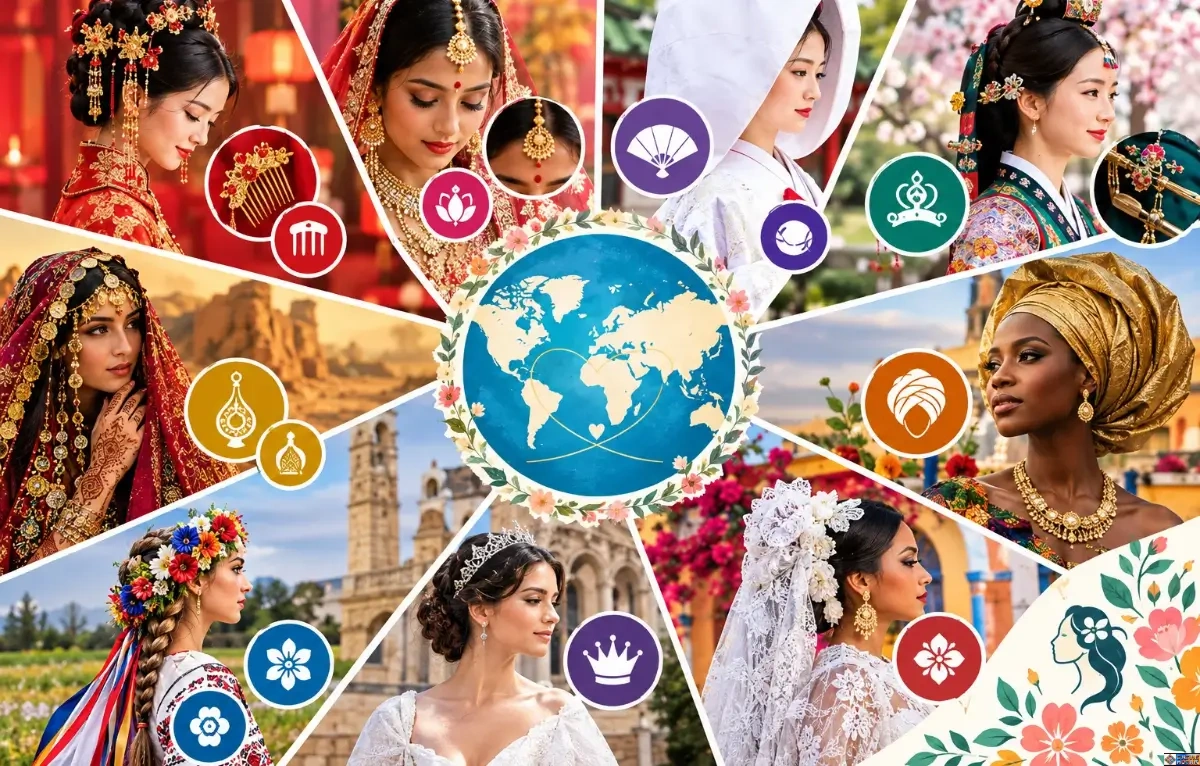
Quick Summary. Global wedding hair traditions all do one job: they make a private change public. Someone who was a daughter or a son becomes a spouse, and the hair announces it. This guide walks through nine traditions: China’s four-stroke Shang Tou combing, India’s maang tikka and sindoor, Japan’s tsunokakushi hood, Korea’s jokduri crown and binyeo pin, the henna, coin and scent customs of the Middle East, Nigeria’s gele and Southern Africa’s married-woman headwear, Ukraine’s vinok and unbraiding, Europe’s long road from Roman spear-parted locks to the Norwegian silver crown, and Mexico’s lace headdress beside Spain’s peineta.
For each one you get the look, the meaning and how it is made, plus a quick-reference table and a short guide to borrowing without disrespect.
You search for bridal hair ideas and the results arrive as a wall of pretty. Crowns, braids, flowers, a hairpin that belongs behind museum glass. Gorgeous. And almost nothing about why.
That gap hurts more than it looks. Maybe you’re honouring a grandmother’s village. Maybe you’re marrying into a family whose customs you only half know. Either way you want the meaning before the look. Wear a sacred object as a costume and you risk insulting the very people you meant to honour. Skip the tradition entirely and something quiet leaves the day.
Here is the fix. Learn the logic. Once you see what global wedding hair traditions are actually doing, not just how they look, you can read a new one in minutes. I’ll set out that logic first, then take you through nine traditions, then show you how to use them well. This guide sits inside a larger library at Culture mosaic; if you want the wider map first, start with What Traditions Are Common in Weddings and come back.
Why Global Wedding Hair Traditions Exist: The Anthropology in Plain English
Start with a strange fact. Hair is dead. Every strand you can see is keratin, no nerves, no blood. Yet almost every society treats it as though it were alive with social information. Cut it, cover it, braid it, shave it, crown it. Each choice says something a crowded room can read in a second.
Anthropologists spotted this early. Edmund Leach argued in 1958 that ritual treatment of hair works like a public language for private changes. C. R. Hallpike answered in 1969 with a sharper claim: long, loose hair tends to signal someone standing outside ordinary social control, while cutting or binding it brings the person back inside. Anthony Synnott later framed hair as both intensely personal and completely public. The scholars argue about the mechanism. Nobody argues that the signal is real, and it runs through every one of the global wedding hair traditions below.
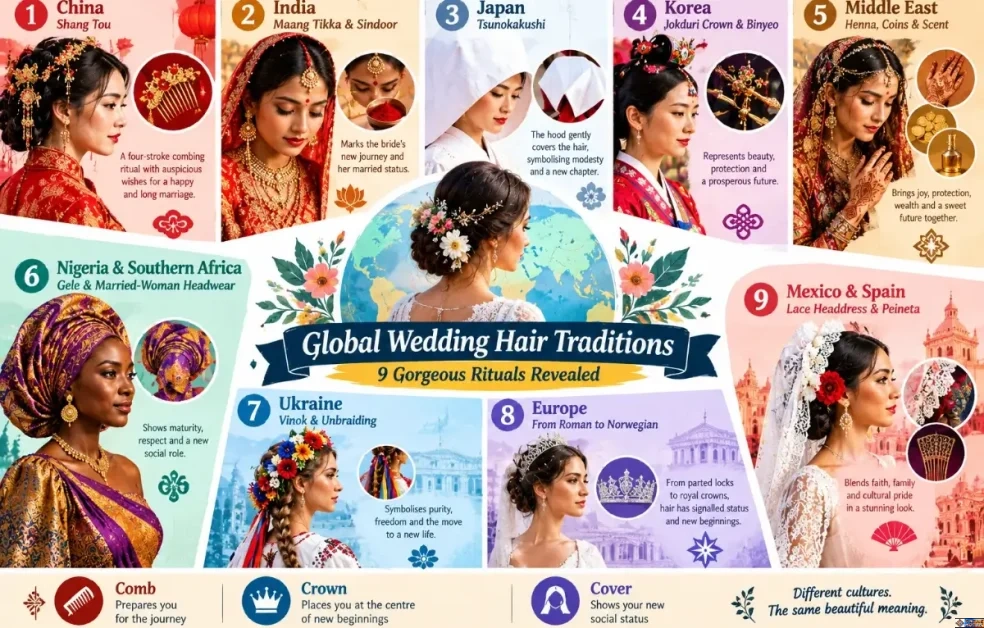
Arnold van Gennep gave us the frame back in 1909: a rite of passage has separation from the old status, a threshold in between, and incorporation into the new one. Weddings are the textbook case, and hair manages all three jobs at once. For the wider picture of cultural anthropology wedding customs, Marriage Rituals in Different Cultures Anthropology goes further than I can here.
Sort the global wedding hair traditions below and I think three gestures keep coming back. I call them comb, crown and cover. That’s my own sorting, not a formal scholarly category, so weigh it accordingly. The comb is a hand preparing you (China, Ukraine, Rome). The crown makes you the centre of the room (Korea, Norway, Greece). The cover tells the community your status has changed (India’s sindoor, the Zulu isicholo, the Ukrainian cap). Many traditions use two of the three. A few use all.
One more thought before the tour. Nearly every ritual here puts someone else’s hands in your hair, and usually someone older. That closeness is part of the point, and part of why these customs outlast fashion. I’ve written about how bodies hold ritual memory in Somatic Heritage Practices. Hair may be the plainest case of all.
A cultural sensitivity note. Global wedding hair traditions belong first to the people who live them. These are living practices, and some objects are sacred to the people who use them. Describing a tradition is not permission to copy it. Regional variation is enormous, so one line in this guide cannot speak for every family. I’m also deliberately not summarising Native American hair customs as a single thing, because hundreds of distinct nations hold their own. For one nation’s ceremony told on its own terms, see Native American Cherokee Wedding Traditions.
Traditional Bridal Headwear Around the World: 9 Traditions, Up Close
1. China: Shang Tou Meaning and the Four-Stroke Blessing
The night before the wedding, a pair of candles is lit and someone combs the couple’s hair four times. That’s the whole rite. Its power sits in the restraint.
Singapore’s National Heritage Board, which documents Chinese wedding customs in its intangible heritage register, describes shang tou (上头) as a night-before ritual marking the couple’s passage into adulthood. The comb is held by a woman considered fortunate, meaning her husband, children and grandchildren are all alive, and each stroke comes with an auspicious phrase. Both partners are combed, not only the bride.
The wording shifts by dialect and family, and I’d distrust any single tidy list. The usual blessings run along these lines: a marriage that lasts, harmony, many descendants, long life. Wedding guides from Singapore and Malaysia add that many families have the couple wash beforehand in water steeped with pomelo leaves, and share sweet glutinous rice balls (tangyuan) afterwards.
The blessings are spoken, never printed, which makes this a small piece of oral tradition. If that thread interests you, Why is Oral Storytelling Important follows it.
There is an older ancestor. The Liji (Book of Rites) records that a girl who has been promised in marriage has the hairpin put in and receives a courtesy name. I read shang tou as a cousin of that ancient pinning rite, though that reading is mine, not settled consensus.
Then there is the crown. The fengguan, or phoenix crown, is the best-known piece of Chinese bridal headwear: gold, pearls and kingfisher-blue detail shaped into phoenix forms. As the story is commonly told, it belonged to ranked court women, and later dynasties let ordinary brides borrow the look for a single day. A one-day promotion, in effect. Today most couples wear a fengguan-inspired headpiece for the tea ceremony or the morning “collecting the bride” session, and keep the comb for the night before.
2. India: Maang Tikka Symbolism, Sindoor and the Flower-Wrapped Braid
Maang means the parting in the hair. That tells you what the ornament is. A maang tikka is a pendant on a fine chain, hooked into the parting so the jewel rests at the centre of the forehead. Many families connect that spot with the ajna chakra, the so-called third eye, and with protection and blessing. That reading is popular, not universal, and plenty of brides wear the tikka simply because it is what brides in their family wear.
The parting does more work in many Hindu weddings. In sindoor daan, the groom draws vermilion along the bride’s parting, and in many communities wearing it afterwards signals a married woman. Anthropological studies of Bengali marriage, such as Lina Fruzzetti’s, treat sindoor as a core marital symbol. Practice varies widely, though. Plenty of modern wives wear it only for ceremonies, and some communities have never used it.
Regional variation is where this section gets rich. Rajasthani brides often wear a borla, a domed ornament set on the crown of the head. Bengali weddings feature the pith-and-sola crown, the bride’s mukut and the groom’s conical topor. In many Tamil and Telugu weddings the braid is lengthened and threaded with gold hair jewellery, while strings of jasmine (gajra) are pinned along it or ringed around a bun. Preparation is mostly patience: oiling, washing, sectioning, then flowers pinned strand by strand.
If you are searching for traditional hairstyles for saree wear, three classics hold up. A low side bun ringed with flowers. A long braid threaded with gajra. A soft half-up wave beneath the pallu. My vote goes to the low bun. It sits quietly under a draped pallu and doesn’t fight the fabric. Pair it with a maang tikka and you have a complete look with centuries behind it.
3. Japan: Tsunokakushi, Shiromuku and the Wig Beneath
The classic Japanese bride wears shiromuku, a kimono of pure white, and covers her head with one of two things. The tsunokakushi is a stiff white hood whose name translates as “horn hider”. The wataboshi is a softer, floppy white hat. Beneath either sits a nihongami updo, classically the bunkin takashimada, a high, lacquer-smooth chignon fixed with combs (kushi) and ornamental pins (kanzashi).
Creating it is specialist work. At shrine weddings and in bridal salons the hair is typically a fitted wig, a katsura, because the sculpted shapes are hard to build and hold on natural hair through a long ritual day. For kimono and dress in the wider cultural context, Liza Dalby’s Kimono: Fashioning Culture is the standard English-language reference.
What does the hood mean? Sources disagree, and that’s the honest answer. One popular account says it hides the “horns” of jealousy and ego. Another says it expresses a bride’s vow of gentleness and patience. A third, plainer account says it simply protects a very elaborate hairstyle. I find the jealousy story hard to love, since it casts the bride as a risk to be managed. The patience reading is easier to live alongside. Treat all three as folklore as much as documented fact.
4. Korea: The Jokduri Bridal Crown, the Binyeo and the Braid That Becomes a Bun
In Joseon-era Korea, hair worked like a calendar. An unmarried girl wore a single braid down her back, finished with a ribbon called a daenggi. A married woman rolled her hair into a chignon at the nape and fixed it with a binyeo, the long ornamental hairpin. The wedding is the day the braid becomes a bun. The Encyclopedia of Korean Folk Culture, run by the National Folk Museum of Korea, documents this shift in dress and hairstyle at marriage.
The jokduri (the Korean jokduri bridal crown) is a small black silk crown, embroidered in gold thread and set with beads and stones, worn with ceremonial dress such as the hwarot or wonsam. The binyeo’s decorative head is often carved or cast with motifs of longevity and luck, and material once followed rank. Many modern couples wear hanbok for the pyebaek, the family greeting ceremony after the main wedding, and that is where a jokduri most often appears today.
5. Middle East and North Africa: Henna, Coins and the Scent of Smoke
This is the hardest tradition to write about honestly, because “the Middle East” is dozens of cultures. So I’ll keep the claims small and tell you where my confidence thins.
The henna night, the evening before the wedding in much of the region, gathers women to paint the bride’s hands and feet. Henna has long doubled as a hair dye and conditioner there too. In Morocco, a professional dresser called a negafa manages the bride’s several outfits, hair and jewellery across the day. In Palestine, brides historically wore caps sewn with silver coins, a family’s wealth carried on the head. Shelagh Weir’s Palestinian Costume documents these headdresses in detail. In Persian weddings, the sofreh aghd ceremony holds a cloth over the couple while sugar cones are rubbed above their heads so their life will be sweet.
Gulf wedding practitioners often describe scenting the bride’s hair over a burner of bukhoor, the fragrant smoke of oud and resins. I have not found a rigorous academic account, so I’m passing it on as reported custom, not established fact. For brides who wear the hijab, the same logic of crown and cover applies: the beauty moves into the headband, tiara, pearls or flowers set over the cloth. The adornment is still the hair’s job, just done on top.
6. Nigeria and Southern Africa: Gele, Isicholo and Hair That Talks
Nigerian gele wedding meaning starts with the object. A gele is a large wrap of stiff cloth, such as aso-oke or another heavy fabric, folded and pleated into a sculpture on the head. At Yoruba weddings the bride and her women often coordinate their cloth and their gele, and a skilled gele-tier is a professional whose work is judged as closely as the dress.
What does it mean? Here I’d resist anyone selling a secret code in every fold. The gele broadly marks an adult woman dressed for a major occasion, and its scale carries celebration, status and respect. Underneath, Yoruba hair-threading and braiding have a long history of their own. Lori Tharps and Ayana Byrd, in Hair Story, describe how West African hairstyles historically communicated age, marital status, wealth and rank, which is why hair mattered so much to the people who wore it.
Further south the marker moves to the head covering. Zulu married women traditionally wore the isicholo, first a sculpted topknot treated with ochre and later a flat-topped woven hat. Xhosa married women wear the iqhiya, a headwrap whose colour and tying vary by family and region. In both cases the covering says the same thing a ring says elsewhere. The Berg Encyclopedia of World Dress and Fashion volume on Africa is a good place to follow the regional detail.
7. Ukraine: The Vinok Bride Wreath, the Unbraiding and the Cap
The Ukrainian vinok bride wreath is a crown of flowers, ribbons and often sprigs of evergreen periwinkle (barvinok), the plant commonly said to stand for lasting life. Ribbons stream down the back in colours that vary by region. A maiden’s hair is loose or in a single braid beneath it. Hutsul, Poltava and Polissia wreaths differ in shape, flowers and ribbon palette, so there is no single correct vinok.
Here is where it turns. In the unbraiding (rozpletennia), the bride’s maiden braid is taken apart by women of her circle, often to the sound of songs that mourn the end of girlhood. The hair is then put up and covered with a cap (ochipok) or a long linen cloth (namitka), the sign of a married woman. Comb, crown, cover. All three in one afternoon. The Internet Encyclopedia of Ukraine’s entry on weddings records the ritual sequence.
I think this is the most quietly devastating hair ritual on the planet. A room full of women taking something apart, singing while they do it, then putting a cap on the person they love. It is grief and celebration with the seam showing.
8. Europe: Roman Spear Parting to the Norwegian Silver Crown
Europe’s story is a relay race, and the oldest runner is Rome. A Roman bride’s hair was dressed in six locks (seni crines), traditionally parted with a spear point, the hasta caelibaris, and she wore a flame-coloured veil, the flammeum. Plutarch asks in his Roman Questions why the spear, then offers several guesses without settling the matter, including echoes of marriage and early warfare. If the Roman angle grabs you, Ancient Roman Wedding Traditions and Roman Wedding Night Ritual carry the story forward.
The crown thread runs through the Christian world. In Greek and wider Orthodox weddings, the couple wear stefana, crowns joined by a ribbon, and exchange them three times. The longer story of crowning is in Crown Family Wedding Traditions. In Norway, the silver bridal crown, often lent by a parish or passed down in a family, is hung with pendants that jingle. Folk belief held that the sound drove off evil spirits. Store norske leksikon, Norway’s national encyclopedia, has an entry on the brudekrone. German-speaking regions favoured the myrtle wreath, and Queen Victoria’s 1840 orange-blossom wreath over a lace veil helped carry the flowers-and-veil look far beyond Britain. The Royal Collection Trust holds the records.
Veils bring us to the question people type into search engines more than any other: why? Christian head covering owes much to Paul’s instruction on head coverings in 1 Corinthians 11, which What Are Christian Wedding Traditions unpacks. For the veil’s longer arc, see History of the bridal veil and its companion on global bridal veil traditions. The cultural significance of bridal veils and crowns shifts with who is looking: modesty, protection, ownership, ceremony, or just very good lace.
Closer to home for a British reader, Celtic and Irish weddings feature flowers, handfasting and, in modern revivals, flower crowns. I’m not going to invent a Celtic hair rulebook I can’t source. The tradition is better served by Celtic Wedding Traditions and Customs and Irish Wedding Traditions, and Italy’s bridal customs get their own treatment in Italian Wedding Traditions for Bride.
9. Latin America: The Oaxacan Resplandor and Spain’s Peineta and Mantilla
Latin American entries among global wedding hair traditions carry two histories at once. One is Spanish and Catholic. The peineta is a tall decorative comb set high in the hair, over which a lace mantilla drapes, and the pairing travelled with Spanish colonisation across the Americas. In Catholic weddings in Mexico and beyond, a veil or mantilla over a polished updo remains a familiar sight. The Mexican side of the story has its own page in Mexican Wedding Traditions.
The other is Indigenous. Among the Zapotec women of the Isthmus of Tehuantepec in Oaxaca, the resplandor is a starched lace headdress that frames the face like a sunburst, worn for festivals and, historically, for weddings. It became globally famous partly through the portraits of Frida Kahlo, who wore Tehuana dress. For flowers and braids in modern Mexican weddings, fresh blooms woven into a braid or crown are common, and tradition stays flexible there more than rigid.
Quick Reference: Wedding Traditions List by Hair and Headwear
This table pulls the nine global wedding hair traditions together. Treat each cell as the commonest form of a custom, not the only form.
Bride Hair Rituals Across Cultures: What Changes After the Wedding
Here is the pattern I find most useful when reading any of the global wedding hair traditions for the first time: ask what the hair looked like before the day and what it looks like after. The answer often tells you the whole story. This is a small piece of original analysis built from the sources above, so check it against family practice before you rely on it.
The shape repeats. Open becomes bound. Loose becomes covered. Plain becomes marked. Rarely, as in the shaving customs I describe in the FAQ below, it goes the other way.
Do Grooms Have Hair Traditions? Traditional Hairstyles for Men
They do, though the groom’s version is usually a hat, a turban or a flower veil more than a hairstyle. In Chinese shang tou the groom is combed too, in his own room. In Korea, a man’s coming-of-age had earlier meant a topknot and the horsehair gat hat, and the groom’s formal headgear still echoes it. In many Indian weddings the groom’s turban (safa or pagri) is tied by family members, and some grooms add a sehra, a curtain of flowers or beads that falls over the face.
Yoruba grooms commonly wear the fila, a fitted cap in aso-oke or other fabric, often matched to the bride’s gele. For anyone researching traditional hairstyles men wear within global wedding hair traditions, the lesson is plain: the head is dressed, the hair underneath mostly stays itself.
The Artistry Behind Wedding Hair: Hands, Time and Patience
Every one of these global wedding hair traditions shares a quiet craft ethic. The Japanese updo needs a specialist. A gele can take an expert a long stretch to fold. A Ukrainian wreath is built from living plants that wilt by evening. A coin cap is heavy; a jokduri is stiff; a vinok pulls. None of this is comfortable and all of it is the point. These adornments announce that the day has weight, literally. If you borrow one, plan time, plan a trial run, and plan for the person doing it to be paid and credited.
Children enter these rituals sideways. For little ones, a flower girl in a daisy-style crown nods to the vinok, and a single braid with a ribbon echoes the Korean daenggi. Keep it simple and keep it comfortable. Cultural hairstyles for kids work best when the child can sit through the ceremony without tugging.
How to Borrow From Global Wedding Hair Traditions Without Getting It Wrong
You can honour any of the global wedding hair traditions without wearing a costume. I’d use three tests, and then a strange fourth idea if you are feeling brave.
First, ask whose it is. If your grandmother or your partner’s family holds the custom, ask them to teach it. That’s inheritance, not borrowing. Second, separate the sacred from the decorative. A comb ritual or a vinok built with a family elder’s guidance is different from a sindoor line used as a prop, and a maang tikka as a fashion piece is different again. When in doubt, ask a practitioner or a cultural centre. Third, borrow the structure, not the costume. The comb-crown-cover idea travels easily. Have a trusted elder comb your hair before the ceremony while she says a blessing in your own words. Add a crown or flowers. Then cover, or mark, as your own heritage suggests.
The wildcard: try an unbraiding. Have your closest women take down a braid together at the end of the evening, with no veil, no ceremony, no speech. It borrows the shape of the Ukrainian rite and none of its sacred objects, and it works for any couple, any gender. If you’re planning a ceremony outside a faith setting, wedding ceremony rituals non religious has more such ideas, and Modern Cultural Wedding Dresses shows how to pair hair with a gown.
For a bigger list of ideas to compare, Best Wedding Traditions Worldwide and Cultural Marriage Traditions sit alongside this guide, and a short programme note naming the origin of each custom you use is a courtesy that costs nothing.
Somewhere tonight a hand is lifting a comb, and a woman is saying a few words that no one will write down.
Global Wedding Hair Traditions: Frequently Asked Questions
1. Why do brides wear veils or headpieces?
Brides wear veils and headpieces for different reasons in different places. Roman brides wore a flame-coloured flammeum as part of the wedding rite. Christian practice draws on Paul’s instruction on head coverings in 1 Corinthians 11. Queen Victoria’s 1840 wedding, with orange blossom and a lace veil, cemented the white veil in Britain. In many traditions the headpiece also marks the bride as the centre of the ceremony, offers protection, or signals the move into married life. Meanings overlap and change by community, so ask a family member what theirs means.
2. What is the significance of the hair-combing ceremony?
In Chinese weddings, the hair-combing ceremony (shang tou) is held the night before the wedding and marks the couple’s passage into adulthood. A woman considered fortunate, with her husband, children and grandchildren living, combs the hair four times, each stroke paired with a blessing. Common blessings cover a lasting marriage, harmony, descendants and long life, though exact wording varies by dialect and family. Among global wedding hair traditions, the ritual has quieter echoes wherever an elder prepares the bride’s hair before the day.
3. Do grooms have hair traditions?
Yes, though the groom’s tradition often focuses on headwear. In Chinese shang tou the groom’s hair is combed too. Many Indian grooms wear a turban, and some add a flower or bead veil called a sehra. Yoruba grooms in Nigeria commonly wear a fila cap, while Korean ceremonial dress for men includes the gat hat that echoes an older topknot tradition. In most of these customs, the head is dressed rather than restyled.
4. Why do some cultures emphasize shaving hair for marriage?
Shaving at marriage is a minority custom worldwide. The best-known examples come from some Jewish communities, where historians record brides having their hair cut or shaved before the wedding, and where some Hasidic groups still do so, followed by covering the head with a wig, scarf or hat. Practices differ widely and many communities never followed them. Anthropologists read such customs as marking a sharp break between the old status and the new, which fits Leach’s and Hallpike’s work on hair and social control. Ask someone from the community for specifics.
5. Can I wear a hair tradition from a culture that isn’t mine?
You can, if you do it with care. Learn what the piece means, ask a practitioner or a family member from that culture, and avoid sacred objects used as props. Borrowing the structure of a tradition, such as an elder’s blessing while combing your hair, is usually easier to defend than copying a costume. Credit the origin in your programme or speech, pay the artisan who makes the piece, and expect that some communities will say no. Respect that answer.
Sources
- National Heritage Board (Singapore). “Chinese Weddings.” Roots.gov.sg, Intangible Cultural Heritage. https://www.roots.gov.sg/ich-landing/ich/chinese-weddings
- Legge, J. (trans.). Liji (Book of Rites), “Qu Li.” Chinese Text Project, ctext.org.
- Plutarch. Roman Questions (Quaestiones Romanae), 87. Moralia, Loeb Classical Library; online at LacusCurtius, penelope.uchicago.edu.
- Festus (Paulus Diaconus). De verborum significatu, entries on seni crines and the hasta caelibaris (spear used in parting the bride’s hair).
- Van Gennep, A. (1909; Eng. trans. 1960). The Rites of Passage. University of Chicago Press / Routledge.
- Leach, E. R. (1958). “Magical Hair.” Journal of the Royal Anthropological Institute, 88(2), 147-164.
- Hallpike, C. R. (1969). “Social Hair.” Man, 4(2), 256-264.
- Synnott, A. (1987). “Shame and Glory: A Sociology of Hair.” British Journal of Sociology, 38(3), 381-413.
- Fruzzetti, L. M. (1982). The Gift of a Virgin: Women, Marriage, and Ritual in a Bengali Society. Rutgers University Press.
- Banerjee, M. and Miller, D. (2003). The Sari. Berg.
- Dalby, L. (1993). Kimono: Fashioning Culture. Yale University Press.
- National Folk Museum of Korea. Encyclopedia of Korean Folk Culture (entries on traditional wedding dress, hairstyles and the binyeo). folkency.nfm.go.kr
- Weir, S. (1989). Palestinian Costume. British Museum Publications.
- Byrd, A. D. and Tharps, L. L. (2001). Hair Story: Untangling the Roots of Black Hair in America. St. Martin’s Press.
- Eicher, J. B. and Ross, D. H. (eds.) (2010). Berg Encyclopedia of World Dress and Fashion, Volume 1: Africa. Berg.
- Internet Encyclopedia of Ukraine (Canadian Institute of Ukrainian Studies, University of Alberta). Entry: “Wedding.” encyclopediaofukraine.com
- Store norske leksikon. Entry: “brudekrone.” snl.no
- Royal Collection Trust. Collection records for Queen Victoria’s 1840 wedding wreath and Honiton lace veil. rct.uk
- Bible, 1 Corinthians 11 (on head coverings).