
 By Marcus J. Holloway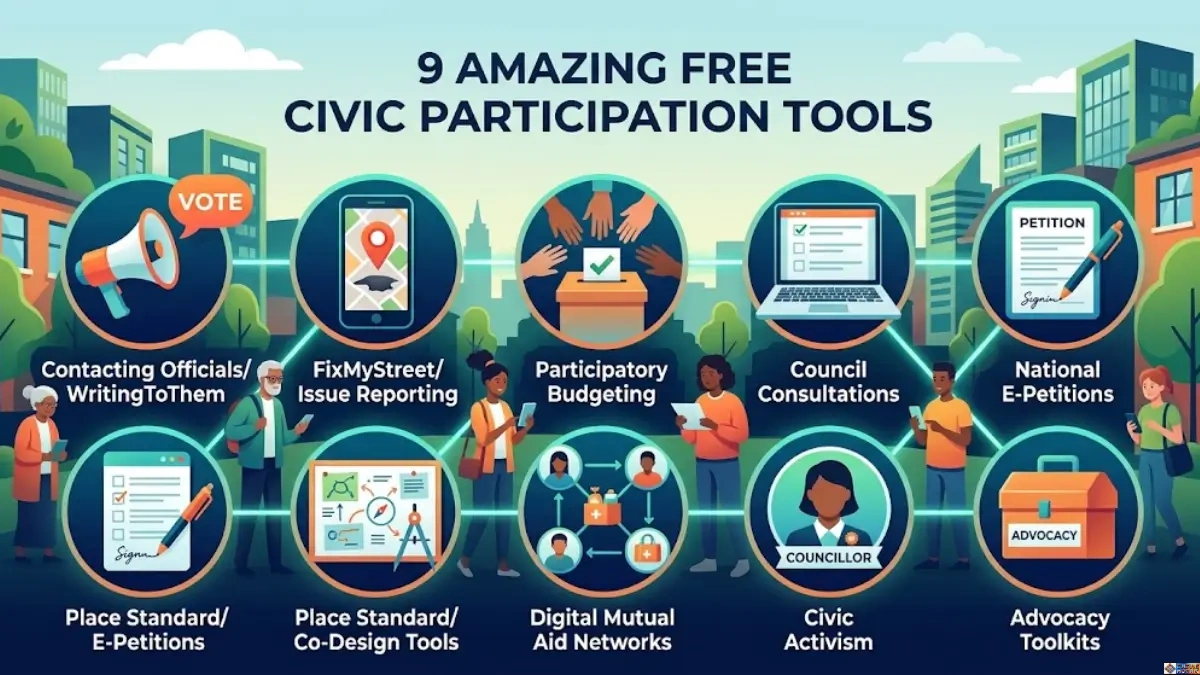
Quick Summary
- • Civic participation tools are the platforms — digital and physical — that let residents actually shape decisions on budgets, planning, and local services, rather than just hearing about them after the fact.
- • The UK’s newest official measure, the Community and Engagement Survey 2025/26, found 46% of adults in England took part in some form of civic engagement in the past year, up from 41% the year before.
- • Free, UK-built tools such as WriteToThem, FixMyStreet, and the Parliament e-petitions site let anyone contact a representative or flag a broken streetlight in minutes, at no cost.
- • Participatory budgeting platforms — used at scale in places like Newham — hand residents a real say over how public money gets spent, not just a comment box.
- • Councils run most of their formal consultations through platforms such as Commonplace, Citizen Space, and Go Vocal, so knowing where your council actually posts things matters as much as knowing the tools exist.
A planning notice zip-tied to a lamppost in the rain. A council consultation link buried on page 40 of a PDF nobody was ever going to open. A meeting held at 2pm on a Tuesday, in a room that seats twenty, for a decision that affects twenty thousand. This is what “getting involved” has looked like for most people, for most of modern British local government, and it’s exactly why so many good, capable people quietly stop trying.
I get why. Turning up to speak for two minutes at a planning committee, then watching the vote go the other way anyway, teaches a lesson fast: your time is worth more than that. Multiply that experience across a borough and you get the numbers behind most consultation responses — a few dozen people, usually the same few dozen, usually not representative of the street outside.
Civic participation tools exist to close that gap. Not by making local democracy louder, but by making it reachable — from a phone, in five minutes, without needing to know the difference between a ward councillor and an MP. And the UK, as it turns out, builds rather a lot of these tools. Some are free. Some are council-licensed software most residents have never heard of. A few started as one person’s frustration with a broken payphone. Here are nine worth knowing, roughly in the order you’d meet them.
1. Council Consultation Platforms — Where Community Engagement Tools Actually Live
Most people’s first brush with civic participation tools is accidental: a link in a council newsletter, a QR code on a bin lorry, a Facebook ad about a road closure. Behind that link sits one of a small handful of platforms that now run the bulk of UK council consultations — Commonplace, Citizen Space, Go Vocal, and Bang the Table’s EngagementHQ among them.
These are the community engagement tools doing the unglamorous, structural work: hosting surveys, mapping comments against a literal map of the neighbourhood, and — crucially — giving councils a paper trail that shows who was asked and what they said. The Local Government Association’s own roundtable on transformation named the exact mix in use across England: Go Vocal in Havant and Newham, Citizen Space in Buckinghamshire, Bang the Table in Barnet, the Place Standard Tool in Newcastle, EngagementHQ in Oldham, Commonplace also in Oldham, and even Miro pressed into service for live co-design sessions.
None of that is glamorous. I’d argue that’s the point. Good civic participation tools rarely are — a council consultation platform’s job is to be boring and reliable, the civic equivalent of plumbing. You want it to work every time, not to win a design award. If your council has a name for its engagement hub, that’s almost certainly one of these tools wearing a local badge — worth bookmarking, because it’s usually where the actual decisions get made public before they’re finalised. We’ve written more on where these decisions get shaped in Local Civic Engagement Strategies, and on the basics in Civic Engagement.
2. Participatory Budgeting Software and the Rise of Hyper-Local Budgeting
Consultation asks your opinion. Participatory budgeting hands you an actual budget line. Among civic participation tools, it’s a different order entirely, and it’s the one I find genuinely striking when it works.
Newham’s People Powered Places programme is the sharpest UK example running right now. Between 2021 and 2023, the borough put £1.6 million from its Neighbourhood Community Infrastructure Levy directly into resident hands, funding 157 local projects. The digital side runs through Newham Co-create, a Go Vocal-powered platform that logged 16,552 resident engagements over that period — more than five times the participation of the 2018–2020 cycle. That’s not a rounding error. That’s a borough that changed how many people showed up by changing the tool they showed up on.
It isn’t the first attempt, either. Tower Hamlets ran a participatory budgeting scheme called “You Decide!” across the whole borough with £2.38 million a year over two years — one of the earliest and largest UK trials of the model, and one that surfaced a genuinely uncomfortable finding: some residents argued young people, who don’t pay council tax directly, shouldn’t get an equal vote on how it’s spent. I don’t share that view, but it’s worth knowing the argument exists, because it resurfaces every time a council debates who gets a ballot.
Then there’s hyper-local budgeting at a much smaller scale — schemes like Northern Ireland’s Grand Choice initiative in Downshire East, where Community Planning partners pooled £15,000 for local people to allocate directly. Small money, same principle: real spending power, not a suggestion box. Newham’s own People Powered Places programme is explicit about running as a people powered mission rather than a top-down grant scheme, which is precisely why the participation numbers moved the way they did. Both of these count among the more compelling participatory budgeting examples in England right now. For the fuller picture of what these programmes are trying to achieve, see What Is the Value of Civic Participation? and 10 Civic Engagement Opportunities.
3. mySociety’s Free Democracy Stack — Civic Participation Tools Online, at No Cost
If you want civic participation tools online that are genuinely free, not “free trial,” look at mySociety. The UK charity behind WriteToThem, FixMyStreet, TheyWorkForYou, and WhatDoTheyKnow has been building this stack since 2003 — reportedly sparked, in one telling, by a vandalised phone box that made founder Tom Steinberg wonder why reporting it to the council was so hard.
WriteToThem lets you find and message your MP or councillor without knowing their name first. FixMyStreet does the same for potholes, broken streetlights, and flytipping — you drop a pin, add a photo, and it routes the report to whichever authority actually owns that stretch of pavement. Thirty-one UK councils now run FixMyStreet Pro as their primary reporting system, which tells you something: this service saves councils money and staff time too, not just residents’ patience.
TheyWorkForYou turns Hansard into something searchable and subscribable. WhatDoTheyKnow walks anyone through a Freedom of Information request and publishes the answer for good, so nobody has to ask the same question twice. All four are open source, all four are free, and all four exist because one small team decided civic participation tools free of charge and free of jargon shouldn’t be a niche idea. For the case for using them at all, we’ve covered that in Why Is Voting Important in Local Elections?, Civic Voice, and Volunteer for Civic Education Programs.
4. The E-Petitions System — A Free On-Ramp Into National Debate
Petitions to Parliament are older than most of what’s in this list — the Commons has handled them since resolutions in 1669 — but the current digital version is a genuinely modern civic participation tool with clear, published rules. A petition needs six supporters and a clean check against the site’s standards before it goes public. At 10,000 signatures, the government has to publish a written response. At 100,000, the Petitions Committee — a cross-party group of backbench MPs — considers it for a Westminster Hall debate.
Worth being honest about what that debate actually is: general, not a vote on legislation, and “considered” doesn’t mean guaranteed. But ministers do have to turn up and answer for the record, and that alone changes the political weight of an issue. The system traces back to Tony Blair’s original Downing Street e-petitions site in 2006 — which drew 2.86 million active petitions and one with over a million signatures within six months — before a 2015 relaunch put it under the Petitions Committee’s direct control. It’s free, it’s fast to use, and it’s precisely the sort of low-friction civic literacy in action that we cover more broadly in Civic Literacy and Understanding Civic Duty.
5. Tactical Urbanism Initiatives You Can Join This Weekend
Not every one of these civic participation tools lives on a screen. Tactical urbanism initiatives — the “lighter, quicker, cheaper” school of urban change popularised by Mike Lydon and Anthony Garcia — turn a parking bay into a parklet, a road into a play street, a blank wall into something worth looking at, all without waiting years for a masterplan.
London boroughs have formalised this more than most people realise. Hackney runs parklet schemes through a “keeper” arrangement, where nearby businesses or residents take on day-to-day upkeep as a condition of installation. Lambeth’s business parklet scheme works similarly, with applicants responsible for maintenance and eventual removal while the council keeps a supervisory role. It’s participatory in a very literal sense: you don’t just get consulted on the parklet, you’re expected to sweep it.
Small grant programmes exist to fund exactly this kind of hands-on intervention — I’d point anyone starting out toward Love Your Block Grant 2026 and Micro-Civic Interventions for a sense of scale. And if murals feel more your speed than planters, we’ve written a full breakdown of the legal and funding routes in Community Street Murals UK and Grassroots Murals UK Civic Engagement, plus a practical walkthrough in Organising a Neighbourhood Mural. For the broader case that these small, physical projects count as civic engagement in their own right, see Tactical Urbanism in Community Civic Engagement and DIY Placemaking Community Engagement.
6. Digital Mutual Aid Networks — the Tools Behind Neighbour-to-Neighbour Support
Digital mutual aid networks are the least formal of the civic participation tools on this list and, in some ways, the most immediately useful. Covid-19 Mutual Aid UK, coordinated through a national Facebook hub, pointed people toward thousands of hyper-local groups almost overnight — the kind of infrastructure that gets built out of necessity and then, if a community’s lucky, doesn’t fully disappear once the emergency ends.
That “doesn’t fully disappear” part is the hard bit, and I don’t think it’s honest to pretend otherwise. Academic work published in 2026 on sustaining digital mutual aid found what a lot of organisers already suspected: online communities without pre-existing offline ties struggle to keep reciprocity and accountability going once the crisis energy fades. A WhatsApp group formed in April can be a ghost town by September. That’s not a failure of the tool, exactly. It’s a reminder that the tool is only ever as strong as the relationships underneath it.
Where it does stick, it’s often folded into wider community activism — food-share groups, tool libraries, informal skill exchanges — the kind of thing we’ve mapped out in Community Activism Strategies and Real-World Problems. It also sits close to the bigger story of how neighbourhoods hold together across real difference, which is where I’d send you to Diverse Civic Harmony and Social Change in Modern Society.
7. Gen Z Civic Engagement Platforms — and a Statistic That Might Surprise You
The story you’ll hear most often about Gen Z civic engagement is that young people have simply moved the whole business online — organising through group chats, TikTok, and single-issue campaigns rather than committee rooms. There’s truth in that. There’s also a number that complicates it, and I think it’s more useful than the tidy narrative.
England’s Community and Engagement Survey 2025/26 found people aged 16 to 24 were among the least likely age group to have taken part in any form of civic engagement in the past year — 35%, against a 46% national average. Compare that with 65 to 74 year-olds at 51%, the single most engaged age band. So no, digital-native platforms haven’t automatically closed the age gap. If anything, the data suggests the opposite of the assumption baked into most youth-engagement strategy decks.
My honest read: the tools matter less than who bothers to design them with young people rather than for them — school councils, the UK Youth Parliament, and platforms built around issues (climate, housing, mental health services) rather than institutions tend to do better than a generic “youth portal” bolted onto a council website. We go deeper on what’s actually working in Youth Engagement Strategy and From Hashtags to Agency 2026, and on the wider pattern of who shows up and why in Civic Engagement Trends.
8. Co-Design and Virtual Engagement Activities for Planning Decisions
Consultation asks “what do you think?” Co-design asks “help us build it.” Newham’s own engagement lead has drawn that line clearly, arguing that co-design demands active collaboration and shared decision-making between people with lived experience and people with professional planning expertise, not a one-way survey.
In practice this now happens as much on a screen as around a table. Miro boards run live co-design workshops. Scotland’s Place Standard Tool structures conversations about a neighbourhood’s physical, social, cultural, and economic life into a shared “compass diagram” that’s been adopted by councils across the UK, not just north of the border — Edinburgh’s spatial policy team has specifically praised it for reaching young people that other formats struggle with. These virtual engagement activities matter because they let someone contribute from a hospital waiting room or a night shift break, not just from a Tuesday afternoon meeting they had to book annual leave for.
There’s a real distinction worth holding onto between feedback that shapes a decision and feedback that’s noted and filed. We’ve written on that gap specifically in How Public Feedback Shapes Local Policy, Why Public Consultation Is Important, and What Is Public Commentary?. For how this scales up to genuinely local governance structures rather than one-off sessions, see Vernacular Governance Structures and Hyperlocal Digital Deliberation, and for the co-design argument in full, Co-design in urban planning and civic engagement.
9. Community Advocacy Toolkits and Playbooks
The last of these nine civic participation tools isn’t a single platform so much as a set of frameworks — the toolkits that help a resident turn a private grievance into an organised, credible campaign. A good toolkit tells you how to build a coalition, how to write to a councillor so the letter gets read rather than filed, and how to run a campaign that survives contact with local politics without losing its ethics along the way.
We’ve built out a fair few of these ourselves: the Community Advocacy Toolkit and Hyperlocal Advocacy Toolkits for the practical mechanics, Hyperlocal Advocacy Strategies and Ethical Grassroots Advocacy for the harder question of doing it well rather than just loudly, and Narrative Advocacy for the case that a well-told story moves a council chamber faster than a spreadsheet ever will. Civic Leader’s Playbook pulls a lot of that together for anyone thinking about standing for something more formal, like a parish or town council seat.
I’d add one thing that doesn’t get said enough: some of the most effective advocacy tools aren’t campaign templates at all, they’re the slower, quieter projects that get a community talking honestly about its own past — oral history recordings, community choirs revisiting old songs, local archives finally opened up. We’ve covered that thread in Healing Family Silences and UK community choirs civic engagement, and it’s a genuinely underused entry point — my wildcard pick on this whole list. If you’re starting from zero and just want a plain-language route in, how to get involved in local civic issues online is the place to start.
Free vs Paid Civic Participation Tools at a Glance
Civic Participation vs Civic Consultation vs Civic Activism (England, 2025/26)
Frequently Asked Questions
What are some examples of civic participation skills?
The skills that make civic participation tools actually work are mostly ordinary ones applied deliberately: writing a clear, specific message to a representative rather than a vague complaint; reading a consultation document well enough to respond to the actual question asked; public speaking in a two-minute slot at a council meeting; organising a small group so five voices arrive with one clear ask instead of five different ones; and basic research skills, like knowing which authority actually owns the pothole outside your house before you report it. None of these require a qualification. They’re learned by doing them once, badly, and then better.
What are examples of civic participation?
Signing or starting a petition, writing to your MP or councillor through a service like WriteToThem, responding to a council consultation on a platform like Commonplace, attending a public meeting or Westminster Hall debate, voting in local elections, serving on a tenants’ association or as a school governor, and taking part in a participatory budgeting vote like Newham’s People Powered Places programme all count. So does the smaller, physical stuff — helping build a parklet, joining a mutual aid group, turning up to a neighbourhood planning workshop.
What are community engagement tools?
Community engagement tools are the platforms councils and organisations use to structure conversations with residents at scale — things like Commonplace, Citizen Space, Bang the Table’s EngagementHQ, and Go Vocal. They handle surveys, map-based comments, participatory budgeting votes, and reporting, and they exist mainly so a consultation produces a documented, auditable record rather than a stack of loose emails.
What are some online tools for civic engagement?
WriteToThem and FixMyStreet for contacting representatives and reporting local problems; the UK Parliament petitions site for national issues; TheyWorkForYou for tracking what your MP actually says and votes for; WhatDoTheyKnow for Freedom of Information requests; and council consultation platforms like Commonplace or Citizen Space for formal local input. Most of these are free; the council-run consultation platforms are licensed by the local authority, so residents use them at no personal cost either.
Quick aside: isn’t “platform for community engagement” a crossword clue?
It genuinely is one. Search “platform for community engagement crossword clue” and you’ll usually land on FORUM or AGORA as the answer, since both originally meant a physical public meeting space. If that’s what brought you here: nice detour. But the modern answer to “where does community engagement actually happen” is less a single word and more the full list above.
Sources
- Department for Digital, Culture, Media and Sport / Ministry of Housing, Communities and Local Government — Community and Engagement Survey 2025/26: civic engagement report, GOV.UK
- UK Parliament — Petitions site and Petitions Committee guidance
- mySociety — Impact report and accounts; FixMyStreet and WriteToThem service history
- Go Vocal — Newham Co-create / People Powered Places case study
- Local Government Association — Transformation roundtable on participation, co-design, community engagement and consultation
- Information, Communication & Society (2026) — research on sustaining digital mutual aid communities, Taylor & Francis
- Co-design in the street: everyday urban space, neoliberalism, and the limits of participation in England, 2026 — parklet stewardship in Hackney and Lambeth, Taylor & Francis
- UK Government Communications Service / OECD — Communications and citizen participation toolkit
Read more from Culture Mosaic at culturemosaic.co.uk.