
 By Culture Expert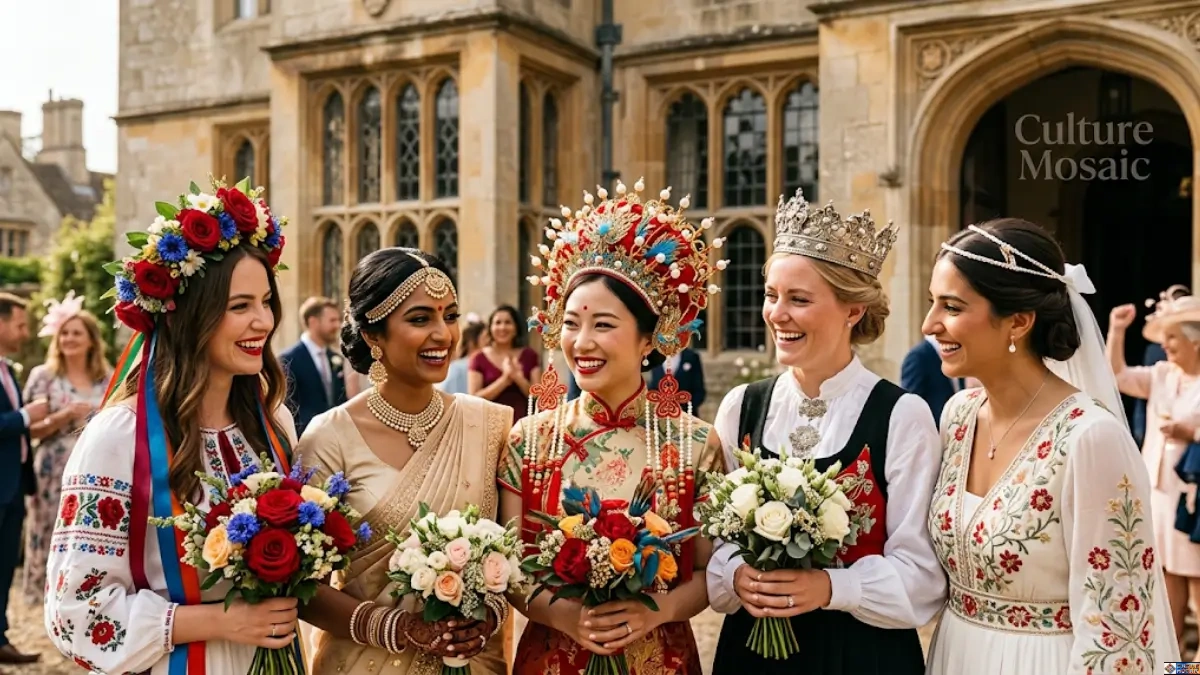
- Veils, crowns, wreaths, and forehead jewels all count as bridal headwear, but they don’t mean the same thing — a veil hides, a crown elevates, a wreath marks a threshold.
- The Western veil traces back to the Roman flammeum, a flame-coloured cloth meant to disguise the bride from evil spirits, not from the groom.
- Silver bridal crowns from Norway and Denmark survive in museum collections today; some were so heavy they had to be stitched into the bride’s hair.
- China’s fengguan, India’s maang tikka, and Greece’s stefana aren’t costume-drawer relics — real brides still wear versions of all three.
- A hat or fascinator isn’t a break from British wedding tradition. It’s simply what centuries of hat-wearing etiquette turned into.
Stand in a bridal shop for long enough and you’ll watch the same small crisis happen over and over. A bride picks up a veil, puts it down, picks up a flower crown instead, frowns, tries a jewelled headband, and asks the assistant — half joking, half not — “what am I even supposed to wear?”
I understand the anxiety underneath that question, because it’s rarely about the object itself. It’s about what the object says. Brides today are marrying across cultures, blending families, reconnecting with grandparents’ countries they’ve never lived in, or simply trying not to get something “wrong” in front of relatives who’ll notice. Headwear carries more freight than any other part of a wedding outfit, and almost nobody explains why.
So here’s what I can offer as someone who studies wedding ritual for a living: a walk through nine Global Bridal Headwear Traditions, checked against museum records, religious sources, and folklore archives rather than wedding-blog guesswork. Some of what follows will surprise you. The veil, for instance, was never really about modesty at first — it was about keeping evil spirits off the bride’s face. Read on and pick your headwear on purpose, not by accident.
Why Cultural Wedding Headwear Symbolism Runs So Deep
Anthropologists have a fairly boring technical name for what a wedding does: a rite of passage. The bride enters the ceremony as one kind of person and leaves as another — daughter becomes wife, girl becomes woman, guest becomes host of her own household. Rites of passage almost always mark that shift on the body, and the head is the part of the body every culture treats as the most meaningful to touch, cover, or crown.
That’s why bridal headwear symbolism splits fairly cleanly into three functions once you look across enough cultures side by side. A veil conceals — from evil spirits, from the groom, from public view, depending on who’s telling the story. A crown elevates — it borrows the visual language of royalty and puts it, briefly, on an ordinary woman’s head. And a wreath marks a threshold — it says this person is passing from one state into another, right now, in front of everyone. Once you know which function a given headwear tradition is performing, the specific object stops looking arbitrary.
I’ve laid out the anthropology behind rites like these in more depth in Marriage Rituals in Different Cultures Anthropology, and the wider pattern of shared customs in What Traditions Are Common in Weddings. This piece narrows in on just the headwear.
1. Ancient Rome: The Flammeum and the Birth of the Veil
Start where the Western veil actually starts, and it isn’t Queen Victoria. It’s Rome, centuries earlier, where a bride wore a flame-coloured cloth called the flammeum over her whole head and shoulders. The colour wasn’t decorative. Roman writers linked it to Vesta, goddess of hearth and fire, and the veil’s job was protective — it hid the bride from spirits believed to prey on a woman at exactly the vulnerable moment she changed status.
The Latin verb for “to marry,” when applied to a woman, was literally nubere — “to veil oneself.” That’s not a minor etymological curiosity. It tells you the veil wasn’t an accessory to the Roman wedding; it was, linguistically, the wedding. I’d argue that fact alone should retire the modern idea that veiling is purely a modesty custom. In Rome it was closer to a spell.
I go further into the Roman ceremony itself, including the parts that had nothing to do with headwear, in Ancient Roman Wedding Traditions and Roman Wedding Night Ritual.
2. What Is the History Behind the Traditional Wedding Veil in the West?
The flammeum didn’t survive Rome intact, but the habit of veiling did, and it moved into the Christian church as a marker of modesty and reverence rather than spirit-warding. For most of that history, though, veils weren’t white. Brides wore whatever colour suited their station — red, blue, even black were common well into the nineteenth century.
What actually invented “the” white wedding veil, as far as the historical record shows, was one specific event: Queen Victoria’s wedding to Prince Albert in 1840. She chose white lace over the cloth-of-gold and crimson velvet that royal brides typically wore, and the choice caught on so widely across British and then American society that within a generation, white had hardened from personal taste into an unwritten rule. It’s a strange origin story for something now treated as ancient and universal — it’s really only about 185 years old.
The broader Christian ceremony this veil sits inside, including its other borrowed customs, is covered in What Are Christian Wedding Traditions. And Italian brides layered their own Mediterranean take on this white-veil moment, which I detail in Italian Wedding Traditions for Bride.
3. Scandinavia’s Silver Crowns: Norway’s Brudekrone
Norwegian bridal crowns, or brudekroner, are where the anthropology gets genuinely physical. Some surviving examples, now held by the Victoria and Albert Museum and Norway’s Vesterheim collection, weigh over a kilogram of silver. Brides occasionally had the crown sewn directly into their hair so it would sit properly through a full day of dancing — which tells you something about how seriously these communities took the symbolism, given the discomfort they were willing to accept for it.
Many crowns weren’t privately owned at all. Village churches held them and rented them out for a fee, which meant even a poor bride could wear the same silver crown as her wealthier neighbour on her one day as, effectively, the village’s temporary royalty. The pattern repeats just across the border: Denmark’s early sixteenth-century Middelfart Crown, unearthed beneath a marketplace in 1933 and now in the National Museum of Denmark, shows the same gilded-silver, ceremonial-royalty logic at work.
Solar motifs show up constantly on these crowns, too — stamped disks and cut suns believed to link the bride’s head to the sky and draw down good fortune, a detail Vesterheim’s own curators have noted echoes similar solar symbolism in Russian and Estonian headdresses. It’s a reminder that “European” bridal tradition is not one thing; it’s a patchwork with more in common with Eastern Europe than with the veil-and-tiara look most people picture.
4. China’s Phoenix Crown: The Fengguan
The fengguan, or “phoenix crown,” began as an empress’s crown, first recorded around the Tang dynasty and standardised under the Ming. It’s a genuinely staggering piece of craft: gold dragons, phoenixes built from inlaid kingfisher feathers, strings of pearls sometimes numbering in the thousands. One archaeological example attributed to Empress Xiao of the Sui dynasty is among the earliest surviving specimens.
What interests me most, as someone who studies how royal symbols trickle down into folk custom, is how the fengguan escaped the palace. By the Ming dynasty, ordinary brides in parts of China — Zhejiang in particular — had earned the right to wear a version of it on their wedding day, becoming, as the custom puts it, “empress for a day.” It’s the closest parallel I know of to the Norwegian church-crown-rental system: two unrelated cultures independently deciding that a wedding day justifies briefly loaning a commoner the visual language of a monarch.
Kingfisher-feather fengguan are now rare and fragile, so most modern wedding versions substitute imitation pearls and rhinestones — a practical compromise, not a loss of meaning. The crown is still recognisably doing its original job.
5. What Do Bridal Crowns Symbolize? South Asia’s Maang Tikka
The maang tikka isn’t a crown in the Western sense — it’s a single pendant hung from a chain along the hair parting, resting at the centre of the forehead. But it does the same symbolic work a crown does elsewhere: it marks the wearer as someone temporarily, ceremonially elevated.
Its placement is deliberate. In Hindu tradition, the point where the tikka rests corresponds to the ajna chakra, the “third eye” associated with clarity and inner perception, and the piece is counted among the solah shringar, the sixteen traditional adornments of a bride. Historically, forehead ornaments like this appear in South Asian sculpture and painting from very early periods, and the form we’d recognise today was substantially shaped under Mughal-era workshops, using kundan-set uncut diamonds and polki stonework that regional traditions — Rajasthani, Punjabi, South Indian — then adapted into their own distinct styles. Documented historical examples sit today in the Victoria and Albert Museum’s South Asian jewellery galleries alongside the Metropolitan Museum of Art’s collection.
The design historian Amin Jaffer has suggested the maang tikka may have started even simpler than metalwork — as an arrangement of real flowers pressed to the forehead, later translated into gold and gemstones. If that’s right, it puts the maang tikka in the same family as the flower wreaths I’ll get to next: jewellery imitating a living plant, long after anyone remembers why.
6. Ukraine’s Vinok: When a Wreath Replaces a Crown
Not every headwear tradition is trying to be royal. Ukraine’s vinok is a flower wreath, historically made from fresh, paper, or wax blooms fixed to a stiffened band, and it marks something closer to eligibility than elevation — it was worn by unmarried girls of marrying age, not brides specifically, and every flower woven into it had assigned meaning: roses for love, cornflowers for modesty, peonies for longevity.
Here’s the detail I find most telling, structurally: on her wedding day, the Ukrainian bride’s vinok was ceremonially removed and replaced with the ochipok, a cap she would then wear as a married woman for the rest of her life. That’s a headwear tradition literally built around the moment of transition — not a single object worn throughout, but two objects, swapped, with the swap itself functioning as the wedding. Few customs make the anthropology this visible.
The vinok nearly disappeared from daily wear during the twentieth century, then came back with real force after Ukraine’s 2004 Orange Revolution and again after 2014, worn now as much as a marker of national identity as of marital status — a reminder that headwear traditions don’t stay frozen in the century they were invented.
7. Jewish Tradition: The Bedeken Before the Chuppah
The bedeken, Yiddish for “veiling,” is a ceremony rather than an object: the groom approaches his bride before the chuppah, surrounded by singing and dancing, and lowers a veil over her face himself. The Jewish Theological Seminary traces its biblical root to Genesis, where Rebecca veils herself on first seeing Isaac approaching — an act she performs, notably, before the marriage, on her own initiative.
A second, more cautionary story usually gets attached to it: Jacob was tricked into marrying the veiled Leah instead of his intended, Rachel, because he never confirmed who was actually under the veil. Many communities now explain the bedeken as the groom “checking” — the Hebrew root b-d-k literally means to inspect — to be sure history doesn’t repeat itself. It’s worth noting the custom is specifically Ashkenazi; Sephardi and Mizrahi traditions mark the equivalent moment through a henna ceremony instead, which is a useful check against treating “Jewish wedding tradition” as one uniform thing.
What I keep coming back to with the bedeken is that unusual detail from the Rebecca story: she veils herself before the union, not after, and some readings take that as a statement that marriage doesn’t erase her independent identity — it happens alongside it.
8. Greek Orthodox Crowns: Stefana and the Dance of Isaiah
Greek Orthodox weddings crown both partners, not just the bride. The stefana are two matching crowns — traditionally olive branches or orange blossom, now often metal or fabric versions joined by a single ribbon — placed on the couple’s heads by the priest during the ceremony’s central rite, literally called “the Crowning.”
The theology attached to it is specific: the couple is crowned as “king and queen” of the small kingdom they’re about to build together, and the connecting ribbon represents a bond meant to remain unbroken for life. Near the end of the service, the priest leads the newly crowned pair around the altar three times in the Dance of Isaiah, their sponsors — the koumbaro and koumbara — following behind, holding the ribbon in place. The custom itself draws on a much older Greek habit of crowning victors and honoured guests with olive or laurel wreaths, later absorbed and re-purposed by the Orthodox church.
Many couples keep their stefana afterward, framed in a case called a stefanothiki, which turns a wedding-day object into a permanent household one — not unlike how a Norwegian brudekrone or a Greek family’s own heirloom pieces get passed down, a pattern I return to in Crown Family Wedding Traditions.
9. The Philippines: The Veil-and-Cord Ceremony
Filipino Catholic weddings fold headwear into a ritual most Western guests have never seen: sponsors drape a white veil over the bride’s head and the groom’s shoulder together, so the two are visibly “clothed as one,” while a second set of sponsors loops a cord — the yugal, usually shaped into a figure eight — around both their shoulders at once. Folklore researchers at USC’s Digital Folklore Archives class it, alongside the coin ceremony, as a life-cycle ritual marking the couple’s shift into a shared communal identity, not just a legal one.
What’s distinctive here is that the headwear isn’t the bride’s alone. The veil physically connects two people rather than adorning one, a structural choice that sets it apart from every other tradition on this list. Three centuries of Spanish colonial Catholicism shaped the ritual, but its emotional logic — covering two people to make them legally and symbolically one — has its own clear internal sense once you see it performed.
Are Bridal Hats a Traditional Alternative to Veils?
Short answer: yes, and in Britain specifically, more traditional than most people assume. Hats have been standard formal wear for British women at any daytime event for well over a century, and weddings are a daytime event by definition. A hat, or its smaller modern cousin the fascinator, isn’t really a rejection of veil tradition — it’s an extension of general British hat etiquette into the one occasion where headwear carries extra symbolic weight.
The two aren’t mutually exclusive, either. Many British brides still wear a veil for the ceremony itself and switch into a hat, headband, or fascinator for the reception — practical, since a full-length veil is awkward for dancing, but also a neat compromise between inherited symbolism and modern comfort.
Traditional Wedding Crowns and Veils, Compared
Laid out side by side, the differences between these forms stop looking random and start looking like three separate strategies for solving the same anthropological problem — marking a change of status on the body.
| Headwear | Form | Core Symbolic Function | Still Worn Today? |
|---|---|---|---|
| Flammeum (Rome) | Flame-coloured full veil | Protection from evil spirits | No — historical only |
| White veil (West) | Lace or tulle veil | Modesty; post-1840, bridal fashion | Yes, widely |
| Brudekrone (Norway/Denmark) | Silver crown | Temporary royal status; church-owned | Rarely — folk/museums |
| Fengguan (China) | Phoenix crown | “Empress for a day” status | Yes — traditional rite |
| Maang tikka (South Asia) | Forehead pendant | Auspiciousness; third-eye symbolism | Yes, widely |
| Vinok (Ukraine) | Flower wreath | Marriageable-age status; swapped at wedding | Yes — heritage dress |
| Bedeken veil (Jewish) | Face veil, placed by groom | Identity confirmation; modesty | Yes — Ashkenazi rite |
| Stefana (Greek Orthodox) | Paired crowns on a ribbon | Coronation as “king and queen” of home | Yes — Orthodox rite |
| Veil-and-cord (Philippines) | Shared veil and figure-eight cord | Unity of two people, made visible | Yes — Catholic rite |
Global Wedding Attire Meanings: A Few More Regional Notes
Nine traditions can’t cover every culture, and I don’t want to pretend they do. A few more are worth a shorter mention here, and worth their own full read elsewhere on Culture Mosaic.
- Mexico: many Mexican Catholic brides wear a floral or beaded crown reflecting Indigenous and Catholic influences layered together over centuries — covered fully in Mexican Wedding Traditions.
- Celtic and Irish tradition: myrtle and flower crowns appear across the Celtic wedding world, often tied to older handfasting customs — see Celtic wedding traditions and customs and Irish Wedding Traditions.
- Native North American traditions: headwear varies enormously by nation and is often tied to specific ceremonial or clan protocols rather than one shared “Native American” style — I’ve written in more detail on Native American Cherokee Wedding Traditions and Red Clay Tribe Wedding Traditions, and I’d urge caution against treating any single nation’s customs as representative of all of them.
Modern Adaptations: Mixing Heritage Without Losing It
Diaspora and intercultural weddings are where these traditions get genuinely interesting, in my view, because they’re where a bride has to make an active choice rather than an inherited one. I regularly see brides pair a Western veil with a maang tikka, or wear a grandmother’s brudekrone for photos and switch to a modern fascinator for the reception, or have both a bedeken and a secular hair comb from the other side of the family.
My own rule of thumb, offered as an anthropologist rather than an etiquette columnist: a tradition borrowed with its meaning intact — understood, credited, ideally worn with input from people who live inside that culture — tends to land as respectful. A tradition borrowed only for its look, stripped of the story behind it, tends to land badly, and people notice the difference more often than brides expect. Bridal jewellery houses have started documenting this history themselves too; Olivia Heirlooms has put together its own overview of Global Bridal Headwear Traditions from the trade side, worth a look alongside the historical record here.
For a wider view of which customs show up again and again across continents — not just headwear — I’ve pulled the recurring patterns together in Cultural Marriage Traditions and Best Wedding Traditions Worldwide.
Frequently Asked Questions
- What do bridal crowns symbolize across different cultures?
Almost universally, a bridal crown borrows the visual language of royalty and applies it briefly to an ordinary woman. Norway’s brudekrone, China’s fengguan, and Greece’s stefana all work this way, even though they developed independently — each turns the bride, and in the Greek case the groom too, into temporary royalty for the length of the ceremony. The specific materials and rules differ enormously, but the underlying logic — wedding day as brief coronation — repeats across cultures that had no contact with one another, which is part of why anthropologists find the pattern so interesting.
- What is the history behind the traditional wedding veil?
The Western veil’s clearest ancestor is the Roman flammeum, a flame-coloured cloth worn to protect the bride from evil spirits rather than for modesty. Christianity later reframed veiling around modesty and reverence, and it stayed a coloured, non-standardised garment for centuries. The specifically white wedding veil is much younger than most people assume — it dates to Queen Victoria’s 1840 wedding, after which white spread through British and American bridal fashion as an imitated style rather than a religious rule.
- Are bridal hats a traditional alternative to veils?
In Britain, yes. Hats have been standard formal daytime wear for women for well over a century, and a wedding is a formal daytime event, so a hat or fascinator fits existing etiquette rather than breaking from it. Plenty of British brides wear both: a veil for the ceremony, then a hat or fascinator for the reception, once dancing makes a full veil impractical.
- Do I have to wear my culture’s traditional headwear at my wedding?
No — and I’d gently push back on anyone who tells a bride she must. Every tradition covered here started as a living, evolving custom, not a fixed rulebook; Ukraine’s vinok nearly vanished from daily use before being revived, and Chinese fengguan now commonly use imitation stones instead of the original kingfisher feathers. Choosing to skip, adapt, or blend a tradition is itself part of how these customs have always changed over time.
- Can brides mix headwear traditions from different cultures respectfully?
Generally, yes, and intercultural weddings do it constantly — a Western veil paired with a maang tikka, or a family heirloom crown worn alongside a modern fascinator. The distinction I’d draw is between borrowing a tradition’s meaning, ideally with guidance from people who live inside that culture, versus borrowing only its look. The first tends to read as respectful; the second is where most of the discomfort around cultural borrowing actually comes from.
Sources
Victoria and Albert Museum, Bridal Crown — catalogue record for a Norwegian silver-gilt brudekrone, 1650–1750.
Vesterheim Norwegian-American Museum, Bridal Crown / Brudekrone — solar symbolism in Norwegian bridal crowns.
Wikipedia, Middelfart Crown — discovery and holding institution, the National Museum of Denmark.
Jewish Theological Seminary, Rebecca’s Veil of Independence — biblical origin and interpretation of the bedeken.
My Jewish Learning, Ask the Expert: Veiled Bride — Ashkenazi origin of the bedeken and its absence from Sephardi/Mizrahi custom.
National Geographic, Spectacular flower crowns rule in Ukraine — the vinok’s post-2004 and post-2014 revival.
Wikipedia, Ukrainian wreath — the vinok-to-ochipok transition at marriage.
Wikipedia, Fengguan — origins and imperial-to-bridal use of the Chinese phoenix crown.
Natural Diamonds, Maang Tikka — History, Evolution and Origin — comments from jewellery historian Amin Jaffer on the maang tikka’s likely floral origins.
USC Digital Folklore Archives, Filipino Wedding Cord — the yugal and veil-and-cord ceremony as a life-cycle ritual.
Ancient Origins, The Origins of the Bridal Veil and Its Protection From Evil Spirits — the Roman flammeum and its apotropaic function.
Facts and Details, Weddings in Ancient Rome — primary-source description of the flammeum within the Roman wedding costume.
Note on the white veil: its association with Queen Victoria’s 1840 wedding is widely documented across bridal-history sources; readers wanting the Christian ceremonial context around it should also see What Are Christian Wedding Traditions on Culture Mosaic.