
 By Culture Expert
Quick Summary
Yes, “Happy Holidays” is correct, polite and a safe default for the weeks between late November and New Year’s Day, at work, on cards and with people whose traditions you don’t know. Part of its modern popularity is credited to Irving Berlin’s song “Happy Holiday,” written for the 1942 film Holiday Inn (Library of Congress). In Pew Research’s 2017 survey, 52% of Americans said a business’s choice between “Merry Christmas” and “Happy Holidays” does not matter to them (Pew).
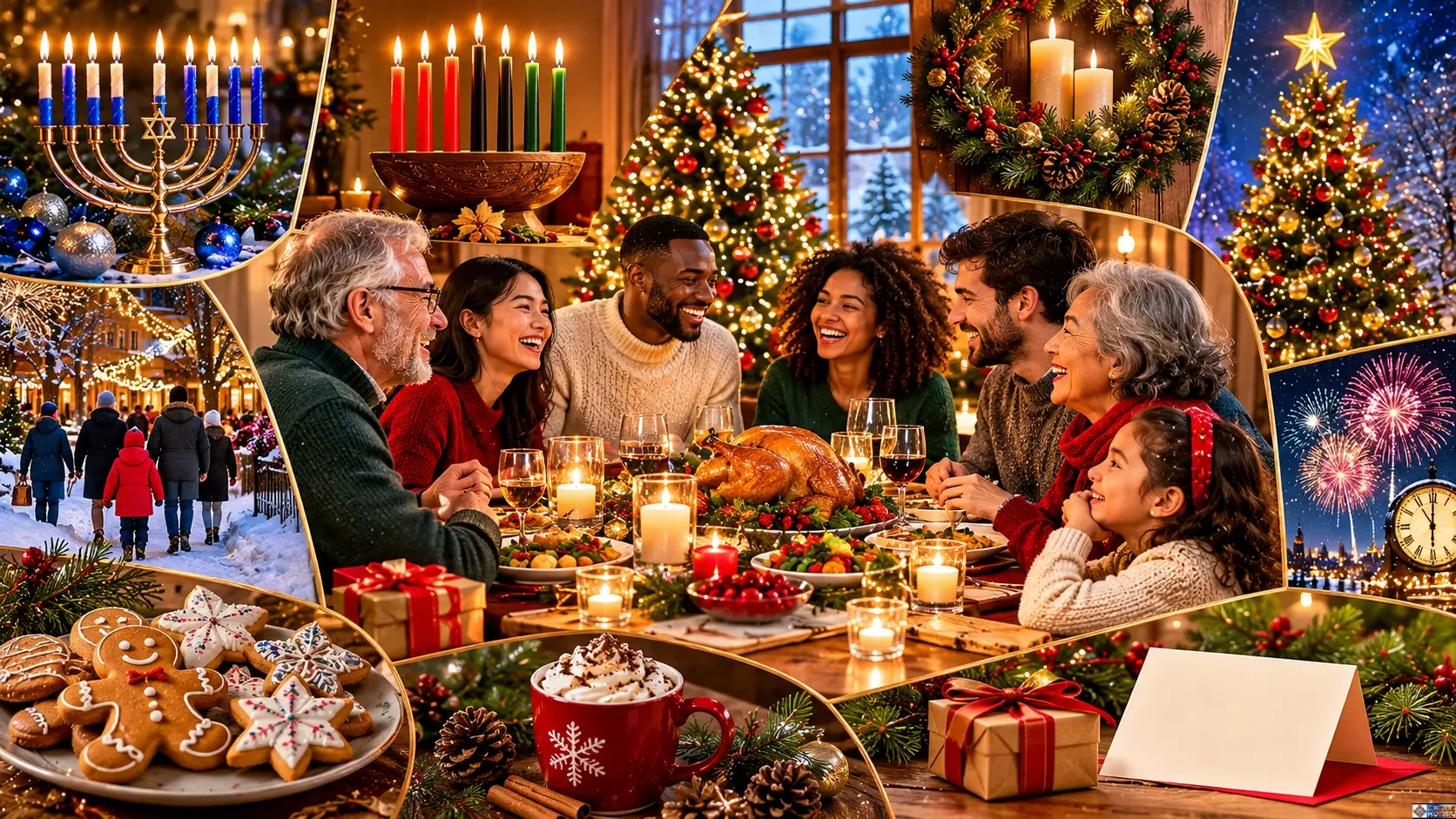
Below you’ll find the history, a table of what to say to whom, notes on the song, movie, images and GIFs, how the greeting works in the UK, ten ways to celebrate, five FAQs and a ready-to-send holiday message. Read to the end if you’d like words you can use today.
The December greeting dilemma
You’ve probably been here: the email to the whole client list is half written, the cursor is blinking after “Wishing you a very…”, and you stop. Merry Christmas might not fit everyone on the list. Season’s Greetings feels stiff. Nobody wants to look careless, and nobody wants to leave someone out.
That hesitation is real, and it’s reasonable. Greetings are small, but they signal whether we’ve noticed the other person. In a 2017 Morning Consult poll reported by Christianity Today, 71% of U.S. adults called “Happy Holidays” a good greeting and 13% called it inappropriate, so the worry isn’t imaginary, but it’s a minority view.
The good news: you don’t need to pick a side. The sections below give you the history, the etiquette, and the exact wording for family, colleagues and clients. If you’re also looking for something to do this season, skip ahead to the ten ways to celebrate near the end of this guide.
Is it correct to say “Happy Holidays”?
Yes, it is standard, correct English. The word holiday began as “holy day”: Merriam-Webster traces it to Old English hāligdæg, from hālig (holy) plus dæg (day) (Aleteia, quoting the dictionary). So when you wish someone a happy holiday, you are using a very old word for a very old idea: a day set apart.
The modern phrase is often credited to pop culture. Irving Berlin’s song “Happy Holiday” appears in the 1942 film Holiday Inn, in a scene set on New Year’s Eve, and it wishes the listener happy holidays all year long (Wikipedia). The season also has a civic side. On June 28, 1870, President Ulysses S. Grant signed a law making Christmas Day, New Year’s Day, Independence Day and Thanksgiving unpaid holidays for federal employees in Washington, D.C. (Time; Brooklyn Law School Library). If you want the wider story of how winter and year-end festivals took shape, see Ancient roots of modern festivals, and for other uses of the phrase, the Happy Holidays disambiguation page lists them.
Why say Happy Holidays instead of Merry Christmas?
Because the season holds more than one celebration. Hanukkah, Christmas, Kwanzaa, Winter Solstice and New Year’s Day all fall in the same stretch (The Diversity Movement). Gallup found that 90% of Americans said they celebrate Christmas in December 2024, but only 78% of non-Christians did (Gallup). Even among those who do celebrate, the meaning varies: 55% told Pew in 2017 that they mark Christmas as a religious holiday (Pew).
Americans are also relaxed about the wording. Pew asked how people want stores to greet them and found the share saying it doesn’t matter rose between 2012 and 2017:
| Pew survey | Prefer “Merry Christmas” | Say it doesn’t matter |
|---|---|---|
| 2012 | 42% | 46% |
| 2017 | 32% | 52% |
Sources: Pew 2012 results and Pew 2017 report. Pew’s 2017 report is the most recent one I opened, so treat these as a snapshot, not today’s numbers.
Is it professional to say Happy Holidays?
Yes. Workplace guidance commonly recommends a general greeting when you don’t know colleagues’ or clients’ traditions, because it includes everyone and keeps the message short (Indeed). For a minority of people it can feel like hedging; that is a fair view, and the answer is to be warm and specific (“thank you for this year”) so the greeting doesn’t read as generic. If a client greets you with “Merry Christmas,” you can simply return it. Related reading on how faiths mark this time of year: Religious Festivals in the World.
How to wish a Happy Holiday: wording for every audience
The best greeting is one that fits the person in front of you. Use this table as a starting point and adjust it to your own voice.
| Who you’re writing to | Safe choice | Warmer option | Better to avoid |
|---|---|---|---|
| Family who celebrate Christmas | “Merry Christmas” | “Merry Christmas, can’t wait to see you all” | Generic mass messages |
| Friends of different faiths | “Happy Holidays” | “Wishing you a peaceful and joyful season” | Assuming which holiday they keep |
| A friend who observes a specific holiday | Name that holiday, e.g. “Happy Hanukkah” | Add a personal line about their plans | Guessing the date or customs |
| Colleagues | “Happy Holidays” | “Thank you for this year. Enjoy the break” | Long personal or religious messages |
| Clients and customers | “Happy Holidays” or “Season’s Greetings” | “Thank you for your trust this year; warm wishes for the new one” | Sales pitches inside the greeting |
| UK contacts | “Happy Christmas” or “Merry Christmas” | “Happy Christmas and a peaceful new year” | Assuming one form is wrong; all three are understood |
Happy Holidays wishes you can use
These are original lines, free to copy and adapt:
- May your table be full and your schedule light this season.
- Wishing you rest, good company and a quiet moment just for you.
- Thank you for this year. Here’s to a warm winter and a bright start to the next.
- Whatever you celebrate, I hope it brings you closer to the people you love.
- Happy Holidays, with gratitude for everything you’ve shared with us.
Happy Holidays quotes from the public domain
Two classic lines from works now in the public domain: Clement Clarke Moore’s 1823 poem A Visit from St. Nicholas ends by wishing a “Happy Christmas to all” (Wonderopolis), and in Charles Dickens’s A Christmas Carol (1843), Scrooge promises to honour Christmas in his heart and try to keep it all the year. For more on how festivals shape our shared calendar, browse the Global Cultural Festivals Guide.
Happy Holidays song, movie, images, PNG and GIF
The Happy Holidays song
The song behind the phrase is Irving Berlin’s “Happy Holiday,” sometimes performed as “Happy Holidays.” Bing Crosby and Marjorie Reynolds (whose singing voice was dubbed by Martha Mears) introduced it in Holiday Inn (Wikipedia). Andy Williams paired it with “The Holiday Season” on his 1963 Christmas album, and Peggy Lee released a 1965 album titled Happy Holiday (same source). The Library of Congress holds the Irving Berlin Collection, about 750,000 items (Library of Congress). The lyrics are protected by copyright, so I won’t print them here; a licensed music service is the best place to listen.
The Happy Holidays movie
Two films tell the story. Holiday Inn (1942) stars Bing Crosby and Fred Astaire and centres on an inn that opens only on holidays; “Happy Holiday” plays over its opening credits and again in the plot (Wikipedia). White Christmas (1954) reunited Crosby with Danny Kaye, Rosemary Clooney and Vera-Ellen, and Paramount released it on October 14, 1954 (Catholic University of America Libraries). A fair warning before a family movie night: NPR station WFAE notes that Holiday Inn contains racist stereotypes and a blackface number, so some viewers prefer to watch it with context or choose White Christmas instead (WFAE).
Happy Holidays timeline
| Date | What happened | Source |
|---|---|---|
| Dec 2024 | 90% of Americans said they celebrate Christmas (78% of non-Christians) | Gallup |
| 2017 | 52% said stores’ holiday greeting does not matter to them | Pew |
| 2012 | 46% said the greeting does not matter | Pew |
| 2002 | Crosby’s 1942 “White Christmas” recording added to the National Recording Registry | Library of Congress |
| Oct 14, 1954 | White Christmas released | CUA Libraries |
| 1942 | Holiday Inn released; “Happy Holiday” introduced | Library of Congress |
| Jun 28, 1870 | Grant signs the law creating Christmas and three other federal holidays in D.C. | Time |
Happy Holidays images, PNG and GIF: free to find is not free to use
Searching for “happy holidays png” or “happy holidays gif” returns thousands of files, but most are protected by copyright. Safer options are works in the public domain or under CC0, which need no attribution, and sources such as Wikimedia Commons, Openverse and the Library of Congress (Alabama State University guide). Check the license on each file’s own page: Commons says which licenses it accepts (Wikimedia Commons), but it gives no guarantee its license labels are accurate (Plagiarism Today). If you plan to use a PNG or GIF for a business, avoid anything marked non-commercial, and give credit whenever the license asks for it. The simplest route of all is to make your own card in a design app or with your phone’s camera.
Happy Holidays UK: what to say in Britain
In Britain, holiday usually means vacation, so “Happy holidays” can sound like “enjoy your trip” (Aleteia). Britons more often reach for “Happy Christmas” or “Merry Christmas.” Language writers Grammarphobia report that searches of the major English corpora show “merry Christmas” is far more common in the U.S., while “happy Christmas” is somewhat more common in the UK, and that some commentators credit the royal family’s Christmas broadcasts for the British habit (Grammarphobia).
If your season is about getting out and seeing something, these Culture Mosaic guides point to lights and music that suit a British winter:
- Glowing displays: cultural light festivals and the Amsterdam Light Festival
- Live music: the Best UK Folk Festivals and World Folk Music
10 ways to make your Happy Holidays count
Christmas Day is about five weeks away, and the best seasonal plans fill up early: calendars, tickets, kitchens and the free evenings of the people you love. Pick two or three of these now and put them on the calendar.
- Hold a holiday movie marathon. Make one night a tradition. White Christmas (1954) is a natural pick, and Holiday Inn (1942) is where the “Happy Holiday” song began; see the context note above before you press play.
- Bake something to give away. Choose one recipe you can make in batches, then deliver it to a neighbour, a colleague or a local food bank.
- Take an evening winter walk. Go after dark, look at the lights in your area, and bring a flask. It costs almost nothing and gets everyone outside.
- Do one planned act of kindness. Check in on someone who lives alone, write a thank-you note, or donate to a cause you trust.
- Go wassailing, or sing with friends. The word wassail comes from a toast to someone’s health, and “going wassailing” came to mean carolling from house to house at Christmas (Merriam-Webster).
- Learn a festival from another culture. Read about Diwali diya lighting meaning and history, why the Day of the Dead is celebrated, or the Latino Cultural Festival, then ask a friend to share how their family marks the season.
- Make the season greener. Festivals and parties create waste; see the post-concert hangover and Regenerative Festival Culture for ideas you can scale down to a living room.
- Create a small ritual. A shared meal grace, a lit candle, a walk on the same day each year. For background on why group rituals feel powerful, read Ancestral Somatic Rituals 2026 and The Somatic Architecture of Collective Ritual.
- Build a gathering that other people can join. Open your table to someone who would otherwise be alone. The idea behind Ephemeral Social Infrastructure is that temporary gatherings can leave lasting bonds.
- Send a real greeting. Write one card by hand. The message at the end of this guide is ready to copy.
Festivals and traditions to explore next
If this season sparks curiosity about how people celebrate around the world, Culture Mosaic has a library of festival guides. Use this table to choose where to start.
| If you’re curious about | Read |
|---|---|
| Roots and heritage | Traditional World Festivals Cultural Heritage and Ethno Cultural Festivals Heritage |
| Big-picture lists | Cultural Festivals Worldwide and Top 20 Biggest Festivals in the World |
| Something different | Unique cultural festivals and underground cultural festivals |
| Travel and trips | Event-Centered Escapes and Festivalle 2026 |
| U.S. events | Festivals in November in USA and the Washington Whiskey Rebellion Festival |
| Money and community | What Is the Economic Impact of Music Festivals |
Prefer to start with faith traditions? Religious Festivals in the World shows how different communities mark this time of year.
The thread through all of them is the same: people gather, light something, share food and music, and say, in their own words, that they’re glad you’re here. That’s what “Happy Holidays” is for.
Happy Holidays FAQs
1. Is it correct to say “Happy Holidays”?
Yes. It is ordinary, correct English, and the word holiday itself comes from “holy day.” The phrase is used from late November through New Year’s Day to cover Christmas, Hanukkah, Kwanzaa, Winter Solstice and New Year’s celebrations. If you know the person’s own holiday, naming it is even better.
2. How do I wish someone a happy holiday?
Keep it short, warm and specific. Name the person, add one concrete thing (“thank you for this year” or “enjoy the time with your family”), and close with a wish for the new year. The audience table earlier in this guide gives safe wording for family, friends, colleagues, clients and UK contacts.
3. Why say Happy Holidays instead of Merry Christmas?
Because not everyone celebrates Christmas, and a general greeting avoids guessing. Gallup found 78% of non-Christian Americans celebrate it, versus 90% of Americans overall, so a large minority marks the season differently or not at all. Pew found in 2017 that about half of Americans said a store’s choice of greeting doesn’t matter to them, so the choice is usually about kindness, not politics.
4. Is it professional to say Happy Holidays?
Yes. It is the usual choice in business emails and client messages because it includes everyone. Keep the message brief, sincere and free of sales language, and respond in kind if someone greets you with “Merry Christmas.”
5. Can I use a Happy Holidays image, PNG or GIF I find online?
Only if its license allows it. Public-domain and CC0 files need no attribution; Creative Commons files with attribution requirements need credit; anything marked non-commercial should not be used in a business message. Check the license on the file’s source page, keep a note of where you found it, and when in doubt, make your own.
A Happy Holidays message you can send
This works for a card, an email or a short message to friends, family, colleagues or clients.