
 By Culture Expert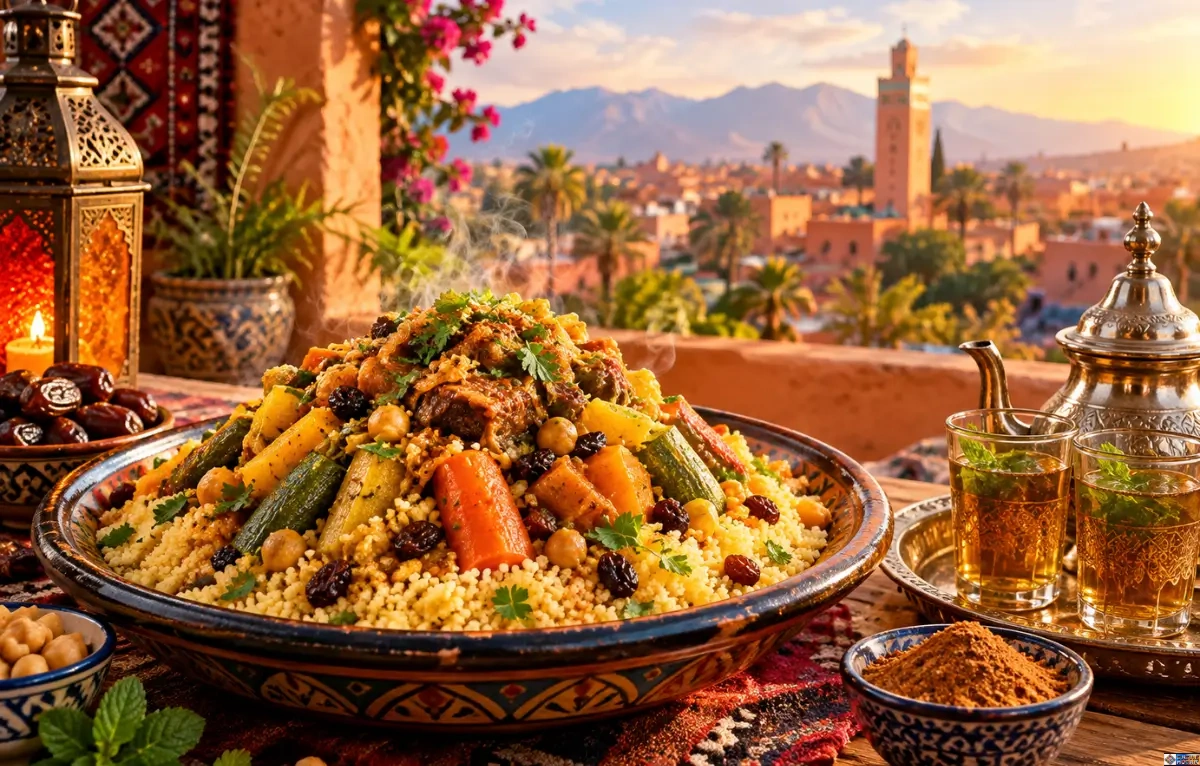
QUICK SUMMARY
Here’s the fast version of everything below, for anyone who wants the answers on authentic Moroccan couscous before the full story.
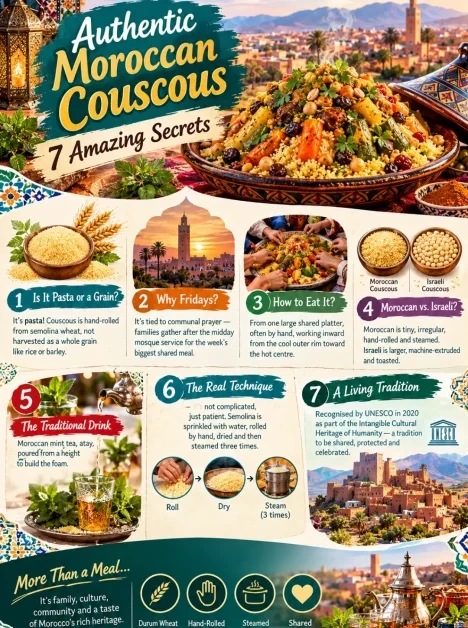
- Is Moroccan couscous pasta or a grain? It’s pasta. Couscous is hand-rolled from semolina wheat, not harvested as a whole grain like rice or barley.
- Why is couscous eaten on Fridays? It’s tied to communal prayer — families gather after the midday mosque service for the week’s biggest shared meal.
- How do you eat authentic couscous traditionally? From one large shared platter, often by hand, working inward from the cool outer rim toward the hot centre.
- What’s the difference between Moroccan and Israeli couscous? Size and method. Moroccan couscous is tiny, irregular, and hand-rolled in three steamings. Israeli (pearl) couscous is larger, machine-extruded, and toasted rather than steamed.
- What’s the traditional drink served with it? Moroccan mint tea, atay, poured from a height to build the foam.
The Problem: Why Most “Moroccan Couscous” Isn’t Moroccan at All
Type “authentic Moroccan couscous” into a search bar and you’ll land somewhere strange. Half the results are five-minute instant couscous dumped in a bowl with raisins and a pinch of cinnamon. The other half call themselves “authentic” while listing ingredients no Fez grandmother would recognise. Supermarket pouches promise a taste of Marrakech and deliver something closer to sweetened bulgur.
I understand the frustration. You want the dish that took Algeria, Morocco, Tunisia, and Mauritania into UNESCO’s Representative List of the Intangible Cultural Heritage of Humanity in December 2020 — recognised not as a single recipe but as a whole living tradition of growing the cereal, rolling the semolina into grains by hand, and steaming it.[1] Instead, you keep finding shortcuts dressed up in the right adjectives.
Here is the good news: the real technique isn’t complicated, only patient. At Culture Mosaic, we spend a lot of time drawing that line between shortcut and tradition, and couscous is one of the clearest cases we’ve covered. Once you understand what couscous actually is, why Moroccan families still build a Friday around it, and how the grain, the broth, and the spice cupboard work together, the “authentic” version stops being a mystery and becomes something you can genuinely cook at home.
Is Moroccan Couscous Pasta or a Grain?
This is the single most-searched question about the dish, and the answer surprises people every time: couscous is pasta, not a grain.
It starts as durum wheat semolina, coarse-milled flour that’s sprinkled with water and rolled by hand between the palms until it forms tiny, irregular granules. Those granules are then dried. Nothing is harvested whole and cooked, the way rice, barley, or quinoa are — the grain shape is built from scratch, which is exactly why couscous behaves more like a fresh pasta than a cereal. The confusion is understandable. Couscous sits in the same aisle as rice, gets served the same way rice does, and even looks a little like a grain once it’s steamed and fluffed. But its manufacture is closer kin to orzo or fregola than to anything you’d thresh in a field.
Traditional Moroccan couscous is also, historically, home-made rather than shop-bought. The earliest confirmed written references to the dish appear in a 13th-century anonymous Andalusian cookbook, and the technique of rolling semolina with water into fine granules by hand has been documented across the Maghreb for at least that long. Almost everything sold in UK supermarkets today, including M&S’s own Moroccan couscous recipe, is “instant” or “pre-steamed” couscous, dried again after an initial steaming so it rehydrates in five minutes. It’s a legitimate modern convenience. It is not, however, how the dish is built in a Moroccan kitchen, where the grain is steamed three separate times over a simmering stew.
Moroccan Couscous vs. Israeli Couscous: What’s Actually Different
This is the second question everyone asks, and it matters if you’re specifically after authentic Moroccan couscous rather than its more common supermarket cousin — the two are genuinely different foods that happen to share a name.
| Moroccan Couscous | Israeli (Pearl) Couscous | |
| Grain size | Tiny, roughly 1–2mm, irregular | Large, uniform, roughly the size of a peppercorn |
| How it’s made | Hand-rolled semolina and water, sun-dried | Machine-extruded dough, then toasted |
| Cooking method | Steamed (traditionally three times, over a stew) | Boiled in water or broth, like pasta |
| Texture | Light, fluffy, separate grains | Chewy, nutty, slightly firmer |
| Origin | Berber, North African, documented from at least the 13th century | Invented in Israel in the 1950s as a rice substitute during food shortages |
| Traditional cooking vessel | Couscoussier (two-tiered steamer pot) | Ordinary saucepan |
Neither is more “correct” than the other for its own cuisine — they’re just not interchangeable if you’re after the real Moroccan dish. If a recipe calls for pearl couscous and labels the result “authentic Moroccan couscous,” that’s your first clue to keep scrolling.
Why Is Couscous Traditionally Eaten on Fridays?
In Morocco, Friday is the day families make the effort. Friday prayer, jumu’ah, draws the household to the mosque at midday, and the meal that follows is the week’s largest and most social — extended family invited, the best serving platter brought out, the stew simmered for hours beforehand. Couscous, being labour-intensive and meant to be shared, fits that rhythm perfectly. It isn’t a rule written down anywhere; it’s a habit repeated for generations until it became identity. Many households still make couscous only once a week, and for most of them, that week still means Friday.
This is also why couscous carries more emotional weight in Moroccan homes than an ordinary side dish would. It’s the meal a grandmother teaches a granddaughter to steam by feel rather than by timer — what Culture Mosaic has explored elsewhere as somatic food memory, the way a dish gets encoded in the hands and the nose long before it’s written down as a recipe.
How Do You Eat Authentic Couscous Traditionally?
Forget individual plates. Traditional couscous is served on one large round platter set at the centre of the table or the low majlis seating, with the grain mounded and the stew — meat, vegetables, chickpeas — arranged on top and in a well at the centre.
In an authentic Moroccan couscous setting, diners eat from the section of the platter directly in front of them, working with the right hand only, rolling a small amount of couscous into a loose ball against the palm before eating it. The centre, closest to the meat and broth, is often nudged toward guests or elders as a mark of respect.
sits beside the platter, used to scoop rather than as a separate course. It’s a genuinely communal way of eating, and it says something about the dish’s cultural function: shared-platter dining tends to survive longest in cultures where hospitality itself is treated as the point of the meal, not just the food on it. Culture Mosaic has written more broadly about that idea in its piece on dining rituals around the world.
If eating by hand isn’t practical at your table, a spoon is entirely acceptable in most modern Moroccan households too — the ritual matters more than the utensil.
What Is the Traditional Drink Served With Moroccan Couscous?
Mint tea — atay bi na’na’ — green gunpowder tea steeped with fresh spearmint and a generous amount of sugar, poured from a height to raise a light foam on top. It’s served before, during, and after the meal, not as an afterthought but as punctuation. In some households, particularly outside the big cities, a glass of lben — cultured buttermilk, tangy and thin — accompanies the meal instead of or alongside the tea, cutting through the richness of the stew.
Both drinks do real culinary work: the mint tea’s sugar and menthol cool the palate against the chilli warmth of harissa, and lben‘s acidity balances the fat in a lamb or chicken couscous the same way buttermilk cuts a rich curry.
The Spices That Make Moroccan Couscous Taste Like Morocco
The spice profile behind authentic Moroccan couscous isn’t heavily spiced in the chilli-heat sense — it’s layered. The base is almost always onion, ginger, and turmeric or saffron threads, cooked slowly into the broth until the liquid turns a deep gold. Cinnamon appears more often than most people expect, especially in versions finished with raisins and caramelised onion (the tfaya topping associated with Fez). Ras el hanout — a house-blended spice mix that can run to twenty or more ingredients — shows up in festive versions, though everyday family couscous usually leans on a shorter, simpler list.
The spices aren’t measured so much as felt — a pinch judged by eye, a broth tasted and adjusted mid-simmer. Culture Mosaic has looked at that instinctive, hands-on approach to seasoning before in its piece on somatic seasoning, and couscous is one of the clearest examples of it in Moroccan cooking: no two households’ spice blends taste quite the same, and that’s treated as a feature, not an inconsistency.
Two other flavour builders deserve a mention, because they rarely show up in UK recipe write-ups. The first is smen, a salted butter that’s been aged — sometimes for months or years — until it develops a sharp, almost cheese-like funk; a spoonful stirred through the finished couscous is a Fez signature. The second is preserved lemon, salt-cured for weeks until the peel turns soft and intensely savoury, used more often in the accompanying tagine than in the grain itself, but essential to the wider meal.
Both are, technically, salt-fermentation projects rather than spices, and if you want the science behind why weeks in salt transform a piece of fruit or a block of butter this dramatically, it’s the same chemistry Culture Mosaic covers in the biochemistry of salt-glaze fermentation — and the same logic, followed in a different direction, that governs ancestral fermentation rituals and ancestral fermentation techniques from cultures a long way from Morocco. If it helps to picture the family resemblance, a jar of Traditional Sauerkraut Fermentation is doing broadly the same slow, salty work as a jar of preserved lemons — just with cabbage instead of citrus.
Moroccan Couscous and Tagine: How the Two Dishes Relate
Couscous and tagine are frequently confused by people outside Morocco, partly because UK menus tend to plate them together. They’re not the same dish. A tagine is a slow-cooked stew — named for the conical clay pot it’s cooked in — of meat or vegetables, spices, and often fruit or preserved lemon. Couscous is the steamed grain served either underneath or alongside that stew, soaking up its broth.
Think of the tagine as the engine and the couscous as the vehicle it drives. On a Friday table, the tagine’s broth is often ladled directly over the couscous mound, so the two genuinely merge into one dish by the time anyone starts eating. If you want the full method for the stew side of that pairing, Culture Mosaic has a dedicated guide to how to cook traditional Moroccan tagine.
How the British Recipe Versions Compare
UK home cooks mostly meet something called Moroccan couscous through four well-known routes, and none of them is quite authentic Moroccan couscous as it’s cooked in Morocco — and it’s worth knowing what each one is actually offering before you decide which to follow.
| Version | What it actually is | Closest to authentic? |
| Jamie Oliver-style Moroccan couscous | Instant couscous, hot stock, and a big handful of fresh herbs, lemon, and spice stirred through in minutes | A flavourful weeknight shortcut, not a traditional method |
| Mary Berry Moroccan couscous | A structured, measured British home-cooking approach — apricots, almonds, and warming spice in reliable proportions | Closer in spirit to a spiced pilaf than a steamed Maghrebi dish |
| BBC Good Food-style Moroccan couscous | Quick, accessible recipes built around stock, harissa, and store-cupboard vegetables | Good for a fast dinner; skips the multi-steaming technique entirely |
| M&S Moroccan couscous (ready-to-eat pouch) | Pre-cooked, pre-spiced, microwave-ready convenience food | Convenience-first; furthest from the traditional dish |
| Traditional family-style Moroccan couscous | Hand-rolled or good-quality dried couscous, steamed three times over a slow-cooked, spiced broth | The genuine article |
None of these are “wrong” — a Tuesday-night dinner doesn’t need a couscoussier. But if the goal is the dish that earned UNESCO recognition, worth knowing which category a recipe actually falls into before you call it authentic.
The Authentic Moroccan Couscous Recipe
This is the traditional method for authentic Moroccan couscous, built around a couscoussier — the two-tiered steamer that lets the grain cook directly over the simmering stew, rather than simply being rehydrated in a bowl. If you don’t own one, a metal colander set snugly over a large pot, sealed at the join with a damp cloth, does the job.
Serves 6, as part of a shared meal
For the couscous:
- 500g medium-grain couscous (not “instant” if you can source it)
- 2 tbsp vegetable oil
- 1 tsp salt
- Water, for hydrating between steamings
- 3 tbsp melted butter or smen, to finish
For the broth and vegetables:
- 1kg lamb shoulder or chicken thighs, bone-in, cut into pieces
- 2 onions, one grated, one quartered
- 3 tbsp olive oil
- 1 tsp ground ginger
- 1 tsp turmeric
- A large pinch of saffron threads
- 2 cinnamon sticks
- Salt and black pepper
- 1.5 litres water or light stock
- 4 carrots, peeled and halved lengthways
- 2 turnips, quartered
- 2 courgettes, halved lengthways
- 1 small squash or pumpkin wedge
- 400g chickpeas, soaked overnight (or tinned, drained)
- A small bunch of coriander and parsley, tied
Optional Fez-style topping (tfaya):
- 2 large onions, thinly sliced
- 100g raisins
- 2 tbsp butter
- 1 tbsp honey
- 1/2 tsp cinnamon
Method
- Dress the couscous. Tip the dry couscous into a wide, flat dish. Sprinkle with cold water a little at a time, working it through the grains with your fingertips (not a spoon) until every grain is damp but not wet. Drizzle with 1 tbsp of the oil and rub it through. Let it rest for 10 minutes so the water is fully absorbed.
- Build the broth. In the base of the couscoussier, heat the olive oil and brown the meat with the grated onion, ginger, turmeric, saffron, cinnamon sticks, salt, and pepper. Add the water or stock and the herb bundle, bring to a simmer, cover, and cook gently for 45 minutes.
- First steaming. Line the steamer basket with muslin or a clean tea towel if the holes are wide enough to let grain through. Tip the dressed couscous into the basket, set it over the simmering broth (uncovered, so steam escapes upward through the grain rather than condensing back into it), and steam for 20 minutes.
- Fluff and rest. Tip the steamed couscous back into the flat dish. Sprinkle with a little more cold water and 1 tbsp oil, and rake it through thoroughly with your fingers to break up any clumps and let it cool slightly. This step is what keeps the final grain light rather than gluey — do not skip it, however tempting it is to save ten minutes.
- Add the vegetables and second steaming. Add the quartered onion, carrots, turnips, and chickpeas to the broth. Return the couscous to the steamer basket and steam for a further 20 minutes.
- Third steaming. Fluff the couscous again as in step 4. Add the courgettes and squash to the broth (they cook faster and turn to mush if added earlier). Steam the couscous a final 15–20 minutes, until every grain is tender and separate.
- Finish and plate. Tip the couscous onto a large communal platter, drizzle with the melted butter or smen, and rake through one last time. Mound it into a dome, hollow the centre slightly, and spoon the meat, vegetables, and a generous ladle of broth into the well. If making the tfaya topping, cook the sliced onions slowly in butter until deep gold and soft, stir in the raisins, honey, and cinnamon, and simmer until syrupy; spoon over the meat before serving.
- Serve. Bring the platter to the table with extra broth on the side for anyone who wants it looser, plus mint tea. Eat from the section nearest you, working inward.
Regional Variations
- Fez and the north: Sweetened tfaya topping of caramelised onions and raisins over lamb, the version most associated with festive or Friday tables.
- Marrakech and the south: Seven-vegetable couscous — traditionally exactly seven, considered auspicious — with a lighter, less sweetened broth.
- The Sahara and Berber regions: A simpler, drier style, sometimes using barley couscous instead of wheat, reflecting older, pre-urban agricultural patterns.
- Essaouira and the coast: Fish couscous, built around a light saffron-and-tomato broth, served with white fish and shellfish instead of meat.
Tips for Getting It Authentically Right
- Real, authentic Moroccan couscous is never boiled in liquid the way pasta or rice is — it’s always steamed, dry, over vapour.
- Skipping the multiple fluffing stages is the single biggest reason home versions turn gluey. It looks like an unnecessary step; it is not.
- If you’re using instant couscous out of necessity, you can still improve it hugely by steaming it once over the finished broth for 10 minutes rather than simply pouring boiling stock over it in a bowl.
- Smen keeps for months and only gets more pungent with age — start with a small jar rather than committing to a large batch until you know you like it.
- For a genuinely first-hand account of the traditional couscoussier method as practised in Morocco today, this authentic Moroccan couscous masterclass write-up is worth reading alongside this guide.
Frequently Asked Questions
Is Moroccan couscous pasta or a grain?
It’s pasta. Couscous is made by rolling durum wheat semolina with water into small granules by hand, then drying them — it isn’t harvested whole the way rice, wheat berries, or barley are. Its texture and cooking method make it feel grain-like, which is where most of the confusion comes from, but by production method it belongs in the same family as fresh pasta.
Why is couscous traditionally eaten on Fridays in Morocco?
Friday is the day of communal prayer, and the meal that follows jumu’ah has become the week’s main family gathering. Couscous, being labour-intensive to prepare properly and naturally suited to a large shared platter, became the dish associated with that gathering over generations, to the point that many households still only make it once a week, on Fridays specifically.
What’s the real difference between Moroccan couscous and Israeli couscous?
Size, manufacture, and cooking method. Moroccan couscous is tiny and irregular, hand-rolled from semolina, and traditionally steamed three times over a stew. Israeli (pearl) couscous is much larger and perfectly uniform because it’s machine-extruded and toasted, and it’s boiled in water like pasta rather than steamed. They’re both technically pasta, but they’re not interchangeable if you’re trying to recreate a traditional Moroccan dish.
How do you eat authentic Moroccan couscous traditionally?
From a single large communal platter set at the centre of the table, typically using the right hand to roll a small portion into a loose ball before eating it, working from the cooler outer edge of the mound inward toward the hot centre where the meat and richest broth sit. A spoon is a widely accepted modern alternative.
What is the traditional drink served with Moroccan couscous?
Moroccan mint tea, atay, made with green tea, fresh spearmint, and plenty of sugar, poured from height to create a light foam. In some households a glass of cultured buttermilk, lben, accompanies the meal as well, particularly outside the major cities.
Explore more of Culture Mosaic’s food heritage coverage, including our earlier deep dive into the traditional Moroccan couscous recipe, a broader look at regenerative heritage recipes, the layered flavour-building behind ancestral umami techniques, and the hands-on knowledge passed down through heritage cooking techniques worldwide. For other street-food and family-table traditions from around the globe, see our coverage of the Korean hot dog, the range of Hispanic cultural foods, USA famous dishes, and how to make Mexican street tacos al pastor.
Sources
- UNESCO Intangible Cultural Heritage. “Knowledge, know-how and practices pertaining to the production and consumption of couscous.” Inscribed 2020.
- UNESCO. “UNESCO’s inscription of couscous traditions, an example of international cultural cooperation.” 16 December 2020.
- Forbes. “UNESCO Announces Couscous Now Inscribed On Intangible Cultural Heritage Of Humanity List.” December 2020.
- Morocco World News. “Couscous Joins UNESCO List of World Intangible Heritage.” December 2020.
- Al Jazeera. “UNESCO adds couscous to list of intangible world heritage.” December 2020.
- Escoffier Online. “Couscous vs. Israeli Couscous: What’s the Difference?”
- America’s Test Kitchen. “Moroccan Couscous vs. Pearl Couscous: What’s the Difference?”