
 By Culture Expert
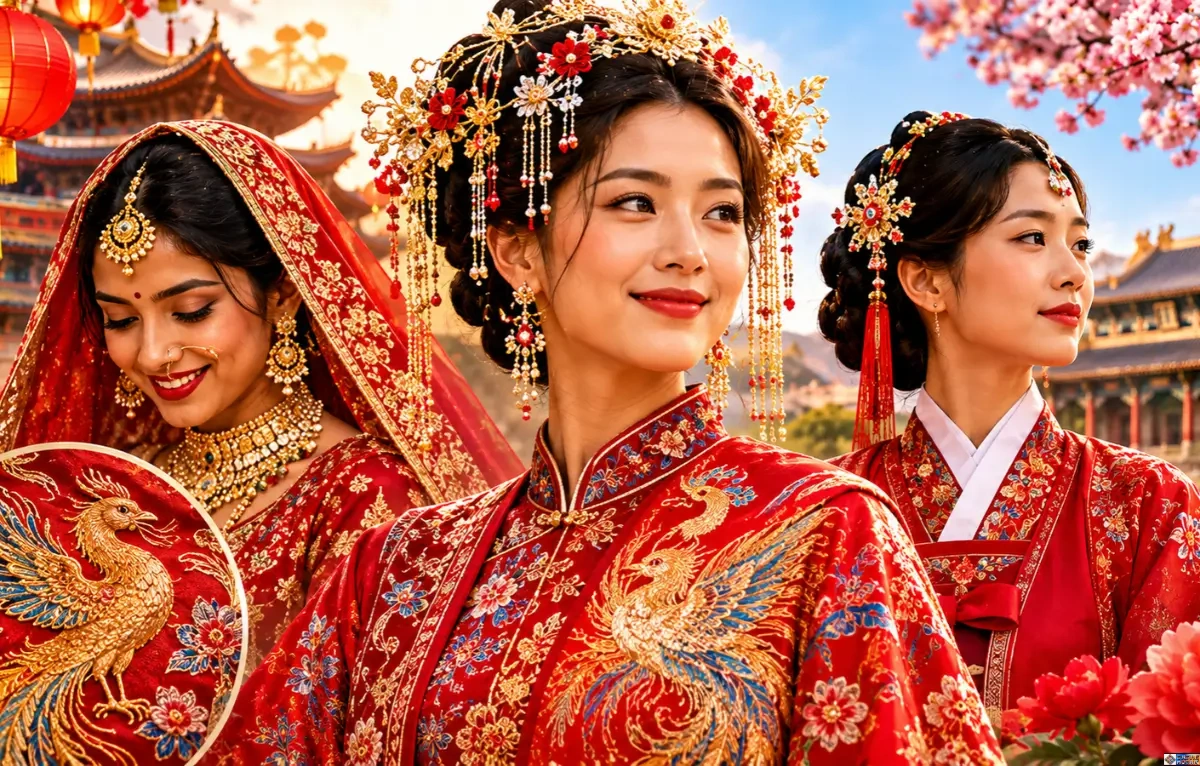
A traditional red wedding dress is bridal wear dyed red for luck, joy, and a prosperous start to married life across China, India, Korea, and beyond. Chinese brides wear the qun gua or hong gua stitched with dragons and phoenixes, while Indian brides wear a red lehenga or sari worked in gold zardozi thread. Korean brides historically wore the hwarot, a magnificent red silk robe lined in deep blue. While white became the Western default in the 1800s, modern brides in Britain and worldwide are now blending these heritage garments with modern cuts, contemporary sleeves, and second outfits. This guide explains what each dress signifies, how it is crafted, and how to wear one today.
Walk into most British bridal shops and the rails run in one direction: ivory, champagne, blush. White is the default. Everything else gets filed under “alternative”.
If your heritage is Chinese, Indian, Korean or any of the many cultures that marry in red, that framing stings. You are not asking for something alternative. You are asking for the older, longer tradition. Brides in red were being photographed, painted and embroidered into museum collections long before the white gown became a shop-window standard.
So here is the story, told properly. Where red comes from, what the stitches say, and how a modern bride can wear a traditional red wedding dress without it feeling like fancy dress.
A quick note on method. I have not invented bridal anecdotes or reviews for this piece. The evidence below comes from museum records, exhibition catalogues and published reporting, and every source is listed at the end. Where something is general cultural knowledge rather than something I could pin to a source, I say so.
Why Do Chinese Brides Wear Red? The Meaning of Red in Weddings
Red is the most auspicious colour in Chinese culture. It stands for happiness, luck and fortune, which is why red is also the colour of New Year envelopes and festival lanterns. A bride in red is not making a style choice. She is wearing a blessing.
The pairing matters too. Red is almost always joined to gold. Gold thread signals wealth and prosperity, so the two together read as a wish: may this household be happy and well off.
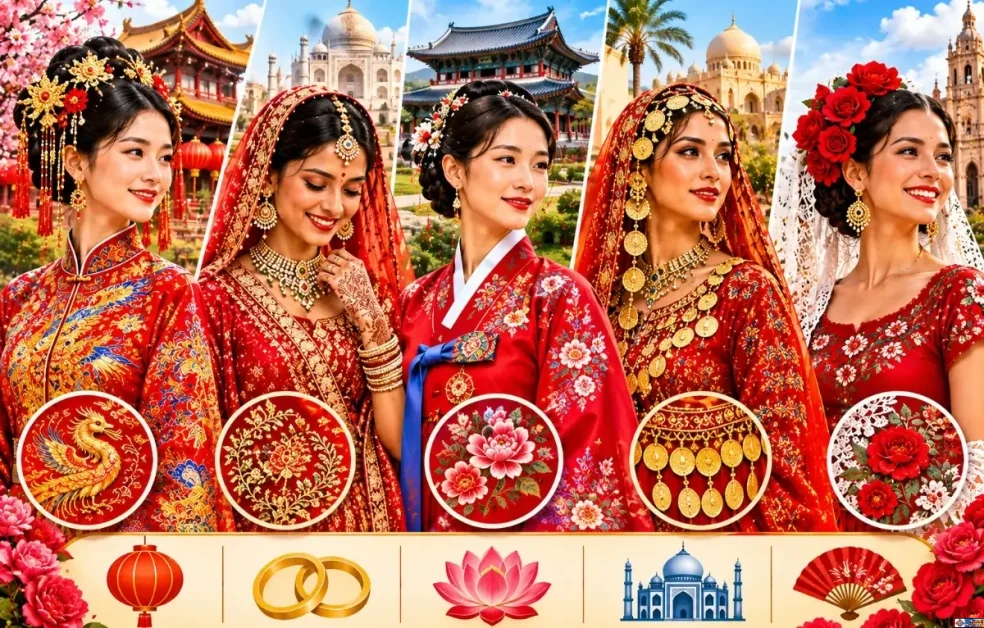
The same logic travels. In India, red marks marriage itself and is tied to auspiciousness and fertility in Hindu custom (that is widely accepted cultural understanding rather than a single sourced claim). In Korea, a red outer robe announced the most important day of a woman’s life. Different countries, different cuts, the same instinct. If you want the wider map, our guide to traditional wedding dress symbolism and the longer read on Traditional Wedding Dress Cultural Meaning go deeper on colour.
Chinese Traditional Red Wedding Dress: The Qun Gua and the Phoenix Crown
The classic southern Chinese bridal outfit is the qun gua (裙褂), sometimes called hong gua, “red gown”. Qun means skirt. Gua means jacket. Simple name, extraordinary object.
The pattern language is where it gets interesting. The South China Morning Post reports that these sets carry an embroidered dragon and phoenix, standing for groom and bride. The Metropolitan Museum of Art holds a wedding jacket and skirt, and its curators note that the phoenix was the most typical bridal pattern, with this particular set instead showing ears of grain and cranes, symbols of longevity, in heavy gold thread.
The V&A holds a pair of red bridal shoes that would have completed a hong gua, embroidered with a dragon and a phoenix chasing a pearl. Even the footwear was part of the story.
A few details worth knowing:
- Grades of embroidery. Qun gua come in grades, based on how much of the red base fabric is covered by gold and silver work. More coverage, more hours, higher price. The SCMP headline puts the top end at around US$13,000.
- Not always all red. A museum record from Singapore describes a qun kua with a black jacket and a red skirt, both worked with phoenix motifs. Reference summaries say the gua was originally black, with the all-red jacket becoming common only in the 1960s, and that the black-and-red set later moved to the bride’s mother. Treat that last point as a regional convention rather than a universal rule.
- The phoenix coronet. The fengguan is the jewelled phoenix headdress. In older Han Chinese bridal sets it was paired with a red embroidered jacket, a skirt and an embroidered stole called the xiapei.
I think the qun gua is the most under-appreciated bridal garment in the world. It is heavy, hand-stitched, built to be inherited. One museum record even notes that a daughter later wore her mother’s set to her own son’s wedding.
For readers in Britain who want the Chinese bridal story alongside other cultures, Global bridal wear traditions is the natural companion piece.
Zardozi Embroidered Lehenga: India’s Red and Gold Bridal Heritage
Picture a red lehenga. Now picture it with the gold doing the talking.
That gold is usually zardozi. The word is Persian: zar means gold, dozi means sewing. Sewing with gold, literally. The craft is closely tied to the Mughal courts, and Emperor Akbar is widely credited as a patron who helped popularise it. Reporting on the craft’s history says that in 1618 Akbar’s son Jahangir commissioned a robe set with gems and embroidered in pure gold and silver thread as a gift for Shah Abbas of Iran.
Then the money dried up. Accounts of the craft say that royal patronage faded under later rulers, and with it the demand for real precious-metal thread. Much of today’s zari is synthetic or “tested” zari, an alloy or coated thread rather than solid gold. That is not a scandal. It is simply worth knowing when you see a price tag.
What does a real zardozi bridal piece involve? One boutique’s guide estimates that a heavily worked designer lehenga can take four to six months of craftsperson time. Treat that as a trade estimate, not a research finding. But the direction is right. The embellishment alone adds serious weight, and the raised, three-dimensional surface is something no print or machine process matches.
Regional variations, from general cultural knowledge:
- Gujarat: the red gharchola with gold squares.
- Punjab: red lehengas with red-and-ivory chooda bangles.
- Tamil Nadu and Karnataka: red or maroon silk saris with heavy gold borders.
- Bengal: red Banarasi silks, often worn with red-bordered white pieces.
Silk provenance is a quiet part of this too. Where the fibre was grown and woven shapes the cloth, and Geographic Fingerprinting of Heritage Fibers explains how that can even be traced.
Hwarot: Korea’s Red Bridal Robe
Korea’s answer is the hwarot (활옷), also written hwalot. Under the Joseon dynasty (1392 to 1910) it was the most sumptuous bridal robe, made of fine red silk and embroidered with flowers and auspicious symbols in coloured thread, according to a talk by Met textile conservator Kisook Suh.
Some details I find striking:
- Red outside, blue inside. Google Arts & Culture’s record for a hwarot at Sookmyung Women’s University Museum describes the red exterior and blue interior, with floral patterns and characters meaning longevity and happiness across the robe. The Brooklyn Museum’s notes add colour-blocked sleeves in blue, yellow, red and white.
- A rule bent for one day. The same record says princesses wore the hwarot for major ceremonies, while commoners were allowed to wear it only on their wedding day. Before that, ordinary brides wore the plainer wonsam.
- Paired birds. Coverage of the 2023 exhibition “Blooming Hwarot: Bridal Robes of the Joseon Royal Court” at the National Palace Museum of Korea notes motifs such as pairs of egrets and phoenixes with their chicks, wishes for lifelong marital happiness. The show displayed over 110 objects, and included Princess Bogon’s robe of 1830, described as the only surviving Joseon bridal robe whose wearer is identified.
Accessories complete the look: a crown-like jokduri or hwagwan, a hairpin (binyeo), a ribbon (daenggi), and red dots on the cheeks and forehead known as yeonji gonji. Many of these elements survive in modern Korean ceremonies, especially the pyebaek family greeting.
Red Silk Wedding Gown Traditions Compared
| Attribute | Chinese Qun Gua | Indian Lehenga / Sari | Korean Hwarot |
|---|---|---|---|
| Silhouette | Two pieces: jacket plus long straight or pleated skirt | Fitted choli, full flared skirt, dupatta; or draped sari | Wide-sleeved robe worn over a long skirt |
| Fabric | Silk, heavily embroidered | Silk, velvet, brocade, georgette | Silk, satin, silk embroidery |
| Signature Craft | Gold and silver couching, dragon and phoenix | Zardozi, zari, mirror work | Silk-thread floral embroidery, sometimes gilding |
| Key Motifs | Dragon (groom), phoenix (bride), cranes, grain | Florals, paisleys, peacocks, geometric forms | Paired egrets, phoenix, peonies, longevity characters |
| Head & Hair | Phoenix coronet (fengguan) | Maang tikka, veil-like dupatta | Jokduri or hwagwan, binyeo |
| Colour Note | Red with gold; some sets pair a black jacket | Red, maroon, with gold; sometimes ivory-and-red | Red outside, blue lining |
The comparison is mine, drawn from the museum and press sources listed below. Where a cell reflects general cultural knowledge rather than a specific citation, treat it as a starting point for your own checking.
Which Cultures Have Red Wedding Dresses? (And What About Christianity?)
Longer list than most people expect. Beyond China, India and Korea, red bridal dress appears in Pakistan and Bangladesh, Nepal, Vietnam, where the red áo dài is a familiar bridal choice, and Turkey, where the Ottoman-era bindallı is classically made in red velvet worked with gold. If velvet is your fabric of interest, The Cultural Significance of Red Velvet Fabric explains why that cloth carries so much weight. Parts of Eastern Europe and Russia also have long folk traditions of red in bridal costume.
Then there is the Western question. What does a red wedding dress mean in Christianity?
Nothing, officially. There is no church rule that a bride must wear white. White became the norm largely through fashion after Queen Victoria married in white in 1840, a story told in Why Wedding Dresses Are White. Before then, a bride wore her best dress, in whatever colour she owned. In Christian symbolism red is more often linked to martyrdom and the Holy Spirit (that is general liturgical understanding), so a red dress in a church is a matter of the couple’s and priest’s comfort, not doctrine.
There is also a folk rhyme, “Married in red, you’ll wish yourself dead”. Superstition, not scripture, and I would not lose sleep over it.
Modern Traditional Red Wedding Dress Ideas: Blending Heritage and Fashion
Here is where I take a stand. The best modern red bridal looks are not costume and not compromise. They keep one heritage element at full volume and let everything else be contemporary.
Three approaches that work:
- Heritage cut, modern fabric. A qun gua or lehenga silhouette in a lighter silk, with a cleaner embroidery layout. Less weight, same meaning. For a wider view of current bridal direction, see Latest Trends in Bridal Wear and What Wedding Dresses Are in Style.
- Western shape, cultural detail. A structured gown, perhaps even a mermaid-style silhouette, carrying phoenix or paisley embroidery. Our Modern Cultural Wedding Dresses feature maps several of these fusions.
- Two outfits, two traditions. Red for the tea ceremony or cultural ceremony, ivory for the civil one. This is increasingly common among couples in the UK, where the legal ceremony and the cultural celebration often happen separately. It also lets families on both sides feel seen. Multicultural wedding attire looks at how couples handle this.
And the wildcard, the weird one: line the whole dress in red. Wear ivory outside, red inside. Nobody sees it but you. The hwarot’s blue lining is the historical precedent for a hidden second colour, and there is something I find quietly thrilling about carrying the tradition against your skin.
Traditional Red Wedding Dress With Sleeves
Sleeves are not a modern concession. The hwarot is wide-sleeved, the gua is long-sleeved, and the Indian choli and dupatta can cover as little or as much as you like. If you want sleeves on a Western gown, lace or illusion sleeves in red or gold-tone tulle work well.
Traditional Red Wedding Dress for Older Brides
There is no age limit on red. My own bias: deeper tones such as maroon, oxblood and garnet tend to read as rich rather than loud, and structured silk flatters at any age. Choose the heirloom route. A heritage piece from a family member, re-fitted, can say more than anything new. For fit guidance beyond the sample size rails, Plus Size Wedding Dresses is worth a read.
Buying, Renting and Budgeting
Hand embroidery is priced by hours, not by metres. For ordinary British gown price benchmarks, see How Much Are Wedding Dresses UK? If you only need a piece for one day, Where Can I Rent Wedding Dresses lists rental routes. For ideas on reusing and repairing fine textiles afterwards, Regenerative Textile Traditions is useful, and What is Heritage Fashion explains why these garments deserve a second life.
Want a place to start browsing? Carats & Cake has a useful overview of the traditional red wedding dress and its modern styling. And if you are thinking about colour direction more broadly, Colour of the Season 2026 and Fashion 2026 show where red sits this year.
Can You Wear Red to a Chinese Wedding as a Guest?
Short answer: often yes, with care. Longer answer: it depends on the family.
My honest view is that a touch of red or gold is festive and welcome, while a head-to-toe red outfit risks looking like you are competing with the bride. If you are unsure, ask the couple. They will tell you.
The taboo colours, as a rule of thumb:
- White at a Western-style wedding, because it is the bride’s colour.
- Black at many Chinese weddings, because of its association with mourning.
- White at some traditional Hindu weddings, where it has long been linked with mourning, though attitudes vary widely by family and region.
Custom, not law. Families differ, and so do generations. When in doubt, ask.
Frequently Asked Questions
Bridal Heritage GuideThe red has outlasted every empire that ever tried to dress a bride. I would bet on it outlasting the trends too.
Sources
- Metropolitan Museum of Art, “Jacket and Skirt for Wedding”, collection record 65367. https://www.metmuseum.org/art/collection/search/65367
- Victoria and Albert Museum, red bridal shoes for a hong gua (object O167373). https://api.vam.ac.uk/v2/object/O167373
- Roots.gov.sg (National Heritage Board, Singapore), “Qun belonging to Sin Mee Kuen”. https://www.roots.gov.sg/Collection-Landing/listing/1515757
- South China Morning Post, “How Chinese wedding dresses are made, their symbolism and why some can cost US$13,000”. https://mcdn.i-scmp.com/lifestyle/arts-culture/article/3286161/how-chinese-wedding-dresses-are-made-their-symbolism-and-why-some-can-cost-us13000
- Wikipedia, “Qungua” and “Fengguan xiapei” (secondary reference summaries; check the cited primary articles, including the US-China Institute piece on the long feng gua). https://en.wikipedia.org/wiki/Fengguan_xiapei
- Kisook Suh, “The Documentary Value of Repairs to the Hwarot, the Korean Bridal Robe”, Korean Cultural Service New York talk listing. https://www.koreanculture.org/gallery-korea/2010/3/18/the-documentary-value-of-repairs-to-the-hwarot-the-korean-bridal-robe
- Google Arts & Culture / Sookmyung Women’s University Museum, “Woman’s Wedding Robe (Hwarot)”. https://artsandculture.google.com/asset/활옷-闊衣/NQEgDN0DvRee4A
- Brooklyn Museum, hwarot collection record. https://www.brooklynmuseum.org/opencollection/objects/120674
- Cleveland Museum of Art, “Bridal Robe (Hwarot)”, 1850 to 1910. https://www.clevelandart.org/art/1918.549
- Los Angeles County Museum of Art, “Woman’s Wedding Robe (Hwarot)”. https://collections.lacma.org/node/225667
- Korea JoongAng Daily, “Exhibit explores the opulence of Joseon wedding gowns”. https://www.koreajoongangdaily.com/lifestyle/exhibit-explores-the-opulence-of-joseon-wedding-gowns/11542536
- National Palace Museum of Korea, “Blooming Hwarot” exhibition summary (via History Library). https://historylibrary.net/entry/Blooming-Hwarot-Bridal-Robes-of-Joseon-Royal-Court
- The Juggernaut, “How Zardozi Lost Its Gold”. https://www.thejuggernaut.com/zardozi-india-history
- Gulf News, “Zardozi workers struggle to make ends meet”. https://gulfnews.com/amp/story/lifestyle%2Fzardozi-workers-struggle-to-make-ends-meet-1.2253404
- Lucknow Observer, on zardozi thread composition. https://lucknowobserver.com/?p=2580
- Barkha Boutique, “Zardozi: The Complete Guide” (retailer source, used only for a trade estimate). https://barkhaboutique.com/fabrics/zardozi
- Carats & Cake, red wedding dress overview. https://caratsandcake.com/articles/red-wedding-dress