
 By Culture Expert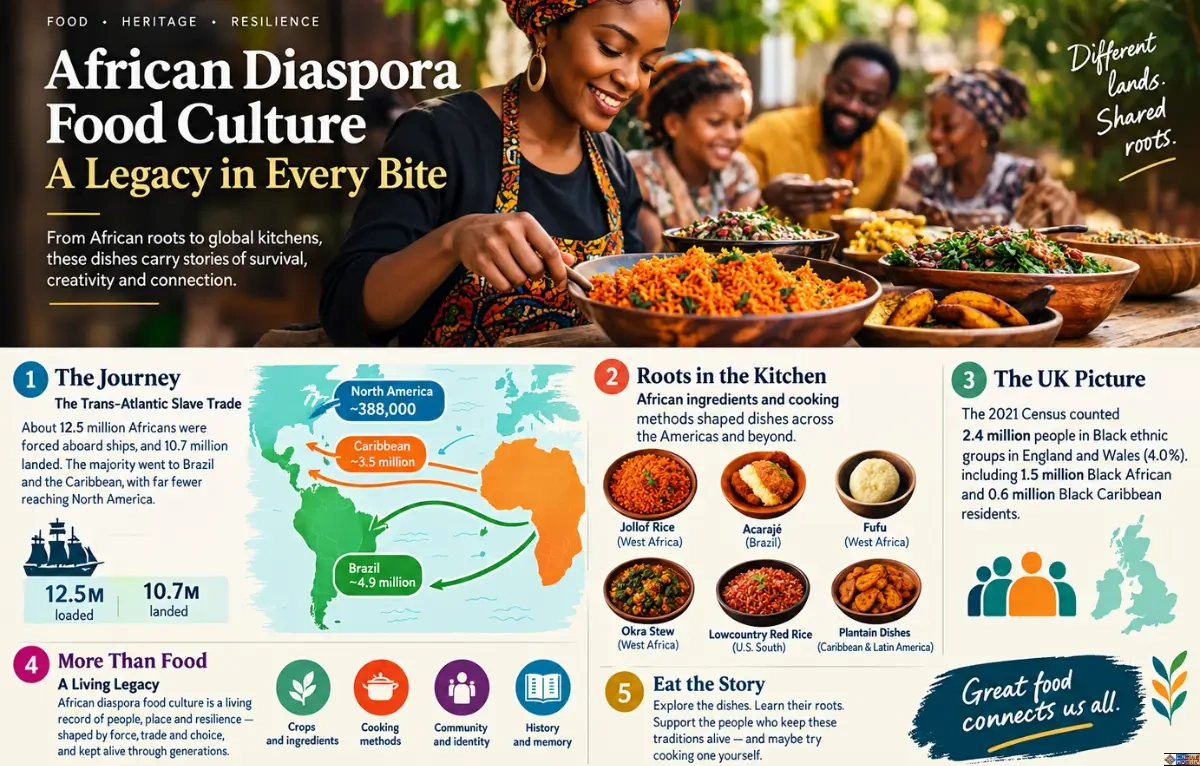
Quick Summary
- What it is: African diaspora food culture is the living record of dishes, crops and cooking methods that left Africa by force, by trade and by choice, then got rebuilt in the Caribbean, Latin America, the American South and Britain.
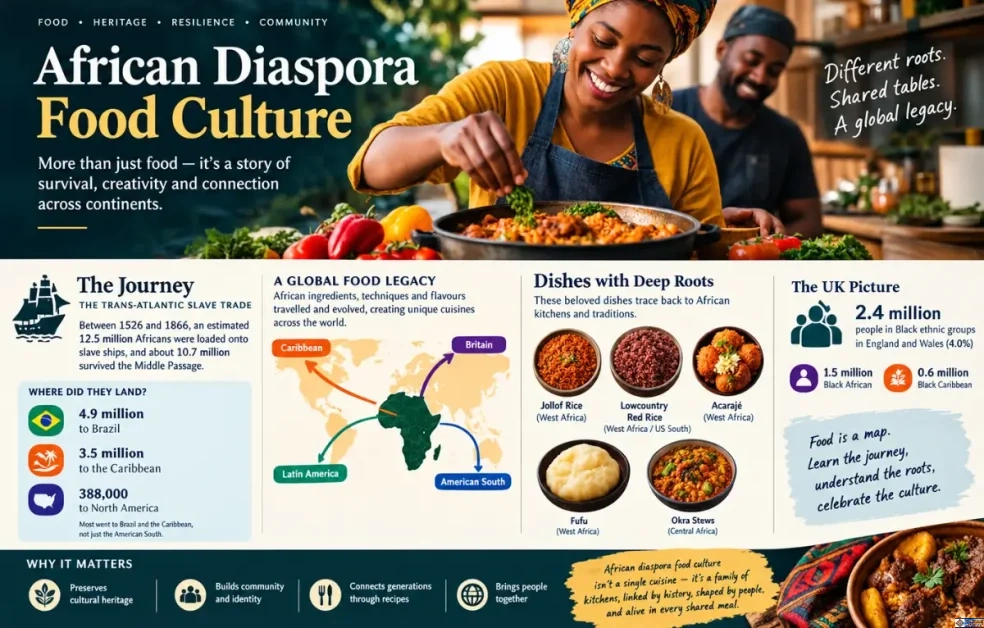
- The scale: The Trans-Atlantic Slave Trade Database estimates about 12.5 million Africans were forced aboard ships and about 10.7 million landed. Almost 4.9 million went to Brazil and about 3.5 million to the Caribbean. Only around 388,000 reached North America.
- Proof on the plate: Jollof, Lowcountry red rice, acarajé, fufu and okra-thickened stews all trace back to named West and Central African kitchens.
- The UK picture: The 2021 Census counted 2.4 million people in Black ethnic groups in England and Wales (4.0%), including 1.5 million Black African and 0.6 million Black Caribbean residents.
- Best next step: Eat it with its story attached. Then cook one dish yourself.
The Problem: One Shelf Labelled “World Foods”
Walk into a big supermarket and find the aisle. You know the one. Soy sauce, tortillas, a jar of jerk paste, plantain chips, all stacked under a single sign. It says “world foods”. It says almost nothing else.
That shelf flattens five centuries of movement, loss, invention and stubborn memory into a price tag, and African diaspora food culture gets squeezed onto it along with everything else. If your grandmother’s kitchen sat inside that story, the flattening stings. Maybe someone has asked whether your family’s stew is “authentic” without being able to place the country on a map. Maybe you learned to cook from a recipe nobody ever wrote down, in a British kitchen that never quite smelled like the one it came from. People often call that gap second-generation cooking: the work of holding a food inheritance in a new place with a different pantry.
The fix is simpler than it sounds. Learn the map. Once you know how a pot of rice in South Carolina relates to a pot of rice in Senegal, or why a bean fritter sold in Bahia carries a Yoruba name, the food stops being “ethnic” and starts being legible. That is what African diaspora food culture really is: a set of connected kitchens. Lydia Wilson Marshall, introducing a special collection of the Journal of African Diaspora Archaeology and Heritage, frames these foodways as sitting between necessity and expression, survival on one side and pleasure on the other. I think that is the sharpest short description of the subject I’ve come across.
I’m writing this for Culture Mosaic as a culinary historian. Not a mourner, not a cheerleader. The story includes atrocity. It also includes some of the best cooking anywhere. Both are true, and I won’t pick one.
1. The Map of African Diaspora Food Culture Starts With a Crossing
What are examples of the African diaspora? The African Union’s working definition covers people of African origin living outside the continent, whatever their citizenship, and it treats that population as a sixth region alongside its five geographic ones. Historians usually split the story in two. There is the historic diaspora created by the slave trade, and there are newer communities built by migration since the twentieth century, including West African and Caribbean families in Britain.
The historic part is measurable. The Trans-Atlantic Slave Trade Database, a project supported by the National Endowment for the Humanities, estimates that about 12.5 million Africans were loaded onto slave ships between 1526 and 1866, and about 10.7 million survived the Middle Passage. Where they landed is the surprise.
![Bar chart titled "Where the crossing ended: three destinations compared," showing approximate disembarked numbers during the transatlantic slave trade: almost 4.9 million to Brazil, about 3.5 million to the Caribbean, and about 388,000 to North America, highlighting the geographic scope of African diaspora food culture[cite: 1].](https://culturemosaic.co.uk/wp-content/uploads/2026/09/image-1.png)
Bar chart comparing the approximate number of Africans who disembarked in Brazil, the Caribbean and North America
Most of us picture the American South first. The data points somewhere else. Brazil and the Caribbean took the overwhelming majority, and North America took a small fraction. So if you go looking for African roots in Latin American and Caribbean food, you’re not chasing a footnote. You’re looking at the main event.
2. Rice Remembers Whose Hands Planted It
Picture a rice field in coastal South Carolina in the eighteenth century. The standard textbook version credits European planters. The geographer Judith Carney, in her book Black Rice, argues the opposite: that rice had been cultivated in West Africa for about a thousand years before Europeans arrived, and that enslaved West Africans carried across the Atlantic not just seed but the know-how of water control, winnowing, milling and cooking. Her thesis builds on earlier work by historians Peter Wood and Daniel Littlefield, and reviewers have found it persuasive.
You can still see the result. The Gullah Geechee people, descendants of enslaved West and Central Africans on the coast from North Carolina to Florida, kept African foodways alive through relative isolation. Congress designated the Gullah Geechee Cultural Heritage Corridor in 2006. Dishes such as hoppin’ John, pilau and the low country boil trace back to that culture, and Lowcountry red rice is the one-pot cousin that food writers keep comparing to jollof.
There was a cost, too. Marshall’s editorial notes that a forced, abrupt change of diet was culturally disorienting and dehumanising for captives newly arrived, an argument drawn from the archaeobotanical work of Alexandra Crowder at Stratford Hall in Virginia. Every pot of rice on this map carries that weight as well as the pleasure, which is why African diaspora food culture can’t be told as a simple celebration.
3. Jollof Is Older Than the Argument About It
Ask a Nigerian and a Ghanaian who makes the better jollof and you’ll start a fight that has its own hashtag. Under the banter sits real history. Britannica traces jollof to the Senegambian region and the Wolof, or Jolof, empire, and to a fish-and-rice dish called thieboudienne, from the Wolof words for rice and fish. The name jollof is a variant spelling of that empire’s name.
Food historians don’t all agree on how the dish travelled. Fran Osseo-Asare traces its origins to northern Senegal, while James McCann has questioned whether one dish could have spread outward across such different cultures in a straight line. Both points can hold. The red, tomato-rich version people eat today also can’t be ancient, because tomatoes, chilli peppers and tomato paste reached West Africa from elsewhere in later centuries. Honest food history keeps both the roots and the remixing in view. That’s what redefining traditional cuisine means to me: not a purity test, but a family tree with a few disputed branches.
| Version | Where | What defines it |
|---|---|---|
| Thieboudienne | Senegal | Rice cooked with fish, shellfish and vegetables; widely called the national dish |
| Benachin | The Gambia | Literally “one pot”; the same rice-in-a-single-pot idea |
| Nigerian jollof | Nigeria | Often parboiled rice with assorted meats or dried seafood |
| Ghanaian jollof | Ghana | Often jasmine rice, usually with goat |
| Lowcountry red rice | South Carolina | Tomatoes with meat or seafood; jollof’s one-pot cousin |
4. Fufu Means More Than “Mash”
What does fufu mean in Africa? The word is Twi, the language of the Akan people of Ghana and south-eastern Côte d’Ivoire. Sources differ on the literal sense. Some translate it as “to mash or mix”, a nod to the pounding. A historian cited in reference works reads it as “white”, after the pale colour of cassava. Either way, the food itself is clear: boiled cassava, plantain, yam or cocoyam, beaten in a wooden mortar until it turns soft, stretchy and smooth, then torn into pieces and used to scoop up soup.
Across Nigeria, similar pounded and stirred starches go by other names, and further east and south you meet cousins such as ugali, nshima, sadza and pap. Fufu itself crossed the Atlantic and adapted to local starches in Haiti, Jamaica, Cuba and Puerto Rico. Nobody eats it alone. It exists to be shared, which is why it belongs alongside the commensal architecture of shared vessels and the wider world of dining rituals and food rituals in different cultures.
There’s a primary source worth reading here. In 1789, Olaudah Equiano published a memoir describing the food of his childhood home: meat stewed in a pan with pepper and other spices, salt made from wood ashes, and vegetables he lists as plantains, cocoyams, yams, beans and maize. He adds that people washed their hands before eating. One caution: biographers have debated details of Equiano’s early life, so I read the passage as an eighteenth-century description of West African cooking, not as gospel. It still matches what the cooking of the region looks like centuries later, and it shows how old the rules of the table are. Pounding, stewing and hand-washing are heritage cooking techniques that never needed a manual.
Clay matters too. West African cooks have long relied on unglazed clay pots, whose porous walls let a stew breathe as it simmers. The ancestral cookware history behind that choice is a story about materials as much as taste.
5. Afro-Latino Dishes Kept Their African Names
Here is my favourite proof that a dish can survive an ocean. Acarajé, the golden bean fritter sold from trays on the streets of Salvador, Bahia, carries a name built from two Yoruba words: akará, meaning fireball, and je, meaning to eat. The recipe is black-eyed peas, fried in dendê, the red palm oil. In the Afro-Brazilian religion Candomblé it’s a sacred offering to the orisha Iansã.
Brazil’s federal heritage body, IPHAN, registered the craft of the Baianas de Acarajé as intangible national heritage in 2005. The craft began with enslaved and freed women selling from the streets, and the registration treats the women who carry it on as knowledge-holders, not just cooks. The urgency is real, though. A report from AARP International notes that the work is financially precarious and that an ageing workforce leaves its future uncertain, although family teaching and the vendors’ association are helping to sustain it.
That is why I’d argue Afro-Latino dishes deserve a shelf of their own, and why African diaspora food culture in Brazil is worth studying on its own terms. If you’re exploring Hispanic cultural foods, remember that Africa runs straight through the middle of them. Salvador is only the loudest example.
![Flowchart titled "From West African pot to diaspora plate: Four documented links," mapping West African food origins (Upper Guinea rice know-how, Senegambian jollof/thieboudienne, Yoruba akara fritters, and Akan fufu) to their diaspora counterparts in the Carolinas, Brazil, and the Caribbean[cite: 2].](https://culturemosaic.co.uk/wp-content/uploads/2026/09/image-2.png)
Diagram linking four West African foods to their diaspora descendants
6. Afro-Caribbean Food Recipes Are Acts of Adaptation
Callaloo, bananas, butter beans, palm oil and catfish appear on the African Heritage Diet Pyramid as everyday foods of the diaspora, and the Caribbean is where African diaspora food culture does its fastest mixing. The recipes in the Smithsonian’s Sweet Home Café Cookbook, built around the menu of the National Museum of African American History and Culture, include Jamaican jerk chicken, curried goat, Trinidad’s Afro-Indian doubles and Guyanese oxtail pepper pot. One region, several inheritances, one plate.
Britain has its own chapter. When HMT Empire Windrush docked at Tilbury in June 1948, it started a wave of Caribbean migration that reshaped British cities. Food history writers point out that in the 1950s, yams, plantain, callaloo and ackee were hard to import, so early cooks improvised with what shops stocked. Brixton Market, at the centre of that story, was Grade II listed in 2010 partly as the commercial and social heart of the Afro-Caribbean community that settled there after the war.
Afro-Caribbean food near me is one of the most common searches on this topic, and it makes sense: people want the dish and the place together. I’ll come back to how to find it.
| Region of the diaspora | Signature dishes | The African thread | What changed on arrival |
|---|---|---|---|
| West and Central Africa | Jollof, thieboudienne, fufu | Rice, tubers, palm oil, pounding and one-pot cooking | Modern red jollof absorbed tomatoes and other newer ingredients |
| The Caribbean | Callaloo, jerk chicken, curried goat, fufu variants | Leafy greens, pounded starches, slow stews | Blended with Indian, Indigenous and European influences |
| South America (Brazil) | Acarajé | Black-eyed pea fritters fried in palm oil | Tied to Candomblé; craft registered as Brazilian heritage in 2005 |
| The American South | Red rice, hoppin’ John, pilau, collards and potlikker | Rice knowledge, greens, one-pot cooking | Ingredients shifted to what enslaved cooks could grow or obtain |
7. The American South Was Cooking Africa All Along
For a long time, Southern food was told as a story with the cooks missing. That is changing, and African diaspora food culture in the United States is finally getting its due. Michael W. Twitty’s The Cooking Gene traced his ancestry through food from West and Central Africa into the American South, and it won the 2018 James Beard Foundation Book of the Year and Writing awards. Harvard’s Graduate School of Design describes him as the first Black author to receive that honour. Jessica B. Harris, whose book High on the Hog became a screen series, wrote the historical headnotes for the Sweet Home Café Cookbook, which offers 109 recipes and treats collards with potlikker, hoppin’ John and sweet potato pie as African American culinary history.
The museum’s café opened in 2016 and quickly became a destination in its own right, which tells you something about appetite. People wanted the history in a form they could eat. For the wider American plate, from gumbo to fried chicken, our own guide to USA famous dishes shows how deeply these kitchens shaped what the country calls its cooking.
8. African Food Is Not One Cuisine
What are some traditional foods in African culture? That question has a trap in it, because “African food” is a continent’s worth of cooking. West Africa gives you jollof and pounded starches. North Africa gives you couscous, the dish that in December 2020 was jointly inscribed on UNESCO’s Representative List of the Intangible Cultural Heritage of Humanity by Algeria, Mauritania, Morocco and Tunisia. It was a rare moment of shared credit, given the long rivalry over who invented it.
Steamed semolina, spiced stews, clay vessels: I’ve covered the North African end of this story in our traditional Moroccan couscous recipe and how to cook traditional Moroccan tagine. Ethiopian injera, a fermented flatbread, belongs to yet another tradition. If you take one lesson from this section, take this: understanding African diaspora food culture means asking which part of Africa a menu means when it says “African”.
9. Diaspora Fusion Food Is the Newest Chapter and the Oldest Habit
Here is the twist. Fusion isn’t new. Cooks in the diaspora have been improvising with what they could reach for centuries: African technique, local crops, Indigenous and European influences. What’s new is that diaspora fusion food now appears on restaurant menus, in cookbooks and across social feeds under names like heritage food fusion, modern immigrant recipes and cross-cultural cooking trends. I like it best when the cook can explain what came from where.
Any honest account of African diaspora food culture in Britain has to start with the numbers, because the audience is growing. The 2021 Census counted 2.4 million people in Black ethnic groups in England and Wales, and the Black African group grew fastest.
| Group (England and Wales) | 2011 | 2021 |
|---|---|---|
| Black African | 978,000 (1.8%) | 1.49 million (2.5%) |
| Black Caribbean | 591,000 (1.1%) | 623,000 (1.0%) |
| Black other | 278,000 (0.5%) | 298,000 (0.5%) |
Numbers like these are why multicultural culinary traditions in the UK are no longer a niche topic. They are the everyday high street.
The cooking of home has a second inheritance, too, and that’s how memory lives in hands. Second-generation cooks often learn by handful and by eye, which is somatic seasoning in its purest form. A smell can pull a whole kitchen back into a room, the effect I call somatic food memory. Fermentation carries memory as well. Injera, ogi and other soured staples are living examples of ancestral fermentation techniques, and they connect to the broader idea of ancestral fermentation rituals. Seasoning with fermented seeds and dried fish is, in the same spirit, ancestral umami cooking.
Health enters this story too. In November 2011, the nonprofit Oldways launched the African Heritage Diet Pyramid, developed with nutrition scientists including Walter Willett of Harvard and culinary historians Jessica B. Harris and Robert Hall. It draws on four regions of the diaspora: Africa, the Caribbean, South America and the American South. Leafy greens sit at the base, and one of its twelve sample plates is jollof rice with black-eyed peas. Hall told Northeastern University that the pyramid centres traditional African and Caribbean foods rather than what he called inherently unhealthy soul food. Not everyone accepts that framing, and soul food has fierce defenders, so treat it as one scholar’s argument. It also isn’t medical advice. But as a way to look at ingredients, it works. If you like the idea of rediscovering heirloom crops, our regenerative heritage recipes pick up that thread.
How to Taste It: Afro-Caribbean Food Near Me and Beyond
Reading about food only gets you so far. If you want to experience African diaspora food culture rather than just read about it, here is how I’d start. Recipes from the African diaspora are easy to find. The trick is finding ones that come with context.
First, shop where the ingredients live. Independent African and Caribbean grocers and markets, the kind of places Brixton Market has stood for since the postwar years, stock yam, plantain, scotch bonnets, palm oil and dried fish. Second, cook something with a documented lineage. Oldways publishes free heritage recipes, including a jollof and black-eyed pea plate, and the Sweet Home Café Cookbook puts each recipe in historical context. Third, read one primary voice. Marshall’s editorial introduction and Twitty’s The Cooking Gene are good places to begin, and our roundup of traditional recipes from around the world is a useful sidebar once you’ve got a taste for it.
Now the wildcard. Cook jollof and Lowcountry red rice on the same night, one pot each, and taste the argument for yourself. The smoky edge, the tomato depth, the way one seems to whisper a cousin’s name. It’s the fastest history lesson I know, and it fits on a dinner plate.
If you’re in the UK, timing helps. October is Black History Month here, which means markets, talks and pop-ups tend to cluster now. And ask the older cooks in your family or community what they remember, while they can still tell you. Recipes that live only in someone’s hands don’t last long once the hands stop.
Here’s the thing I keep coming back to about African diaspora food culture. Every dish on this page began with someone standing over a pot, deciding what to do with the ingredients they had. Some were free. Many were not. The pot is still on.
Frequently Asked Questions
What are some traditional foods of the African diaspora?
In African diaspora food culture, the best-known dishes include jollof rice and its cousins (thieboudienne, benachin, Lowcountry red rice), fufu and its Caribbean variants, acarajé in Brazil, callaloo and jerk in the Caribbean, and hoppin’ John, pilau and collards with potlikker in the American South. Each has a documented link to West or Central African cooking, though every region added its own local ingredients.
What are examples of African diaspora?
African diaspora food culture grows out of communities such as the descendants of enslaved Africans in Brazil, the Caribbean, the United States and elsewhere in the Americas, such as the Gullah Geechee people of the southeastern United States. Newer diaspora communities include West African, East African and Caribbean families in the UK, including the Windrush generation who arrived from 1948. The African Union counts the diaspora as its sixth region.
What are some traditional foods in African culture?
Africa’s food is many cuisines. Common examples include jollof rice and fufu in West Africa, couscous and tagine in North Africa, and pounded or stirred starches such as ugali, nshima and sadza in eastern and southern regions. Injera, the fermented Ethiopian flatbread, is another well-known staple. What links them is technique: slow stews, shared pots and starchy staples eaten with the hands.
What does fufu mean in Africa?
Fufu is a Twi word from the Akan people of Ghana and Côte d’Ivoire. Sources translate it as “to mash or mix” or as “white”, after the colour of cassava. It describes a soft, stretchy dough made by pounding boiled cassava, plantain, yam or cocoyam. It’s eaten across West and Central Africa with soups and stews, and versions exist in the Caribbean too.
What is the African Heritage Diet?
It’s a way of eating based on the traditional foods of four regions of the diaspora: Africa, the Caribbean, South America and the American South. Oldways launched its pyramid in 2011 with nutrition scientists and culinary historians. It emphasises leafy greens, tubers, beans, whole grains and fish, with little meat and few sweets. Treat it as a cultural framework for eating, not personalised medical advice.
Sources
- Marshall, L. W. (2020). African Diaspora Foodways in Social and Cultural Context. Journal of African Diaspora Archaeology and Heritage, 9(2), 73-76.
- National Endowment for the Humanities. The Transatlantic Slave Trade Database.
- Einhorn, R. (2011). An Atlas of Reckonings. The Nation. PBS, How Many Slaves Landed in the U.S.?
- Carney, J. (2001). Black Rice: The African Origins of Rice Cultivation in the Americas. Harvard University Press. See the Technology and Culture review.
- National Park Service. Who are the Gullah Geechee?
- Encyclopaedia Britannica. Jollof rice.
- PushBlack. The Hidden Empire Behind This Famously Debated Black Food.
- Wikipedia (secondary summary of Osseo-Asare and McCann). Jollof rice.
- Fine Dining Lovers. Fufu: what it is and how to eat it.
- Equiano, O. (1789). The Interesting Narrative of the Life of Olaudah Equiano, ch. 1. Hanover Historical Texts.
- AARP International. Serving Up Tradition. Brasil 61, Ofício das Baianas de Acarajé.
- Penguin Random House. Sweet Home Café Cookbook, Smithsonian Books (2018).
- Harvard Graduate School of Design. Michael Twitty event listing.
- African Union definition of the diaspora, as cited in ACCORD and the South African government address.
- Middle East Eye. Couscous added to UNESCO list (2020).
- Office for National Statistics. Ethnic group, England and Wales: Census 2021. UK Data Service, race and migration tables.
- African American Intellectual History Society. Post-war Representations of British Caribbean Food Markets. Plated History, An Ode to the Windrush Generation.
- Oldways. Oldways introduces the African Heritage Diet Pyramid (2011). Northeastern University, Healthy eating through cultural discovery.