
 By Marcus J. Holloway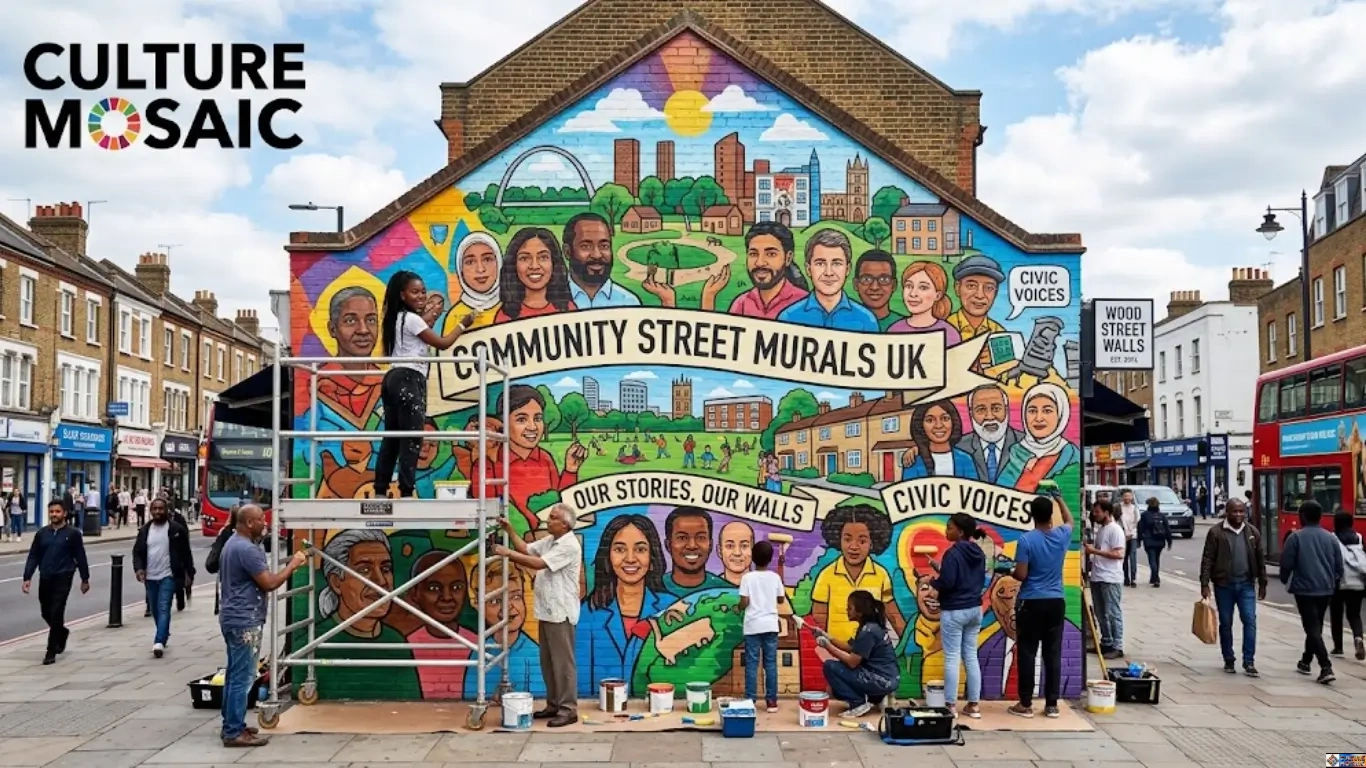
Quick Summary
- Focus keyword: Community Street Murals UK
- Painting a mural in England usually falls under permitted development, but it needs Advertisement Consent if it promotes a brand, and Listed Building Consent if the wall is protected.
- Most community murals are designed with residents, not just for them, through workshops, ballots, and open design days.
- Funding usually comes from a mix of Arts Council England National Lottery Project Grants, council placemaking pots, Business Improvement Districts, and old-fashioned crowdfunding.
- Art UK’s national mural database now holds more than 21,000 catalogued works, with over 6,600 added since 2024 alone.
- Murals are linked to less tagging, more footfall, and a stronger sense of pride on the street where they sit.
I run Culture Mosaic, and community street murals are one of the few civic subjects I never get tired of writing about. Give me an hour and I’ll walk you through the legal bit, the funding bit, and the part nobody puts in the brochure: what it actually feels like to stand on a ladder with a paintbrush while your neighbours watch and decide, out loud, whether they like it.
The Problem: A Grey Wall Nobody Owns
Every town has one. A gable end above a chippy, a underpass wall streaked with damp, a row of shutters on a parade that’s half-empty since the bank left. Nobody vandalised it exactly. It just got tired. And tired walls send a message whether anyone means them to or not: nobody’s looking after this place.
That message compounds. Litter collects near a neglected wall faster than near a cared-for one. Confidence drops. Footfall drops with it. I’ve spoken to enough town centre managers to know the pattern repeats from Consett to Cornwall, and it rarely gets fixed by a council report. It gets fixed, when it does, by people picking up brushes.
What Are Community Street Murals, Really?
A community street mural is a large-scale painted artwork, usually on an exterior wall, created with meaningful input from the people who live or work around it — as opposed to a piece dropped in by an artist with no local brief at all. The “community” part is doing real work in that definition. It’s not decoration applied to a place. It’s a decision a neighbourhood makes about itself.
This distinguishes murals from tagging and from purely commercial branding on a wall, though the legal line between “art” and “advertisement” is blurrier than most people assume — more on that shortly.
Community Street Murals UK: A Movement That’s Finally Being Counted
For years, nobody actually knew how many murals existed across Britain. That changed with Art UK’s murals digitisation and engagement programme, launched in January 2024 and originally aiming to record around 5,000 works. By April 2026, the project had added more than 6,600 new murals and wall-based artworks to its database, bringing the total number of catalogued public artworks to well over 21,000. The project is funded principally by the National Lottery Heritage Fund and spans the length of the country, from Kirkwall in Orkney to Penzance in Cornwall.
I find the scale of the volunteer effort more striking than the headline number. Volunteers gave more than 5,000 hours locating and photographing works that might otherwise never have been recorded before a redevelopment quietly painted over them. Some are decades old, some go back centuries as wall paintings in historic churches, and some were finished last month on the side of a chicken shop.
Public Art Manager Tracy Jenkins put it well when the project launched: the aim was simply to record murals and wall-based artworks from across the UK dating from the year 1000 to the present day. That framing matters. It puts a spray-painted piece from last summer in the same conversation as a Victorian ceramic panel, which is exactly the kind of levelling that street art has always done best.
One London project shows what this looks like at street level. Wood Street Walls, a community-driven group in Walthamstow, has helped bring more than 100 murals to the borough over roughly a decade, working with artists including Conor Harrington, Invader, and Remi Rough. Their most ambitious piece — a six-storey animated mural at the Priory Court estate, created with local artist INSA — was built directly from stories residents shared about eighty years of living there. That’s not public art parachuted in. That’s Co-design in urban planning and civic engagement done properly, and I’d argue it’s the model every council placemaking team should study before they commission anything.
Is Street Art and Community Mural Painting Legal in the UK?
Short answer: usually, yes — but “usually” is doing some heavy lifting, and getting this wrong is the single most common way a mural project stalls.
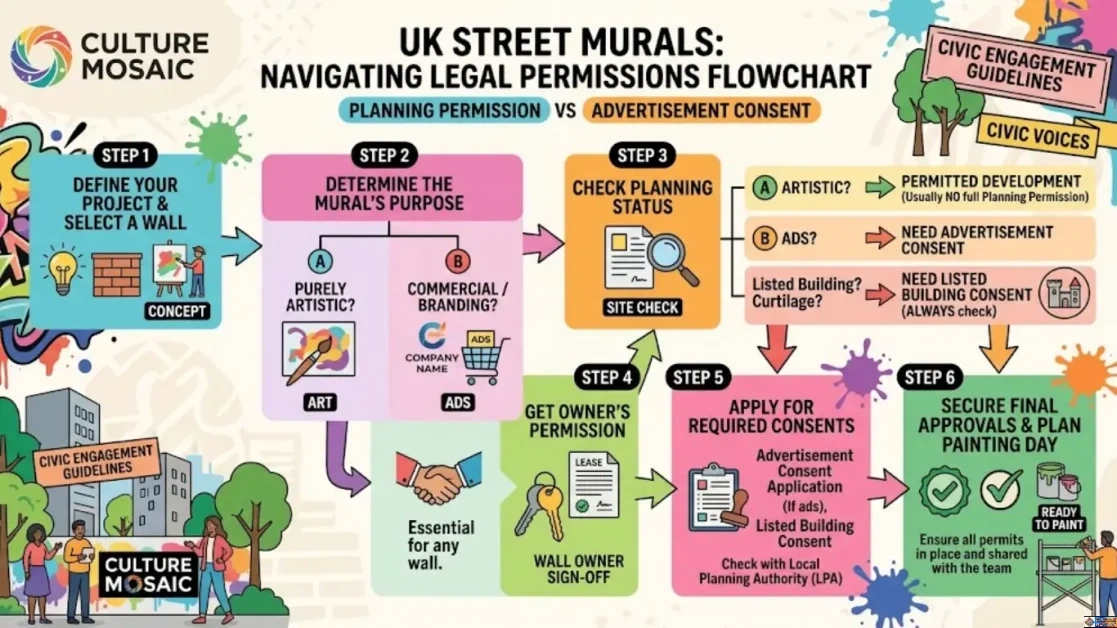
England’s planning system treats a mural as one of three things, and which one determines what paperwork you need.
| Situation | What applies | Consent needed? |
| Artistic mural on a plain exterior wall, no branding, no listed status | Permitted development for painting a building’s exterior | Usually none, beyond the owner’s sign-off |
| Mural includes a logo, brand name, or promotes a product or service | Advertisement, under the Town and Country Planning (Control of Advertisements) (England) Regulations 2007 | Advertisement Consent from the local planning authority |
| Wall sits on, or within the curtilage of, a listed building | Listed Building Consent regime | Listed Building Consent, sometimes alongside Advertisement Consent |
Section 336 of the Town and Country Planning Act 1990 defines an advertisement as any representation “wholly or partly for the purpose of advertisement, announcement or direction,” and councils decide case by case whether a given mural crosses that line. A recent Camden appeal makes the stakes concrete: a planning inspector dismissed an appeal by a street art company for hand-painted murals at 48 Chalk Farm Road after concluding they harmed the amenity of the area, even though the murals were community-commissioned. Painting the exterior of a building without any advertising purpose is generally excluded from that permitted-development route altogether once branding enters the frame.
Local authorities also require the agreement of anyone with a legal interest in the wall before street art goes up, and if one or more property owners object, the usual response is to find another site rather than push ahead regardless. If you’re in a conservation area, expect extra scrutiny even without a listed building involved — some councils treat a prominent exterior mural there as a material change needing planning permission in its own right.
My honest advice: ring the council’s planning duty officer before you buy a single tin of paint. It’s a five-minute call that saves months.
How Do Communities Get Involved in Designing and Painting a Mural?
This is the part that separates a genuinely community mural from a mural that just happens to be near a community. The process, done well, tends to run through the same rough stages.
1. Someone names the wall. A resident, a Business Improvement District, a school, a tenants’ association — someone identifies a site and starts a conversation about it. This is grassroots Local Civic Engagement Strategies in its purest form: no committee, just a person deciding a wall matters.
2. The brief gets built with residents, not for them. Good projects run open design days, ballots, or workshops where people share memories, symbols, and objections. That’s Co-design in urban planning and civic engagement at its most direct — and it’s why How Public Feedback Shapes Local Policy is worth reading alongside this, since a mural consultation and a planning consultation run on nearly identical logic. If your borough runs formal sessions on this, it’s worth understanding Why Public Consultation Is Important before you sit through one that feels like box-ticking.
3. Objections get heard properly, not just logged. What Is Public Commentary? matters here — a mural that ignores the one loud objector in a street WhatsApp group tends to get vandalised within a month. Listening isn’t the same as agreeing, but skipping it almost always costs more later.
4. An artist translates the brief without flattening it. The best muralists treat resident input as material, not decoration to bolt on afterwards. This is where Narrative Advocacy becomes visible on a wall — someone’s actual story, painted at six storeys high, rather than a generic “unity” motif.
5. Painting day becomes a civic event in itself. Wood Street Walls’ “Paint Your London” fortnight turned a fundraising push into a street festival — people watched artists work, asked questions, brought their kids down after school. That kind of open process is exactly the sort of Tactical Urbanism in Community Civic Engagement that costs little and builds trust fast, closer to DIY Placemaking Community Engagement than to a formal council scheme.
None of this needs to be complicated or expensive to start. Small interventions — a single doorway, a bin store, a subway wall — count as Micro-Civic Interventions, and they’re often the easiest way for a new group to build a track record before tackling a bigger wall. If you want a structured way to run the whole process, our guide on Organising a Neighbourhood Mural covers the practical sequencing step by step.
Youth involvement deserves its own line here. The Priory Court mural I mentioned earlier was coordinated in part by young people running a social action project — a genuine Youth Engagement Strategy rather than a token “young people’s panel” that meets once and gets photographed. If your project is short on volunteers, look at how choirs handle this too; UK community choirs civic engagement runs on strikingly similar recruitment logic to mural groups.
How Are UK Community Murals Typically Funded?
Money for murals rarely comes from one pot. It’s usually stitched together from several, which is annoying to manage but does spread the risk.
| Funding route | Typical scale | Best suited to |
| Arts Council England National Lottery Project Grants | A few thousand pounds up to tens of thousands | Groups with a named artist and a clear community engagement plan |
| National Lottery Heritage Fund | Varies widely; larger for heritage-linked or historic-site murals | Projects tied to local history, commemoration, or heritage buildings |
| Business Improvement District (BID) budgets | Council/BID-agreed, often multi-year | High streets and commercial parades wanting footfall and image gains |
| Council placemaking and “Love Your Block”-style micro-grants | Small, fast-turnaround grants | First-time groups, single walls, quick wins |
| Crowdfunding and local business sponsorship | Variable, often matched against a target | Groups without charitable status building a first track record |
Arts Council England is investing £467 million of public money from Government between 2023 and 2026, alongside an estimated £250 million a year from the National Lottery, to support individual practitioners, community projects and cultural organisations across England. National Lottery Project Grants is the open-access route most mural groups apply through first.
Camden’s experience shows how council and BID money often combines with consent processes rather than sitting apart from them. Camden Town Unlimited, the Business Improvement District for the area, has run a rolling advertising consent for community-led art murals on a Camden High Street gable wall, curating at least three community-led artworks under a model already supported elsewhere in the borough. That’s a useful template: consent and funding negotiated together, rather than an artist turning up with a grant and no permission.
For groups working outside London, Love Your Block Grant 2026 is worth checking before you assume you need a big application — small, fast grants like this exist precisely because councils know first-time groups get put off by paperwork. And whatever the funding source, an Ethical Grassroots Advocacy approach — being upfront with funders and residents about who benefits and how — tends to keep a project on good terms with everyone long after the paint dries.
What Are the Main Benefits of Street Murals for Local Neighbourhoods?
I’m not going to pretend murals fix everything. They don’t rebuild a high street on their own, and treating them as a substitute for actual investment is a mistake I’ve seen councils make more than once. But the evidence for what they do achieve is stronger than the sceptics usually admit.
- Less tagging, more care. Adding murals to a street scene has been shown to significantly reduce instances of unsightly tagging graffiti, which is often part of a wider pattern of anti-social behaviour and fear of crime in a community, alongside driving visitor numbers and economic benefit.
- A measurable lift in connectedness. Research on pedestrian-level public art has found it can improve neighbourhood connectedness and wellbeing for the people who walk past it daily — not just the people who commissioned it.
- Civic pride that outlasts the paint. A wall with a story attached becomes a landmark people give directions by. That’s a small thing, until you notice how often it comes up in resident surveys about neighbourhood satisfaction.
- A soft entry point into local democracy. People who’d never attend a planning meeting will turn up to vote on a mural design. It’s a genuinely useful 10 Civic Engagement Opportunities-style on-ramp, and one I think is underused deliberately by local authorities who find it easier to consult about paint than about budgets.
This mirrors wider Civic Engagement Trends — councils across the country are leaning harder on visible, tactile projects precisely because they draw people in who wouldn’t otherwise show up. None of that is a replacement for Why Is Voting Important in Local Elections? — a mural vote and a council election are not the same act of citizenship, and I’d push back hard on anyone who conflates the two. But as a first taste of Civic Engagement, murals do something that a leaflet through the door rarely manages: they make participation visible on the street itself, permanently, for anyone who wasn’t in the room.
There’s a deeper case for Civic Literacy here too. A resident who’s sat through a mural consultation has a working understanding of how Understanding Civic Duty actually functions locally — who has to sign off what, why a wall isn’t just “free to paint,” why the council can’t just say yes. That’s a small but real education in What is the Value of Civic Participation?, delivered without anyone sitting through a lecture.
And in areas where different communities share a high street but rarely share a table, a well-run mural project is one of the few things I’ve seen genuinely produce Diverse Civic Harmony — because everyone gets a say in what goes on the wall they all walk past.
Where to Find a Community Street Murals UK Map and Free Trails Near You
If you want to see this for yourself rather than take my word for it, three resources are worth bookmarking.
Art UK’s public database is now the closest thing Britain has to a national mural atlas, covering everything from Banksy pieces to post-war ceramic panels. It’s free to browse and searchable by location, which makes it the best starting point if you’re after a genuine community street murals UK map rather than a curated top-ten list.
For a city-level example of how this works in practice, Community Street Murals UK tracks street art locations and artist information across UK cities, and it’s a decent second stop once you’ve found your region on Art UK’s map.
Wood Street Walls also publishes its own downloadable map of Walthamstow’s murals, which is worth doing on foot — starting at Wood Street station and working towards Hoe Street covers most of the highlights in an afternoon, and it costs nothing beyond a train fare.
If you’re after the free community street murals UK experience rather than a paid gallery visit, this is genuinely it: most of what’s worth seeing sits in public streets, with no ticket and no opening hours.
Best Community Street Murals UK: A Few Worth the Detour
A shortlist, not a ranking — comparing murals directly always feels a bit like comparing songs.
- Priory Court, Walthamstow — INSA’s six-storey animated “Unity Banner,” built from residents’ own stories of their estate.
- Wood Street and Forest Road, Walthamstow — a working trail of over a hundred pieces, including work by Invader, Remi Rough, and Axel Void.
- Cable Street, Tower Hamlets — the “Battle of Cable Street” mural, a decades-old civic memorial that Art UK’s database now records alongside newer work.
- Camden High Street — a rolling programme of BID-curated community murals, renewed under successive advertising consents.
- West Street, Bristol — home to large-scale contemporary pieces catalogued through Art UK’s national survey.
Every one of these started as somebody’s Real-World Problems-solving idea for a wall nobody was looking after. None of them stayed that way for long once a community got involved.
Getting Your Own Wall Painted: A Short Action Plan
If you’ve read this far, you’re probably already picturing a wall near you. Here’s the honest sequence:
- Find the wall and the owner. Ask before you assume.
- Ring the council’s planning duty desk and ask, plainly, whether the design needs Advertisement Consent or Listed Building Consent.
- Run a short design session with neighbours — even a Saturday morning with tea and a flipchart works.
- Apply to a small local grant first, then layer in Arts Council or Heritage Fund money if the ambition grows.
- Commission an artist who’s done community work before, not just a portfolio piece.
- Make painting day public. Invite the street. Let people watch.
This is Social Change in Modern Society at a genuinely achievable scale — no petition, no protest, just a wall and a plan. If you want a fuller framework before you start knocking on doors, our Community Advocacy Toolkit and our wider set of Hyperlocal Advocacy Toolkits go through funding applications and objection-handling in more depth than I can fit here. For groups running things mostly over WhatsApp and Facebook, Hyperlocal Digital Deliberation is worth a read too, since most mural consultations now happen online before they happen on a doorstep.
And if murals are your first step into local organising more broadly, our Hyperlocal Advocacy Strategies and Community Activism Strategies pieces are the natural next reads, alongside Civic Voice if you want to understand how this fits into the wider democratic picture. Councils genuinely do want more residents involved — Volunteer for Civic Education Programs is a good place to see what that looks like beyond murals, and for the wider structural context behind why some councils move faster than others, Vernacular Governance Structures is worth a look too.
For readers who want to see exactly how a similar project unfolded from first sketch to funded, painted wall, our earlier piece on Grassroots Murals UK Civic Engagement walks through a full case study, including the funding routes and consultation stages in more detail than fits in this overview. And if you’re trying to get residents involved beyond a single mural, how to get involved in local civic issues online covers the digital tools most groups end up using anyway.
Frequently Asked Questions
Is street art and community mural painting legal in the UK?
Generally yes. Painting a plain artistic mural on an exterior wall is normally covered by permitted development, so you don’t need a full planning application. But two things change that: if the mural includes a brand, logo, or promotes a product or service, it counts as an advertisement under the Town and Country Planning (Control of Advertisements) (England) Regulations 2007, and needs Advertisement Consent from the local council. And if the wall is listed, or sits within the curtilage of a listed building, you’ll need Listed Building Consent too. You’ll also need sign-off from whoever legally owns or controls the wall — the council alone can’t grant that on someone else’s behalf.
How do communities get involved in designing and painting a mural?
Most well-run projects follow a similar pattern: someone identifies a wall and starts a conversation, a design brief gets built through workshops or open days with residents, an artist translates that brief into a design, objections get addressed rather than ignored, and the painting itself often becomes a public event people can watch. Schools, tenants’ associations, Business Improvement Districts, and informal resident groups can all initiate this — you don’t need charitable status to start, though it helps once you’re applying for larger grants.
What are the main benefits of street murals for local neighbourhoods?
The most consistently reported benefits are a reduction in tagging and low-level anti-social behaviour, increased footfall and visible investment in a street, a boost to neighbourhood connectedness and wellbeing for people who walk past regularly, and a low-pressure way for residents to engage in local decision-making who might never attend a formal council meeting. Murals don’t replace investment in a high street, but they’re a genuinely cost-effective complement to it.
How are UK community murals typically funded?
Funding is usually blended rather than coming from a single source. Common routes include Arts Council England’s National Lottery Project Grants, National Lottery Heritage Fund money for heritage-linked projects, Business Improvement District budgets, council micro-grants aimed at first-time groups, and crowdfunding or local business sponsorship. Larger or more historically significant walls sometimes combine two or three of these routes within one project.
Where can I find a map of community street murals across the UK?
Art UK’s national database is the most complete free resource, now covering over 21,000 catalogued public artworks including thousands of street murals, searchable by location. Several city and neighbourhood groups — Wood Street Walls in Walthamstow being a good example — also publish their own free downloadable trail maps, which are usually more detailed for that specific area than a national database can be.
Sources
- Art UK, “Walls with stories: mapping the UK’s murals and street art”
- Art UK, “About Digitisation programmes: Murals project”
- The Art Newspaper, “Charity Art UK digitises nearly 7,000 murals across country” (April 2026)
- GOV.UK, “Advertisements” planning guidance
- Planning Resource, “Does a mural require planning permission?”
- London Borough of Camden, Planning Inspectorate appeal decision, 48 Chalk Farm Road (APP/X5210/Z/24/3354706), April 2025
- Newham Council, “Approach to New Street Art Projects”
- Arts Council England, “New to the Arts Council” funding overview
- Wood Street Walls, “Projects” and “Community case studies”
- Delib, “Future of Public Engagement: Trends 2025”