
 By Dr. Julian Thorne
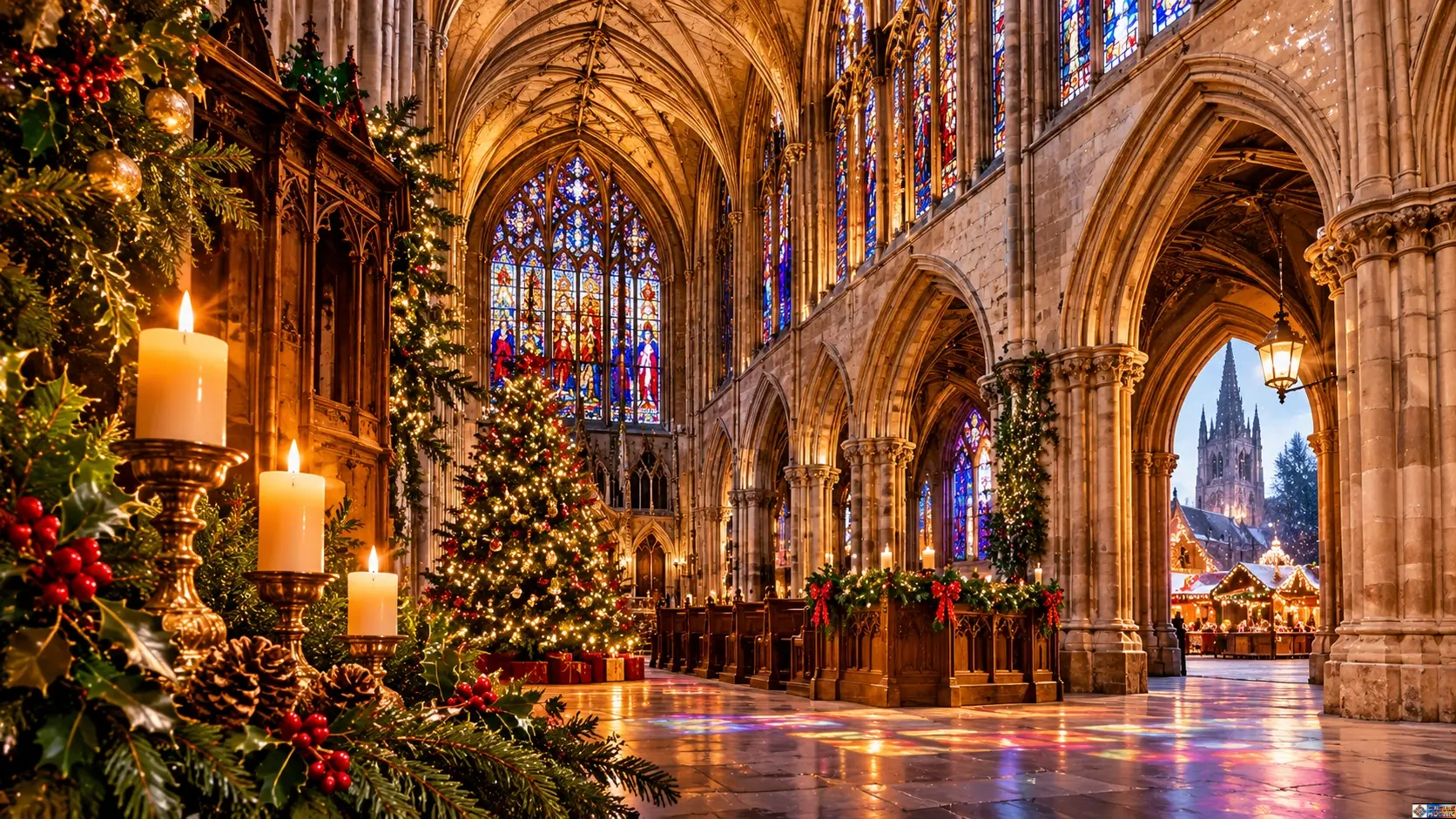
Why does Gothic architecture Christmas feel like one idea rather than two? Because the building was engineered to do what the season asks of us: lift the eye, dim the world, and make a small flame feel enormous. Pointed arches pull your gaze up. Stained glass turns thin winter daylight into colour. A vaulted stone ceiling holds a choir’s last note for seconds after the singers stop. Put a candle in that, and you have Christmas, whether or not anyone hung a single bauble.
Here’s the snag. Most festive guides treat a cathedral as scenery, a handsome grey blur behind the mulled-wine stall. You can stand beneath a centuries-old west front with a paper cup in your hand and still miss what the building is doing to you. That gap between being moved and knowing why is a small, real loss. The fix is simple. Learn the machinery once, and every Gothic cathedral at Christmas reads differently from then on.
That is what this piece does, as part of the Artistic Expressions series here at Culture mosaic. Seven truths, in order, each anchored to something you can check: a medieval embroidery in the V&A, a wooden shed in Cornwall, an engraving in a Victorian magazine, a cathedral that went silent in 2019. Where I couldn’t confirm a 2026 detail, I say so. And because it is 21 November, the clock matters. Christmas Eve is 33 days away, and some of what follows has a short window.
A Gothic Architecture Christmas Scene: Picture the Nave on Christmas Eve
Picture the west doors opening onto a nave that doesn’t seem to end. The first thing that reaches you isn’t a sight. It’s the cold: that mineral, slow chill stone keeps long after the street has warmed, with a trace of old candle smoke caught in it. Then the smell arrives in layers, resinous pine from garlands wound around the pier bases, and over it the sweet, smoky drift of incense curling toward the vault. Look up. Pointed arches climb in pairs, then in rows, narrowing into ribs that meet at carved bosses far overhead, and the whole ceiling seems to hold its breath. Outside, unseen from where you stand, flying buttresses carry the weight of all that height to the ground while gargoyles lean from the parapets. Inside, only the lightness shows.
The windows do the rest. In the low December sun the glass doesn’t so much glow as slide, ruby and cobalt drifting across the floor tiles, over a bank of poinsettias at the chancel step, up the pale flank of a pillar, changing its mood by the hour. By late afternoon the colour drains toward blue and the candles take over, hundreds of small flames, each one doubled in the brass of the lectern. Somewhere beyond the screen a choir sings a single phrase and the vault keeps it, letting the last note hang in the air long after the voices have gone.
Then comes the contrast, which is the whole secret. Above you the masons are showing off: tracery spun like frost across the windows, crocketed finials, a carved grotesque grinning from a corbel at the choir below. Beneath all that stone extravagance the decorations are almost shy. A wreath of holly and ivy. A plain white candle in an iron stand. A single spray of fir tied with red ribbon at the end of each pew. Nothing competes. The stone is already shouting, so the greenery only has to whisper. If the outside struts in that first paragraph puzzled you, I’ve laid out the mechanics in Flying Buttress Definition in Art. For now, all you need is the effect: the weight goes outside, and the light comes in.
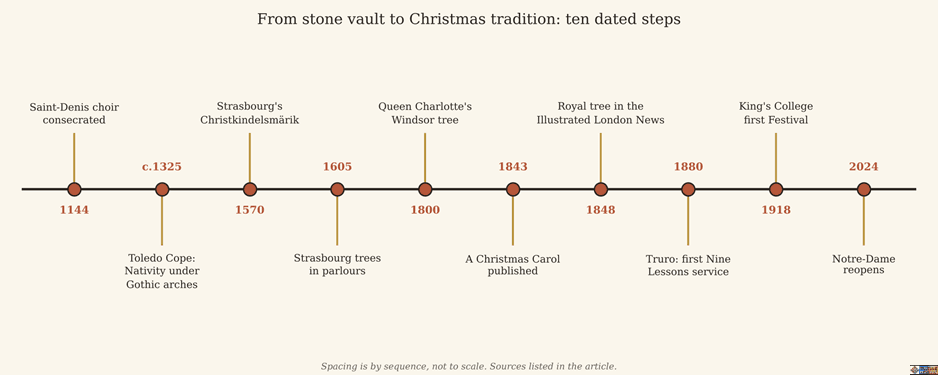
Figure 1. Original Gothic architecture Christmas timeline, built from the sources listed at the end. Spacing is by sequence, not to scale.
1. Christmas Was Written Into the Stone Before It Was Written Into the Tree
Gothic Architecture Christmas begins somewhere most guides skip: embroidery. The V&A’s account of Christmas in opus anglicanum, the English needlework prized across medieval Europe, shows nativity scenes, shepherds and angels turning up everywhere in medieval art, from stained glass to manuscripts to priests’ vestments. Take the Toledo Cope, made in England around 1320 to 1330. Its Nativity sits beneath elaborate Gothic architecture stitched into the garment’s own design, with a star above the scene that was once embellished with pearls. The poor stable is gone. Bethlehem has acquired arches.
I find that quietly radical. The designers didn’t keep to the Gospel’s humble setting. They placed the Holy Family inside the most prestigious building type they knew. That tells you where Gothic stood in the medieval mind: less a style than a stage set for the sacred, built to feel like a glimpse of heaven. It was Abbot Suger’s hope at Saint-Denis in the 1140s, according to Historic England’s guide to the style, a church that worked as an earthly version of heaven. I tell that story properly in How Did Gothic Architecture Begin?.
Medieval Christmas wasn’t a single day, either. The V&A notes that celebrations ran for twelve days, from Christmas Eve to Twelfth Night, mixing church rites with older winter-solstice customs, with ivy, mistletoe and holly hung in houses, plus feasting, singing and dancing. Churches were the biggest room in the village and the loudest voice in the calendar. So when builders pushed walls thinner and windows taller, they were enlarging the setting for the season’s central story. The theology behind that ambition is in How Did Gothic Architecture Reinforce Christianity, and the carved symbolism, from foliage to beasts, is mapped in English Gothic architecture symbolism. The glass and the stitching belong to the same family, and the wider picture of how painting, sculpture and building grew together is in What Is Gothic Art and Architecture?.
2. Light Is the Only Decoration Gothic Ever Needed
Strip every garland from a Gothic nave and it would still feel like Christmas, because the building is a machine for handling light. Flying buttresses move the roof’s sideways push outside, so the walls can become mostly glass. That’s the engineering. The emotion is simpler. In December the sun never climbs high. At London’s latitude it peaks at roughly 15 degrees above the horizon on the shortest day (my arithmetic: 90 degrees, minus 51.5 degrees of latitude, minus 23.4 degrees of axial tilt). Its rays enter at a slant, so the coloured patches from the windows travel a long way across the floor and up the piers.
Gloom helps, too. Gothic interiors are often dim at ground level and brighter in the upper walls, so the eye goes where the architects wanted it to go: up. Add candles and you double the effect. A small flame looks enormous against that scale, which is why a carol service by candlelight can feel immense with only a few hundred people in the room.
I’d argue this is the real reason Gothic architecture Christmas feels inevitable. Both are about keeping a light alive in the dark. The full optical argument is in Gothic cathedral architecture light and shadow, and the checklist of structural features behind it is in Gothic architecture key features.
3. Gothic Architecture Christmas Music Began in a Wooden Shed
Now the strangest fact in this whole story. The service that defines Christmas Eve for millions began in a temporary building. On 24 December 1880 at 10pm, Edward White Benson, the first Bishop of Truro, led a service of nine lessons and carols that he had arranged from ancient sources. His cathedral at the time was a large wooden shed. Church Times reporting describes a temporary pro-cathedral beside a masons’ yard, with the permanent building only starting to rise nearby. More than 400 people reportedly came.
Then 1918. Eric Milner-White, a 34-year-old former army chaplain, arrived as Dean of King’s College, Cambridge, a few weeks after the Armistice, and adapted Benson’s order for the chapel. The first Festival of Nine Lessons and Carols at King’s was held that Christmas Eve, and it has run every year since. From 1919 “Once in Royal David’s City” has opened it, though in 1918 it was only the second carol. The BBC began broadcasting the service in 1928, and King’s now says it reaches millions.
The setting matters. King’s College Chapel is late Perpendicular Gothic, begun in 1446 and crowned by what many call the most celebrated fan vault in England. A fan vault spreads the ceiling’s load into a canopy of ribs that looks like frozen fountain spray, and I’d say it is the finest stone sounding board a choir could ask for. The vault types are explained in English Gothic vaulting types, and the style’s three English phases in English Gothic Architecture Characteristics.
If you want to hear it this year, plan now. The 2026 service is at 3pm on Thursday 24 December, broadcast live on BBC Radio 4 and the BBC World Service. King’s says tickets go through an annual online ballot and there is no longer a public queue, so turning up on the day won’t get you in. The television programme, Carols from King’s, is a different service, recorded early in December and shown on BBC Two on Christmas Eve.
4. The Victorians Rebuilt Gothic Christmas for the Modern Home
Gothic didn’t arrive at Christmas by accident. The Victorians put it there. Horace Walpole’s Strawberry Hill, begun in 1749 as his “little Gothic castle”, is credited by the National Lottery Heritage Fund as a catalyst for the Gothic Revival that flourished more than 80 years later. By the 1840s the revival had a moral argument as well as a look, because Augustus Pugin’s 1841 writing presented pointed architecture as a heaven-pointing, Christian style. The result was a wave of new Gothic churches and the Gothic dress of the Houses of Parliament.
Meanwhile Christmas itself was being remodelled. Queen Charlotte set up the first known English tree at Windsor in December 1800, according to History Today, for a children’s party. But the tree became a national habit after December 1848, when the Illustrated London News published an engraving of Victoria, Albert and their children around a decorated tree at Windsor. Royal Museums Greenwich notes that it inspired middle-class families to copy the scene. Five years earlier, in 1843, Dickens had published A Christmas Carol, a ghost story built from Gothic ingredients. The British Library’s commentary points out that it keeps its ghosts in the real London of Scrooge rather than in a ruined castle.
So here is my take. Medieval builders gave Christmas its sacred stage. Victorian revivalists gave it a domestic one: the tree, the candles, the ghost story, the pointed window in the church on the corner. The two halves fit because the Victorians were deliberately borrowing the first. The full revival story is in Gothic Revival architecture UK, and a plain-language definition of the style itself is in What Defines Gothic Architecture?.
Table 1. Gothic Christmas across three eras
5. Strasbourg and Cologne Put the Christmas Market at the Cathedral’s Feet
Walk out of a cathedral in Alsace or the Rhineland at Christmas and the market is already there. That’s no modern tourist trick. Strasbourg’s Christkindelsmärik, the market of the Christ Child, dates to 1570 and grew up around the cathedral, and one account says Protestant leaders created it to replace the old Saint Nicholas market. A manuscript from 1605 describes decorated fir trees set up in guild houses during Advent, often cited as the earliest written description of a decorated Christmas tree. For Gothic architecture Christmas in continental Europe, this is ground zero.
The cathedral itself shows how long Gothic took. Work began in 1015 and finished in 1439, large parts remain Romanesque, yet it’s widely regarded as one of the finest examples of Rayonnant Gothic, and it joined UNESCO’s World Heritage list in 1988 with the city’s Grande Île. You can read that Romanesque-to-Gothic hand-off in Gothic vs. Romanesque Architecture.
Cologne tells a different story. Its cathedral was begun in 1248 and not completed until 1880, which means the market at its foot sits under a building that took 632 years to finish. The Weihnachtsmarkt am Kölner Dom runs on Roncalliplatz from 16 November to 23 December 2026, with free entry, and local listings show it closed on Sunday 22 November for the Totensonntag remembrance day. Markets beneath a Gothic façade work for the same reason carols do. The building makes any small human thing look precious. A wooden stall hung with lights, dwarfed by a twin-spired west front, reads as intimate rather than commercial.
6. Notre-Dame Shows What Christmas Sounds Like When It Goes Missing
In December 2019, eight months after the fire, Notre-Dame held no Midnight Mass. A diocesan spokesman told Reuters it was the first time since the French Revolution, with Christmas celebrations held there continuously since 1803. The building that gave Paris its Gothic silhouette stood shut, scaffolded and silent.
Then it came back. The cathedral reopened in December 2024, and its Midnight Mass returned that Christmas. For 2025, the cathedral’s own programme listed a Christmas vigil with the Maîtrise Notre-Dame de Paris choir at 11pm and Midnight Mass at midnight. I couldn’t find confirmed 2026 service times on its official pages, so check them before you travel.
What strikes me is the lesson in absence. We rarely notice what a Gothic building does until it stops doing it. The vault holds sound, the glass holds colour, the nave holds a crowd and makes it feel like a congregation. Take that away for five Christmases and everyone understands, fast. Gothic architecture Christmas traditions survive because the buildings do the work. The wider case for why the style still matters is in Gothic Architecture and Its Significance.
7. Gothic Architecture Christmas Tree, Decorations and House: Bringing It Home
You don’t need a cathedral to borrow the effect. Here’s where I’d start, and I’ll be opinionated. First, the tree. A Gothic architecture Christmas tree today usually means a dark palette, black branches or deep green, with gold. It’s a lovely mood, but it isn’t historical. The Ashmolean’s account of the Victorians at Christmas describes tree ornaments in bright colours and reflective materials, made to shimmer in candlelight, which is closer to a stained-glass effect than to gloom. If you want the real thing, think colour caught in light, not colour drained out of it.
Second, Gothic architecture Christmas decorations. Use what medieval houses used: ivy, holly and mistletoe, according to the V&A. Weave them along a mantel or a window ledge and you borrow the cathedral’s garland logic, soft greenery set against hard geometry. If you want to know which shapes to borrow, Gothic architecture elements lists seven. Pointed-arch lanterns and LED candles give the right silhouette with far less risk than real flame, which is how the Victorians lit their trees and how I’d rather not.
Third, the house. A Gothic architecture Christmas house starts with a window. If yours has a pointed arch or a leaded pane, light it from inside and leave the curtains open. For a house that does it properly, Strawberry Hill House in Twickenham has staged Georgian Christmas events in recent years, with candlelit rooms and live harp music (3 December 2025 to 4 January 2026 last year). I couldn’t confirm 2026 dates, so check its website.
Now the weird one, my wildcard. Fold a circle of paper six ways, then cut it like a snowflake, but follow tracery instead of random notches: a trefoil here, a pointed lancet there. Tape it to a window and the low winter sun will throw a small rose window onto your floor. It’s a ten-minute craft that teaches more about tracery than most lectures, and I mean that.
Your 2026 Gothic Architecture Christmas Shortlist
Here is the plan in one place. Dates marked “unconfirmed” are ones I could not verify against an official 2026 source, so treat them as prompts to check.
Table 2. Where to find Gothic cathedrals at Christmas, 2026
The Last Light
Everything above was built, rebuilt or revived by people who wanted a winter night to feel larger than it was. The masons did it with stone. Benson did it with a shed and nine readings. Strasbourg did it with fir trees in guild houses. The method never changes: find the darkest evening of the year and give it one good light. Somewhere near you, a pointed window is about to do exactly that.
Frequently Asked Questions
1. Is a Christmas carol Gothic?
Not strictly. A carol is a song form, not an architectural style, but it is tied to the Gothic in three ways. Historically, the carol tradition is medieval, so it grew up alongside Gothic building. Architecturally, the best-known carol service, Nine Lessons and Carols, began in a wooden shed at Truro in 1880 and found its famous home in King’s College Chapel, a Gothic masterpiece. Literarily, Dickens’s A Christmas Carol is a ghost story that borrows Gothic conventions, though the British Library’s commentary notes it keeps its ghosts in ordinary London rather than a ruined castle.
2. What are the 7 characteristics and elements of Gothic architecture?
Most historians group them as the pointed arch, the ribbed vault, the flying buttress, tall windows with tracery and stained glass, strong verticality through pinnacles and spires, sculpted portals, and carved ornament such as gargoyles and crockets. The first three are structural and make the rest possible, because once the buttress carries the roof’s thrust outside, walls can turn into glass. That is why Gothic interiors feel so full of light at Christmas.
3. Why is Gothic architecture no longer used?
It is still used, but the medieval phase ended. Renaissance classicism spread across Europe, and in England the Reformation stripped much Gothic ornament from churches, although English builders kept using Gothic forms into the seventeenth century. The style then returned as the Gothic Revival, from Walpole’s Strawberry Hill in the eighteenth century to Pugin’s Parliament in the nineteenth. Gothic cathedrals were still being finished in the twentieth century; Liverpool Cathedral was completed in 1978 and Washington National Cathedral in 1990. What disappeared was the structural need for flying buttresses, since steel and concrete made them optional.
4. What is considered the most beautiful Gothic architecture in the world?
There is no official ranking, and anyone who claims one is selling something. The usual contenders are Chartres for its largely intact medieval glass, Notre-Dame de Paris for its silhouette, Cologne for its scale, Salisbury for its unity, and King’s College Chapel for its ceiling. If you pressed me, I’d pick Chartres for the glass and King’s for the vault, then admit I changed my mind twice while typing this. At Christmas, I’d add whichever one has a carol service on.
5. How do I decorate a Christmas tree or house in a Gothic style?
Borrow the cathedral’s logic: ornate shapes against simple greenery. Use ivy, holly and mistletoe, as medieval houses did. Choose jewel-toned, reflective baubles with warm light, closer to stained glass than to darkness. Hang pointed-arch lanterns and use LED candles instead of real flame. Light a pointed or leaded window from inside, and leave the curtains open. For a quirky extra, cut a paper star that follows tracery patterns and hang it where the winter sun will throw it across the floor.
Sources and Further Reading
- Victoria and Albert Museum, “The Christmas story in opus anglicanum” (last updated 17 April 2024). https://www.vam.ac.uk/articles/the-christmas-story-in-opus-anglicanum
- King’s College, Cambridge, “A Festival of Nine Lessons and Carols” (2026 service details). https://www.kings.cam.ac.uk/chapel/festival-nine-lessons-and-carols
- King’s College, Cambridge, “History of A Festival of Nine Lessons and Carols”. https://www.kings.cam.ac.uk/history-festival-nine-lessons-and-carols
- King’s College Chapel, order of service 2020 (brief history of the service; primary institutional source). https://www.kings.cam.ac.uk/sites/default/files/documents/chapel/nine-lessons-and-carols-oos-2020.pdf
- Howard Tomlinson, “Nine Lessons and Carols: It all began in Truro”, Church Times, 18 December 2020. https://www.churchtimes.co.uk/articles/2020/18-december/features/features/nine-lessons-and-carols-it-all-began-in-truro
- Royal Collection Trust, “A Royal Christmas”. https://www.rct.uk/collection/stories/a-royal-christmas
- History Today, “The First Christmas Tree”. https://www.historytoday.com/archive/history-matters/first-christmas-tree
- Royal Museums Greenwich, “Victorian Christmas”. https://www.rmg.co.uk/stories/royal-history/victorian-christmas
- Ashmolean Museum, “The Victorians at Christmas”. https://ashmolean.web.ox.ac.uk/node/3604456
- City of Strasbourg, “Our history” (Christkindelsmärik, 1570). https://www.strasbourg.eu/en/web/noel/our-history
- Strasbourg tourism press kit, “Strasbourg, Capital of Christmas” (1605 manuscript). https://www.visitstrasbourg.fr/wp-content/uploads/2022/02/DP15-Strasbourg-Christmas.pdf
- Strasbourg Cathedral (construction dates, Rayonnant Gothic, UNESCO 1988). https://en.wikipedia.org/wiki/Strasbourg_Cathedral
- NRW Tourism, “Christmas market at Cologne Cathedral” (2026 dates, free entry). https://www.nrw-tourism.com/christmas-markets/christmas-market-at-cologne-cathedral
- Culture Mosaic, “Gothic Architecture Elements” (Cologne Cathedral 1248 to 1880; King’s College fan vault). https://culturemosaic.co.uk/gothic-architecture-elements/
- Notre-Dame de Paris, “Christmas 2025 at Notre-Dame de Paris” (official service programme). https://www.notredamedeparis.fr/en/?p=9486
- Orthodox Times, “There will be no Christmas service at Notre Dame for the first time since 1803” (reporting Reuters, 2019). https://orthodoxtimes.com/there-will-be-no-christmas-service-at-notre-dame-for-the-first-time-since-1803/
- Strawberry Hill House, “A Georgian Christmas at Horace Walpole’s Gothic Castle”. https://strawberryhillhouse.org.uk/christmas
- National Lottery Heritage Fund, “Strawberry Hill forever! Gothic revival’s birthplace”. https://heritagefund.org.uk/news/strawberry-hill-forever-gothic-revivals-birthplace
- Historic England, “A Guide to English Gothic Architecture” (via Heritage Calling). https://heritagecalling.com/2022/05/05/what-is-gothic-architecture/
- Encyclopedia of Romantic Nationalism in Europe, entry on Gothic revival and Pugin’s 1841 writing. https://ernie.uva.nl/viewer.p/21/56/object/122-160757
- British Library (republished), “Ghosts in A Christmas Carol: comical, grotesque, allegorical”. https://brewminate.com/ghosts-in-a-christmas-carol-comical-grotesque-allegorical/
- Wikipedia, “English Gothic architecture” (Gothic forms continuing into the 17th century). https://en.wikipedia.org/wiki/English_Gothic_architecture
 Culture Expert