
 By Culture Expert
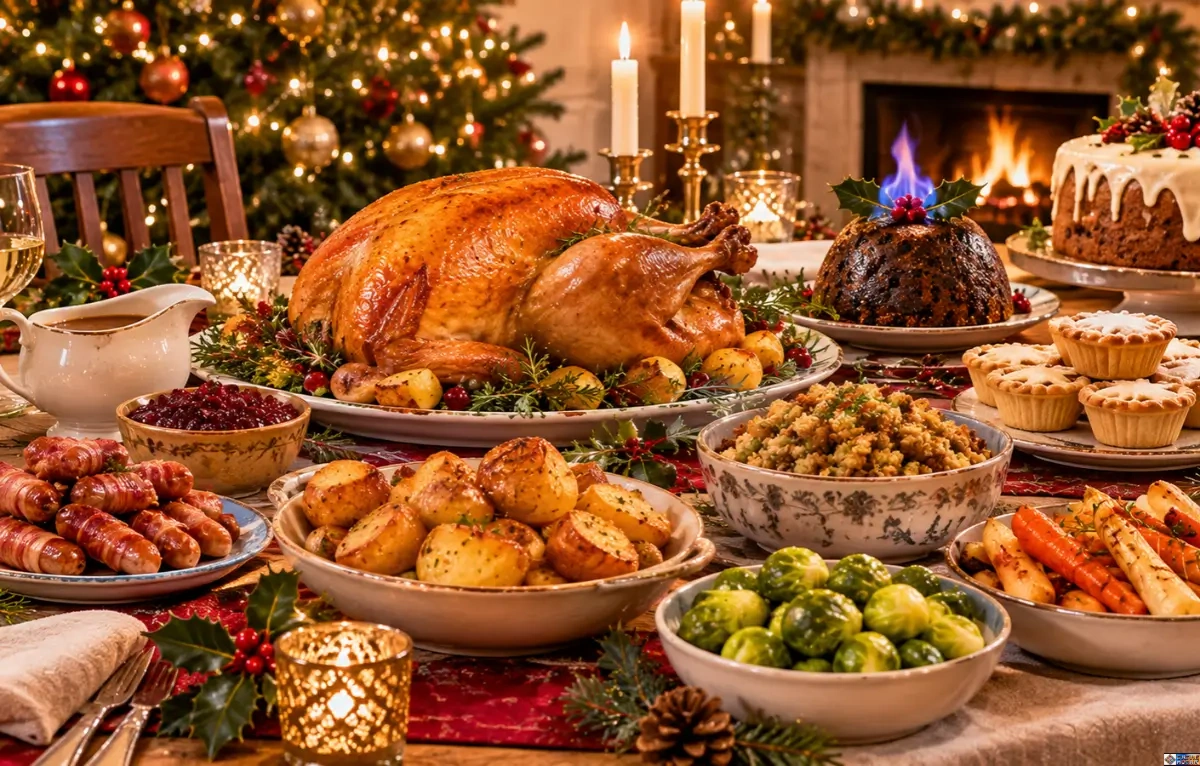
The top 10 Christmas foods UK households rely on, in the order you eat them: 1. roast turkey, 2. pigs in blankets, 3. roast potatoes, 4. stuffing, 5. Brussels sprouts, 6. roast parsnips and carrots, 7. gravy and sauces, 8. Christmas pudding, 9. mince pies and 10. Christmas cake.
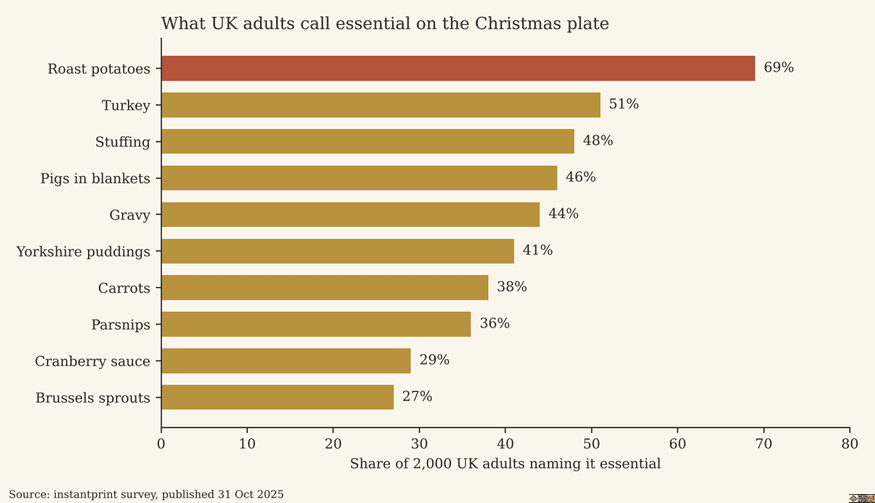
In the latest big UK poll I could verify, roast potatoes came first (69%) and turkey second (51%).
Turkey, pudding and mince pies are centuries older than pigs in blankets, and the pudding and the pies both began with meat in them.
A ten-item Christmas dinner basket averaged about £26 across six supermarkets at 2025 prices, and the turkey alone took more than half of it.
| Quick Summary: The top 10 Christmas foods UK households rely on, in the order you eat them: roast turkey, pigs in blankets, roast potatoes, stuffing, Brussels sprouts, roast parsnips and carrots, gravy and sauces, Christmas pudding, mince pies and Christmas cake. In the latest big UK poll I could verify, roast potatoes came first (69%) and turkey second (51%). Turkey, pudding and mince pies are centuries older than pigs in blankets, and the pudding and the pies both began with meat in them. A ten-item Christmas dinner basket averaged about £26 across six supermarkets at 2025 prices, and the turkey alone took more than half of it. |
Every year the same quiet panic arrives around now. Someone has to plan the menu. Someone else wants to know whether sprouts are really traditional or just a habit. A guest from abroad asks what a pig in a blanket is, and you realise you have never had to explain it.
The trouble with most festive food lists is that they are shopping baskets in disguise. Or they are recipe dumps: ten long methods on one endless scroll. Neither tells you why the plate looks the way it does. That is the bit I find most interesting, and honestly the most useful when you are deciding what to keep and what to bin.
So here is the fix. This guide to the top 10 Christmas foods UK tables really lean on runs from main course to pudding, with the history, the regional quirks and the 2026 taste-test results that tell you what is worth buying. I have leaned on museum, archive and academic sources rather than folklore, and where a popular story turns out to be shaky, I say so. Welcome to Culture Mosaic. Pull up a chair.
How This List Works (and Where the Numbers Come From)
The order below is the order of the meal, not a popularity contest. For popularity, I have used the most recent large poll I could verify: instantprint’s survey of 2,000 UK adults, published at the end of October 2025, which ranked the top 10 Christmas foods UK respondents called essential. Treat it as a useful snapshot, not gospel. It was run by a printing company, not a university, and the page gives no detailed methodology.
The Top 10 Christmas Foods UK Poll: What People Actually Said
| Rank | Dish | Share Naming It Essential |
|---|---|---|
| #1 | Roast potatoes |
69% |
| #2 | Turkey |
51% |
| #3 | Stuffing |
48% |
| #4 | Pigs in blankets |
46% |
| #5 | Gravy |
44% |
| #6 | Yorkshire puddings |
41% |
| #7 | Carrots |
38% |
| #8 | Parsnips |
36% |
| #9 | Cranberry sauce |
29% |
| #10 | Brussels sprouts |
27% |
Roast potatoes beat turkey by eighteen points. I think that is the most honest result in the whole survey. The bird gets the photograph; the potatoes get eaten.
Two other numbers stuck with me. Only one in five under-30s called turkey their most important dish, and 19% of Gen Z diners said they would happily skip meat if the sides were strong enough. Regionally, Leeds rated Yorkshire puddings essential at 61%, Glasgow was the sprout stronghold at 35%, and Bristol and Brighton led on nut roast, with one in four choosing it as their main.
Top 10 Christmas Foods UK at a Glance
Skimming? This table gives you the dish, where it sits in the meal, roughly when it entered the story and what is in it. Some eras are broad on purpose. Food history rarely comes with a birth certificate.
| Dish | Course | Era of Origin | Signature Ingredients |
|---|---|---|---|
| 1. Roast turkey | Main | Arrived in the Tudor period; the everyday default only in the 20th century | Turkey, butter or bacon, herbs |
| 2. Pigs in blankets | Side | 20th century; origin disputed | Chipolatas, streaky bacon |
| 3. Roast potatoes | Side | Roast-dinner staple from the 18th–19th centuries | Floury potatoes, goose fat or dripping |
| 4. Stuffing | Side | Very old; seasoned crumbs have long flavoured roasts | Onion, sage, breadcrumbs, sausagemeat or chestnut |
| 5. Brussels sprouts | Vegetable | Grown in Belgium from c.1200s; Christmas fixture c.1900 | Sprouts, butter, bacon or chestnuts |
| 6. Roast parsnips and carrots | Vegetable | Centuries-old winter roots | Parsnips, carrots, honey or mustard |
| 7. Gravy, bread sauce, cranberry | Sauces | Gravy and bread sauce old; cranberry a later arrival | Pan juices, milk, cloves, cranberries |
| 8. Christmas pudding | Dessert | Medieval pottage; Victorian pudding | Dried fruit, suet, spices, brandy |
| 9. Mince pies | Dessert or snack | Medieval and Tudor (with meat); sweet by the Victorian era | Dried fruit, suet, spices, pastry |
| 10. Christmas cake | Dessert or tea | Georgian–Victorian rich fruit cake | Fruit, marzipan, royal icing |
The Top 10 Christmas Foods UK, in the Order You Will Eat Them
1. Roast Turkey with All the Trimmings
The centrepiece. Also, strangely, a bit of an incomer. Turkeys come from the Americas and reached Europe in the early sixteenth century. English tradition ties them to a Yorkshireman called William Strickland, said to have brought six birds home in 1526 and sold them in Bristol. Nobody has ever verified that story. What is on the record is his coat of arms, granted around 1550, which carries a turkey-cock as its crest, one of the earliest European pictures of the bird.
Early turkeys were dear. East Anglia changed that: Norfolk and Suffolk became the breeding heartland from the 1570s. Even so, for ordinary Victorian families goose was the realistic Christmas bird, which is exactly why Scrooge’s gift to the Cratchits lands so hard in A Christmas Carol. The royal table of 1851 is the date people love to quote. My reading of the evidence: turkey spent centuries as a luxury and became the default only in the twentieth century.
Variations are everywhere. Crown or whole bird. Goose for the traditionalists. Gammon, beef or nut roast for everyone else. If you want the bird’s other story, the Mesoamerican one, I have told it in Importance of Food in Mexican Culture. On the shopping side, Good Housekeeping’s 2026 taste tests reportedly named Aldi’s Specially Selected Roly Poly Whole Turkey the overall winning product.
2. Pigs in Blankets
Small sausages, wrapped in streaky bacon, roasted until the fat spits and the edges go dark and sticky. Fourth in the poll at 46%. And, I will say it, the youngest dish on this list and the most fiercely defended.
The history is murky. The phrase first turns up in print in a 1957 American children’s cookbook, where the idea was sausages in dough. In Britain the bacon version won out and the pastry version became the sausage roll. Even Delia Smith’s original Cookery Course from 1978 puts sausagemeat in the stuffing and bacon over the turkey, but no pigs in blankets. They have been a Christmas fixture for a few decades, and they behave as if they were always there.
Cumberland sausages, honey-mustard glazes, a sprig of rosemary, vegan versions, a Boxing Day sandwich. The price spread is the real surprise, and I come back to it in the cost section: £2.19 at Aldi, £5.25 at Waitrose in the 2025 price check.
3. Roast Potatoes
Sixty-nine per cent. First place. No contest.
The method is simple and unforgiving. Parboil, drain, shake the pan until the edges turn fluffy and ragged, then into hot fat. That rough surface is what crisps. Goose fat, beef dripping or oil: pick your side and defend it. The craft logic of high heat, rough edges and patience is old kitchen wisdom, and I unpack some of it in Heritage Cooking Techniques.
Why a staple? Because the roast potato is the Sunday roast’s hardest-working player, promoted to the biggest roast of the year. If you want that lineage, start with How did the Sunday roast tradition start? and the wider Sunday roast England guide. Families argue over semolina versus flour, garlic versus none, and the instantprint price check found a bag of them anywhere from £0.94 to £3.00.
Wildcard: some cooks stir a spoonful of Marmite into the hot fat before the potatoes go in. Weird. Savoury, dark and oddly moreish.
4. Stuffing
Third in the poll at 48%. Stuffing is a very old idea: seasoned crumbs, fat and herbs, used to flavour and stretch a roast. Sage and onion is the classic. Sausagemeat, chestnut and apricot are the usual challengers, and in Ireland you will find potato stuffing. I will take sage and onion every time, with a ragged crisp top. It is the dish that makes the turkey taste like Christmas rather than just dinner.
5. Brussels Sprouts
Love them or hide them. The poll ranks them tenth at 27%, so they are hardly universal, yet a Christmas plate without them looks oddly bare. Sprouts have been grown in Belgium since around the thirteenth century, but food historian Angela Clutton says Britain only adopted them as a Christmas essential around the turn of the twentieth century. That is younger than most people assume.
Boiling them grey is the crime. Roast or pan-fry them with bacon or chestnuts and they become something else. Glasgow, remember, backed sprouts at 35%. Someone up there knows something.
6. Roast Parsnips and Carrots
Carrots took 38% in the poll, parsnips 36%. These are winter roots that hold their sweetness, and parsnips were eaten in Britain long before the potato muscled in. Roast them hard until the edges catch and darken, with honey, mustard or a glug of maple. That caramel crust is the whole point.
Wildcard: roast the parsnip peelings with salt and a pinch of curry powder. They crisp like chips and vanish before the turkey is carved.
7. Gravy, Bread Sauce and Cranberry Sauce
Gravy came fifth at 44%, cranberry sauce ninth at 29%. Gravy is the glue: pan juices, a little flour, stock, patience. The deep savoury backbone is what cooks chase, and the Ancestral Umami Cooking piece explains why. Bread sauce, milk infused with onion and cloves then thickened with crumbs, divides the table like nothing else. I am firmly in the pro camp. Cranberry brings the sharpness that cuts through all that fat.
And the one that got away: Yorkshire puddings, sixth in the poll at 41%. Hannah Glasse put the name in print in 1747. Leeds, as above, rates them essential at 61%. Squeeze one on the plate if you are from the north, and nobody will say a word.
8. Christmas Pudding
Here is where the story gets properly strange. The pudding began as a medieval pottage, a stew-like dish made with meat or meat stock, dried fruit and spices, and it was served at the start of the meal. It firmed up toward the end of the seventeenth century. George I, nicknamed the Pudding King, asked for plum pudding at his first English Christmas. Eliza Acton’s 1845 recipe is generally understood to be the first to call it “Christmas pudding”, and the Victorians moved it from cloth to basin.
If you are reading this on 22 November 2026, it is Stir-up Sunday, the traditional day to make the pudding. The name comes from a prayer read that day, and the custom is that everyone in the house gives the mixture a stir. Making it now gives it weeks to mature. Hiding a coin, pouring on warmed brandy and lighting it are the rituals that follow; I wrote about why such rituals stick in Food Rituals in Different Cultures and Dining Rituals. The old pudding cloth, still used for Scotland’s clootie dumpling, is part of the ancestral cookware story.
Shopping? Good Housekeeping’s 2026 test reportedly gave the pudding crown to Aldi’s Specially Selected 24 Month Matured, while woman&home picked Morrisons The Best (£5 for 800g) as its best traditional pudding. Different panels, different winners. That tells you plenty about how personal pudding is.
9. Mince Pies
Mince pies contain no meat today. They did. In the Tudor period they were large and meaty, and the National Archives holds an early modern recipe for mince pies in the state papers. Georgian recipes carried less meat and more dried fruit, spices and sugar, but even in the 1850s Eliza Acton’s recipe still contained some meat. That is why the word “mince” survives, and why traditional suet still sits in the filling.
Folk belief says you should eat one on each of the twelve days of Christmas for good luck. Treat it as folklore, but I admire the commitment. The spices, cloves, mace, nutmeg, cinnamon, are a long trade story, which I follow in silk road spices in british food. If you bake your own, butter is where pastry is won or lost; see Heritage European Butter Varieties. On the shelf, woman&home’s 2026 awards picked Sainsbury’s Taste the Difference All Butter Mince Pies (£3.50 for six) as the best supermarket mince pies.
Wildcard: a slice of mature Wensleydale on a warm mince pie. Cheese with fruit pastry is an old northern habit, and it works.
10. Christmas Cake
Rich, dark, fruit-heavy, wrapped in marzipan and a hard shell of royal icing. Food historians commonly link it to the same family as plum pottage and Twelfth Night cakes, which is a way of saying the Christmas table has been recycling its best ideas for centuries. Families disagree about when to feed it with brandy, and whether the marzipan should be thick or thin.
Regional and family versions matter here. Yorkshire households traditionally serve fruit cake with a wedge of Wensleydale. In Caribbean-British homes, black cake, soaked for weeks in rum and wine, is the centrepiece; the wider story sits in African diaspora food culture. Our shared memory of these flavours is a subject I return to in Somatic Food Memory. For shopping, BBC Good Food’s 2026 test named Sainsbury’s Taste the Difference rich iced Christmas cake the best supermarket cake, in a contest where 11 supermarkets entered products across 19 categories.
Christmas Taste Test 2026: What Good Food, Good Housekeeping and woman&home Picked
I have not tasted these myself, so I am reporting, not reviewing. For the top 10 Christmas foods UK shoppers buy ready-made, these are the panels’ picks as published or as relayed by the press. Winners differ between panels, which is exactly why I would use them as a shortlist rather than a verdict.
| Category | Winner | Test |
|---|---|---|
| Overall winning product | 🏆 Aldi Specially Selected Roly Poly Whole Turkey | Good Housekeeping 2026 |
| Christmas pudding | Aldi Specially Selected 24 Month Matured | Good Housekeeping 2026 |
| Best traditional pudding | Morrisons The Best Christmas Pudding | woman&home 2026 |
| Mince pies | Sainsbury’s Taste the Difference All Butter | woman&home 2026 |
| Christmas cake | Sainsbury’s Taste the Difference rich iced | BBC Good Food 2026 |
| Best overall supermarket | ⭐ Marks & Spencer | BBC Good Food 2026 |
What Does the Top 10 Christmas Foods UK Dinner Cost? Tesco, Aldi and the Rest
instantprint priced its ten most-named items at six supermarkets in autumn 2025. The cheapest basket was Aldi at £21.67, followed by Asda (£24.76), Morrisons (£24.87), Tesco (£25.64), Sainsbury’s (£26.33) and Waitrose (£34.55). I averaged the six totals myself and got £26.30; the source page quotes £26.44, so I am using my own arithmetic.
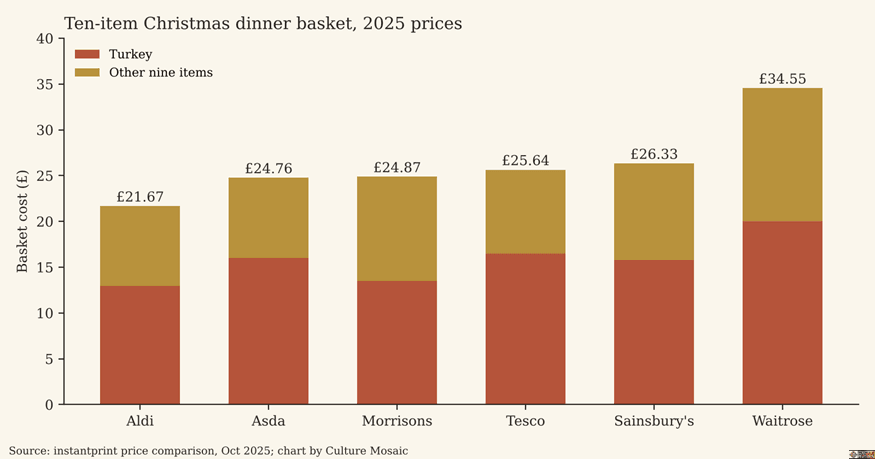
Here is the original analysis. Turkey took between roughly 54% and 65% of each basket. The gap between the cheapest and dearest basket is £12.88, about 59% more at Waitrose than at Aldi. And pigs in blankets cost 2.4 times as much at Waitrose as at Aldi, which tells me that is where the premium really lives. These are 2025 prices, so check current shelf prices before you plan a budget. The basket also leaves out pudding, pies and cake.
The Wildcard Plate: Ketchup, Nuggets and Toast
Not everyone follows the script. In the same survey 11% of respondents said ketchup deserves a place on the Christmas plate, rising to 17% in London. Chicken nuggets were called a valid side by 8% nationally, and 14% of Londoners said they serve them. Toast appears on 7% of plates, chips on 9% of men’s, and baked beans on 4% of tables. Treat the figures as a snapshot of one commercial survey. I would defend toast, since it is just bread sauce’s plain cousin. Ketchup, no.
Make Your Move This Week
If you are cooking for guests from abroad, pick three or four dishes from the top 10 Christmas foods UK list and tell the story behind each; our Traditional Recipes from Around the World collection is a good way to return the favour at the next dinner. If you are planning your own table, the pudding and the cake are the two items that reward starting early, and a turkey is worth ordering before the shelves thin out. Do it now, not on the 23rd.
Take away the novelty sides and the supermarket awards and what is left is not really a menu. It is a seating plan for the past, with a roast potato at every place.
Frequently Asked Questions
What is the most popular Christmas food in the UK?
In the largest recent poll I could verify, instantprint’s survey of 2,000 UK adults published in October 2025, roast potatoes were the most popular item, named essential by 69% of people. Turkey followed at 51%, then stuffing (48%), pigs in blankets (46%) and gravy (44%). That is one commercial survey, and other polls rank the items slightly differently, but turkey remains the centrepiece of the main course in most homes.
What do the Brits eat for Christmas?
Most households sit down to roast turkey, though some choose goose, beef, gammon or a nut roast. It comes with roast potatoes, pigs in blankets, stuffing, Brussels sprouts, parsnips and carrots, gravy, cranberry sauce and often Yorkshire puddings. Pudding follows, usually Christmas pudding with brandy butter or custard, then mince pies and Christmas cake through the afternoon and across the twelve days.
What are the 12 dishes of Christmas?
There is no official or traditional UK list of twelve Christmas dishes. The phrase is sometimes borrowed from the Twelve Days of Christmas, which run from 25 December to 5 January, and from Eastern European Christmas Eve suppers that traditionally serve twelve meatless dishes. In Britain the closest thing is the core ten in this guide, plus Yorkshire puddings and the extras your family insists on.
What goes on a traditional UK Christmas dinner?
A traditional UK Christmas dinner centres on roast turkey with all the trimmings: roast potatoes, pigs in blankets, stuffing, sprouts, root vegetables, gravy, bread sauce and cranberry sauce. The meal ends with Christmas pudding and mince pies, and Christmas cake usually appears later in the day. Regional touches include Yorkshire puddings in the north, Wensleydale with fruit cake, clootie dumpling in Scotland and black cake in Caribbean-British homes.
What is the best supermarket Christmas food in 2026?
It depends on the panel. BBC Good Food named Marks & Spencer its best overall supermarket and gave its cake prize to Sainsbury’s Taste the Difference. Good Housekeeping’s tests reportedly put Aldi’s whole turkey and 24 Month Matured pudding on top, and woman&home picked Sainsbury’s all-butter mince pies and Morrisons’ The Best pudding. Use the winners as a shortlist and compare current prices.
Sources and Further Reading
- instantprint (31 October 2025), “The UK’s Ultimate Christmas Dinner Revealed 2025”. https://www.instantprint.co.uk/printspiration/be-inspired/the-uks-ultimate-christmas-dinner-revealed-2025
- Museum of English Rural Life, University of Reading (2022), “Why do we eat turkey at Christmas?”. https://merl.reading.ac.uk/blog/2022/12/why-do-we-eat-turkey-at-christmas/
- History Today, “Death of a Turkey Legend”. https://www.historytoday.com/archive/months-past/death-turkey-legend
- History Today, “The Rise of the Turkey”. https://www.historytoday.com/archive/feature/rise-turkey
- Borough Market, “Edible Histories: The Turkey”. https://boroughmarket.org.uk/market-blog/edible-histories-the-turkey/
- English Heritage, “A History of the Christmas Pudding”. https://english-heritage.org.uk/visit/inspire-me/history-of-the-christmas-pudding
- English Heritage, “Christmas dinners through history”. https://english-heritage.org.uk/link/265b8a4c2c4e43ceb6295d697b6f640f.aspx
- English Heritage, medieval Christmas food. https://www.english-heritage.org.uk/christmas/medieval-christmas-food
- The National Archives (UK), Christmas food documents, including SP 14/189 early modern mince pie recipe. https://www.nationalarchives.gov.uk/education/families/christmas/food/copy-1-232-294/
- Historic UK, “The History of the British Christmas Dinner”. https://www.historic-uk.com/CultureUK/History-British-Christmas-Dinner/
- Sainsbury’s Magazine (retailer publication), “Best of British Christmas lunch traditions” (Angela Clutton on sprouts). https://sainsburysmagazine.co.uk/lifestyle/food/best-of-british-christmas-lunch-traditions
- The Spectator, Michael Simmons (7 December 2024), “The many faces of pigs in blankets”. https://www.spectator.co.uk/article/the-many-faces-of-pigs-in-blankets
- Yahoo News UK, “The best supermarket pigs in blankets, tried and tested” (on Delia’s Cookery Course, 1978). https://uk.news.yahoo.com/best-supermarket-pigs-blankets-tried-090000244.html
- woman&home, “Christmas Food Awards 2026”. https://www.womanandhome.com/us/food/christmas_food_awards_2026/
- Express via AOL (November 2026), “Best Christmas pudding named – cheapest supermarket wins” (Good Housekeeping 2026 results). https://www.aol.co.uk/articles/best-christmas-pudding-named-cheapest-070000000.html
- Express via AOL (2026), “The UK’s best Christmas cake named” (BBC Good Food 2026 results). https://www.aol.co.uk/articles/uks-best-christmas-cake-named-065100000.html
- BritBrief (2026), report on BBC Good Food 2026 supermarket results. https://britbrief.co.uk/business/retail/sainsburys-cake-named-uks-best-christmas-cake-2026.html
- Primary printed sources: Hannah Glasse, The Art of Cookery Made Plain and Easy (1747); Eliza Acton, Modern Cookery for Private Families (1845); Charles Dickens, A Christmas Carol (1843); Delia Smith, Delia Smith’s Cookery Course (1978).