
 By Culture Expert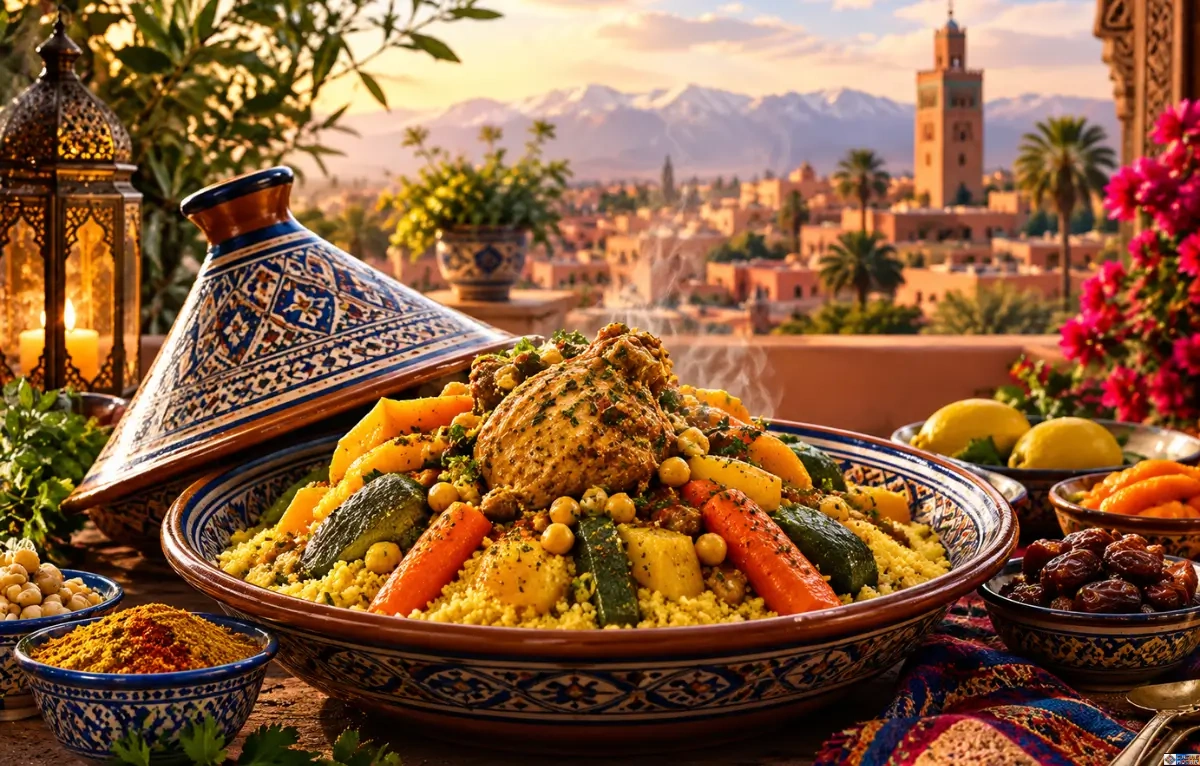
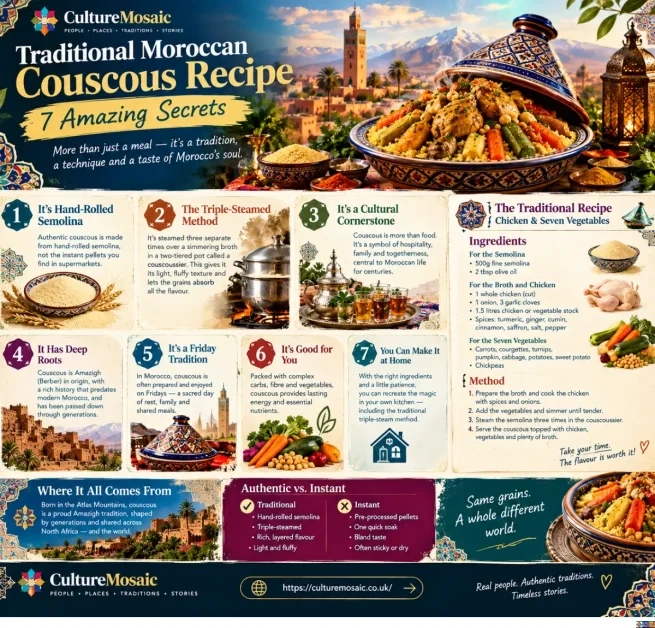
A traditional Moroccan couscous recipe is never just “grain plus boiling water.” Authentic couscous is hand-rolled semolina, steamed three separate times over a simmering broth in a two-tiered pot called a couscoussier, so every granule drinks in the meat, spice, and vegetable flavour from below. That triple-steam method — not the five-minute soak sold in Western supermarket boxes — is what separates real Moroccan couscous from the instant version most people have only ever known.
Why Your Couscous Keeps Turning Out Wrong
If you’ve searched for a traditional Moroccan couscous recipe before and ended up disappointed, you’re not alone. I’ll say the quiet part first: most home cooks outside North Africa have never actually eaten couscous. They’ve eaten reconstituted semolina pellets, steamed for exactly as long as it takes to boil a kettle, fluffed with a fork, and called it dinner. It isn’t unpleasant. It’s just not couscous — not the dish that Berber grandmothers have been building, grain by grain, for over a thousand years.
Here’s the pain point, and it’s a real one. You pour boiling water over a box of instant couscous, cover it, wait five minutes, fluff it, and you get something dry on the outside and gummy in the middle. Or you overdo the water and end up with porridge. Either way, you’ve missed the entire point of the dish: couscous is supposed to be light, separate, faintly nutty, and saturated with the smell of whatever is cooking underneath it. That’s not a hydration problem.
That’s a steaming problem, and instant couscous was never built to solve it. The whole point of a traditional Moroccan couscous recipe is that flavour builds in three stages, not one — and skipping straight to the fork-fluff stage skips the part that actually matters.
I want to be honest about something: modern British cookery has actually done a great deal to popularise couscous, and I don’t think that’s a bad thing. Recipes for moroccan couscous jamie oliver fans will recognise — the ones built around lemon, dried apricots, and a fast steam — are genuinely good weeknight food. So is the mary berry moroccan couscous approach from her Simple Comforts era, which leans on stock and toasted almonds.
I’ll even say the moroccan couscous recipe – bbc has published over the years is a reasonable entry point if you’ve got twenty minutes and a hungry family. None of these are wrong. They’re just a different dish wearing the same name — a shortcut, not the tradition. If what you actually want is a best moroccan couscous recipe in the fullest sense — the one made on a Friday, steamed three times, ladled with broth at the table — you need the slower method, and I promise it’s worth the extra hour.
Where This Dish Actually Comes From
Couscous is Amazigh — Berber — before it is Moroccan, Algerian, or Tunisian. Archaeological and culinary-historical evidence points to North African wheat cultivation stretching back well over a thousand years, with the semolina-steaming technique developing as a way to stretch hard durum wheat into something tender, filling, and endlessly adaptable to whatever vegetables or meat a household had on hand that week. I go into the deeper roots of this kind of grain-based, hand-worked cooking in Ancestral Umami Techniques, and the pattern holds here too: the slow, hands-on methods almost always outlast the shortcuts, because they were built by people who couldn’t afford to waste anything.
By the time couscous reached the Moroccan royal courts and spread through the Maghreb, it had already become something bigger than a grain dish. It became a ritual. That deep-rooted heritage is exactly why a traditional Moroccan couscous recipe never skips the hand-rolling stage — it’s not fussiness, it’s inheritance. Which brings me to Friday.
The Sacred Friday Tradition
In Morocco, couscous isn’t a Tuesday-night improvisation. It’s Jumaa food — the dish eaten after Friday prayers, when families gather around one enormous shared platter instead of individual plates. The Moroccan Friday couscous tradition is less about the recipe itself and more about what it represents: rest, community, and a full afternoon given over to eating slowly with people you love.
I’ve written before about how food and gathering are tangled together in ways Western dining rarely bothers with — see Dining Rituals if you want the fuller picture — and Friday couscous might be the clearest example of that idea I know. It’s part of what makes a traditional Moroccan couscous recipe feel less like a meal and more like an occasion.
The centrepiece of that Friday table is usually seven vegetable moroccan couscous — Couscous aux Sept Légumes — and the number seven isn’t decorative. In Moroccan folk belief, seven is considered a number of blessing and abundance, so the dish is deliberately built from seven types of vegetable arranged around the grain like petals: carrots, turnips, courgettes (zucchini), pumpkin, cabbage, chickpeas, and tomatoes, though the exact seven shift a little from region to region and household to household.
Instant Couscous vs. Traditional Triple-Steamed Couscous
I think a side-by-side comparison makes the gap between these two dishes obvious faster than any paragraph could — and it explains, plainly, why a traditional Moroccan couscous recipe outperforms the instant version on every count that matters.
| Feature | Instant / Western Quick Couscous | Traditional Moroccan Triple-Steamed Couscous |
|---|---|---|
| Vessel | Bowl, kettle, cling film | Couscoussier (two-tier steamer pot) |
| Cook Time | 5–10 minutes | 60–90 minutes, across three steam cycles |
| Broth Integration | None — couscous and stew cooked separately | Direct — steam rises through the grain from the simmering broth beneath |
| Texture | Clumpy, gummy, or dry depending on water ratio | Light, separate, almost fluffy; each grain distinct |
| Flavour Profile | Flat, relies entirely on toppings | Deeply savoury; grain itself carries spice, fat, and meat aroma |
That broth integration row is the one people underestimate. When couscous steams directly over a simmering pot of chicken or beef, ras el hanout, saffron, and vegetables, the grain isn’t just sitting next to the flavour — it’s absorbing it, cycle after cycle. That’s the whole trick, and it’s the part no instant box can replicate no matter how good the seasoning packet is.
The Couscoussier Steaming Method, Step by Step
A couscoussier is a two-part pot: a wide-bellied base for broth and stew, and a perforated steamer basket that sits snugly on top, so steam has to pass through the grain rather than around it. If you don’t own one, a metal colander lined with cheesecloth set over a stockpot does a passable job — not perfect, but close enough to learn the technique. Every traditional Moroccan couscous recipe worth its name starts with understanding this pot, because the pot is the technique.
The traditional method for how do moroccans cook couscous is built on hand-work as much as heat:
- Hydrate and hand-roll. Dry semolina is spread in a wide dish, drizzled with cold water and a little olive oil or smen (Morocco’s aged, salted clarified butter), then rubbed between the palms in circular motions to separate every grain and coat it lightly in fat. This step alone can take fifteen minutes, and rushing it is the single most common mistake home cooks make — it’s what separates a traditional Moroccan couscous recipe from anything poured straight out of a box.
- First steam. The rolled semolina goes into the steamer basket, uncovered, over the simmering broth for about 20 minutes, until it’s warmed through and slightly swollen.
- Cool, separate, re-hydrate. The couscous is tipped back into the wide dish, drizzled with a little more water, and hand-rolled again to break up any clumps that formed during steaming.
- Second and third steam. The process repeats twice more, each round drawing more moisture and aroma up from the broth, until the grain is tender but distinctly separate — never mushy.
- Finish with fat. A final knob of butter or smen is worked through the hot couscous, which is what gives the finished dish its faint sheen and rounds out the flavour.
That’s the whole secret to how to make authentic moroccan couscous, and it’s not really a secret at all — it’s patience, repeated three times.
A Traditional Moroccan Couscous Recipe with Chicken and Seven Vegetables
This is my working version of a traditional moroccan couscous recipe with chicken, built for a table of six.
Ingredients for This Traditional Moroccan Couscous Recipe
For the Semolina
| Ingredient | Amount |
|---|---|
| Medium-grain couscous semolina (not instant) | 700g |
| Olive oil, divided | 4 tbsp |
| Cold water, plus more as needed | 60ml |
| Smen or unsalted butter | 40g |
For the Broth and Chicken
| Ingredient | Amount |
|---|---|
| Bone-in chicken pieces (or 900g stewing beef for a beef version) | 1.2kg |
| Onions, roughly chopped | 2 |
| Olive oil | 3 tbsp |
| Ras el hanout | 2 tsp |
| Ground turmeric | 1 tsp |
| Ground ginger | 1 tsp |
| Cinnamon stick | 1 |
| Saffron threads, soaked in 2 tbsp warm water | A generous pinch |
| Water or light chicken stock | 2 litres |
| Salt and black pepper | To taste |
For the Seven Vegetables
| Ingredient | Amount |
|---|---|
| Carrots, peeled and halved lengthwise | 4 |
| Small turnips, quartered | 4 |
| Courgettes, halved lengthwise | 2 |
| Pumpkin or butternut squash, cut into large chunks | 400g |
| Small cabbage, cut into wedges | ½ head |
| Cooked or tinned chickpeas | 400g |
| Ripe tomatoes, halved | 3 |
| Fresh coriander and parsley, tied with kitchen string | A handful |
Method
Follow this traditional Moroccan couscous recipe method in order — the sequencing of the vegetables matters as much as the steaming does.
- In the base of your couscoussier, warm 3 tbsp olive oil and brown the chicken pieces with the onions over medium-high heat for about 8 minutes.
- Stir in the ras el hanout, turmeric, ginger, cinnamon stick, and saffron water. Cook for a further minute until fragrant.
- Add the water or stock, herb bundle, and season generously. Bring to a simmer, then partially cover and cook for 30 minutes.
- Meanwhile, hand-roll the semolina with olive oil and cold water as described above, and complete the first steam over the simmering broth for 20 minutes.
- Add the carrots and turnips to the broth. Continue simmering.
- Tip the couscous out, hand-roll with a little more water, and return it for a second 20-minute steam.
- Add the courgettes, pumpkin, cabbage, and chickpeas to the broth. Simmer until the vegetables are tender but not falling apart, roughly 20 more minutes.
- Add the tomatoes for the final 10 minutes of cooking.
- Do the final hand-roll and third steam of the couscous, then tip it into a wide bowl and work the smen or butter through it while it’s still hot.
Serving Suggestions
The final stage of any traditional Moroccan couscous recipe is presentation. Mound the finished couscous onto a wide communal platter — the Gsaa — and arrange the chicken and vegetables on top, ladling broth generously over the whole thing so the grain stays moist at the table. Everyone eats from the same platter, usually with the right hand or a spoon, working from the section directly in front of them inward. It’s a completely different rhythm to plated Western dining, and once you’ve eaten this way, individual plates start to feel a little lonely by comparison. Serving it this way is as much a part of a traditional Moroccan couscous recipe as the steaming itself.
A Fruity and Vegetarian Take on the Tradition
Not every couscous needs meat, and Fridays aren’t the only day it belongs on the table. A fruity moroccan couscous recipe swaps the broth-and-chicken base for a lighter vegetable stock, and finishes the grain with raisins, dried apricots plumped in orange blossom water, toasted almonds, and a dusting of cinnamon — closer in spirit to a celebratory dish than a Friday staple, but built on exactly the same triple-steam technique that anchors every traditional Moroccan couscous recipe.
For a fully traditional moroccan couscous recipe vegetarian version, simply replace the chicken and its cooking liquid with a well-seasoned vegetable stock, add the seven vegetables in the same staggered order, and finish with a generous swirl of olive oil instead of smen if you’re keeping it dairy-free. It’s every bit as satisfying, and honestly, on a hot day I sometimes prefer it to the heartier version.
Either way, it’s still a traditional Moroccan couscous recipe at its core — the vegetables and fat change, the technique doesn’t. If you want a genuinely traditional moroccan couscous recipe easy enough for a weeknight, use tinned chickpeas, pre-cut squash, and skip straight to a single 25-minute steam — you’ll lose some of the layered flavour, but you’ll still land much closer to a real traditional Moroccan couscous recipe than any instant box gets you.
This kind of patient, layered cooking isn’t unique to Morocco, either. I’ve traced similar techniques — where the process itself carries as much meaning as the finished plate — in pieces like The Biochemistry of Salt-Glaze Fermentation, Ancestral Fermentation Rituals, and Ancestral Fermentation Techniques, and if you’d like a step-by-step on preserving vegetables at home, Traditional Sauerkraut Fermentation is a good place to start. It’s all the same underlying instinct: don’t rush what your ancestors learned to slow down.
If you’re building out a wider North African table, I’d also point you toward How to Cook Traditional Moroccan Tagine, which shares a lot of its spice logic with this dish, and if your appetite runs further afield, How to Make Mexican Street Tacos al Pastor is another dish built entirely around patience rewarding you at the table.
For more on why these slow techniques persist generation after generation, Heritage Cooking Techniques, Somatic Food Memory, and Somatic Seasoning all dig into the sensory side of why we cook the way our grandmothers did. And if you want a broader library of dishes built the way this one is — from the ground up, region by region — Regenerative Heritage Recipes is where I keep adding to that collection. You can find the full archive at Culture mosaic.
For readers who want a lighter, faster route into this dish before attempting the full triple-steam version, this traditional moroccan couscous recipe is a solid, approachable starting point.
Frequently Asked Questions
What are the ingredients for Moroccan couscous?
At its core, a traditional Moroccan couscous recipe needs medium-grain durum semolina, olive oil, water, and a fat like smen or butter for the grain itself, plus a broth built from meat (usually chicken or beef), onions, ras el hanout, turmeric, ginger, saffron, and a mix of seasonal vegetables — traditionally seven of them.
How do Moroccans cook couscous?
Moroccans steam couscous over a simmering pot of broth in a couscoussier, hand-rolling the semolina with water and oil between each of three separate steaming cycles, so the grain gradually absorbs moisture, fat, and flavour from below rather than simply being soaked. That’s the method behind every traditional Moroccan couscous recipe worth eating.
Is Moroccan couscous different from regular couscous?
Yes, meaningfully. “Regular” couscous in most Western supermarkets is pre-steamed and dried at the factory, designed to rehydrate in five minutes with boiling water. A traditional Moroccan couscous recipe uses raw semolina, hand-rolled and steamed fresh three times over broth, giving it a lighter texture and far deeper flavour than anything out of a box.
Can you provide a traditional Moroccan chicken couscous recipe?
Yes — the traditional Moroccan couscous recipe above uses bone-in chicken simmered with ras el hanout, turmeric, ginger, and saffron, paired with a staggered seven-vegetable garnish and semolina steamed three times directly over that broth.
What is the Moroccan Friday couscous tradition?
Jumaa couscous is the meal eaten after Friday midday prayers, when extended families gather around one large communal platter. It’s less about a fixed recipe and more about the ritual of slowing down together, which is why the seven-vegetable, traditional Moroccan couscous recipe tends to appear most often on this particular day.
Credible Sources & Historical References
- UNESCO Intangible Cultural Heritage Lists — “Couscous: knowledge, know-how and practices pertaining to the production and consumption of couscous”
- Charles Perry, “Couscous and Its Cousins,” in Petits Propos Culinaires and subsequent food-history scholarship on Maghrebi grain preparation
- Paula Wolfert, Couscous and Other Good Food from Morocco — widely cited ethnographic and culinary documentation of regional Moroccan couscous variation
- The British Museum’s North African collections, for archaeological context on Berber agricultural and grain-processing history
- Food and Agriculture Organization (FAO) regional reports on durum wheat cultivation across the Maghreb