
 By Culture Expert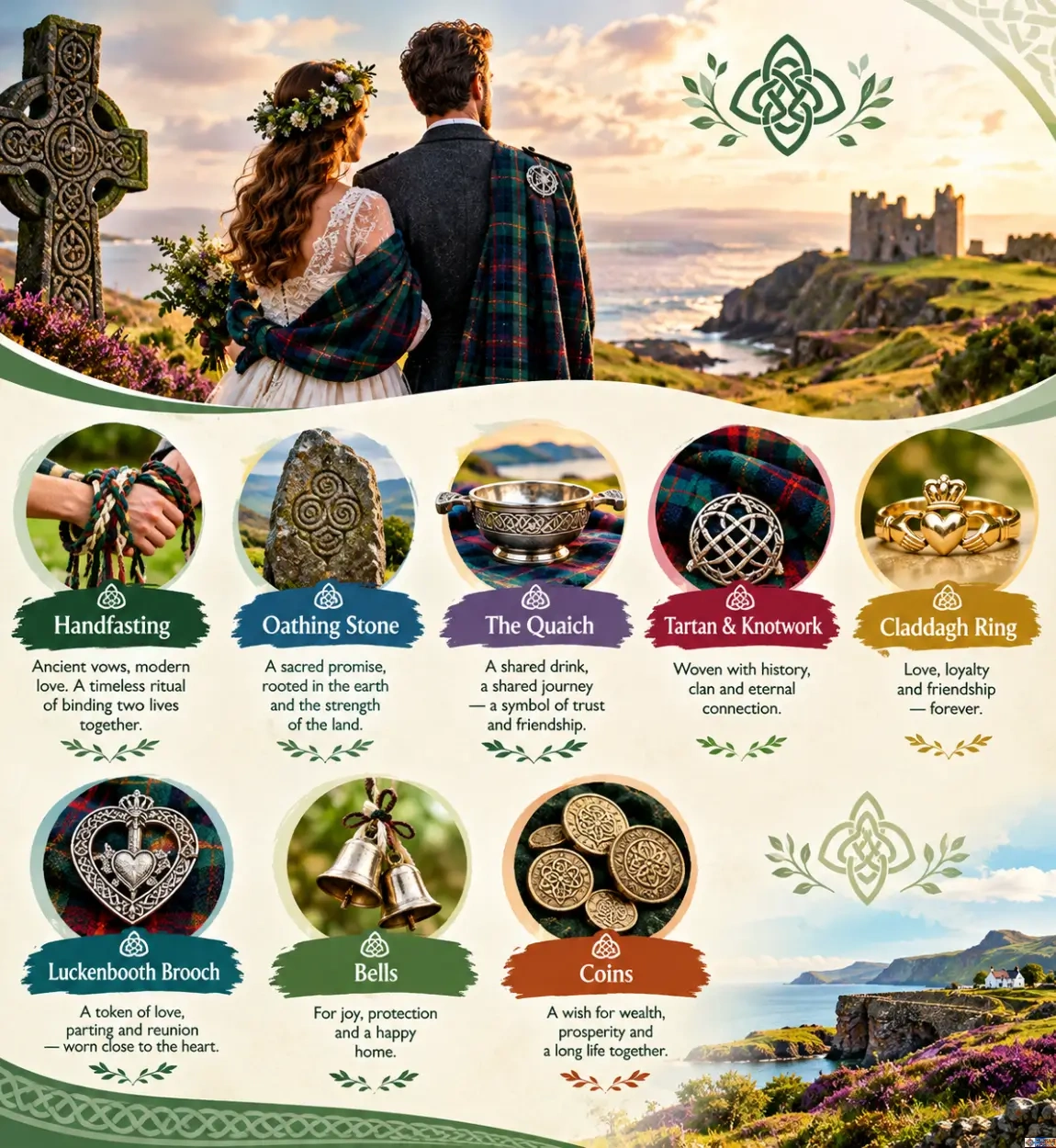
Quick Summary
Celtic wedding traditions and customs blend pre-Christian ritual with centuries of Irish, Scottish, and Welsh folk practice. The best-known is handfasting, where a couple’s hands are bound together with cord or ribbon — the literal origin of “tying the knot.” Other core customs include the oathing stone, the quaich, tartan and Celtic knotwork, the Claddagh ring, the Luckenbooth brooch, and gifts such as bells and coins.
Many began as pagan rituals tied to the land and the seasons, long before either the Catholic or Protestant churches took charge of marriage. Today they turn up in both religious and entirely secular ceremonies, across the UK, Ireland, and further afield, because couples want something that feels older and truer than a rented venue and a seating plan.
There is a particular kind of wedding fatigue that sets in somewhere around the third identical marquee, the third identical string quartet, the third identical “first dance to a song you’ve heard a hundred times.” Couples feel it. Wedding planners feel it. And it is exactly why so many people are turning back toward celtic wedding traditions and customs — not out of nostalgia, but because these rituals were built to carry real emotional weight. A cord binding two hands together says something a hashtag on a photo booth backdrop simply cannot.
The trouble is that most of what circulates online about Celtic weddings is thin. A listicle here, a jewellery shop’s blog there, a vague gesture toward “ancient Druids” with no dates, no sources, and no sense of which practice belongs to which country. If you’re planning a wedding — or just trying to understand where your own family’s customs came from — that vagueness is frustrating. You want to know what’s actually documented, what’s folklore dressed up as history, and how to use any of it without it feeling like costume.
This guide sorts that out. It walks through the documented rituals, the symbols and their real meanings, the regional differences between Ireland, Scotland, and Wales, and the way the Catholic Church and, later, civil law reshaped — but never fully erased — the older customs. Along the way I’ll flag where the record is solid and where it’s genuinely murky, because a cultural historian who tells you everything is certain is not being straight with you.
What Are Celtic Wedding Traditions and Customs, Really?
“Celtic” is a slippery word. It doesn’t describe one nation or one unbroken bloodline — it describes a family of related cultures and languages across Ireland, Scotland, Wales, Cornwall, the Isle of Man, and Brittany, each with its own dialect of custom. Ancient Celtic wedding traditions grew out of agrarian, clan-based societies where marriage was as much a contract between families and territories as it was a romantic union. Property, alliance, land use, and lineage were all riding on the outcome, so the rituals had teeth.
That’s worth sitting with for a second. When a modern couple holds hands over an oathing stone, they’re echoing a ceremony that once had real legal and political stakes attached to it — clan alliances, inheritance rights, the whole social order of a community. The romance is genuine, but so was the original stakes. Ancient Celtic wedding rituals weren’t decorative. They were binding, sometimes literally.
Most of what survives comes to us filtered through later written sources — early Irish law tracts known as the Brehon Laws, medieval Welsh legal codices, and centuries of oral tradition eventually recorded by folklorists and antiquarians. That filtering matters. It means some details are well attested and others are best-guess reconstructions dressed up with more confidence than they deserve. I’ve tried to be honest about which is which throughout this piece.
Handfasting: The Ceremony Everyone Recognises
Ask anyone to name a Celtic wedding custom and handfasting is what they’ll say first. The handfasting ceremony customs are simple in outline: the couple’s hands, sometimes wrists, are bound together with cord, ribbon, or tartan sashing while vows are spoken, and the phrase “tying the knot” is widely believed to trace back to exactly this act.
The history is older and stranger than the wedding-blog version suggests. Under early Irish and Scottish custom, handfasting functioned as a formal declaration of intent to marry — in some tellings, a trial period of a year and a day, after which the couple could part or commit for good.
Scotland’s own legal history backs up the seriousness of it. Right up until the Marriage (Scotland) Act 1939 came into force in 1940, Scots law recognised several forms of “irregular marriage,” including unions formed simply through mutual consent, without clergy or ceremony — and one of those forms, marriage by cohabitation with habit and repute, remained legally valid all the way until the Family Law (Scotland) Act 2006 finally closed the loophole. That’s not folklore. That’s parliamentary record. It tells you how deeply consent-based, community-witnessed marriage was baked into Scottish law long after most of Europe had handed the whole business over to the church.
Handfasting faded from official use with the Reformation and the tightening grip of church-sanctioned marriage, surviving mainly as folk memory in the Highlands and rural Ireland. Its modern revival owes a great deal to the twentieth-century Pagan movement — in Scotland, celebrants from the Pagan Federation only regained the legal right to perform recognised marriage ceremonies in 2004. Today you’ll find it woven into civil ceremonies, humanist weddings, full pagan wedding traditions, and even Catholic services where a priest allows the binding as a symbolic addition rather than the legal act itself.
The Oathing Stone and Other Ancient Rituals
If handfasting is the headline act, the oathing stone is the quieter, older-feeling moment tucked earlier in the ceremony. The couple places their joined hands on a stone while speaking their vows. In Celtic belief, an oath sworn on stone — or near water — carried more weight than one spoken into open air; the earth itself was made a witness. Some couples now have a stone engraved with their names and wedding date and keep it afterward as a paperweight or a piece of quiet, tangible history on a shelf.
A handful of other ancient Celtic wedding rituals turn up across the sources, with varying degrees of documentation:
- The passing of light — candles carried in and shared between the couple, echoing older fire rituals tied to the Celtic festival calendar.
- Honouring the four elements — fire, earth, air, and water marked with a candle, a stone, incense, and water at four points around the ceremony space.
- Jumping the broom — less exclusively Celtic than often claimed, but present in Welsh and border folk custom as a threshold ritual marking the start of shared life.
- Beltane timing — many early handfastings were performed at Beltane, the first of May, when Celtic communities marked the fertility of land and body alike.
None of this was performed for spectacle. A community that depended on the harvest and the goodwill of neighbouring clans needed its unions to be seen, remembered, and trusted.
Celtic Wedding Symbols and What They Actually Mean
Ask about celtic wedding symbols and most people picture a knot pattern on a wedding invitation. Fair enough — but the specific symbols are more interesting, and more regionally distinct, than the general Celtic-knot aesthetic suggests.
The Claddagh’s story is worth a beat of its own. Tradition credits its design to Richard Joyce, a fisherman from the Claddagh, a small fishing village outside Galway, who is said to have created the ring after being captured and enslaved, eventually returning home to marry his sweetheart.
Whether every detail of that story is strictly verifiable or has been polished by generations of retelling, the ring itself is real and dated: goldsmiths in Galway were producing the design by the late 1600s, and it has been used as both an engagement and wedding ring since. How it’s worn still carries meaning — heart facing outward on the right hand for “available,” inward on the right hand for “someone has my heart,” and on the left hand for “spoken for” or married.
The Luckenbooth brooch, Scotland’s closest equivalent, gets its name from the “locked booths” of Edinburgh’s Royal Mile, where the silver hearts were originally sold. It was pinned to a bride before the wedding and, later, to a baby’s shawl at christening — a single object carrying a family from one milestone to the next.
Traditional Celtic Wedding Dress
The traditional celtic wedding dress isn’t one garment — it’s a set of regional habits that modern bridalwear has borrowed and softened. Irish brides once favoured saffron or deep blue wool, dyed with local plants, worn under a cloak fastened with a brooch; blue, not white, was historically considered the luckier colour for an Irish wedding. Scottish weddings brought tartan into the equation properly — a bride’s sash, a groom’s kilt in his own clan tartan, ribbons woven through the handfasting cord itself. Welsh brides sometimes wore a “cape” of the local wool weave known as Welsh flannel, along with a lovespoon tucked somewhere in the ensemble as a token from her intended.
Modern celtic wedding traditions and customs around dress usually mean one accent rather than a full costume change: a tartan sash pinned over a white gown, a Claddagh ring instead of (or alongside) a diamond, a Celtic-knot embroidered veil hem, or a groom in a kilt with his bride’s family tartan worked into her bouquet ribbon. It reads as heritage rather than pageantry, which is exactly the point — nobody wants to look like they’re in a Highland Games opening ceremony unless that’s genuinely their thing.
Celtic Wedding Traditions and Customs in Scotland
Scotland deserves its own section because its wedding culture runs on a slightly different set of props than Ireland’s. These customs lean hard on tartan, whisky, and the quaich.
The quaich — literally “cup” in Gaelic — is a shallow, two-handled vessel, traditionally carved from wood and later made in pewter or silver. During the ceremony, the couple drinks from it together, usually filled with whisky or mead, as a public sign of trust; in the clan era, the cup would then be passed to the leaders of each family, binding not just two people but two households. It’s one of the few Celtic rituals that survived church disapproval more or less intact, because sharing a drink never looked much like a rival religious rite to the people trying to stamp those out.
Scotland also holds the deepest documented legal history of informal, community-recognised marriage anywhere in the UK, which is precisely why handfasting sat comfortably within Scots law for so long — the country simply had more room, legally and culturally, for a marriage made by consent rather than clergy.
Traditional Irish and Scottish Wedding Customs, Side by Side
Ireland and Scotland share a common Gaelic root, and their customs overlap constantly — but the emphasis differs enough that it’s worth laying them out next to each other.
The overlap on handfasting and the oathing stone tells you something real: these predate the modern Ireland/Scotland border by a very long way. They belong to a shared Gaelic and Brythonic inheritance, not to either nation exclusively — which is exactly why couples with mixed Irish-Scottish heritage often combine a Claddagh ring with a quaich toast without it feeling like they’re mixing two unrelated cultures.
Pagan Roots, Catholic Adaptation
Here’s the part people tend to flatten into a single sentence, and it deserves more room. Pagan wedding traditions are the substrate underneath nearly everything discussed so far — handfasting, the oathing stone, Beltane timing, the four elements — all of it predates Christianity’s arrival in Ireland and Scotland by centuries.
What actually happened over time wasn’t erasure; it was layering. Celtic wedding traditions and customs Catholic couples now use are frequently the old rituals wrapped inside a Mass — a handfasting cord blessed by the priest during the vows, an oathing stone placed at the altar rail, a Claddagh ring exchanged in place of, or alongside, a plain band. The Church spent centuries trying to bring marriage fully under clerical and sacramental control, and largely succeeded in doing so legally, but it never managed to fully dislodge the older gestures from popular practice. They simply went quiet, then came back dressed differently.
That layering is worth remembering if you’re planning a Catholic wedding and want to include handfasting: talk to your priest early. Some are entirely open to it as a symbolic addition; others will want it kept separate from the sacramental rite itself. Neither answer is “wrong” — it’s a live, ongoing negotiation between old custom and church practice, exactly as it has been for a thousand years.
Celtic Wedding Traditions and Customs Gifts
If you’re attending a Celtic-inspired wedding, or planning one, gifts carry specific symbolic freight rather than being generic homeware.
- A bell — Ireland’s “make-up bell,” rung by the couple after the vows and kept at home afterward; folklore holds that ringing it during an argument restores harmony.
- A silver coin — traditionally given by the groom to the bride just after the ring exchange, spoken with the line “I give thee this as a token of all I possess.” Modern couples often exchange coins between each other rather than one-directional.
- A horseshoe — carried by Irish brides for luck, always kept pointing upward so the luck doesn’t “spill out.”
- A quaich set — a practical and popular gift for a Scottish wedding, engraved with the date.
- A Claddagh piece — ring, pendant, or cufflinks, appropriate for either the couple or close bridal party.
- Galway crystal or Belleek china — a very traditional Irish household gift, still common at Irish weddings today.
So, what is the traditional gift for an Irish wedding? If there’s one clear answer, it’s the bell — small, symbolic, and meant to outlast the reception by decades.
Modern Celtic Wedding Traditions and Customs
Modern Celtic weddings rarely mean a full historical re-enactment. Couples pick two or three elements that mean something to their own heritage or aesthetic and let the rest of the day be entirely contemporary. A handfasting during an otherwise secular ceremony. A quaich toast at the top table instead of the usual champagne. A Claddagh ring alongside a modern diamond band. Tartan used as table runners rather than full Highland dress.
What’s changed most isn’t the symbols — it’s who gets to use them. Handfasting is now performed by humanist and civil celebrants across the UK and Ireland for couples with no pagan belief at all, simply because the ritual itself communicates something that a signature on a register doesn’t. And it travels well: destination weddings in Scotland and Ireland now market handfasting and quaich ceremonies specifically to couples from the diaspora — Irish-American, Scottish-Canadian, Australian — reconnecting with a heritage several generations removed.
Celtic Wedding Ideas Worth Actually Using
If you’re pulling from this for your own day, a few ideas that read as considered rather than costume:
- Have your celebrant explain the handfasting cord’s history to guests in one or two sentences — the “why” lands harder than the visual alone.
- Choose cord colours with real meaning to you (green for growth, gold for prosperity) rather than whatever matches the flowers.
- Use a quaich even outside a Scottish-heritage wedding; the shared-cup gesture reads clearly to any audience.
- Skip the “authentic Druid” costuming. It wasn’t accurate a hundred years ago and it isn’t now — a simple cord, a stone, a cup, and honest words do more work than a robe.
- If you’re blending traditions — say, Celtic and another heritage entirely — look at how other cultures structure the same emotional beats. Native American Cherokee wedding traditions and Mexican wedding traditions both use binding and shared-object rituals that sit surprisingly well alongside handfasting.
Celtic Weddings in the Wider World of Marriage Custom
No wedding tradition exists in isolation, and Celtic custom is easiest to appreciate once you’ve seen what it shares with — and how it differs from — everyone else’s inherited rituals. At Culture Mosaic, this piece sits inside a much larger project of tracking how communities turn a private commitment into a public, symbol-laden event.
The binding-and-blessing structure at the heart of handfasting has close cousins elsewhere. Irish Wedding Traditions covers the Ireland-specific detail in far more depth than one section here can. What Are Christian Wedding Traditions traces how the church-sanctioned ceremony most Western couples now default to actually absorbed a great deal of older, pre-Christian custom along the way — Celtic Europe was hardly unique in that respect. Rome went through the same process from the other direction: Ancient Roman Wedding Traditions and the Roman Wedding Night Ritual show a legal, contract-heavy marriage culture that, like early Celtic society, cared as much about property and alliance as it did about affection.
Further afield, Native American Cherokee Wedding Traditions and the Red Clay Tribe Wedding Traditions both use binding and shared-object rituals with a structure that will feel immediately familiar to anyone who has just read about the quaich or the handfasting cord.
Mexican Wedding Traditions and Italian Wedding Traditions for Bride show how Catholic Europe’s Mediterranean edge layered its own folk custom onto church ritual in a way that rhymes with what happened in Ireland and Scotland, just with different props — coins and confetti rather than bells and quaichs. The Crown Family Wedding Traditions piece looks at how ritual functions when the stakes are dynastic rather than personal, which is closer to the original clan-alliance function of Celtic marriage than most modern couples realise.
For the broader picture, What Traditions Are Common in Weddings, Best Wedding Traditions Worldwide, Marriage Rituals in Different Cultures Anthropology, and Cultural Marriage Traditions all pull the lens back further still, mapping the handful of ritual functions — binding, blessing, gift, feast, witness — that show up in almost every marriage custom on record, Celtic or otherwise.
FAQs About Celtic Wedding Traditions and Customs
What is the traditional gift for an Irish wedding?
The most commonly cited traditional gift is a small bell, known as the “make-up bell.” Given after the ceremony, it was rung to ward off bad luck and, later, kept at home as a reminder to ring it (rather than argue) during a disagreement. A silver coin, exchanged just after the rings, is the other strong contender — the groom historically gave it to the bride as “a token of all I possess.” Galway crystal and Belleek china are the standard household gifts for guests to bring, and both remain genuinely common at Irish weddings today, not just marketing copy for gift shops.
What are some Celtic symbols of marriage?
The Claddagh ring (Ireland) and the Luckenbooth brooch (Scotland) are the two best-documented symbols, both featuring a heart, and both tied to love, loyalty, and friendship. The quaich, Scotland’s two-handled cup, symbolises shared trust between the couple and their families. Celtic knotwork — particularly the Trinity knot and the endless knot — represents unity through its unbroken line, which is why it appears on everything from rings to invitations. In Wales, the carved lovespoon predates all of these as a courtship symbol, each carved motif (a key, an anchor, a horseshoe) carrying its own coded meaning.
What are some traditional Celtic wedding vows?
Few word-for-word ancient vows survive verbatim, but Irish folk tradition preserved several blessings commonly spoken at weddings, the best known being some version of: “May the road rise to meet you, may the wind be always at your back, may the sun shine warm upon your face.” Handfasting ceremonies today typically use modern-composed vows built around the four elements — promising warmth like fire, stability like earth, honesty like air, and adaptability like water — which are contemporary compositions inspired by Celtic symbolism rather than verified ancient text, and worth saying plainly as such if a celebrant presents them to you.
What are some traditions for the bride at an Irish wedding?
An Irish bride traditionally avoided wearing green (considered unlucky, associated with fairies wanting to steal her away) and instead favoured blue as the historically lucky colour, long before white became the default. She might carry a horseshoe, kept pointing upward, and wear a sprig of shamrock tucked into her bouquet. Wildflower wreaths in the hair were common in earlier generations. Many brides today still incorporate a Claddagh ring, worn or gifted, as a nod to all three: love, loyalty, and friendship on the one day they’re supposed to matter most publicly.
Is handfasting a legally recognised marriage today?
It depends entirely on where you are and who performs it. In Scotland, a handfasting conducted by a celebrant registered with a recognised body — including Pagan Federation Scotland celebrants since 2004, or humanist celebrants — can be a fully legal marriage. In England and Wales, handfasting on its own generally isn’t legally binding unless performed within a ceremony by an authorised registrar or in a licensed venue meeting civil marriage requirements, so most couples there treat it as a symbolic addition alongside a separate legal registration. Always check current rules with your local register office before assuming either way.
Sources
- The Celebrant Directory, “The Ultimate Guide to a Handfasting Ceremony”
- Celtic Life International, “Handfasting”
- Wikipedia, “Claddagh Ring”
- Wikipedia, “Luckenbooth Brooch”
- Wikipedia, “Marriage in Scotland”
- UK Parliament, Hansard, “Marriage (Scotland) Bill (Lords), 30 March 1939”
- Legislation.gov.uk, “Marriage (Scotland) Act 1977”
- ScotlandsPeople (National Records of Scotland), “Irregular Marriage and the Kirk Session in Scotland”
- Gordon, Eleanor, “Irregular Marriage and Cohabitation in Scotland, 1855–1939,” The Historical Journal, Cambridge University Press (2015) — eprints.gla.ac.uk
- relocatingtoireland.com, “Irish Wedding Traditions”