
 By Marcus J. Holloway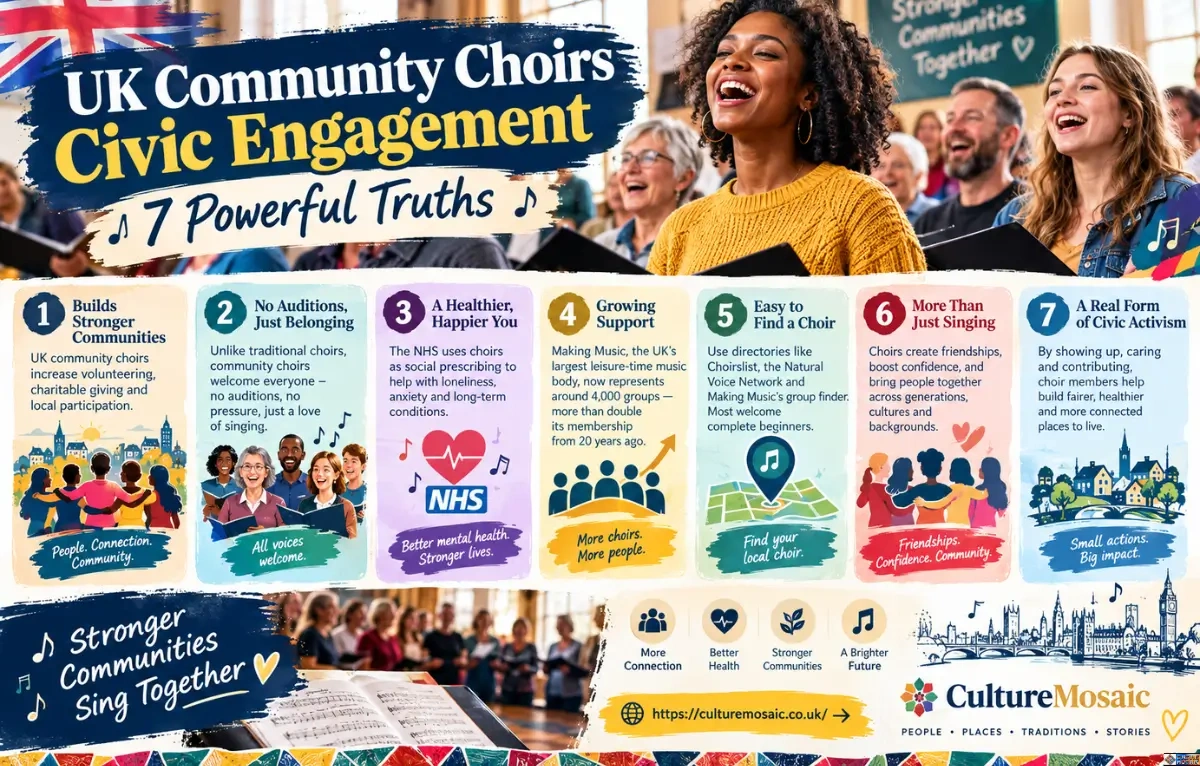
Quick Summary
- Civic Engagement Pattern: UK community choirs civic engagement isn’t a marketing phrase. It’s a measurable pattern: singing together predicts higher rates of volunteering, charitable giving, and local participation.
- Open Access: Community choirs differ from traditional or classical choral societies mainly in one way: nobody auditions you out at the door.
- Social Prescribing: The NHS uses choirs as a form of social prescribing, referring patients through link workers to non-clinical, community-based support for loneliness, anxiety, and long-term conditions.
- Remarkable Growth: Making Music, the UK’s largest umbrella body for leisure-time music, now represents roughly 4,000 groups, more than double its membership from twenty years ago.
- Find a Group: You can find a verified choir near you through directories such as Choirslist, the Natural Voice Network, and Making Music’s own group finder — most welcome complete beginners.
Let’s be clear about what this article actually is: a plain look at UK community choirs civic engagement, backed by research rather than good intentions. I want to be upfront about something before we go further: I’m not going to tell you singing fixes broken town centres. It doesn’t. But I’ve spent years writing about what does hold a fractured community together, and I keep landing back on the same unglamorous answer. Rehearsal halls. Wednesday evenings. Forty people who can’t all hold a tune, standing in a circle anyway.
THE PROBLEM: A COUNTRY THAT’S FORGOTTEN HOW TO SHOW UP
Something has gone quiet in British civic life, and it isn’t subtle. The House of Commons Library’s own briefing on community cohesion lays it out in blunt terms: trust in politicians and democratic institutions is low, and that erosion is pushing some people out of civic life altogether while pushing others toward populist and extremist actors looking for meaning [Source 1]. Deprivation and the cost of living squeeze are hardening grievances against neighbours who look different, and councils, stretched thin, are “ill-equipped” to counter the misinformation doing the damage [Source 1].
That’s the diagnosis from Parliament’s own researchers, not from me. And it should worry you, whatever your politics, because a country that stops trusting its institutions doesn’t stop needing them. It just stops showing up to shape them.
Read enough of these reports and you start to feel the weight of it. What is the Value of Civic Participation? becomes less of an abstract question and more of an urgent one. Where, exactly, are ordinary people supposed to practise being neighbours anymore? Church attendance has fallen for decades. Pubs close at a steady clip. Working men’s clubs, women’s institutes, union branches — the old scaffolding of local life has been quietly dismantled, plank by plank, and nobody built a replacement.
THE EMPATHY: LONELY, DISTRUSTFUL, AND TIRED OF BEING TALKED AT
Here’s the part that doesn’t make it into most policy briefings: this isn’t only a structural problem. It’s a lonely, exhausting, personal one. If you’ve ever moved to a new town and struggled to meet anyone who wasn’t a colleague, you already know the feeling I mean. If you’ve watched a parent grow isolated after retirement, or a teenager retreat entirely into a phone screen, you know it too.
People aren’t disengaging from civic life because they stopped caring. Most people I’ve spoken to over the years care plenty. They’re disengaged because the usual on-ramps — town hall meetings, council consultations, party politics — feel closed, technical, or frankly a bit humourless. Nobody wants to spend their one free evening a week parsing a planning document. Why Public Consultation Is Important is a genuine question worth asking, and one honest answer is: it usually isn’t fun, and fun is not a small thing when you’re trying to get tired, wary people to participate in anything.
That’s the gap. And it’s exactly the gap that a slightly chaotic Wednesday-night choir rehearsal fills, almost by accident — which is really the whole case for UK community choirs civic engagement in a single sentence.
THE SOLUTION: WHY SINGING TOGETHER REBUILDS THE HABIT OF SHOWING UP
Here is the honest, evidence-backed case for UK community choirs civic engagement, and I’ll say straight away that the strongest research doesn’t come from choir enthusiasts with something to sell. It comes from academics who went looking for something else entirely.
Research from the University of Kent, cited by Arts Professional in its reporting on everyday creativity, found that taking part in the arts is a strong indicator of further Civic Engagement — that regular involvement in local creative groups nudges people toward volunteering and charitable giving they wouldn’t otherwise have done [Source 2]. That’s not a vague wellness claim. It’s a behavioural one: turn up to sing on Tuesday, and you become measurably more likely to turn up somewhere else on Thursday.
Daisy Fancourt’s research, referenced in that same piece, goes further, making the case that voluntary creative groups perform what the article calls “quietly radical acts” — book groups opening their doors to new neighbours, choirs welcoming asylum seekers into rehearsal rooms where nobody asks for paperwork first [Source 2]. I find that phrase weirdly moving. Quietly radical. No banners, no hashtags, just a soprano section that got a little more diverse this year.
What Is Civic Activism, and Where Does Singing Fit?
Civic activism is usually defined as the deliberate work citizens do to influence the conditions of their shared life — voting, campaigning, organising, showing up to a council meeting and saying your piece. It’s a broader category than Civic Engagement, which includes quieter, less confrontational participation too: volunteering, mutual aid, and yes, joining a choir that performs at the local hospice fundraiser.
Choirs sit at an interesting hinge point between the two. A choir singing at a Pride march or a picket line is doing something close to activism. A choir singing carols at a care home is doing something closer to plain Civic Engagement. Most UK community choirs do a bit of both across a single year, which is precisely why the Civic Literacy conversation shouldn’t skip over them. You learn how your town actually works — who books the community hall, which councillor turns up to things, how a grant application gets written — by being embedded in a group that has to deal with all of it to put on a concert.
WHAT’S THE DIFFERENCE BETWEEN A COMMUNITY CHOIR AND A TRADITIONAL CHOIR?
This question comes up constantly, and the honest answer has less to do with music and more to do with the door policy.
A traditional or classical choir — a cathedral choir, a big-name choral society, many of the groups people picture when they search for a classical choir near me — usually auditions. You need to read music, hold a part unaided, and often already have a vocal training background. The repertoire tends toward the canon: Handel, Bach, Fauré, Rutter.
A community choir, by contrast, is built around access rather than excellence. The scoping review published in the journal Arts & Health puts it plainly: members recognise the importance of choirs that are open to everyone, audition-free, and built around the idea that anyone can sing, with the emphasis on inclusivity over musical polish [Source 3]. That same review found something I think is genuinely underappreciated — existing social connections help people join in the first place, but it’s the choir itself that then builds the new ones [Source 3].
Choir Comparison Guide
| Feature | Community Choir | Traditional / Classical Choir |
|---|---|---|
| Audition required | Rarely — most are open access | Usually, plus prior musical literacy |
| Typical repertoire | Pop, folk, world, and light classical | Handel, Bach, Fauré, and canonical choral works |
| Primary aim | Inclusion, wellbeing, and civic connection | Musical excellence and performance standard |
| Membership size (typical) | 20–60 members | 30–80 members, sometimes larger |
| Civic engagement role | Strong — designed around access and mixing communities | Moderate — often more insular by design |
HOW EXACTLY DO COMMUNITY CHOIRS IMPROVE LOCAL CIVIC ENGAGEMENT?
Three mechanisms keep showing up across the research, and none of them require a single grand gesture.
First, there’s simple repeated contact. A choir meets weekly, often for years. That’s an unusual amount of sustained, structured time spent with people you didn’t choose and wouldn’t otherwise meet — a different generation, a different postcode, sometimes a different faith. Cambridge’s Good Vibrations choir, documented in the Oxford Academic study of natural-voice community choirs, worked directly with asylum seekers at the Oakington Immigration Reception Centre, turning a rehearsal room into one of the only spaces where that kind of contact happened at all [Source 4]. That’s Diverse Civic Harmony in the most literal sense the phrase could have.
Second, choirs generate what I’d call “civic infrastructure by accident.” To exist at all, a choir needs a hall booking, a bank account, a constitution, a treasurer, insurance, a relationship with the local council or church that owns the building. Someone has to write a grant application. Someone has to negotiate with the parish council over rehearsal times. That’s Vernacular Governance Structures in action — small-scale, homemade democracy that trains ordinary members in exactly the administrative and negotiating skills that formal civic life also demands, minus the intimidating jargon.
Third, and this is the one people underrate, choirs give members practice in public voice — literally and figuratively. Someone who has stood in front of an audience of three hundred people at a Christmas concert finds it considerably less terrifying to stand up at a planning consultation six months later. That’s Narrative Advocacy built through rehearsal rather than through a workshop on public speaking nobody wanted to attend.
The Military Wives Choirs are the sharpest example of this pipeline running from private grief to public voice. Formed originally as a support network for women whose partners were deployed, the choirs became a nationally recognised movement, and the research base built around them — including the scoping review I mentioned above — treats them as a case study in how a choir born from isolation can end up shaping national conversation about military family welfare [Source 3].
HOW DOES THE NHS USE COMMUNITY CHOIRS FOR “SOCIAL PRESCRIBING”?
This is, in my view, the most underreported civic engagement story in British healthcare right now, and it deserves more attention than it gets.
Social prescribing is part of the NHS Personalised Care programme. A GP or another local agency refers a patient to a social prescribing link worker, who takes a holistic view of what that person actually needs — which is sometimes not more medicine, but connection [Source 5]. The link worker then connects the patient to non-clinical, community-based support: a walking group, a gardening project, or a choir.
Making Music has partnered with the Singing for Health Network to publish free guides for both choir leaders and social prescribers, because there’s now a genuinely substantial evidence base showing singing’s benefit for mental health, loneliness, and isolation, alongside more specific effects on lung health and the management of conditions like dementia and Parkinson’s [Source 6].
The money backing this isn’t trivial, either. The Power of Music Fund has raised £2.3 million, including £500,000 secured directly from the NHS, and has issued grants to more than 200 organisations supporting over 12,000 people, many of them dementia choirs and singing groups that were quietly folding under rising running costs before the funding arrived [Source 7]. That’s not a rounding error in a wellbeing brochure. That’s a health system tacitly admitting that a badly-tuned Wednesday-night singalong does something a prescription pad can’t.
Power of Music Fund — Headline Figures
| Metric | Total |
|---|---|
| Total raised | £2.3 million |
| Secured directly from the NHS | £500,000 |
| Organisations funded | 200+ |
| People supported | 12,000+ |
| First grant round focus | Dementia choirs and singing groups at risk of closure |
I’d argue this is Social Change in Modern Society happening in the least dramatic way imaginable — through a spreadsheet of grant recipients and a stack of hymn sheets, not a protest.
UK COMMUNITY CHOIRS CIVIC ENGAGEMENT: WHO’S ACTUALLY JOINING, AND WHAT ARE THEY SINGING?
The scale here is bigger than most people assume. Making Music, trading as the National Federation of Music Societies, now represents nearly 4,000 leisure-time music groups across the UK, and vocal groups make up over half of that membership [Source 8]. Membership has more than doubled since 2001, and vocal group numbers specifically have grown by more than 75 percent over the same period [Source 8]. This is Civic Engagement Trends moving in a genuinely hopeful direction, at a time when most other measures of associational life are heading the other way.
As for the songs: forget the stereotype of nothing but hymnals and madrigals. UK community choirs civic engagement songs range from Fauré’s Requiem one term to Fleetwood Mac and Stevie Wonder arrangements the next. Groups such as Some Voices have built entire non-audition choirs around pop repertoire — Bowie, Björk, folk, hip hop — precisely because it lowers the barrier for people who’d never see themselves in a cassock. Repertoire choice is itself a small act of Ethical Grassroots Advocacy: choosing a protest anthem for a Pride concert, or a local folk song for a heritage festival, is a choir deciding, out loud, what story its town gets to tell about itself.
Members, meanwhile, skew toward exactly the demographic policymakers worry most about reaching: people newly retired, people recently widowed, people who moved somewhere new mid-career and haven’t yet built a social circle. Choirs pull in people who would never attend a town hall meeting but will absolutely turn up for tea, biscuits, and a decent alto line.
A SMALL-TOWN CASE STUDY: FORDINGBRIDGE
I like Fordingbridge as an example precisely because nothing about it is exceptional. It’s a Hampshire market town of around 6,200 people on the River Avon, the kind of place with a 12th-century parish church, a football club old enough to have a Victorian origin story, and, tellingly, not one but three separate choral groups [Source 9].
The Fordingbridge choir scene includes One Voice, a non-auditioned community choir of around 40 members meeting Monday evenings at the Avonway Community Centre; the Fordingbridge Choral Society, a similarly sized group with a more classical repertoire based at St Mary’s Church; and a newer Fordingbridge Sing Space musical theatre choir that launched after, by its founder’s own account, over 200 locals expressed interest before it even started [Source 10]. That’s roughly one choir seat available for every fifty residents in a town most people outside Hampshire have never heard of.
What strikes me about Fordingbridge is how ordinary that density is. Walk into almost any English market town’s community directory and you’ll find the same pattern repeating: a choir sitting right alongside the historical society, the camera club, and the Rotary Club, all doing the same quiet work of DIY Placemaking Community Engagement — making a place feel like somewhere worth staying, one shared activity at a time.
HOW CAN I FIND A VERIFIED COMMUNITY CHOIR NEAR ME IN THE UK?
This is where I’ll be direct with you, because I think the “just Google it” advice fails people more often than it should.
Start with Making Music’s own group finder if you want something affiliated with the UK’s largest music societies UK network — groups here are constituted, insured, and vetted to a minimum standard.
Try Choirslist, a free, growing directory that verifies listings so you can filter by whether a choir is auditioned, what it sings, and whether it’s actually taking new members right now rather than just existing on paper.
Search the Natural Voice Network’s directory if you specifically want a non-audition, natural-voice-style choir, which tends to be the friendliest entry point for total beginners.
Ask your GP surgery or local social prescribing link worker whether there’s a singing group on their referral list — worth doing even if you’re not seeking a medical referral, because these lists are usually well-vetted for accessibility.
If it’s a classical choir near me you’re after specifically, cathedral and choral society websites almost always list an audition process and repertoire history up front, so you know what you’re walking into before you show up.
The wildcard option, if the above all feel a bit too “official”: phone your parish or town council directly. Most keep an informal list of local singing groups, historical societies, and singing groups that never made it onto any national directory — Fordingbridge’s own town council page is a good example of exactly this kind of hyperlocal list, hiding in plain sight on a website nobody thinks to check.
Digital tools are also changing how people locate and vet groups before ever showing up to a rehearsal, which is its own quiet example of Hyperlocal Digital Deliberation — reviews, member testimonials, and rehearsal videos doing the reassurance work that used to require knowing someone already in the choir.
BEYOND THE REHEARSAL ROOM: CHOIRS AS EVERYDAY CIVIC INFRASTRUCTURE
I don’t want to overstate the case for UK community choirs civic engagement here. A choir will not fix a housing crisis, and it won’t repair trust in national government on its own. But civic life is rebuilt in Micro-Civic Interventions, not grand ones, and a choir performing at a council-run summer fete, or busking in the high street to raise funds for the food bank, is a small act of Tactical Urbanism in Community Civic Engagement — claiming public space, briefly, for something communal rather than commercial.
Funding schemes are starting to notice. Programmes like the Love Your Block Grant 2026 exist for exactly this category of grassroots activity: small grants for groups that make a street, a square, or a town centre feel more like somewhere people belong. Choirs are natural applicants, because they already do the hard, unglamorous organising work that grant panels want to see evidence of.
And when councils genuinely want feedback on local plans, choirs are often sitting right there in the room already — at consultation evenings, at Co-design in urban planning and civic engagement sessions about a new community hall, at the public meetings where How Public Feedback Shapes Local Policy stops being a theory and starts being a lived experience for whoever turns up. A choir that’s used the community hall every Wednesday for a decade has a legitimate, informed opinion on whether the hall should be sold off, and What Is Public Commentary? really means in practice is exactly that: informed residents, not anonymous internet noise, saying what they actually know.
None of this replaces voting, and I won’t pretend it does. Why Is Voting Important in Local Elections? remains one of the most direct forms of civic power any resident has, and choir membership correlating with higher civic participation, per the University of Kent findings cited earlier, likely includes exactly that kind of participation too [Source 2]. But turnout doesn’t happen in a vacuum. People vote in places where they feel some stake in the outcome, and a choir is one of the cheapest, most enjoyable ways to build that stake before an election ever gets called.
WHY THIS MATTERS NOW, AND WHAT YOU CAN ACTUALLY DO ABOUT IT
If you’ve read this far, I suspect you already sense the shape of the argument, so I’ll say it plainly instead of dressing it up further: Real-World Problems like loneliness, distrust, and civic burnout don’t need a single dramatic solution. They need dozens of small, boring, repeatable ones, done consistently, in ordinary rooms, by ordinary people who showed up on a Wednesday when they could easily have stayed home.
A choir is one of those. It’s not the only one, and I’d never claim it’s the most important one. But it might be the easiest one to start tomorrow.
Here’s what I’d actually suggest doing with that:
- Find a choir this week rather than “eventually.” Most take drop-in visitors for a free trial session before asking for any commitment.
- If singing genuinely isn’t for you, look into 10 Civic Engagement Opportunities for lower-key ways to build the same habit of showing up.
- Consider whether your own street or estate needs the kind of grassroots organising a choir committee already models — Community Activism Strategies borrow more from choir logistics than people expect.
- If you’re already involved in local civic life, invite a choir to your next event. It costs almost nothing and it fills a room faster than a leaflet ever will.
The wildcard suggestion: if there’s no choir where you live, start one. Making Music offers a model constitution and a discounted first-year membership for exactly this situation, and you don’t need any musical training to be the person who organises the hall booking.
You can also Volunteer for Civic Education Programs that work alongside community arts groups, or read more broadly about Local Civic Engagement Strategies and Understanding Civic Duty if you want the fuller picture beyond music specifically. And if you’re curious how to get involved in local civic issues online, our guide is a sensible next stop.
I keep coming back to the same image: a slightly out-of-tune choir, badly lit church hall, someone’s home-baked flapjacks on a folding table at the back. It doesn’t look like civic engagement. It doesn’t look like anything, really, except forty people who decided to turn up. That’s the whole trick. That’s most of what UK community choirs civic engagement has ever actually been, and most of what civic life has ever actually been, too.
Frequently Asked Questions
1. What is the difference between a community choir and a traditional choir?
A community choir is built for access — no audition, mixed ability, an emphasis on inclusion over polish, and often a broad repertoire spanning pop, folk, and classical arrangements. A traditional or classical choir, such as a cathedral choir or established choral society, typically auditions members, expects existing musical literacy, and performs a more canonical repertoire of works by composers like Handel, Bach, or Fauré. Both offer real civic and social value, but community choirs tend to be the more accessible entry point for people who’ve never sung formally before.
2. How exactly do community choirs improve local civic engagement?
Community choirs build civic engagement through three consistent mechanisms: sustained weekly contact between people who wouldn’t otherwise meet, hands-on experience running the informal “governance” a choir needs to survive (bookings, treasurers, grant applications), and practice performing and speaking in front of an audience, which builds confidence that carries over into public meetings and consultations. Research from the University of Kent has linked regular participation in local creative groups, including choirs, to higher rates of volunteering and charitable giving.
3. How does the NHS use community choirs for “social prescribing”?
Social prescribing is part of the NHS’s Personalised Care programme. A GP or link worker refers a patient to non-clinical, community-based support rather than, or alongside, medical treatment. Choirs are one of the most common referrals because of the growing evidence base around singing’s benefits for mental health, loneliness, lung health, and symptom management in conditions such as dementia and Parkinson’s. Organisations including Making Music and the Singing for Health Network publish free guides to help both choirs and social prescribers manage these referrals well.
4. How can I find a verified community choir near me in the UK?
The most reliable starting points are Making Music’s group finder, the Choirslist directory, and the Natural Voice Network’s choir search, all of which list whether a group auditions, what it sings, and whether it’s currently open to new members. Your GP surgery or local social prescribing link worker may also keep a vetted list. For hyperlocal options that never make it onto national directories, your parish or town council office is often worth a phone call.
5. What is civic activism, and is joining a choir really a form of it?
Civic activism generally refers to deliberate action aimed at influencing shared community or political conditions — campaigning, organising, and public advocacy. Civic engagement is the broader category, including quieter participation like volunteering. A community choir sits between the two: it’s rarely activism on its own, but the organisational skills, public confidence, and cross-community contact it builds are the same raw materials that formal activism depends on. That’s exactly why UK community choirs civic engagement keeps showing up in academic research as a meaningful, measurable category rather than a side hobby.
SOURCES
- House of Commons Library, “Strengthening community cohesion” — commonslibrary.parliament.uk/research-briefings/cdp-2026-0047/
- Arts Professional, “Choirs, knitting and printing: Everyday creativity and community bonding,” citing University of Kent (2017) research and Daisy Fancourt — artsprofessional.co.uk
- “Expanding access to adult community choirs: a scoping review to identify facilitators and barriers to choir membership,” Arts & Health, Taylor & Francis Online — tandfonline.com/doi/full/10.1080/14613808.2025.2509949
- Oxford Academic, “A Different Voice, A Different Song: Reclaiming Community through the Natural Voice and World Song,” Chapter 7 — academic.oup.com
- NHS England / Making Music, “Social prescribing – what is it and what can it do for my group?” — makingmusic.org.uk
- Making Music, “Social prescribing resources,” in partnership with the Singing for Health Network — makingmusic.org.uk/resource/social-prescribing-resources
- National Academy for Social Prescribing, “The Power of Music Fund” — socialprescribingacademy.org.uk
- Making Music, “The Big Survey 2022” — makingmusic.org.uk/resource/big-survey-2022-5
- Wikipedia, “Fordingbridge” (2021 Census population figure) — en.wikipedia.org/wiki/Fordingbridge
- Fordingbridge Town Council, “Local Groups and Societies”; Making Music, “One Voice Choir, Fordingbridge”; Fordingbridge Choral Society; Sing Space Choir Fordingbridge