
 By Culture Expert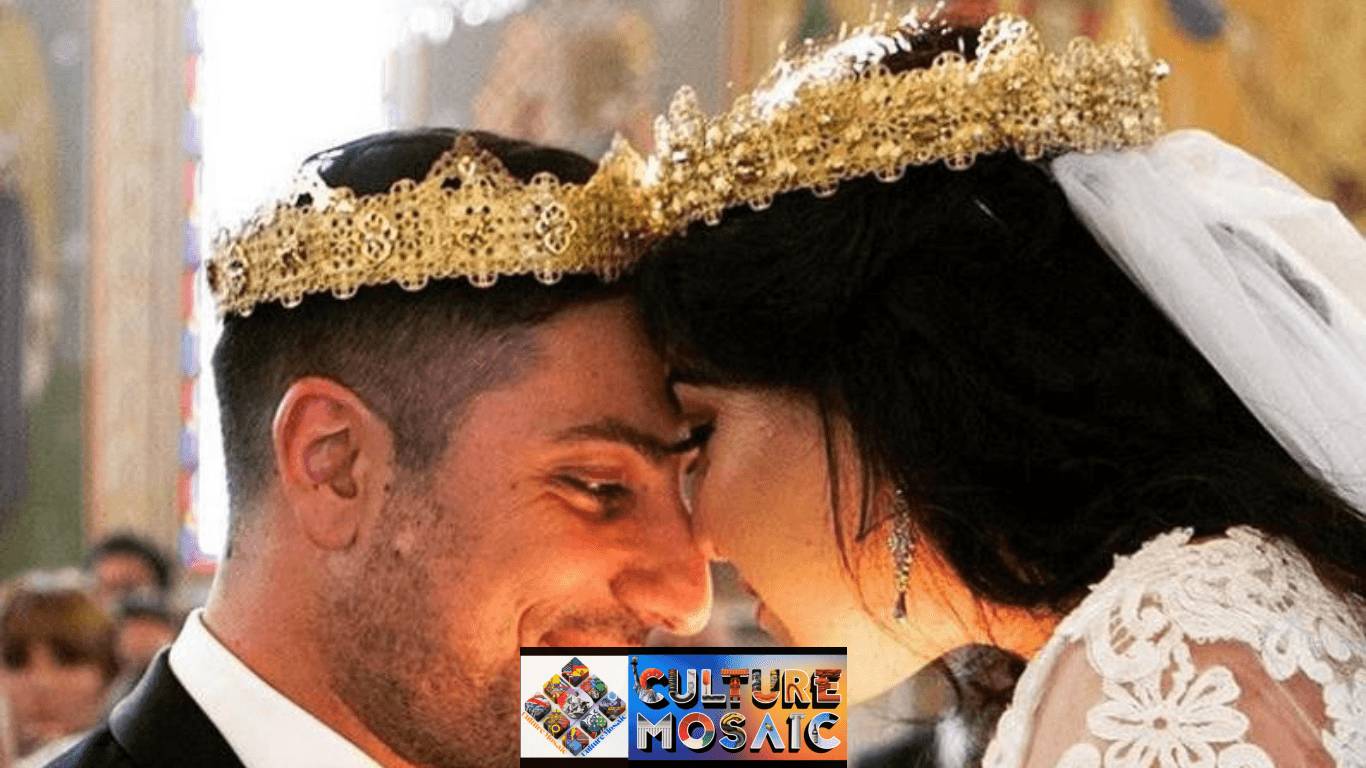
History, Ritual, and What the Crowns Still Mean to Families Today
About the Author
Dr. Helena Voss is a historian specializing in classical antiquity and the family customs that grew out of it. She has spent close to fifteen years tracing how ancient rituals, particularly those tied to marriage, survived migration, conquest, and modernization to remain part of family life today. Her research draws on Byzantine liturgical texts, oral family histories collected across the Mediterranean and Eastern Europe, and museum archives of ceremonial dress. She writes for Culture Mosaic on the history behind the customs families still practice without always knowing why. Read more of her work on her author profile.
I still remember standing in a small stone church outside Nafplio, watching a priest lift two braided crowns joined by a ribbon and set them, one after the other, on the heads of a bride and groom. Nobody in that church needed an explanation. Grandmothers mouthed the words along with the priest. A child in the front pew reached up, half expecting the crown to be his turn next. That’s the thing about Crown family wedding traditions: they aren’t performed for an audience. They’re inherited, the way a recipe or a grudge gets inherited, quietly and without much fuss, until one day you’re the one wearing the crown.
This piece traces where that custom comes from, how it split into distinct regional forms, and why so many families still fold it into weddings that otherwise look thoroughly modern.
What Are Crown Family Wedding Traditions?
At its simplest, a crown family wedding tradition is any marriage custom where the bride, the groom, or both are crowned as part of the ceremony, usually by a priest, an elder, or a family member standing in that role. The crown might be a woven wreath, a metal band, or a stiff floral arrangement, depending on the region and the era. What ties these traditions together isn’t the material. It’s the idea that marriage creates something worth marking with the same gesture once reserved for kings.
Understanding crown family wedding traditions matters as much for what they reveal about family memory as for the ceremony itself. I’d argue this is one of the more misunderstood wedding customs in the historical record, because people often assume “crowning” is a decorative flourish added later for spectacle. It isn’t. In most of the cultures that practice it, the crowning is the ceremony. Everything before it is preparation, and everything after it is celebration.
The Origins of the Wedding Crown
Ancient Greek and Roman Roots
The habit of crowning brides and grooms goes back further than most people expect. In ancient Greece, both bride and groom wore wreaths, usually made of myrtle, olive, or laurel, as a mark of honor and fertility. Roman brides wore a wreath of verbena picked by the bride herself, paired with a flame-colored veil. Neither culture treated the wreath as ornamental. It signaled that the wearer had crossed into a new social category, one with its own obligations and protections under law.
I find it telling that Roman writers described the wedding wreath in the same breath as the wreaths given to victorious generals and athletes. Marriage, in that world, was framed as an achievement worth crowning, not simply a private arrangement between two households.
The Byzantine Influence
The custom took on new weight once it moved into Christian liturgy under the Byzantine Empire. By the fourth century, Christian weddings in the Eastern Mediterranean had absorbed the older crowning gesture and reworked it into a formal sacrament. The Byzantine court, which loved ceremony as much as it loved theology, cemented crowning as the emotional center of the wedding rite rather than a side ritual. That version of the custom is the direct ancestor of what Orthodox Christian families still practice.
The Orthodox Christian Crowning Ceremony
The Eastern Orthodox Church formalized crowning into what’s known liturgically as the Crown family wedding traditions or “Mystery of Crowning,” one of the seven sacraments recognized by Orthodox Christianity. The priest blesses two crowns, then places them on the couple in the name of the Trinity, sometimes exchanging the crowns between the bride and groom three times as a witness stands by holding them steady. It’s a physically active moment, not a quiet blessing, and that’s deliberate. The Church wanted marriage to feel like a coronation, not paperwork.
The Stefana of Greek Weddings
In Greek Orthodox weddings, the crowns are called stefana. They’re joined by a single ribbon, a small but pointed detail meaning that from this point forward, whatever happens to one happens to the other. Traditionally the koumbaros, a sponsor roughly equivalent to a best man but with far heavier religious responsibility, exchanges the stefana between the couple’s heads three times. Many Greek families keep the stefana afterward, framed and displayed in the home for the rest of the marriage. I’ve interviewed families who still had the same box of stefana on a shelf fifty years after the wedding, slightly yellowed, never thrown out.
Slavic and Russian Crowning Rituals
Russian and other Slavic Orthodox traditions use a heavier metal crown called a venets, often held above the couple’s heads rather than resting directly on them, sometimes by groomsmen whose arms genuinely ache by the end of a long service. The weight is part of the point. Marriage, the ritual implies, is a commitment that costs something to hold up.
What the Crown Actually Symbolizes
Ask five historians what the wedding crown symbolizes and you’ll get five overlapping but distinct answers, so I’ll give you mine. I think the crown does three things at once. It marks the couple as, in a sense, ruling their own household, a small kingdom of two. It signals sacrifice, since crowns in Christian iconography are also associated with martyrdom and endurance. And it marks celebration, tying the ceremony back to its pre-Christian roots in athletic and military honor.
None of those readings cancels the others out. That layered meaning is exactly why the custom has survived so long. A symbol that only means one thing tends to fade once that single meaning stops feeling relevant. A symbol that means three or four things at once keeps finding new reasons to matter.
How Families Pass Down Crowning Traditions
Crown family wedding traditions rarely survive through official channels. They survive because a grandmother insists, or a mother quietly orders the stefana months before anyone’s engaged, or a family keeps the same crown for three generations of weddings whether the church officially blesses that practice or not.
Most crown family wedding traditions get passed down informally rather than taught in any formal setting. A few patterns show up again and again in the families I’ve studied:
- The crowns, or the fabric and ribbon used to make them, are frequently kept as heirlooms rather than purchased fresh for every wedding.
- Older female relatives often take charge of crown preparation, even in families where most other wedding planning has become gender neutral.
- Immigrant families tend to hold onto crowning customs more tightly than families who never left the country of origin, partly because the ritual becomes a marker of identity abroad.
- Photographs of the crowning moment are disproportionately treasured compared to other wedding photos, often the ones framed and hung rather than left in an album.
- Even secular or lapsed members of a family will frequently request the crowning be included, treating it as cultural rather than strictly religious.
Regional Variations in Wedding Crown Customs
Romanian and Eastern European Customs
Romanian Orthodox weddings follow a structure close to the Greek and Russian versions but add their own texture, including the couple circling a small table three times while wearing the crowns, a walk meant to represent the first steps of married life taken together. For readers comparing notes across cultures, our piece on Cultural Marriage Traditions covers how godparents rather than a koumbaros often hold the crowning role in parts of Eastern Europe, which shifts the emotional center of the ceremony toward parental figures rather than peers.
Middle Eastern and Armenian Wedding Crowns
Armenian Apostolic weddings include a crowning rite as well, using crowns that are often more elaborate and jeweled than their Greek counterparts. In several Middle Eastern Christian communities, crowning ceremonies happen alongside older pre-Christian customs like the tying of a cord or sash around the couple’s joined hands, layering two symbolic acts into one ceremony.
The Role of the Koumbaros and Best Man
The person who holds and exchanges the crowns carries more weight than a typical wedding attendant. In Greek tradition, becoming a koumbaros is often a lifelong role passed between families across generations, sometimes obligating the koumbaros to sponsor the couple’s children at baptism as well. Refusing the role, once accepted for a couple’s parents, is considered a serious breach. Anyone studying Marriage Rituals in Different Cultures Anthropology will recognize this pattern of sponsorship roles that outlast a single wedding. I’ve heard it described, only half joking, as adopting a second family for life.
Materials and Craftsmanship of Wedding Crowns
Traditional stefana were made from orange blossoms, wax, and silk, chosen because orange blossoms held their shape and scent through a long ceremony. Modern versions range from delicate wire and pearl designs to crowns made of the same fabric as the bride’s dress, custom stitched by relatives rather than bought from a shop. Metal venets, by contrast, are often rented from the church itself, passed between dozens of couples over decades, which gives them a different kind of weight, both literal and historical.
Modern Adaptations of Family Crowning Traditions
Plenty of couples today aren’t Orthodox Christian and still want some version of a crowning moment, drawn to the visual power of it more than the doctrine behind it. I’ve seen secular couples adapt the ritual using floral crowns exchanged by parents instead of a priest, or friends standing in for the koumbaros role without the religious obligations attached. Some couples researching the Best Wedding Traditions Worldwide borrow crowning elements the way they’d borrow any other custom that resonates with their own values, which historians can grumble about but rarely stop. It’s a habit not unlike how couples now casually reference the Roman Wedding Night Ritual or the Ancient Roman Wedding Traditions for inspiration without adopting the full ceremony.
Crown Family Wedding Traditions vs. the British Royal Family
Because the phrase “crown family” sounds so close to “royal family,” it’s worth addressing directly: this custom has no historical connection to the British monarchy or its wedding ceremonies. British royal weddings don’t include a liturgical crowning rite; the closest parallel is the coronation ceremony, a separate event tied to accession rather than marriage. If you searched hoping to learn how the House of Windsor crowns its brides, the honest answer is that it doesn’t. What connects the two is coincidence of language, not shared history.
The Cultural Significance of Crowning in Marriage
Crown family wedding traditions endure precisely because they operate on more than one level at once. What strikes me most, after years of reading through parish records and sitting in on weddings I was technically there to study rather than attend, is how little the crowning ritual has changed in emotional function even as its details drifted by region. Whether it’s a woven Greek stefana, a heavy Russian venets, or a modern floral adaptation at a backyard wedding, the gesture does the same job: it tells everyone in the room, including the couple, that something has shifted. Two people walked in as individuals. They’re walking out as something else, and the crown is there to prove it happened.
How to Honor Crown Family Wedding Traditions Today
Families interested in reviving or preserving crowning customs don’t need a full Orthodox liturgy to do it meaningfully. A few approaches I’ve seen work well:
- Ask older relatives directly what crowns, if any, exist in the family already, since many sit forgotten in closets rather than being deliberately discarded.
- Involve a trusted friend or relative in a koumbaros-style role even outside a religious context, giving the ceremony a witness with real weight.
- Choose materials with personal meaning, such as flowers grown by a parent, rather than defaulting to whatever a florist stocks.
- Photograph and document the crowning moment specifically, since families consistently treasure these images more than general ceremony shots.
- Research the specific regional version tied to your own family history rather than a generic version, since Greek, Russian, Romanian, and Armenian customs each carry distinct meaning.
FAQs About Crown Family Wedding Traditions
1. What exactly does “crowning” mean in a wedding ceremony?
Crowning refers to the act of placing crowns, wreaths, or a similar symbolic headpiece on a bride and groom during the marriage ceremony itself, most commonly within Eastern Orthodox Christian tradition, though the underlying gesture dates back to ancient Greek and Roman customs.
- Recognize that crowning is often the theological center of the ceremony, not a decorative add-on performed for photos.
- Understand that the crowns are usually blessed objects, meaning they carry sacramental weight beyond their appearance.
- Note that specific gestures, like exchanging the crowns three times, vary by regional tradition and shouldn’t be assumed universal.
- Learn who traditionally holds the crowning role in your specific cultural background before assuming it’s always a priest.
- Ask family elders about any crowns already owned by the family before purchasing new ones for a wedding.
2. Why do some cultures crown both the bride and the groom rather than just the bride?
Unlike Western bridal veils or tiaras, which typically adorn only the bride, most crown family wedding traditions crown both partners equally, reflecting the belief that marriage elevates both people jointly rather than honoring one more than the other.
- Treat the crowning as a shared, mutual symbol rather than framing it as primarily about the bride.
- Choose matching or complementary crown designs for both partners to reflect the tradition’s emphasis on equality.
- Avoid modifying the ritual so that only one partner is crowned, since this changes its historical meaning significantly.
- Discuss with officiants in advance how the exchange or sequence of crowning will be handled for both individuals.
- Preserve both crowns afterward as a pair rather than separating them, consistent with how many families store stefana.
3. Is there any real historical link between “crown family” wedding customs and Britain’s royal family?
No. Despite the similar phrasing, the wedding crowning tradition rooted in ancient Greek, Roman, and Orthodox Christian practice has no direct connection to the British monarchy, whose coronation ceremonies mark accession to the throne rather than marriage.
- Search using more specific terms, such as “Orthodox wedding crowning” or “stefana tradition,” if researching the religious custom specifically.
- Understand that “the Crown” as a term for the British monarchy is a legal and political concept unrelated to wedding rites.
- Look for the phrase “Mystery of Crowning” when researching the Orthodox Christian sacrament to avoid confusing search results.
- Recognize that royal wedding ceremonies in Britain follow Anglican liturgy, which does not include a crowning rite.
- Cross reference sources by denomination, since crowning customs are specific to Orthodox and some Eastern Christian communities, not Christianity broadly.
4. What materials were traditionally used to make wedding crowns?
Historically, wedding crowns were made from natural materials such as orange blossoms, myrtle, olive branches, or laurel, chosen for their durability, fragrance, and symbolic association with honor, fertility, and peace.
- Select flowers or greenery with personal or family significance rather than defaulting to whatever is trending.
- Consider durability if the crowns will be worn through a long ceremony, since delicate materials can wilt or lose shape.
- Explore metal or fabric crowns as a lower maintenance alternative to fresh floral versions.
- Ask a relative with sewing or floral skills to help construct the crowns, continuing the tradition of family made regalia.
- Preserve the crowns afterward using pressing, framing, or careful storage if they hold sentimental value.
5. Can non religious or secular couples incorporate crowning traditions into their wedding?
Yes, many couples outside the Orthodox Christian tradition adapt crowning customs into secular ceremonies, using the ritual’s visual and emotional power without the accompanying liturgy.
- Be transparent with guests about the custom’s origins rather than presenting it as generic without context.
- Choose a meaningful person, such as a parent or close friend, to perform the crowning in place of a priest.
- Simplify the ritual’s structure while keeping its core gesture, such as placing crowns on both partners simultaneously.
- Pair the crowning with other cultural marriage traditions the couple wants to honor, rather than isolating it.
- Research the specific tradition being borrowed to avoid combining customs in ways that lose their original meaning.