
 By Culture Expert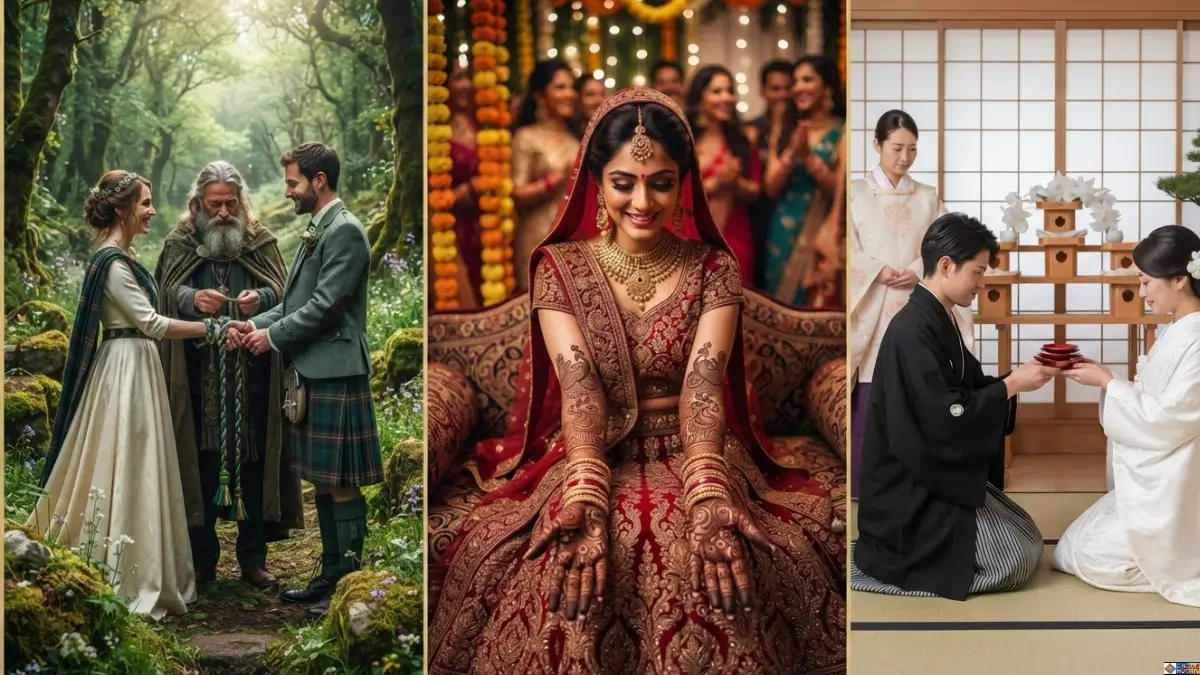
Quick Summary
Every culture solves the same universal challenge: how to transform two separate individuals into a cohesive family unit. While legal paperwork handles the bureaucracy, global wedding traditions rely on symbolic rituals—from physical handfasting in Scotland to Shinto sake-drinking in Japan—to invoke good fortune, build family alliances, and test a couple’s resilience. Understanding these worldwide customs allows modern couples to honor their heritage and build meaningful, authentic ceremonies.
                       [ PILLAR OVERVIEW ]
                     "Best Wedding Traditions Worldwide"
                                      │
  ┌───────────────────────┬───────────┴───────────┬───────────────────────┐
  ▼                       ▼                       ▼                       ▼
[ Binding Rituals ]     [ Playful Tests ]       [ Economic Covenants ]  [ Protective Rites ]
Celtic Handfasting      Polterabend             Las Arras               Jewish Glass Breaking
Japanese San-san-kudo   Joota Chupai            The Money Dance         Jumping the Broom
Modern wedding planning often devolves into an exhausting routine of commercialized trends, color palettes, and cookie-cutter itineraries. Many couples find themselves going through the motions of an expensive event that feels disconnected from real meaning. The pain lies in the loss of depth: when wedding rituals are stripped of their historical roots, the ceremony risks feeling like a performance rather than a profound rite of passage.
The solution is found in history. The Best Wedding Traditions Worldwide have endured for centuries because they offer genuine, embodied symbolism. When we explore marriage in different cultures and religions, we discover that beneath all regional variations, humans everywhere use ritual to satisfy the same three core desires: invoking good fortune, forging structural family alliances, and celebrating resilience.
Drawing from field observations, historical archives, and anthropological data published across Culture Mosaic, this guide explores ten of the most culturally significant wedding customs from around the globe.
1. Rituals of Binding and Unity — Tying the Literal Knot
Many common idioms surrounding marriage stem from physical technologies of union. When people speak of “tying the knot,” they are referencing explicit historical practices involving rope, woven cord, or cloth.
Celtic Handfasting (Scotland and Ireland)
Dating back to the ancient Celtic era, handfasting is one of the oldest unity ceremonies in Western Europe. The officiant wraps colorful cords or ribbons around the couple’s clasped hands, binding them together to physically represent the merging of two lives.
Originally, handfasting functioned under early Celtic law as a formal trial marriage lasting a year and a day. If the couple proved incompatible during that window, they could peacefully separate without legal penalty. Today, Celtic Wedding Traditions and Customs remain popular for secular and heritage ceremonies alike. Its survival demonstrates how Cultural Marriage Traditions frequently outlast the specific socio-political systems that created them.
San-san-kudo (Japan)
In traditional Japanese Shinto ceremonies, the wedding is solemnized through San-san-kudo (literally “three, three, nine times”). Using three distinct stacked cups (sakazuki), the bride and groom take three sips of sake from each cup. Their parents then follow suit.
In Shinto numerology, odd numbers represent active yang forces and good fortune. The number three represents the three couples (bride and groom, bride’s parents, groom’s parents), while nine represents the ultimate pinnacle of harmony. The ritual acts as a binding treaty between two extended lineages rather than a transaction between two isolated individuals.
2. Playful Mischief — Testing the Couple’s Resilience
While some cultures treat marriage with quiet solemnity, others believe a union cannot properly begin without public playfulness, community mischief, and a test of patience.
Polterabend (Germany)
On the night before a traditional German wedding, family and guests gather outside the couple’s home to smash piles of porcelain, stoneware, and ceramics on the ground. Glass is strictly forbidden, as glass represents pure luck and must never be broken.
The couple must work together to sweep up every shattered piece. This physical labor demonstrates to the community that the newlyweds possess the cooperative capacity to handle unexpected messes in life.
                  [ Community Smashes Ceramics ]
                                │
                                ▼
                   ( Glass Forbidden = Luck Preserved )
                                │
                                ▼
               [ Couple Sweeps All Shards Together ]
                                │
                                ▼
             { Demonstrates Cooperative Resilience }
Joota Chupai (India and South Asia)
In South Asian weddings, Joota Chupai is a high-stakes game of domestic diplomacy. When the groom removes his shoes before entering the wedding altar, the bride’s female relatives attempt to steal them while the groom’s family defends them.
To retrieve his footwear and finish the ceremony, the groom must negotiate a monetary ransom with the bride’s side. This lighthearted ritual breaks the ice between families and creates an immediate shared story between newly joined relatives.
3. Blessings of Abundance — The Economics of Matrimony
Marriage has historically served as both an economic alliance and a romantic union. Many wedding traditions in different cultures acknowledge this financial reality through ritualized monetary exchanges.
The Money Dance (Cuba, Poland, and the American South)
Across Latin America, Eastern Europe, and the American South, guests pay a small fee to dance with the bride or groom, pinning paper currency directly onto their attire. In Polish tradition (Taniec Pieniądze), the collected funds are placed into an apron held by the bride’s mother, designated specifically to help the couple purchase their first home.
Las Arras (Spain and Latin America)
During Catholic ceremonies in Spain and Latin America, the groom presents the bride with thirteen blessed gold or silver coins known as Las Arras. The exchange represents the groom’s commitment to provide for the household and the bride’s pledge to steward those resources wisely. Mexican Wedding Traditions heavily feature this custom, which traces its lineage to Ancient Roman Wedding Traditions centered on mutual financial covenants.
4. Protection, Warding, and Fire
In ancient folklore, passing into marriage meant crossing a spiritually vulnerable threshold that required protective rites.
Breaking the Glass (Jewish Tradition)
No traditional Jewish ceremony concludes without crushing a cloth-wrapped glass underfoot, followed by cries of “Mazel Tov!” While modern interpretations link the gesture to remembering the destruction of the Temple in Jerusalem, historical folkloric analyses suggest the sharp sound originally served an apotropaic function: scaring away harmful spirits at a vulnerable moment of transition.
Jumping the Broom (African American Tradition)
Rooted in the history of enslaved African Americans in the antebellum South, jumping the broom involves the couple leaping over a decorated broom placed on the floor. This act symbolizes sweeping away the past and stepping into a new domestic life. Because enslaved individuals were legally denied marriage rights, this ritual served as an act of cultural reclamation and community validation.
                   [ Enslaved Era Antecedents ]
                (Denied Legal Marriage Rights)
                               │
                               ▼
               [ Sacred Act: Jumping the Broom ]
                 /                           \
                ▼                             ▼
   (Sweeping Away the Past)      (Crossing into New Life)
                               │
                               ▼
            [ Contemporary Cultural Reclamation ]
Saptapadi — The Seven Steps (Hindu Tradition)
In Vedic Hindu ceremonies, the central binding moment is the Saptapadi (Seven Steps). The couple walks together around a sacred fire (Agni), taking seven steps while reciting seven vows for nourishment, strength, prosperity, happiness, children, long life, and lifelong friendship.
Best Wedding Traditions Worldwide: Comparing Global Wedding Traditions
| Culture / Region | Ritual Name | Key Action | Primary Symbolic Meaning | Historical Origin |
| Celtic / Western Europe | Handfasting | Binding hands with colored cords | Physical and spiritual unification | Pre-Christian / Medieval Europe |
| Japan | San-san-kudo | Taking 9 sips of sake from 3 cups | Family alliance; odd-number harmony | Shinto Traditions |
| Germany | Polterabend | Smashing ceramics; sweeping together | Shared resilience and teamwork | Germanic Folklore |
| India / South Asia | Joota Chupai | Stealing and ransoming groom’s shoes | Family bonding through playful negotiation | Vedic / South Asian Custom |
| Latin America / Spain | Las Arras | Exchange of 13 gold or silver coins | Economic trust and mutual stewardship | Visigothic & Roman Law |
| Jewish Culture | Breaking the Glass | Crushing a cloth-bound glass underfoot | Historical memory; protective warding | Ancient Judean & European Folklore |
| African American | Jumping the Broom | Leaping together over a broom | Sweeping away the past; household renewal | West African & Antebellum US |
Color and Cloth: How Attire Differs Across Cultures
The Western expectation of a white wedding dress is a relatively recent phenomenon popularized by Queen Victoria in 1840. Global bridal wear relies on a much broader spectrum of symbolic colors:
- Red (China & India): Represents good fortune, joy, vitality, and prosperity. In China, brides wear a red qipao or qun kwa embroidered with dragons and phoenixes. In South Asia, red sarees or lehengas represent the active energy of marriage.
- White (Western World & Japan): In Western traditions, white symbolizes purity and celebration. Conversely, in Shinto traditions, a bride’s white shiromuku kimono symbolizes purity and her willingness to be “dyed” by the colors of her new family.
- Intricate Patterns (Middle East & North Africa): Prior to the ceremony, the bride participates in Kına Gecesi (Henna Night), common in Turkey and the Middle East, where detailed henna patterns are applied to her hands and feet for protection and fertility.
Regional Deep Dives Across Culture Mosaic
To explore specific ancestral practices in greater detail, consult these dedicated guides across our platform:
- North American Heritage: Learn about the sacred rituals of the Native American Cherokee Wedding Traditions and the unique heritage of the Red Clay Tribe Wedding Traditions.
- European Customs: Discover specialized regional bridal customs like Italian Wedding Traditions for Bride or explore historical aristocratic precedents in Crown Family Wedding Traditions.
- Classical & Religious Antecedents: Uncover the historical foundations behind Western vows through What Are Christian Wedding Traditions, inspect ancient household customs in the Roman Wedding Night Ritual, or separate historical facts from popular myths in Victorian Wedding Traditions.
How to Respectfully Incorporate Global Traditions
When incorporating customs outside your immediate heritage, follow these principles to ensure cultural appreciation rather than superficial appropriation:
- Research Depth Over Aesthetics: Understand the historical and spiritual context of a ritual before using it. Handfasting carries specific legal and spiritual history, just as Las Arras involves sacralized economic pledges.
- Acknowledge Origins Explicitly: Have your officiant explain the background of the tradition during the ceremony so guests understand its historical significance.
- Adapt Structure, Preserve Meaning: Modifying logistics for a modern venue is acceptable; gutting the core intent of a sacred ceremony turns meaningful culture into a photo prop.
Frequently Asked Questions
What are the origins of common Western wedding traditions?
Many standard Western customs originate from a mix of Roman law, ancient folklore, and Victorian fashion. The bridal veil was initially used in ancient Rome to protect the bride from malevolent spirits. The white wedding dress gained global popularity after Queen Victoria wore a white lace gown in 1840 to support the English lace industry. Additionally, the practice of wearing a ring on the fourth finger of the left hand stems from the Roman belief in the vena amoris (“vein of love”), which was thought to run directly from that finger to the heart.
Which wedding traditions signify good luck and prosperity?
Traditions that symbolize luck and prosperity often involve food, coins, or deliberate noise. In Hispanic cultures, presenting the 13 coins of Las Arras invokes material abundance. In Chinese culture, wearing red and serving tea to elders brings luck and family blessings. Throwing rice, grains, or flower petals—a practice dating back to ancient Rome—symbolizes fertility and agricultural abundance for the new household.
How do wedding dress colours differ by culture?
Wedding dress colors reflect regional cultural associations with life transitions. While Western cultures favor white to symbolize joy and purity, many East Asian and South Asian cultures use red to signify good fortune, wealth, and energy. In West Africa, brides often wear vibrant, custom-woven Kente cloth or Aso Ebi fabrics featuring distinct geometric patterns that represent specific family lineages and cultural values.
What are some unique wedding ceremony rituals still practiced today?
Unique living rituals include the Japanese San-san-kudo, where the couple and their parents share nine sips of sake from three formal cups, and the German Polterabend, where guests break ceramics for the couple to sweep up together. Another enduring practice is the Irish and Scottish handfasting ceremony, where the couple’s hands are physically bound together using woven cords.
How do ancient wedding traditions influence modern wedding traditions?
Ancient traditions provide the structural template for modern ceremonies. The wording of contemporary vows, the physical exchange of rings, and the arrangement of standing before witnesses all mirror ancient legal and spiritual covenants. Modern secular couples frequently revive ancient rites—such as unity candles, glass breaking, or broom jumping—to add historical depth and tangible symbolism to their ceremonies.
References & Further Reading
- Arnold, A. (2018). Celts, Customs, and Covenants: Pre-Christian Marriage Rites in Western Europe. Academic Press.
- British Museum. (2021). Exhibition Catalogue: Rituals of Union in Ancient Rome and Greece. British Museum Publications.
- Foster, G. L. (2015). Anthropology of Marriage: Comparative Rituals Across Global Cultures. Cambridge University Press.
- Gennep, A. v. (1960). The Rites of Passage. University of Chicago Press.
- Smithsonian Institution. (2019). Cultural Heritage Series: Marriage Traditions of the World. Smithsonian Books.