
 By Culture Expert
Quick Summary
- • World folk music is the traditional, community-made music of every region on Earth, passed on by ear and reshaped by each generation that sings it.
- • A folk song usually has no single known author, travels by memory, and exists in many living versions.
- • Folk music describes how music is made and handed down, whereas “world music” is a shop-shelf label—they overlap, but they aren’t twins.
- • Most global folk instruments fall into five core families: bowed strings, plucked strings, winds and pipes, free-reed and bellows instruments, and drums.
- • The fastest route in is simple: start with a short playlist, then head straight to a live festival.
Why this music feels so hard to approach
You type two words into a search bar. World folk music. Back come ten thousand playlists, an endless list of genres, and a record-shop shelf marked “World” that somehow holds Malian guitar, Hungarian dance-house fiddling and Hawaiian slack-key under one roof.
It’s disorienting. And if you want to hear this music live rather than skim it, the frustration bites harder. Nobody tells you where to start, what to listen for, or which festival deserves the ticket money.
Here’s my fix. I’ll give you a working definition, a map of the main regional styles, the instruments you’ll keep meeting, and a route from your headphones to a field with a stage in it. I think world folk music rewards curious people more than almost any other genre, and I’d rather hand you a good compass than a giant list. This guide lives inside the Culture Mosaic festival library, so you’ll find deeper dives linked as we go.
1. What Actually Defines a “Folk Song”?
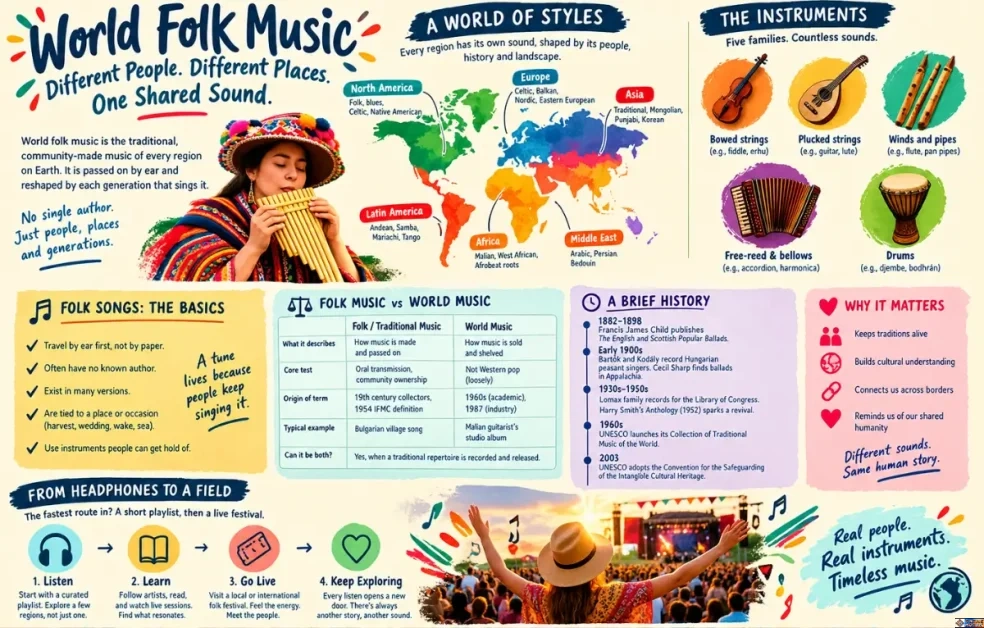
The best-known definition is also one of the oldest. In 1954 the International Folk Music Council, now the International Council for Traditional Music, described folk music as music shaped by oral transmission. Three forces drive it: continuity, variation and selection. A tune lasts. People change it. The community keeps what suits it and drops the rest.
That’s the engine of world folk music. Nobody sits at the centre. “Barbara Allen” survives in hundreds of versions, and no version is the “real” one.
A working checklist helps:
- It travels by ear first, and paper comes later if at all.
- It belongs to a community, often with no named author.
- It exists in variants, because every singer edits.
- It’s tied to a place or an occasion: a harvest, a wedding, a wake, a ship’s deck.
- It’s played on instruments people could actually get hold of.
I’ll take a stand here. Arguments about “authenticity” tire me. A tune doesn’t turn fake because someone wrote it down, plugged it in or sold it. What matters is whether people picked it up and made it theirs.
2. What Is the Difference Between Folk Music and World Music?
Folk music is a description of process. World music is a marketing decision. The term was used in academic circles in the 1960s, but the version you see in shops came from a 1987 meeting of record labels, DJs and promoters in London. They wanted one banner to put over music that didn’t fit a Western chart. It worked commercially. It also flattened a thousand traditions into a single bin.
Put plainly, world folk music is the overlap: traditional repertoires from outside the Anglo-American mainstream, plus the artists who carry them forward.
3. How Did World Folk Music Get Here? A Short History
Folk songs are older than any archive. For most of history nobody wrote them down, because nobody needed to. Then collectors arrived with notebooks, and later with machines.
Francis James Child spent decades gathering English and Scottish ballads, published between 1882 and 1898 as The English and Scottish Popular Ballads. He numbered 305. In the first years of the 1900s Béla Bartók and Zoltán Kodály took phonograph cylinders into Hungarian villages and recorded peasant singers. Cecil Sharp, working with Maud Karpeles, found English ballads still alive in the Appalachians and published them in 1917.
Alan Lomax, working with his father John and then on his own, recorded for the Library of Congress from the 1930s. His field archive is now searchable online as the Global Jukebox. In 1952 Harry Smith’s Anthology of American Folk Music repackaged 1920s commercial recordings for a new audience, and it helped seed the 1960s revival. Meanwhile UNESCO began issuing its Collection of Traditional Music of the World in the early 1960s. In 2003 it adopted the Convention for the Safeguarding of the Intangible Cultural Heritage, which treats oral traditions and performing arts as heritage worth protecting.
Festivals carry those old layers forward. I’ve traced some of the deeper roots in Ancient roots of modern festivals. The ritual side of the story sits in Traditional World Festivals Cultural Heritage.
4. What Are the Most Common Folk Instruments Worldwide?
Strip away the national labels and world folk music instruments sort into a handful of families. The instruments below show up again and again.
The wildcard: the jaw harp. It’s tiny, it’s held against the teeth, and versions of it turn up from Siberia to the Alps to Southeast Asia. It’s the most underrated folk instrument I can name.
5. Traditional Music Around the World: Regional Styles of World Folk Music
Every region’s world folk music has a recognisable accent. Treat these as signposts rather than borders.
Europe. Modal ballads and dance tunes dominate the British Isles and Ireland. Further east, tight polyphony takes over, in Georgian and Bulgarian singing especially. Scandinavia offers fiddle and the Finnish kantele.
Africa. Call-and-response, layered rhythm and the West African griot tradition shape much of the continent’s folk music. The kora is the signature voice.
The Americas. Andean panpipes and charango, Appalachian ballads, Mexican son jarocho and Caribbean rhythms all grew from Indigenous, European and African meetings. The roots of Latin American folk song are celebrated each year at gatherings like the Latino Cultural Festival.
The Middle East and Asia. Maqam modes and the oud anchor the Arab world. In Turkey the aşık bards sing with the saz. Bengal has the wandering Baul singers. China has the erhu and regional opera-song traditions.
Oceania. Aboriginal Australian songlines carry map-like knowledge in melody, and the didgeridoo has been played for a very long time in northern Australia. Hawaiian slack-key guitar grew from a local reworking of imported guitars.
Several of these traditions sit on UNESCO’s Intangible Cultural Heritage lists, including the Baltic song and dance celebrations. If you want the festival side of the map, Ethno Cultural Festivals Heritage and the Global Cultural Festivals Guide are the places to start. Sacred repertoires get their own treatment in Religious Festivals in the World. Dance and the body are where this music lives, and I’ve written about that in Ancestral Somatic Rituals 2026.
6. World Folk Music Artists, Composers and a Starter Playlist
A short list of world folk music artists to know: Toumani Diabaté and Ali Farka Touré (Mali), Mercedes Sosa and Violeta Parra (Argentina and Chile), Altan (Ireland), Värttinä (Finland), Tinariwen (the Sahara) and Lankum (Ireland). For social proof, Diabaté and Touré’s In the Heart of the Moon won a Grammy in 2006 for Best Traditional World Music Album.
Then there are the world folk music composers, the classical writers who borrowed from the village. Bartók and Kodály are the obvious pair. Add Ralph Vaughan Williams in England, Antonín Dvořák in Bohemia and Percy Grainger, who recorded English folk singers on wax cylinders.
Here’s a world folk music playlist to start with:
- Violeta Parra, “Gracias a la vida”
- Mercedes Sosa, “Todo cambia”
- Ali Farka Touré & Toumani Diabaté, In the Heart of the Moon (album)
- Le Mystère des Voix Bulgares (the album series)
- Fairport Convention, “Matty Groves”
- Márta Sebestyén, “Szerelem, szerelem”
- Wildcard: “Izlel je Delyo Haydutin,” sung by Valya Balkanska. It’s a Bulgarian folk song, and it’s on the Voyager Golden Record, now far outside the solar system
- Wildcard: Wander Lomax’s Global Jukebox by region, with no plan at all
7. Why Is Folk Music So Often Tied to Politics?
Because songs are the cheapest printing press ever built. They’re free to learn and hard to censor. A crowd can sing one together, and singing together is a form of agreement.
Woody Guthrie and Pete Seeger tied American folk song to labour and civil rights. In Chile, Víctor Jara sang for the Nueva Canción movement and was killed after the 1973 coup, which tells you how seriously power took a guitar. In Estonia, the song-festival tradition helped power the “Singing Revolution.” In 1988 roughly 300,000 people gathered at the Tallinn Song Festival Grounds.
Politics doesn’t only run one way. Nationalist movements have also borrowed folk music, sometimes by cleaning it up and editing out the inconvenient verses. I think that’s the reason to treat folk songs as living arguments rather than museum pieces.
The science of why singing in a crowd bonds strangers is laid out in The Somatic Architecture of Collective Ritual.
8. What Is Modern Folk Music?
Modern folk music is music rooted in folk forms or folk values but made by named artists, usually recorded and often amplified. It runs from 1960s folk-rock (Fairport Convention, Bob Dylan’s electric turn at Newport in 1965) to today’s contemporary acts like Laura Marling, Fleet Foxes and Lankum, and on to fusion records that pair traditional instruments with electronics.
The line between traditional and modern is blurrier than purists want. A tune from a Child ballad, rearranged and recorded last year, is still carrying a chain of singers behind it. Modern world folk music keeps the tradition on the move.
Scale matters here too. The money these gatherings generate is part of why small folk festivals survive, and the numbers get their own look in What Is the Economic Impact of Music Festivals.
9. Where Can You Hear World Folk Music Live?
Recordings are the map. A festival is the territory.
- Cambridge Folk Festival (England): running since 1964.
- Rudolstadt Festival (Thuringia, Germany): a big international meeting point for the world folk music scene.
- Festival Interceltique de Lorient (Brittany): founded in 1971, a Celtic-nations gathering.
- Fleadh Cheoil na hÉireann (Ireland): run by Comhaltas Ceoltóirí Éireann, first held in 1951.
- WOMAD: founded in 1982 and tied to Peter Gabriel, a pioneer of the “world music” circuit.
- Wildcard: Sweden’s Falun Folk Music Festival. Very few outsiders know it, and I think that’s an advantage.
For UK listings, Best UK Folk Festivals is the best place to begin. If you like your music with spectacle, look at cultural light festivals. For the stranger end of the spectrum, there’s Unique cultural festivals. The biggest names are ranked in Top 20 Biggest Festivals in the World. For a 2026 calendar, check Festivalle 2026. If you’d rather build a whole trip around one, Event-Centered Escapes is for you.
Don’t wait, though. The UK folk circuit has already lost loved names. Towersey Festival closed in 2024, and its story is told in the folk-festival guide. Small festivals vanish when people say “next year.” Go this year.
When you do, travel lightly. Festival fields are temporary communities, a point explored in Ephemeral Social Infrastructure. The mess they leave behind is covered in The Post Concert Hangover, and the better model is described in Regenerative Festival Culture. Take your own cup. Respect the quiet stage.
To go deeper into the sound itself, World Folk Music is a good place to keep listening. Somewhere tonight, a fiddler is changing a tune that three hundred years of players changed before her.
Frequently Asked Questions About World Folk Music
What is world folk music?
It is the traditional music of communities across the globe, passed on by ear and varied by each performer. It covers everything from Appalachian ballads to West African kora music. Today the term also takes in contemporary artists who build on those traditions.
What is the difference between folk music and world music?
Folk music describes a process: oral transmission, community ownership, variation. World music is a retail category introduced in the 1960s academy and popularised by the industry in 1987. A Bulgarian village song is folk music. A studio album by a Malian guitarist might be filed as world music, and may be both.
What are the most common folk instruments worldwide?
Fiddles, plucked lutes and harps (oud, kora, charango, bouzouki), bagpipes and other pipes, accordions and hand drums are the usual suspects. Almost every culture also has a jaw harp or a simple flute. Which ones dominate depends on materials, trade routes and history.
Why is folk music so often tied to politics?
Folk songs are easy to learn, free to share and hard to control. They carry memory and let large groups sing together, which builds solidarity. That’s why movements from the American labour struggle to Chile’s Nueva Canción to Estonia’s Singing Revolution have leaned on them.
What is modern folk music?
It is music that keeps folk forms, instruments or values but is made by identifiable artists and usually recorded. Folk-rock, contemporary acts like Lankum and Laura Marling, and fusion projects all fit. The tradition stays in the room, even when the amplifiers come out.
Sources
- International Council for Traditional Music (ICTM), history and definition of folk music: https://www.ictmusic.org/
- UNESCO, Convention for the Safeguarding of the Intangible Cultural Heritage (2003): https://ich.unesco.org/en/convention
- UNESCO, Baltic song and dance celebrations: https://ich.unesco.org/en/RL/baltic-song-and-dance-celebrations-00087
- Smithsonian Folkways (UNESCO Collection; Anthology of American Folk Music): https://folkways.si.edu/
- Library of Congress, American Folklife Center (Lomax field recordings): https://www.loc.gov/folklife/
- Association for Cultural Equity, the Global Jukebox: https://theglobaljukebox.org/
- NASA/JPL, Voyager Golden Record: https://voyager.jpl.nasa.gov/golden-record/
- Vaughan Williams Memorial Library (Cecil Sharp collections): https://www.vwml.org/
- The Recording Academy, Grammy Awards archive: https://www.grammy.com/
- WOMAD: https://womad.co.uk/
- Child, F. J. (1882–98). The English and Scottish Popular Ballads.
- Sharp, C. and Karpeles, M. (1917). English Folk Songs from the Southern Appalachians.
- Grove Music Online, “Folk music,” “Bartók, Béla,” “Kodály, Zoltán”: https://www.oxfordmusiconline.com/grovemusic