
 By Dr. Marcus Hale
Quick Summary
The ancient Egyptian mummy tattoo is real, and the proof is preserved on the bodies themselves. The oldest known examples sit on two naturally mummified bodies from Gebelein, held by the British Museum and dated to roughly 3351–3017 BC: a wild bull and a Barbary sheep on a man’s arm, and S-shaped marks on a woman’s shoulder. About a thousand years later, a Hathor priestess named Amunet carried dotted patterns on her abdomen and thigh, while infrared scans at Deir el-Medina revealed tattoos on seven women—one of them bearing more than 30 distinct marks.
Far from simple decoration, these markings point to spiritual protection, ritual power, fertility, and social status. Below, you will find what each archaeological discovery reveals, what the documented symbols likely meant, and how to translate authentic ancient iconography into a modern tattoo design that honors the historical source instead of copying a cliché.
Search for an ancient Egyptian mummy tattoo and the results are a mess. Cartoon bandage men. Skull-faced pharaohs. Stock “hieroglyphs” that read as nonsense to anyone who can actually read them.
If you love history, that is maddening, because you came for what archaeologists really found. If you are thinking about getting inked, it is worse. A design built on cliché turns into a regret you carry on your skin for decades.
Here is the good news. The real evidence is stranger and better than the cliché. Researchers have photographed it with infrared light, and the ancient Egyptian mummy tattoo finds at Deir el-Medina rewrote what we thought we knew. I will walk you through each discovery, decode the symbols, and then design a piece that is respectful, powerful and built to last.
One note on voice. I am a tattooer who reads archaeology, not an Egyptologist, and I have no client stories to dress this up with. Every factual claim below traces to the sources at the end. Where scholars disagree, I will say so.
1. Egyptians Really Did Wear Tattoos, and Mummies Prove It
So what counts as an ancient Egyptian mummy tattoo? Pigment set into the dermis, not paint sitting on the surface. Did ancient Egyptian mummies have tattoos? Yes. For a long time the honest answer was “barely.” Before the infrared work at Deir el-Medina, researchers had identified only six Egyptian mummies with tattoos across roughly a century of fieldwork, and most of those were plain dots and dashes.
Why so few? Partly because tattoos hide. Mummification resins darken skin until ink and flesh blend into one dark surface, and the shrunken skin of a 3,000-year-old body distorts everything. Infrared light looks deeper into skin than visible light does, so carbon-based ink suddenly stands out like a pen mark on tracing paper.
A quick vocabulary note, because it matters here. A “mummy” can be a body that embalmers treated, or a body the desert preserved by accident. We will meet both kinds. If you want the wider picture, What Is Mummy in History? covers the definitions, and Ancient Egyptian mummification process history walks through the embalming workshop.
Did ancient Egyptian people have tattoos while they were alive? Of course, since every mummy was once a living person. The better evidence comes from art. Middle Kingdom faience figurines carry dotted patterns across the abdomen and thighs, and New Kingdom images show small figures of the god Bes on women’s thighs.
2. The Oldest Ink Sits in the British Museum
Picture a shallow desert grave near Gebelein, about 40 kilometres south of modern Luxor, some 5,000 years ago. No embalmers. No linen cocoon. Just dry sand, salt and heat doing the preserving.
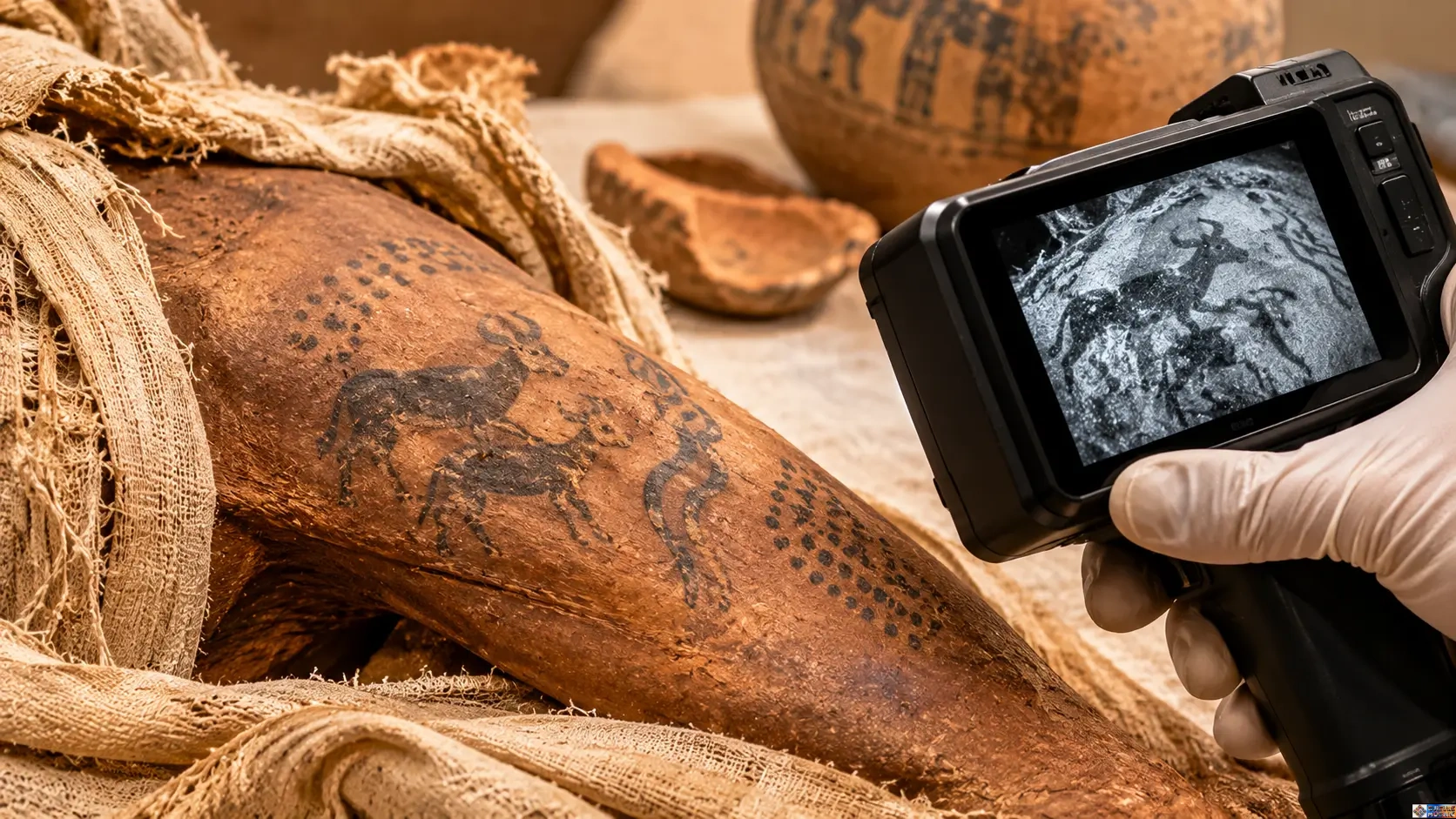
That is how a group of bodies survived to be dug up around 1900, and they have been in the British Museum ever since. In 2017 and 2018 a team led by the museum’s Daniel Antoine and Oxford’s Renée Friedman re-examined two of them with infrared imaging, CT scanning and radiocarbon dating. The results, published in the Journal of Archaeological Science, dated the pair to about 3351–3017 BC.
On the man’s upper right arm: a wild bull with a long tail and sweeping horns, overlapping a Barbary sheep. On the woman: four small S-shaped marks down her right shoulder, plus an L-shaped line on her abdomen that researchers read as a staff, or possibly ritual clappers. The pigment was carbon-based, probably soot, set into the dermis.
Why does it matter? The Gebelein pair hold the record for the oldest figurative ancient Egyptian mummy tattoo anyone has documented, and these are the world’s oldest figurative tattoos, meaning they depict recognizable things. The famous Ötzi the Iceman is a little older, but his marks are geometric lines. The find also overturned the idea that only women were tattooed in predynastic Egypt.
Antoine links the bull to status and virility. Friedman floats a different reading for the man: badges of bravery or skill. For the woman, she suggests marks tied to cult knowledge, the kind you earn by learning the right movements and spells. Nobody can prove any of it. I find that honest uncertainty more convincing than a neat answer.
CT scans add a human sting. The man was in his early 20s, and damage to a shoulder and rib suggests he died from a stab wound to the back. If forensic detective work on ancient bodies hooks you, read How Did King Tut Die and Why next. For how old mummies really are, there is How Old Are Most Egyptian Mummies?, and Where Were Ancient Egyptian Mummies First Buried? explains why desert graves like Gebelein’s preserved so much.
My opinion, as someone who draws for a living: the bull is the first thing I would pin to a mood board. Heavy horns, clean silhouette, instantly readable. A design that reads from across a room has already survived 5,000 years of fashion.
3. Dots and Dashes Marked a Priestess of Hathor
Jump forward roughly a thousand years. In 1891, Eugène Grébaut’s team opened tombs at Deir el-Bahari, across the river from Luxor. Among the burials lay Amunet, an 11th Dynasty priestess of the goddess Hathor whose titles included “King’s Favorite Ornament.”
Her skin carried pinpricks and lines. Rows of dots and dashes formed an elliptical pattern across her abdomen. A lattice of dotted diamonds sat on her right thigh. More marks ran along an arm, a shoulder and a breast. Two other women buried nearby had similar patterns.
Those patterns match the dotted decoration on Middle Kingdom faience figurines, which is how scholars connected figurines, bodies and ritual. Some read the abdominal net as a fertility or childbirth charm, and one idea holds that the pattern would stretch like netting during pregnancy. Others link the women to Hathor’s musicians and dancers. A third camp sees a Nubian tattooing tradition behind the dots. The truth is that all three can be partly right.
The 1891 discovery also had a theatrical afterlife: a painting shows a mummy from the same site being unwrapped before a gathering of scholars and spectators. That public-spectacle era gets its own treatment in Victorian mummy unwrapping. For how a priestess of Amunet’s rank was laid to rest, see Ancient Egyptian burial customs.
4. Infrared Found 30 Tattoos on One Woman at Deir el-Medina
In 2014, archaeologist Anne Austin of the University of Missouri–St. Louis held an iPad rigged with an infrared camera over a mummified torso. It was a long shot. She did not expect it to work.
It worked. The camera revealed a swath of tattoos that the naked eye could not see.
The torso came from Deir el-Medina, the village of artisans who cut and decorated the royal tombs in the Valley of the Kings. Dated to roughly 1300–1070 BC, it was headless and armless. At first Austin thought the markings on the neck were paint. Infrared showed more than 30 tattoos, some on skin so darkened by mummification resin that no one had noticed them. Austin and Cédric Gobeil then digitally stretched the images to correct for the skin’s shrinkage, and published the case in 2016 under a title I love: “Embodying the Divine.”
Further work brought the count to seven tattooed mummies from the site. All seven were women. The designs include protective eyes, crosses, a bent papyrus plant with water, and on another woman a seated baboon on each side of the neck. One neck hieroglyph reads “to do good,” and Austin suggests it may have lent power to the woman’s voice when she sang or spoke. Her wider argument is that the tattoos helped mark this woman as a religious practitioner, someone with a role in magic, medicine and ritual.
Austin is careful about the limits. She has said she can find no discernible pattern across the tattoos found so far, and infrared cannot see through intact linen wrapping. That second point is why virtual unwrapping Egyptian mummies matters: scanners may reveal tattoos on bodies we will never physically unwrap.
That is why every new ancient Egyptian mummy tattoo find carries more weight than its size suggests. To picture the village these women lived in, start with What was everyday life in ancient Egypt. For the resins that blackened their skin, see Ancient Egyptian Mummies Preservation Techniques, and for the tombs those workers carved, Secrets of the Mummy’s Tomb.
Four Chapters of Tattoo Evidence, Side by Side
I have added one famous outsider, the Pazyryk of Siberia, because searchers often confuse the two. Pazyryk mummy tattoos are not Egyptian. They come from Iron Age nomads of the Altai Mountains, roughly the 4th to 3rd centuries BC, whose bodies froze in permafrost. They are useful as a contrast: where Egypt gives us sparse, quiet evidence, the Pazyryk gave us sleeves of leaping griffon-stags that the excavator called among the most complex tattoos ever found. A 2025 study of one woman’s forearms, done with help from modern tattooers, found far more detail on the right arm than the left, which suggests skilled craft rather than casual marking.
| Group | Date | Where | Designs Found | Who (As Far As Known) |
|---|---|---|---|---|
| Gebelein mummies | c. 3351–3017 BC | Upper Egypt | Wild bull, Barbary sheep, S-shapes, L-shaped line | One man, one woman |
| Amunet and neighbours | 11th Dynasty | Deir el-Bahari | Dots, dashes, diamond lattice | Priestess and two other women |
| Deir el-Medina mummies | c. 1300–1070 BC | Deir el-Medina | Eyes, baboons, hieroglyphs, 30+ marks on one body | Seven women |
| Pazyryk (not Egyptian) | 4th–3rd c. BC | Altai, Siberia | Griffon-stags, leopards, roosters | Men and women |
Original chart: date ranges as given in the cited studies. Ötzi and the Pazyryk are shown for comparison only.
5. Mostly Women, and Not What the Old Textbooks Claimed
Who got tattooed in dynastic Egypt? Almost everything we have is female. All seven Deir el-Medina mummies were women, and the figurines are invariably female. The Gebelein man is the exception, and he lived before Egypt had pharaohs.
Early Egyptologists looked at those women and drew an ugly conclusion: tattoos belonged to dancers, servants and prostitutes. That story stuck for a century. Then Amunet, a priestess with royal titles, wrecked it. Austin adds another point I find compelling: the village texts that call women prostitutes and servants were written by men. The bodies tell a different story, and she argues they point to many more functions than sex.
Elite women in Egypt held real power, and the Seti I Wife is a good place to see how much.
So why? The strongest candidates, and they can overlap:
- Protection, shown by the eyes and by Bes, guardian of women in childbirth and of children.
- Fertility and safe birth, suggested by abdominal nets and thigh marks.
- Ritual role, suggested by Austin’s priestess-practitioner reading and Friedman’s clapper-and-cult-knowledge reading of the Gebelein woman.
- Status or bravery, the favored reading for the Gebelein man’s bull.
- Healing, a possibility for some tattoos in other ancient cultures, including Ötzi’s joint-hugging marks.
How were they made? The pigment was carbon black, probably soot. For tools, a few pointed implements in London’s Petrie Museum are candidates for tattoo needles, but without residue testing nobody can confirm it. The common line that Egyptians used bronze needles is an inference, not a proven fact. The nearest modern cousin, in my professional view, is hand-poking: slow, rhythmic, one puncture at a time.
6. Symbols and Meanings: What Each Mark Probably Said
Here is the scannable version of every ancient Egyptian mummy tattoo symbol in the record, with an honest confidence rating. Meanings are scholarly interpretations, not translations of a tattoo manual, because none survives.
| Symbol | Where Documented | Likely Meaning | Confidence |
|---|---|---|---|
| Stylized eyes (wadjet-type) | Deir el-Medina, neck and shoulder | Protection | High |
| Seated baboon | Deir el-Medina, either side of one neck | Baboons were sacred to Thoth; exact intent unknown | Low |
| “To do good” hieroglyph | Deir el-Medina, neck | Blessing or power for the voice (Austin’s suggestion) | Medium |
| Bent papyrus with water | Deir el-Medina, shoulder | Reading not settled in the reports I found | Low |
| Bes figure | Thighs, in New Kingdom art; a Nubian mummy at Aksha | Protection in childbirth, fertility, sexuality | Medium |
| Dots, dashes, diamond lattice | Amunet, abdomen and thigh | Fertility, protection of pregnancy | Medium |
| Wild bull | Gebelein man | Status, virility | Medium |
| Barbary sheep | Gebelein man | Poorly understood | Low |
| S-shaped motifs | Gebelein woman, shoulder | Echo pottery decoration; meaning unknown | Low |
| L-shaped line | Gebelein woman, abdomen | Staff or ritual clappers; cult knowledge | Low–Med |
Notice what is missing. None of the sources I reviewed report an ankh, a scarab or mummy wrappings as tattoos. Those icons belong to amulets and burial gear. Using them in a tattoo is a modern design translation, a perfectly legitimate one, as long as you do not claim it is a copy of a tattoo found on a body.
Animals mattered across this whole belief system, influencing everything from spiritual emblems to green mummies Egyptian afterlife facts. Our piece on Ancient Egyptian animal mummies shows how far that reverence went.
Is an Anubis tattoo good or bad?
Neither, in Egyptian terms. Anubis was the jackal-headed god tied to embalming and cemeteries, a guardian and guide, not a menace. No mummy tattoo in the sources I reviewed shows Anubis, so an Anubis piece is a modern choice drawn from tomb art, not a copy of a known body. Protective, not sinister. The real risk is a lazy stock image.
What does an ancient Egyptian mummy tattoo mean today?
It splits into two meanings. One is a tattoo copied from marks found on mummies, which carries the ancient layers of protection, ritual and status. The other is imagery of mummification, which usually speaks about mortality, preservation and memory. My advice: pick one story and make every element serve it.
7. How I Would Design Your Ancient Egyptian Mummy Tattoo
You want something authentic, striking and not a cartoon. Here is the concept I would hand to a client, built only from documented iconography plus clearly labeled modern additions.
The concept: “The Bound Eye”
A long vertical panel of diagonal linen-wrap linework, drawn the way real bandage layers overlap, with each strip following the curve of the limb. The wrapping splits open near the middle like a window, and in that window sits a stylized eye of the kind documented on the Deir el-Medina necks. Below the eye, a single “to do good” hieroglyph and a narrow band of Amunet-style dots and dashes. A small scarab at the top and a tiny ankh tucked into a bandage fold finish it.
Think in proportions for this ancient Egyptian mummy tattoo: the eye gets about half the visual weight, the wrapping about a third, the glyph and dotted band most of the rest, and the scarab and ankh just a whisper. Restraint is what keeps it from looking like a souvenir.
Placement: three solid choices and one strange one
- Outer upper arm, running toward the elbow. My pick. Long, stable, moderate sun exposure, and the vertical shape suits the bandage flow.
- Outer calf. Another long canvas, easy to see, less sun than the forearm.
- Shoulder blade. Broad and flat, close to where the Gebelein woman’s S-marks sat.
- Wildcard: top of the thigh. That is where the Bes tattoos in Egyptian art were placed. Private, historically grounded, and an unusual story to tell.
Style: three standard routes and one weird one
- Blackwork illustration. My recommendation. The ancient pigment was carbon black, so black ink is the most honest choice, and bold black ages well.
- Realism. Gorgeous at first, but soft grey shading can fade into mush over the years, especially under sun.
- Neo-traditional. Strong outlines and limited color, good if you want warmth and a more graphic look.
- Wildcard: hand-poked dotwork. It echoes Amunet’s pinpricks. Slower and subtler, with a texture machine work rarely matches.
If you want something stranger still, ask about an “infrared ghost” version: very fine, pale linework that reads faintly in daylight, like the hidden tattoos that only infrared could reveal. Be warned that faint work ages worst, so it needs to be larger and denser than your instinct suggests.
Size and detail
Aim for roughly 18–22 cm tall and 9–11 cm wide, with the eye at least 6 cm across and any hieroglyph at least 2.5 cm tall so it stays legible. Leave generous gaps between line groups, about 2 mm or more. These are widely used rules of thumb, not guarantees, and your artist’s judgment of your skin comes first.
Making it age well
Use two or three line weights and let the outer contour be the boldest. Prefer open stipple or whip shading to big smooth greys. Skip tiny text and hairline details, which blur as ink settles. Protect it from sun for life, and book a touch-up after it heals if any line looks thin.
Get the hieroglyphs right
Check reading direction and which way the signs face, because Egyptian signs face the beginning of the line. Never mirror a glyph to make a layout symmetrical. Ask a museum collection or an Egyptologist to confirm the sign and its meaning before it is stenciled. And treat the source with care: these were real people, and the best tribute leaves out gore, jokes and bare skulls.
Before you book
- Bring two or three sources, such as the Smithsonian piece or a museum page, not a Pinterest board.
- Ask to see healed work in the style you want, not just fresh photos.
- Get the stencil placed and look at it in a mirror, moving, for at least ten minutes.
- Sleep on it for a week. A good tattooer will not mind.
Great artists tend to book weeks out, and the research keeps growing, so the moment to brief someone well on your ancient Egyptian mummy tattoo is before you are in a hurry. Somewhere under a layer of resin-blackened skin, a woman from Deir el-Medina carried an eye on her neck for reasons she never wrote down. That is the standard I would hold any design to—and the kind of depth we explore every day at Culture mosaic.
Frequently Asked Questions
Did ancient Egyptian mummies have tattoos?
Yes. The earliest known examples are on two naturally preserved mummies from Gebelein, dated to roughly 3351–3017 BC and held by the British Museum. Infrared scanning later found tattoos on seven mummified women from Deir el-Medina, one with more than 30 marks. Before that work, only about six tattooed Egyptian mummies were known, so the list is still short and growing.
Did ancient Egyptian people have tattoos in everyday life?
The evidence says yes, at least for some people. Middle Kingdom figurines show dotted patterns on the abdomen and thighs, and New Kingdom art shows Bes figures on women’s thighs. Mummies confirm that real women, including a priestess named Amunet, wore them. We lack texts explaining the practice, which is why interpretations still vary.
Is an Anubis tattoo good or bad?
It is not bad. Anubis was a protective god of embalming and cemeteries in Egyptian belief, a guide for the dead and a guardian of the body. No tattooed mummy in the research I reviewed shows Anubis, so any Anubis tattoo is a modern interpretation drawn from tomb art. Choose a source image from a museum rather than clipart.
What does a mummy tattoo mean?
Ancient mummy tattoos likely meant protection, fertility, ritual power or status, depending on the person and the period. A modern mummy tattoo can carry those meanings, or it can speak about mortality, memory and preservation. The honest answer is that meaning is yours to define, as long as you do not misstate what ancient tattoos actually showed.
Were ancient Egyptian tattoos only for women?
Mostly, in the dynastic period. All seven Deir el-Medina mummies were women, and tattooed figurines are female. But the Gebelein man, from about 5,000 years ago, carried a bull and a sheep, so men were tattooed earlier on. Researchers also stress that old claims linking tattoos only to prostitutes do not hold up, because a priestess like Amunet wore them too.
Sources
- Austin, A. and Gobeil, C. (2016). “Embodying the Divine: A Tattooed Female Mummy from Deir el-Medina.” Bulletin de l’Institut français d’archéologie orientale 116, pp. 23–46. journals.openedition.org/bifao/296
- Friedman, R., Antoine, D. et al. (2018). Natural mummies from Predynastic Egypt reveal the world’s earliest figural tattoos. Journal of Archaeological Science. Coverage: NPR and National Geographic
- Smithsonian Magazine, “Infrared Reveals Egyptian Mummies’ Hidden Tattoos”
- Nature news: Hidden tattoos on Egyptian mummies
- University of Missouri–St. Louis: Anne Austin’s discovery and Digging for the Truth
- St. Louis Public Radio: Archaeologist photographs tattoos of ancient Egyptian women
- UCL Researchers in Museums: Egyptian tattooing
- World History Encyclopedia: Tattoos in Ancient Egypt
- Caspari, G. et al. (2025). High-resolution near-infrared data reveal Pazyryk tattooing methods. Antiquity. Cambridge Core
- Archaeology magazine: Iron Age mummy, Pazyryk
- ABC News: Siberian mummy has detailed tattoos
- CBS News: Oldest tattoos from Egypt
 Culture Expert