
 By Culture Expert
Vegan Silk Wedding Dress: The Honest Guide to Cruelty-Free Bridal Fabrics
A true vegan silk wedding dress contains nothing from a silkworm. The honest shortlist is smaller than the marketing suggests, so here is the answer up front.
- Vegan silk means a silk-look fabric made from plants (lotus, pineapple leaf, citrus by-products, wood pulp, cotton linter) or from synthetics. No insects are involved.
- Peace (Ahimsa) silk lets the moth leave the cocoon before harvest. It is gentler, but it is still an insect product, so vegan organisations do not count it as vegan.
- “Vegan silk” on a tag often means polyester satin. It is animal-free, but it is plastic. Read the fibre-content label, not the product name.
- Best for a full gown: TENCEL lyocell, cupro and well-made recycled satin. Best for heirloom details: lotus and piña, which are rare, handwoven and usually used for veils, shawls, panels or bespoke work.
- Before you pay a deposit: ask what the shell, lining, lace, thread, buttons and trims are made of. The “Eight Questions” section below gives you the exact list.
If you read only one thing: the word “vegan” on a gown tells you very little. The fibre list tells you everything.
The Polyester Trap: Why Finding a Vegan Silk Wedding Dress Feels Harder Than It Should
Picture the search. You want a gown that moves like silk but harms no animal. You scroll past hundreds of listings tagged “vegan silk,” the satin gleams, the price looks kind, and you start to relax. Then you check the fibre label and it reads 100% polyester.
That is the pain point, and it is common. Polyester and nylon are technically vegan, and PETA lists polyester microfibre among vegan silk options. But the UK charity Viva! points out that these fabrics involve heavy chemical processing and dyes. A gown can be cruelty-free and still sit badly with the reason you went looking for a gentler fabric in the first place.
The second trap is the opposite one. Some “cruelty-free silk” is real silk. A wedding blog once presented a non-violent silk crepe de chine slip as a vegan wedding dress, which shows how easily the two ideas blur together.
You are not being fussy by asking questions. In the United States, the Federal Trade Commission’s Textile Fiber Products Identification Act requires fibre content to be disclosed on labels, and treats misbranding as unlawful. Rules differ by country, but the principle travels: the label is your evidence.
The good news is that real botanical silks exist, and a small group of designers use them well. For a wider round-up of options, see our guide to vegan silk alternatives 2026. Now let’s sort the genuine from the glossy, starting with what the term means.
What Is Vegan Silk Made Of?
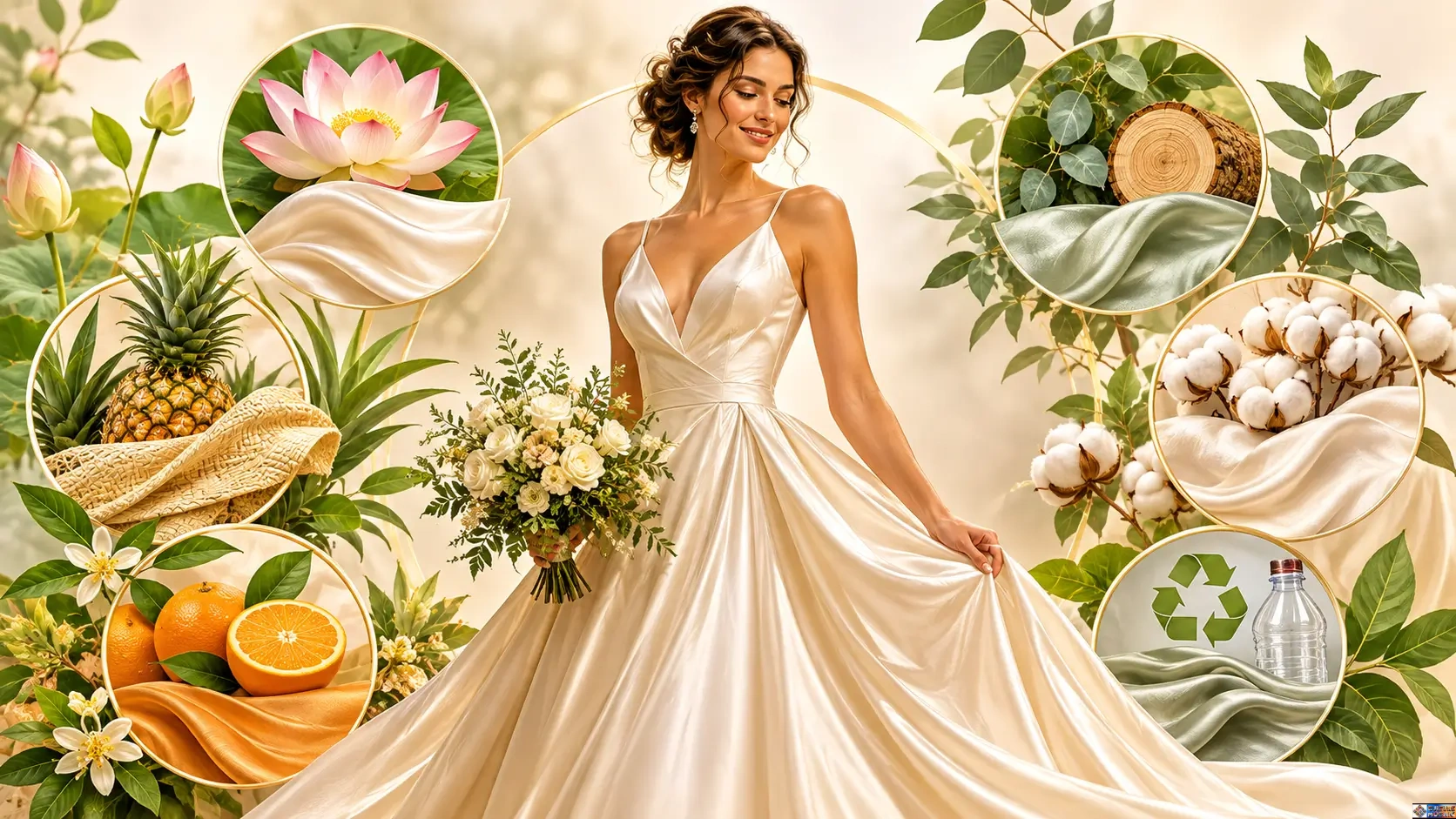
Vegan silk is a family of fabrics, not one material. PETA’s guide names cactus-based fabrics, cupro (made from cotton linter, a cotton by-product), TENCEL lyocell, ramie, rayon and viscose from wood pulp, and polyester microfibre. For brides, five plant-based routes matter most:
- Lotus fibre: threads pulled by hand from lotus stems and woven into cloth.
- Piña: fibre scraped from pineapple leaves and handwoven into a sheer, ivory cloth.
- Orange Fiber: cellulose extracted from citrus juice by-products and spun into a silky yarn.
- TENCEL lyocell: wood pulp dissolved and spun in a closed-loop process, with more than 99% of the solvent recovered and reused.
- Cupro and bamboo-style viscose: regenerated cellulose with a fluid, silky hand.
One note on terms: “silk-like” does not mean “sustainable.” Viscose and rayon can be made with far more chemistry than lyocell, and recycled polyester still sheds microplastics. For the bigger picture on resource use, see our piece on the water footprint of global threads and textiles.
Can Vegans Wear Silk?
Most vegans do not. PETA says conventional silk is made by boiling or gassing silkworms inside their cocoons, and estimates that about 3,000 are killed to make one pound of raw silk. The Vegan Society’s definition, as quoted by Viva!, excludes products that involve animal exploitation and cruelty as far as is practicable. Silk falls on the wrong side of that line.
Some vegans make exceptions for second-hand or inherited silk, on the logic that buying it does not fund new production. That is a personal call, and it is worth knowing it exists if a family gown is on the table.
Ahimsa Silk vs Vegan Silk: What Is the Real Difference?
Ahimsa silk, also sold as peace silk, comes from the Sanskrit word for non-violence. Cocoons are harvested after the moth has emerged, so the larva is not boiled inside. Panaprium credits Hyderabad-based handloom technologist Kusuma Rajaiah with inventing the method in 1991, and the Wandering Silk project describes it as a small-scale Indian cottage industry that supports rural women farmers, spinners and weavers.
So why is it not vegan? Three reasons come up repeatedly:
- It is still an animal product. Vegan organisations treat any insect-derived fibre as animal use.
- The moths are still bred and discarded. Beauty Without Cruelty India argues that each punctured cocoon represents a moth that suffers and dies, and says the product cannot be called vegan or ethical.
- Scale and welfare are contested. Critics, including PETA, call “peace silk” labels humanewashing, while supporters say the practice is a real step toward less harm.
My straightforward reading: peace silk is a legitimate less harmful silk choice for some brides, and it is not a vegan choice. Both can be true. Just make sure whoever sells you the gown does not use the two words interchangeably.
The Heritage Behind Botanical Silks: Lotus, Piña and Handlooms
These fabrics did not start as fashion trends. They are living crafts, and choosing one means joining a long story. Regenerative textile traditions and the geographic fingerprinting of heritage fibers explain why provenance matters so much.
Lotus silk: Inle Lake, Myanmar
Lotus weaving is young by textile standards. Local reporting by The Irrawaddy says women at Inle Lake began weaving lotus fibre more than 100 years ago, with the industry centred on the villages of Kyaing Khan and In Paw Khone. The fibre itself is finer than a hair, according to a travel writer who visited a workshop, and that workshop produced only around 20 metres of fibre a day. The same account says a kilogram of thread takes about two months.
The scale is humbling. The Irrawaddy reports that one full monk’s robe needs roughly 220,000 lotus stems and about 60 weavers working for more than ten days. This is why Wikipedia’s lotus silk entry describes it as one of the most expensive fabrics in the world, and why it is a cellulose fibre, not a protein fibre like true silk.
A practical note for brides: the same travel writer observed that whole garments from lotus are not very practical, which fits what most designers do. Expect lotus in a shawl, a veil, a bodice panel or a bespoke commission, often blended with something else. If a blend includes real silk, it is not vegan, so ask.
Piña: the pineapple-leaf cloth of Aklan, Philippines
Piña is a Philippine textile made from pineapple leaf fibre and handwoven on a loom. UNESCO inscribed Aklan piña handloom weaving on its Representative List of the Intangible Cultural Heritage of Humanity in 2023. Manila Bulletin reports that the weaving began soon after pineapples reached the islands, and that fibre is scraped from the leaf with porcelain or a coconut shell. Vera Files notes that piña was worn by European aristocracy in the 18th and 19th centuries.
The craft is fragile. BusinessMirror reported that only roughly 150 Aklanons still actively hand-weave piña, down from about 300 at the peak. A Philippine Senate press release adds a crucial detail for vegan brides: piña-seda is piña blended with silk. It is cheaper and lovely, and it is not vegan. Ask for pure piña.
Ahimsa handlooms: India
India’s peace silk story draws on ahimsa, the principle of non-violence that the Wandering Silk project links to Jain ethics. As shown above, it is a meaningful craft and a genuine attempt at gentler production, but it belongs in the ethical silk column, not the vegan one.
Vegan Silk Alternatives Compared: Drape, Shine, Breathability and Cost
Here is the side-by-side view of the best sustainable silk alternatives for brides, set against conventional and peace silk. Origins come from the sources linked in this guide. The “look,” “breathability” and “cost” columns are my own rough assessment from fibre type, not lab tests or price quotes, so treat them as a starting point for your fittings.
| Fabric | Made from | Look and drape | Breathability | Vegan? | Relative cost (£ to ££££££) |
|---|---|---|---|---|---|
| Conventional silk | Silkworm cocoons, larvae killed | Liquid drape, deep glow | High | No | £££ |
| Peace (Ahimsa) silk | Cocoons harvested after the moth leaves | Softer, slightly textured, more matte | High | No (insect-derived) | £££ to ££££ |
| Lotus silk | Lotus stem fibre | Matte, handmade, creamy colour; often blended | High (cellulose) | Yes if pure; check blends | ££££££ |
| Piña | Pineapple leaf fibre | Sheer, crisp-soft, ivory sheen | High, very light | Pure piña yes; piña-seda no | ££££ |
| Orange Fiber | Citrus juice by-product cellulose | Light, silky twill hand | High | Yes if 100%; some collections blend silk | £££ |
| TENCEL lyocell | Wood pulp, closed loop | Fluid drape, soft satin finish possible | High, absorbs moisture well | Yes (check blends) | ££ |
| Cupro | Cotton linter | Smooth, fluid, silky | High | Yes | ££ |
| Ramie / hemp-silk weaves | Plant stem (bast) fibres | Crisper, textured, linen-like | High | Yes | ££ |
| Recycled polyester satin | Recycled plastic | Glossy, structured, holds shape | Low | Yes, but plastic-based | £ |
Three takeaways from the table:
- Drape: lyocell and cupro come closest to silk’s flow at a sane price. Polyester satin holds structure well, which suits ballgowns more than slip dresses.
- Breathability: plant-based cellulose fabrics generally feel cooler. Polyester satin traps heat, which matters for summer or long receptions.
- Cost: the rarer the hand labour, the higher the price. Lotus sits at the top because of how little fibre a weaver can extract each day. Budget separately for fittings and trims.
About Orange Fiber: the Victoria and Albert Museum describes the first commercial garments as made from citrus waste and silk. The European Circular Economy Stakeholder Platform explains that the process extracts cellulose from citrus waste and spins it into yarn. Always confirm that your specific fabric is a 100% citrus-cellulose yarn before calling it vegan.
About TENCEL: Lenzing says its lyocell uses wood from certified or controlled sources and a closed-loop process that recovers 99.8% of the solvent. Its REFIBRA technology can also blend in recycled cotton scraps from garment manufacturing.
Is Silk Good for a Wedding Dress? And What Brand Was Kate Middleton’s?
If we set ethics aside for a moment, silk earns its reputation. It drapes beautifully, feels light on the skin and takes dye and light in a way that looks expensive. The downsides are practical: it can mark with water, it needs careful cleaning and it carries the ethical questions above. So silk is good for a wedding dress on the design side, and a vegan bride simply has to look elsewhere for the same effect.
The question “what brand was Kate Middleton’s wedding dress?” is the best-known example of a satin-and-lace gown. The Royal Household’s own announcement, on royal.uk, confirms the dress was designed by Sarah Burton at Alexander McQueen for the 2011 wedding. Wikipedia’s entry lists satin and lace as the main materials. Press coverage also notes a silk tulle underskirt and a veil of ivory silk tulle, so that gown is not a vegan one.
There is a useful contrast here. When Stella McCartney recreated the Duchess of Sussex’s reception dress for sale, Hello! reported that the replicas would be made in sustainable viscose rather than silk. Same silhouette, different material: proof that a famous look can be translated into a silk-free fabric.
Want to see how bridal symbolism has shifted over time? Explore traditional wedding dress symbolism.
Best Vegan Wedding Dress Brands and Designers to Know
A caution first: collections change, and a brand that is vegan this season may add silk next season. Treat this list as a research starting point and confirm the current fibre content with each maker. I have listed what the sources say and where the information is dated.
- Sanyukta Shrestha (UK, made in Nepal): Love My Dress reports that her 2022 collection, The Vegan Dream, features 23 animal-free gowns made with hand-spun, hand-loomed fabrics. A separate feature lists fabrics such as bamboo, organic cotton, recycled polyester tulle and upcycled corded cotton lace.
- Stella McCartney: The label follows a no leather, fur, skin or feather policy, and its first bridal collection launched in 2018, according to Image.ie. The brand also worked with Bolt Threads on lab-grown Microsilk. VegNews noted at the time that the brand is not fully vegan because it still used wool. At the 2018 launch, Marie Claire UK put prices between £675 and £4,300, so check current ones.
- Whimsy + Row (Los Angeles): Good On You describes its TENCEL and cupro “Shiny Vegan Silk,” produced in Los Angeles. Its dresses are aimed at brides and wedding guests, so ask which styles suit a bridal look.
- Designers PETA has recommended: PETA’s vegan wedding guide names The Cotton Bride, Dalia MacPhee, Morgan Boszilkov, Motasem, Swoon and Tara Lynn as offering cruelty-free gowns.
- Fabric innovators: Orange Fiber (Italy) and the lotus and piña cooperatives above supply cloth rather than finished gowns, which makes them useful for commissions.
- Independent and bespoke makers: A custom route lets you specify every component. PETA’s bridal advice points out that many designers and seamstresses will build a gown to your fabric and design choices.
If you prefer a boutique’s perspective, Edinburgh bridal boutique owner Rachel Snedden writes an “Ask the Expert” column on shopping sustainably for your wedding dress, and it is a good place to start when weighing up a vegan silk wedding dress. Her profile at Heriot-Watt University describes her award-winning Edinburgh shop.
Shopping second-hand or renting a gown is also a lower-impact route, as long as you check the fibre content in the same way.
Eight Questions to Ask Before You Commission or Buy
A gown is built from far more than its main fabric. These questions catch the details that quietly break a vegan promise.
- What is the fibre content of the outer shell, lining and interlining? Ask for it in writing, by percentage. In the US, the FTC’s labelling guidance expects fibre content on most product labels.
- Is any silk, wool, feather or leather used anywhere? That includes the tulle, the veil, the sash, the bodice structure and any trim.
- What are the lace, thread and embroidery made from? Silk thread is easy to miss. Cotton, viscose and polyester threads are common alternatives.
- What about beads, pearls and buttons? Natural pearls and mother-of-pearl come from shellfish. Glass, wood and resin are the usual animal-free choices.
- Are glues, boning and interfacings animal-free? Some adhesives and structural materials can be animal-derived. A good atelier will check with its suppliers.
- If a fabric is a blend, what is the blend? Lotus-silk, piña-seda and some citrus-fibre fabrics can include real silk, as shown earlier.
- Where was the fabric woven, and by whom? You are entitled to traceability. Ask about wages and workshop conditions, and ask for photos or certificates where they exist.
- How long will it take, and how do I care for it? Handwoven and made-to-order fabrics need lead time. Ask for written care instructions and a swatch before you commit.
If the answers are vague, treat that as information. Boutiques that know their supply chain are usually happy to share it.
Customising a Cruelty-Free Gown: Embroidery, Lace Alternatives and Fit
A vegan gown does not have to look plain. The skill is choosing animal-free materials for each layer.
Embroidery: Ask for cotton, viscose or polyester thread instead of silk. Plant-based motifs work especially well on botanical fabrics, and a maker can often stitch them in tone-on-tone thread for a subtle finish.
Lace alternatives: Cotton lace is the classic silk-free choice, and designers such as Sanyukta Shrestha use upcycled corded cotton lace. Recycled lace is another route: The Knot reports a bridal brand whose signature eco lace carries Global Recycled Standard certification. Check that any lace is not silk-blended, and ask about the backing and appliqué thread.
Fit and alterations: Different fibres behave differently under the needle. Fluid cellulose fabrics like lyocell and cupro need careful pressing and neat finishing, while stiffer fabrics such as polyester satin hold pleats and structure. Hand-woven lotus and piña are delicate and are best altered by a seamstress with experience of fine fabrics. Ask who will do alterations and whether they have worked with your chosen cloth. Book at least two fittings, and bring the shoes and undergarments you plan to wear.
Silhouette and colour: Fabric changes the way a silhouette falls. If you are leaning toward a mermaid cut, you will want a fabric with body, while a modern Greek-style gown suits something fluid. Not every bride wants stark white either: The Irrawaddy reports that Inle weavers dye lotus thread with natural materials such as jackfruit, bark and leaves, so a softer tint is a lovely option. Marrying in the cold months? Traditional winter wedding outfits offers layering ideas, and taffeta fabric is worth understanding if you like a crisp finish.
How to Care for and Clean a Vegan Silk Gown
The golden rule is simple: the care label and your maker’s instructions beat any general advice, including this. Different fabrics want different treatment, and several vegan silks are more forgiving than real silk.
- TENCEL lyocell: retailers’ care guides suggest washing cold, air-drying and avoiding high heat, because lyocell can shrink. Homes & Gardens advises always checking the care label first, as blends and linings may need dry cleaning.
- Linings and trims: Cuyana notes that garments are sometimes dry-clean-only because a lining can shrink differently from the main fibre. The same logic applies to a multi-layer wedding gown.
- Lotus and piña: these are fine, handmade cloths. Treat them as heirloom textiles: avoid wringing, strong chemicals and direct sun, and ask your maker for specific instructions.
- Polyester satin: generally sturdier, but check the label and spot-test before cleaning.
Cleaning after the wedding: Move quickly. A care guide syndicated on Yahoo says professional dry cleaning typically costs around $200 to $300, and recommends a cleaner that specialises in wedding gowns. Maggie Sottero gives a wider $250 to $800 range for cleaning and preservation, depending on material, embellishment and soiling. Prices vary by country and gown, so ask for a quote.
The Association of Wedding Gown Specialists’ Sally Lorensen Conant told Celebrate Weddings that a truly clean gown is the foundation of preservation, and that sugary stains such as champagne can be invisible at first. Tell your cleaner exactly what spilled and where.
Storage: Harper’s Bazaar Singapore describes wrapping a cleaned gown in acid-free tissue and storing it in an archival chamber. The Drycleaning & Laundry Institute adds that no storage method fully stops ageing, so check the gown every three to five years.
One eco-friendly extra: ask whether your cleaner offers a gentler wet-cleaning or “green” option, which Cuyana recommends for lyocell where available.
The Verdict: Choose Your Fabric Before You Fall for a Dress
Here is the simplest path through all of this. Decide what “vegan” means to you (no insects at all, or just no killing). Pick the fabric family that suits your climate, budget and silhouette. Then hold every dress, tag and designer to the fibre list.
- Want the closest silk feel at a fair price? Start with TENCEL lyocell or cupro.
- Want a story you can tell your grandchildren? Commission lotus or pure piña accents, and budget extra time and money.
- Want structure and a lower price? Recycled polyester satin works, as long as you are comfortable with plastic.
- Want gentler silk and are not strictly vegan? Peace silk is a valid choice. Just do not let anyone sell it as vegan.
There is one reason to move early. The most beautiful options here are made by hand, in small quantities, by a shrinking number of skilled weavers. Reports suggest only around 150 piña weavers remain active in Aklan, and workshop owners at Inle Lake told The Star that skilled lotus weavers are few. Made-to-order gowns and handwoven cloth also take time. Asking your questions at the first consultation, not the final fitting, is what protects both your values and your wedding date.
When you are ready, start a shortlist, request fibre lists and swatches from three makers, and compare them side by side.
Frequently Asked Questions About the Vegan Silk Wedding Dress
1. What is vegan silk made of?
Vegan silk is a silk-look fabric made without any silkworm product. It can be plant-based, such as lotus fibre, pineapple-leaf piña, citrus-waste cellulose, TENCEL lyocell, cupro (from cotton linter), ramie or bamboo-style viscose, or synthetic, such as polyester satin. Plant-based options generally feel cooler and more breathable, while polyester is cheaper and holds structure. Because “vegan silk” is a marketing phrase, not a fibre name, read the fibre-content label for the real material.
2. Can vegans wear silk?
Most vegans avoid silk, because conventional silk involves killing silkworms in their cocoons and vegan definitions exclude animal exploitation as far as practicable. Some vegans accept inherited or second-hand silk, since buying it does not fund new production. If you want the silk look without the ethical question, a silk-free fabric is the cleanest answer.
3. Is Ahimsa (peace) silk vegan?
No. Ahimsa silk lets the moth leave the cocoon before harvest, so it is gentler than conventional silk, but it is still an insect-derived fibre. Vegan organisations such as PETA and Beauty Without Cruelty India argue that the moths still suffer or die and that the “peace” label can mislead. If you choose it, choose it as a less harmful silk, not as a vegan fabric.
4. What is the best fabric for a vegan silk wedding dress?
It depends on what you want. For a full gown at a reasonable price, TENCEL lyocell and cupro offer fluid drape and breathability. For structure, recycled polyester satin is practical. For an heirloom statement, pure lotus or pure piña, used as a veil, shawl or panel, is hard to beat. Always confirm there is no silk blended into the cloth.
5. What brand was Kate Middleton’s wedding dress, and was it vegan?
The dress was designed by Sarah Burton at Alexander McQueen for the 2011 royal wedding, according to the Royal Household. It combined satin and lace, and press coverage notes silk tulle in the underskirt and veil, so it was not vegan. If you love the look, a designer can translate the lace and silhouette into silk-free fabrics, as Stella McCartney did with viscose for her Meghan Markle-inspired replicas.
Sources
This guide draws on published sources only. I did not interview anyone, run a poll or test fabrics first-hand, and the “look,” “breathability” and “cost” columns in the comparison table are my own rough assessments.
Government, museum and heritage institutions
- UNESCO, Aklan piña handloom weaving, Representative List of the Intangible Cultural Heritage of Humanity, 2023.
- Royal Household, The Wedding Dress, Bridesmaids’ Dresses and Pages’ Uniforms, 2011.
- Victoria and Albert Museum, Orange Fiber collection item.
- U.S. Federal Trade Commission, Textile Fiber Products Identification Act and Threading Your Way Through the Labeling Requirements.
- Senate of the Philippines, Press release on piña-seda and the piña industry, 25 October 2017.
- European Circular Economy Stakeholder Platform, Orange Fiber converts orange waste into a versatile, biodegradable fabric.
Fibre producers and industry
- Lenzing, TENCEL fibers, TENCEL lyocell claim proof (2024) and Nature, Future, Us.
- Textile World, REFIBRA: Sustainable Lyocell Production, 2020.
- Orange Fiber and Salvatore Ferragamo, Orange Fiber capsule collection, 2017.
- European Investment Bank, Italian company reuses pulp waste to make fabric.
Heritage and craft reporting
- The Irrawaddy, Lotus weaving on Inle Lake and A Lotus Fabric Business Takes Root on Inle Lake, 2019.
- The Star (Malaysia), With patient hands, Myanmar’s Inthas weave lotus fibres, 2025.
- Wander-Lush, Visiting Inle Lake’s lotus weavers.
- Helvetas, Lotus Fiber Study Myanmar (2018).
- Wikipedia, Lotus silk and Piña.
- Manila Bulletin, Piña makes giant leap onto the world stage, 2023.
- Vera Files, Piña, the queen of Philippine handwoven textiles.
- BusinessMirror, Piña weaving, 2023.
- Wandering Silk, Ahimsa silk: the story.
Silk, veganism and ethics
- PETA, What is vegan silk made of?
- Viva!, Silk.
- Beauty Without Cruelty India, So-called “Ahimsa Silk”.
- Panaprium, Peace silk.
- Magpie Wedding, Vegan wedding dress by River Elliot Bridal.
Brands, brides and boutiques
- Love My Dress, Sanyukta Shrestha, vegan collection and vegan wedding dress feature.
- Image.ie, Stella McCartney’s debut bridal wear, 2018.
- Stella McCartney, Silk and Bolt Threads Microsilk.
- VegNews, Stella McCartney to Replace Silk with Vegan Fibers, 2017.
- Marie Claire UK, Stella McCartney wedding dresses, 2018.
- Hello!, Stella McCartney replicas and Kate Middleton wedding dress details.
- CBS News, Kate Middleton’s dress.
- Good On You, Whimsy + Row.
- PETA, Vegan weddings and Dressing a compassionate bride.
- The Knot, Sustainable wedding dress brands.
- Rachel Scott Couture, Ask the Expert by Rachel Snedden.
Care and cleaning
- Homes & Gardens, How to wash Tencel.
- Cuyana, Tencel care.
- Maggie Sottero, Wedding dress preservation.
- Celebrate Weddings, Wedding Gown Preservation with Sally Lorensen Conant, 2023.
- Harper’s Bazaar Singapore, How to preserve a wedding dress.
- Drycleaning & Laundry Institute, Wedding gowns.