
 By Marcus J. Holloway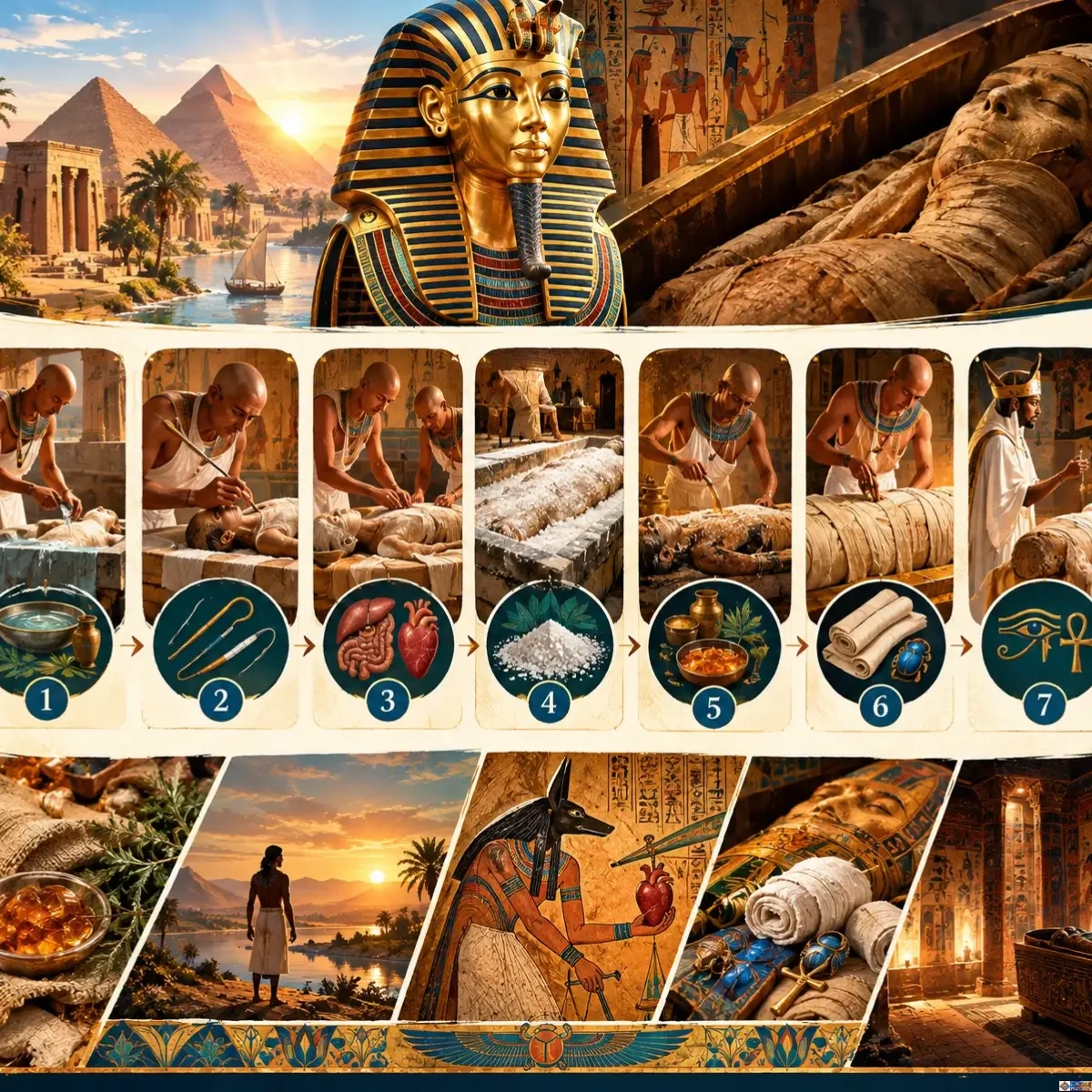
The short answer.
Ancient Egyptian mummification process history runs from a scrap of resin-soaked linen in a prehistoric grave, around 4300 BC, to a seventy-day priestly ritual in the New Kingdom, and out through the Roman era.
Why bother?
Egyptians believed a person survived death only if the body stayed recognisable. Rot meant a second death. Salt, resin and linen were the cure.
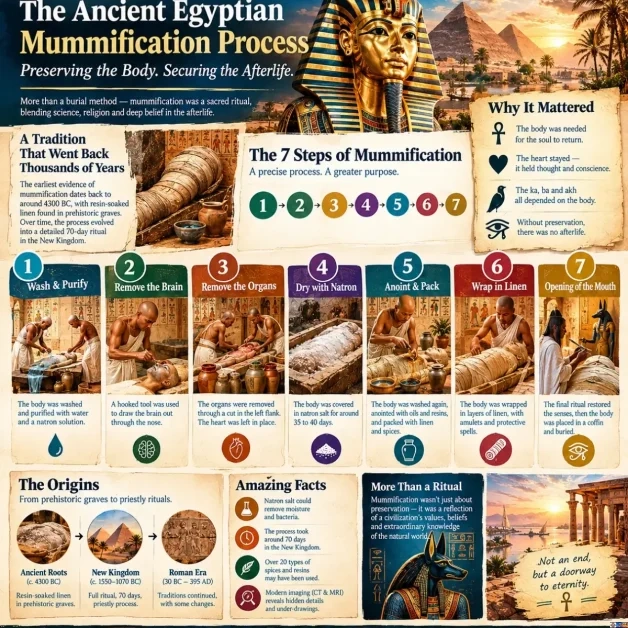
The seven steps, in order:
- 1 Wash and purify the body with water and natron solution.
- 2 Draw the brain out through the nose with a hooked tool.
- 3 Remove the organs through a cut in the left flank. Leave the heart.
- 4 Dry everything in natron salt for roughly 35 to 40 days.
- 5 Wash again, anoint with oils and resins, and pack the body.
- 6 Wrap in linen, layer by layer, with amulets and spells.
- 7 Perform the Opening of the Mouth, then bury.
Why Was Mummification Important to Ancient Egyptians?
Start with the problem, because every chapter of ancient Egyptian mummification process history starts with one. In the earliest Egyptian cemeteries, people were laid in shallow pits in hot, dry sand. The desert did the embalming for free, and it did it well. Skin held. Hair stayed. A family could come back years later and still see a face.
Then tombs got ambitious. Wealthier families dug deeper, built chambers, added coffins. A lovely idea and a terrible one. Cut off from the sun-baked sand, the bodies rotted. Picture what that meant to a household that believed in an afterlife: the person you loved, decaying inside the very structure you’d built to protect them. I can’t think of a sharper kind of grief. That is the traditional explanation, anyway, and as you’ll see below it is probably only half the story.
The Egyptian answer was radical. Stop the rot. A person, they held, was several things at once. The ka was a life force that needed food and drink. The ba, drawn as a bird with a human head, was personality, free to roam. The akh was the transfigured spirit that lived among the gods. All three needed an anchor in the physical world. Lose the body and the ka had nowhere to return to for its offerings. Lose the body, lose the person.
The heart carried even more weight. Egyptians placed thought and conscience there, not in the brain. In the judgement scenes of the Book of the Dead, the heart is weighed against the feather of Maat, goddess of truth, and a creature called Ammit waits to eat the failures. So the embalmers discarded the brain and left the heart exactly where it was. Odd priorities, to us. Perfectly logical to them.
The beliefs make more sense once you know the life that produced them: the bread, the beer, the crowded family houses. I’ve sketched that world in What was everyday life in ancient Egypt, and it reads well alongside this piece.
The Origins of Mummification in Ancient Egypt
For a museum-curated overview of the Ancient Egyptian mummification process history, the Smithsonian’s ancient Egypt spotlight is a sound place to begin. Here is the part most overviews skip. The deepest layer of the story sits far deeper in time than the pyramids.
For a long time, textbooks dated deliberate mummification to about 2600 BC, when the Great Pyramid was going up. Then Jana Jones, an Egyptologist at Macquarie University, and colleagues went back to old linen wrappings from graves at Badari and Mostagedda. Under the microscope the cloth held traces of resin. Their 2014 chemical study pushed resin-soaked wrappings back to roughly 4300 BC, more than a thousand years before writing existed.
The recipe looked remarkably like the later ones. A plant oil or animal fat base. A little pine resin, an aromatic plant extract, some plant gum. The pine resin may have come from south-eastern Turkey. Think about that for a second. No pharaohs, no hieroglyphs, and prehistoric families were already sourcing imported, antibacterial resin for their dead.
The sharpest evidence is a young man in Turin. Catalogued as S. 293 and nicknamed ‘Fred’, he has lain in the Egyptian Museum there since the early 1900s, untouched by modern preservatives. In 2018 the same research group combined chemistry, radiocarbon dating, microscopy and genetic analysis and showed that around 3600 BC someone had embalmed him with a resin-rich balm. He was between twenty and thirty when he died. The balm resembled the classic recipes of some 2,500 years later.
So the neat problem-and-solution story I told a moment ago needs a correction. People seem to have been treating their dead with resin even in the sand-burial days. The desert wasn’t failing them yet, and they were already reaching for something stronger. My reading: mummification was not invented as a reaction to rot. It grew from an older instinct to care for the body, and deeper tombs simply raised the stakes.
By about 2600 BC the evidence turns sturdier. The tomb of Queen Hetepheres, mother of the pharaoh Khufu, held an alabaster chest of preserved internal organs, though her body was never found. Organs were now being removed and kept apart. That is a real technical leap.
One more discovery, and I’ll flag it as unfinished. In 2019 archaeologists opened the tomb of a Fifth Dynasty nobleman named Khuwy at Saqqara. The mummy inside was ‘awash with resins and textiles’, in the words of the Egyptologist Salima Ikram, a level of treatment previously tied to mummies a thousand years younger. Exciting? Certainly. Settled? Not yet. Ikram herself wanted radiocarbon dating before accepting it, and I could not find a published result as of this update. Treat the claim as promising, not proven.
For the burial side of the story, where those earliest bodies actually lay, see Where Were Ancient Egyptian Mummies First Buried?.
How Ancient Egyptian Mummification Process History Unfolded Over 3,000 Years
Mummification never stood still. It crept, jumped, got fussy, got cheap. Here is the quick tour before we reach the step-by-step.
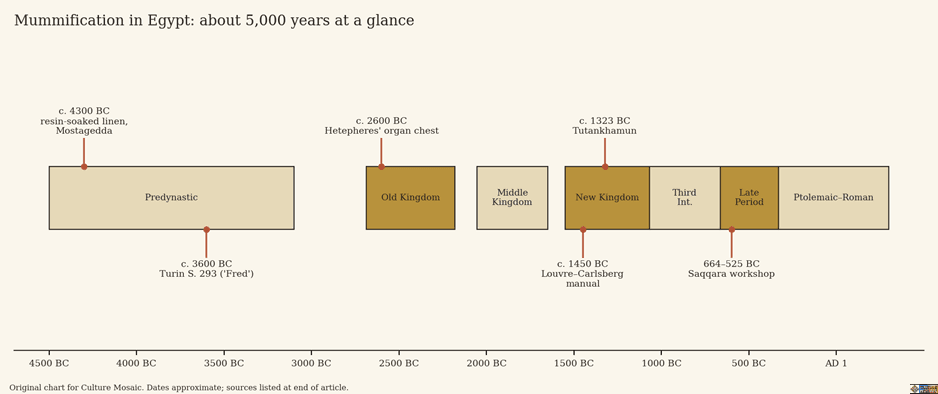
Figure 1. Ancient Egyptian mummification process history across roughly 5,000 years. Original chart; dates approximate.
| Period | Typical approach | Signature detail |
|---|---|---|
| Predynastic (c. 4500–3100 BC) | Resin-soaked linen on bodies buried in sand; no organ removal | Mostagedda linens; Turin S. 293 |
| Old Kingdom (c. 2686–2181 BC) | Linen wrapping, organs sometimes removed, brain usually left | Hetepheres’ organ chest, c. 2600 BC |
| Middle Kingdom (c. 2055–1650 BC) | Organ removal becomes routine; coffins grow more elaborate | Canopic equipment becomes standard |
| New Kingdom (c. 1550–1069 BC) | The classic method: brain through the nose, left-flank cut, natron, long anointing | The 70-day schedule; Tutankhamun, Ramesses II |
| Third Intermediate (c. 1069–664 BC) | Padding beneath the skin for a lifelike look; painted skin; artificial eyes | Obsession with looking alive |
| Late Period (664–332 BC) | Workshop-scale production and more complex recipes | The Saqqara embalming workshop |
| Ptolemaic and Roman (332 BC–c. AD 300) | Showy wrapping patterns and gilded masks; the body inside often cared for less | Painted portrait panels in Roman Egypt |
Table 1. How embalming changed by period. Compiled from the sources listed at the end.
Two things leap out at me. The New Kingdom is the peak of technique, but the Third Intermediate Period is the peak of vanity. Embalmers pushed padding under the skin to give the dead a living plumpness, which tells you what the families feared most: looking dead. And the Late Period is the peak of volume. Industrial scale. The Saqqara workshop belongs to that moment.
How long did any of this last? Longer than most countries have existed. I’ve tackled the age question in How Old Are Most Egyptian Mummies?, and the burial rhythms wrapped around all of it in Ancient Egyptian burial customs.
Ancient Egyptian Mummification Process Steps: The 7 Steps in Order
Every telling of ancient Egyptian mummification process history ends up here, at the mummification process step by step that most readers want in a hurry. The details come from three sources that don’t always agree: the Greek historian Herodotus, writing in the fifth century BC; a rare Egyptian manual from about 1450 BC; and the embalmers’ own pots, found in 2016. I’ll flag where they split.
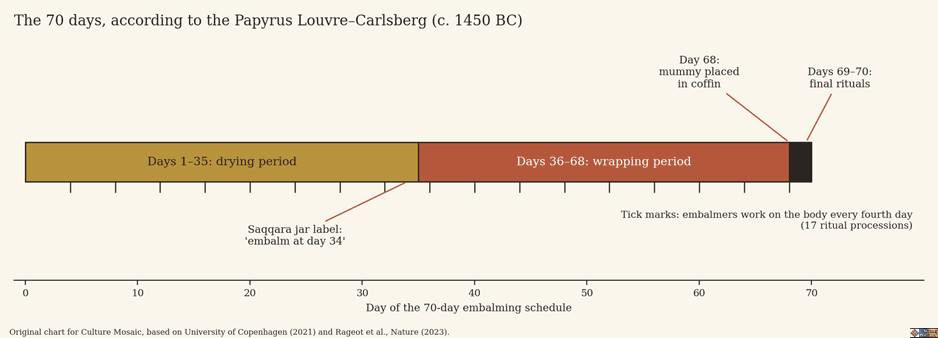
Figure 2. The 70-day schedule described in the Papyrus Louvre–Carlsberg. Original chart.
Step 1: Washing and Purification
Death hands the body to specialists. It was carried to a tent or hall called the ibu, the ‘place of purification’, and washed with water and a natron solution. Palm wine enters the picture too, at least in Herodotus’s account. This was not hygiene alone. Purification was a ritual act, and the embalming workshop counted as sacred space, the place where the dead person began to become Osiris. The manual describes a purpose-built workshop near the grave.
Step 2: Removing the Brain
Now the part Hollywood got right. Embalmers pushed a long hooked tool up a nostril, broke the thin bone behind it, and pulled the brain out in pieces. Herodotus calls the tool an iron hook and says drugs were poured into the skull afterwards. Nobody kept the brain. Remember, thought lived in the heart. The technique became standard in the New Kingdom; Old Kingdom bodies usually kept their brains, as Ikram has noted.
Step 3: Taking Out the Organs
A cut in the left flank, made with a sharp stone blade. Herodotus mentions a stone from Ethiopia. Diodorus Siculus, a Greek writing in the first century BC, adds that the man who made the incision was then chased off with thrown stones, since wounding a body was ritually unclean. Whether that was theatre or a real custom, I can’t say.
Through the cut came the lungs, liver, stomach and intestines. Each organ was dried, wrapped and placed in a canopic jar under the protection of one of the four sons of Horus: Hapy for the lungs, Imsety for the liver, Duamutef for the stomach, Qebehsenuef for the intestines. The heart stayed in the body. The kidneys usually did too. They were awkward to reach.
Step 4: Drying the Body in Natron
This is the technology at the centre of the whole business. Natron is a natural salt mixture, chiefly sodium carbonate and bicarbonate, collected at Wadi Natrun north-west of Cairo and elsewhere. Packed around and inside the body, it draws out water. No water, no bacterial feast.
How long? The papyrus manual gives a drying period of about 35 days. Herodotus says seventy. The biblical account of Jacob’s embalming says forty. The manual comes from inside the profession, and I’d trust it over an outsider’s notes. The chemistry behind the drying gets its own treatment in Ancient Egyptian Mummies Preservation Techniques.
Step 5: Anointing and Packing
After drying, the body was washed again and anointed. This is where the smell arrives. Residues from the Saqqara workshop show oils from juniper and cypress, beeswax, castor oil, and resins including elemi and pistachio. The labels on the pots read like a recipe card. One said ‘substance for the head’. Another said ‘embalm at day 34’.
Embalmers rubbed the skin with resin to seal it, packed the cavity with linen, sawdust or resin-soaked cloth to restore its shape, and in some periods used the same tricks to fill out the cheeks.
Step 6: Wrapping the Body With Amulets and Spells
Wrapping is slow. Fingers, sometimes each one separately, then limbs, then the whole body, with linen strips glued by liquid resin. Between the layers went amulets: a scarab over the heart, the Eye of Horus, the djed pillar. Spells were written on the linen itself.
The manual says embalmers worked on the body every fourth day, and a ritual procession of the mummy marked each of those days, seventeen in all. Wrapping, in other words, was a prayer you could touch. You’ll also read that a priest wore a jackal mask of Anubis during the rites. The evidence is a single pottery mask found at Memphis. Plausible. Far from proven.
Step 7: The Opening of the Mouth and Burial
On day 68, the manual says, the finished mummy went into its coffin, and the last two days belonged to ritual. At the tomb a priest touched the mummy’s mouth, eyes and ears with special tools in the Opening of the Mouth ceremony, so the dead person could breathe, see, eat and speak again. Then came the burial: coffin into sarcophagus, goods into the chamber, door sealed. Tombs keep their own stories, and I’ve written about what some of them hid in Secrets of the Mummy’s Tomb.
The Science Behind Egyptian Mummification: Chemistry, Scanners and a 2,500-Year-Old Workshop
The newest chapter of ancient Egyptian mummification process history is being written in laboratories. For two centuries we guessed. Ancient texts named ingredients, translators chose the likeliest meanings, and that was that. Then, in 2016, archaeologists found an underground embalming workshop at Saqqara dating to roughly 664–525 BC, at the foot of a deep shaft. Its vessels still carried their instructions.
In 2023 a team led by Maxime Rageot and Philipp Stockhammer published the chemistry of 31 of those vessels in Nature. Gas chromatography and mass spectrometry identified oils, tars, resins, beeswax and animal fats. One result upended a habit of translation: the ancient word antiu, long rendered as ‘myrrh’ or ‘incense’, did not name a single substance in this workshop. It named a mixture of fragrant oils or tar with fat.
Then the shock. Many ingredients came from outside Egypt. Pistachio and juniper products probably arrived from the Levant, and elemi resin may have come from the rainforests of South or South-East Asia. The researchers argue that Egyptian embalming helped drive long-distance trade. I find that the most striking idea in all of ancient Egyptian mummification process history. Mummification was a luxury import economy.
Alongside the chemistry sits scanning. CT scanners now let researchers ‘unwrap’ a body digitally, no knife required. That matters, because earlier generations did it the hard way. In London in the 1830s the surgeon Thomas Pettigrew unrolled mummies before audiences, then published A History of Egyptian Mummies in 1834. Fascinating work for its day. It destroyed what it studied.
Modern labs add radiocarbon dating, metagenomics and microscopy, the toolkit that exposed ‘Fred’ in Turin. Experiments help too. In 1994 a team including the anatomist Ronn Wade replicated the process on a modern human body with a National Geographic grant, a useful check on whether the ancient recipe works at all.
A word on trust, because the sources disagree and a lazy blog post will pick one at random. Table 2 sets out the four witnesses side by side. This is my own comparison, not a quotation from any single source.
| Witness | Date | What it says about timing | How far to trust it |
|---|---|---|---|
| Papyrus Louvre–Carlsberg | c. 1450 BC | 70 days in all: 35 drying, 35 wrapping; work every fourth day; coffin on day 68 | Written for practitioners; brief but precise |
| Herodotus, Histories 2.86–88 | 5th century BC | Body in natron for 70 days; three price grades | Vivid outsider’s account, written long after the peak |
| Diodorus Siculus, Library of History 1.91 | 1st century BC | Describes the ritual cutter and long anointing | Late, Greek, partly second-hand |
| Genesis 50:3 | Date debated | 40 days of embalming, 70 days of mourning | Literary tradition, not a technical text |
| Saqqara vessels (Nature, 2023) | 664–525 BC | A jar labelled ‘embalm at day 34’ | Physical evidence; says little about the full schedule |
Table 2. Four witnesses to the same seventy days, plus the physical evidence.
My view: Herodotus got the famous number right and the shape wrong. The older manual, written by people who did the job, makes seventy days the whole programme. The ‘day 34’ jar fits a calendar counted inside that span. So when a post tells you the body soaked in natron for seventy days flat, ask where the figure came from. Odds are it came from the Greek.
Who Was Mummified in Ancient Egypt?
Not just pharaohs. That is the biggest shortcut in popular ancient Egyptian mummification process history. Herodotus describes three price bands: a costly top grade, a middle grade in which cedar oil was injected rather than the body being cut, and a cheap treatment that purged the insides and salted the body. Roughly a luxury package, a standard one and a budget one.
By the Late Period mummification reached well beyond the elite, and well beyond people. Egyptians mummified cats, ibises, crocodiles and dogs as offerings, pets and sacred embodiments of gods. I’ve covered that strange, moving corner in Ancient Egyptian animal mummies.
What moves me about the middle tiers is the ordinariness. A family that couldn’t afford a gilded coffin still paid for a body that would last. Love, working to a budget.
Famous Mummies From Ancient Egypt
| Mummy | Era | Why they matter |
|---|---|---|
| Tutankhamun | 18th Dynasty, c. 1323 BC | The most famous mummy on earth; tomb found in 1922; the cause of death is still debated |
| Ramesses II | 19th Dynasty, d. c. 1213 BC | Flown to Paris in 1976 for treatment of a fungal infestation, then returned to Cairo |
| Hatshepsut | 18th Dynasty, c. 1458 BC | A female pharaoh whose mummy was identified in 2007 after a tooth matched a box bearing her name |
| Turin S. 293 (‘Fred’) | Predynastic, c. 3600 BC | The earliest known mummy treated with a complex embalming recipe |
| Takabuti | Late Period, c. 600 BC | Kept at the Ulster Museum in Belfast since 1834 |
Table 3. Five mummies worth knowing. Dates approximate.
Tutankhamun deserves one extra line. He is the best-known mummy and one of the least typical: a teenage king whose burial looks rushed in places. Scanning since 2005 has pointed towards a broken leg and illness rather than a murderer. The full debate lives in How Did King Tut Die and Why.
Mummy Myths: Hollywood, Curses and the ‘Real Mummy Alive’ Question
Popular tellings of ancient Egyptian mummification process history are full of myths, so let’s clear the air. A real mummy alive? No. Mummies are bodies. Nothing walks. The idea comes from fiction. Universal’s 1932 film The Mummy, starring Boris Karloff, set the template of a bandaged monster and an ancient curse, and cinema has been repeating it ever since.
What Hollywood got wrong: bandages were never the point. Drying was. What it got right, oddly: the brain really did leave through the nose.
Another myth is the one about Ramesses II’s passport. You’ll see a convincing image of it online. Fact-checkers traced that image to an artist’s illustration on a heritage blog, and found no contemporary report of a passport being issued. The trip to Paris, and the fungus, were real.
The word ‘mummy’ itself has a murkier past than the films. It comes from the Arabic mūmiyā, meaning bitumen, because Europeans took the dark, resin-blackened bodies for tar. From there the story turns grim. Apothecaries sold powdered mummy as medicine for centuries, painters used a pigment called mummy brown, and Victorian drawing rooms hosted unrolling parties. The full word history is in What Is Mummy in History?.
See Real Mummies for Yourself
If you’ve only met mummies on screen, fix that. Museums turn ancient Egyptian mummification process history from a story into something you can stand in front of. Three places I’d send you first. The British Museum in London, where the permanent collection is free to enter and the Egyptian galleries hold some of the best-known mummies and coffins anywhere. The Egyptian Museum in Turin, where ‘Fred’ lives. And the National Museum of Egyptian Civilisation in Cairo, where the royal mummies moved in April 2021 in a televised procession called the Pharaohs’ Golden Parade. Don’t walk past the small cases. That’s where the quiet details are.
And the wildcard. Go and read about mummy brown, the pigment Victorian artists prized for its warm tone, made from ground-up embalmed bodies. Look it up before your next gallery visit. You’ll never read a brown shadow in an old oil painting the same way again.
They wanted so little, those embalmers and the families who paid them. Just not to be forgotten. Five thousand years on, strangers are still saying their names.
Frequently Asked Questions About Egyptian Mummification
1. What is the history of mummification in ancient Egypt?
Ancient Egyptian mummification process history begins with simple resin treatment of linen wrappings in prehistoric graves, where chemical evidence reaches back to about 4300 BC. By around 2600 BC elite burials included removed and preserved organs. The classic method, with brain removal, natron drying and a long anointing, matured in the New Kingdom (c. 1550–1069 BC). Workshops produced mummies at scale in the Late Period, and the practice faded in the Roman era as burial customs changed.
2. What are the 5 steps of mummification in order?
The five-step version merges the longer list: (1) wash and purify the body; (2) remove the brain and the internal organs, leaving the heart; (3) dry the body in natron salt for about 35 to 40 days; (4) anoint it with oils and resins and pack it to restore its shape; (5) wrap it in linen with amulets and spells, then perform the Opening of the Mouth and bury it. The seven-step version in this article splits the brain and organ removal, and the wrapping and final rites.
3. Why was mummification important to ancient Egyptians?
Egyptians believed a person had several spiritual parts, including the ka (life force) and the ba (personality), which needed the physical body as an anchor in the afterlife. A rotted body risked a second death. Preserving the body, and especially the heart, kept the person recognisable and able to receive offerings and face judgement before Osiris.
4. Who was mummified in ancient Egypt?
Pharaohs and nobles received the most elaborate treatment, but Herodotus describes three price grades, and in later periods many ordinary Egyptians were mummified too. Egyptians also mummified animals, including cats, ibises, crocodiles and dogs, as pets, offerings and sacred embodiments of gods.
5. What are 5 facts about mummification?
First, chemical evidence for embalming-style treatment dates to about 4300 BC. Second, the classic New Kingdom process lasted 70 days according to the Papyrus Louvre–Carlsberg, split into a 35-day drying period and a 35-day wrapping period. Third, the brain was pulled out through the nose while the heart was left in place. Fourth, a 2023 study of the Saqqara embalming workshop showed that many ingredients were imported, from the Levant and possibly South or South-East Asia. Fifth, the word ‘mummy’ comes from an Arabic word for bitumen.
Sources and Further Reading
1. Rageot, M., Stockhammer, P. W. et al. (2023). Biomolecular analyses enable new insights into ancient Egyptian embalming. Nature, 614. Coverage: Scientific American
2. Jones, J., Higham, T. F. G., et al. (2018). A prehistoric Egyptian mummy: evidence for an ‘embalming recipe’ and the evolution of early formative funerary treatments. Journal of Archaeological Science, 100, 191–200. https://doi.org/10.1016/j.jas.2018.07.011
3. Jones, J. et al. (2014). Evidence for prehistoric origins of Egyptian mummification in Late Neolithic burials. PLOS ONE. Coverage: Live Science
4. National Geographic (2018). Mummy yields earliest known Egyptian embalming recipe. National Geographic
5. University of Copenhagen (2021). Ancient Egyptian manual reveals new details about mummification. humanities.ku.dk
6. Smithsonian Magazine. Richly adorned Egyptian tomb could rewrite the history of mummification (Khuwy). smithsonianmag.com
7. Al-Fanar Media (2021). Mummified remains may rewrite history of an ancient practice. al-fanarmedia.org
8. Smithsonian Institution. Ancient Egypt spotlight: mummies. si.edu
9. BOOM (fact-check). No evidence of a passport being issued to the mummy of Pharaoh Ramesses II. boomlive.in
10. BBC World Service, Witness History. Ramesses II’s ‘mummy makeover’. player.fm
11. Herodotus. Histories, Book 2, chapters 86–88 (Perseus Digital Library, Tufts University).
12. Diodorus Siculus. Library of History, Book 1, chapter 91 (Perseus Digital Library, Tufts University).
13. Pettigrew, T. J. (1834). A History of Egyptian Mummies. London: Longman, Rees, Orme, Brown, Green and Longman.
14. Genesis 50:3 (embalming and mourning of Jacob).
 Culture Expert
  Dr. Marcus Hale