
 By Marcus J. Holloway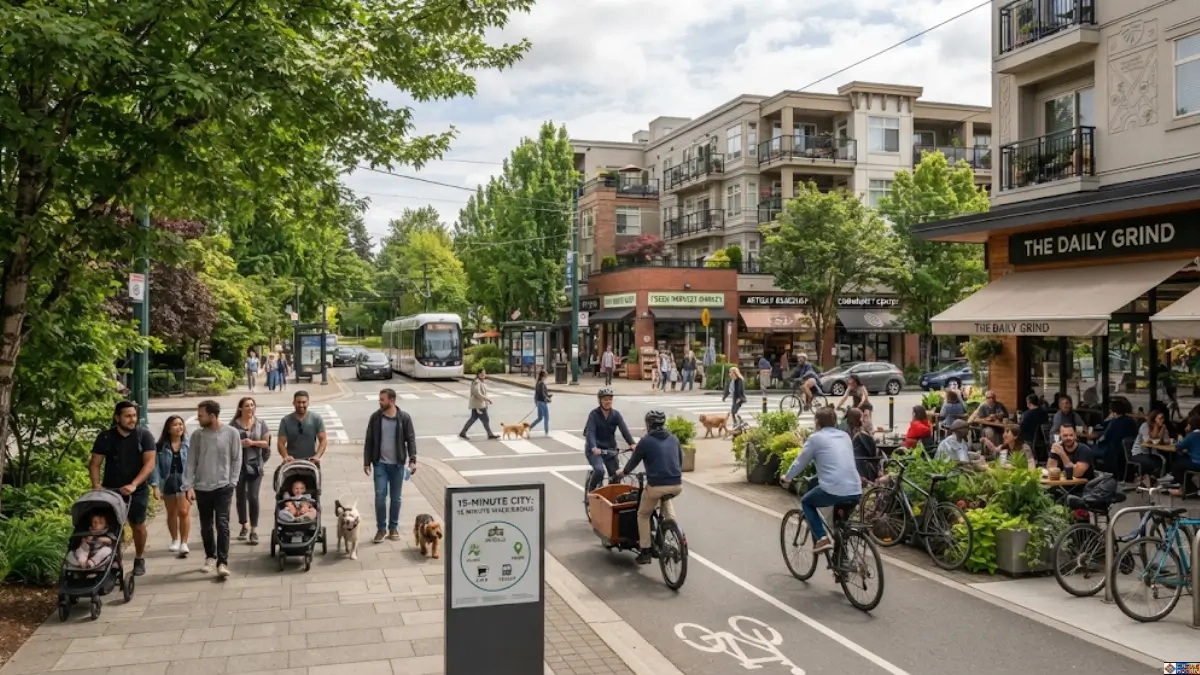
Looking for a clear what is a 15-minute city concept explanation? Here is how walkable neighborhoods, grassroots power, and modern urban planning are reshaping our streets.
Quick Summary
A 15-minute city is a planning model where daily needs — work, food, healthcare, schools, green space — sit within a 15-minute walk or cycle of home.
Franco-Colombian scientist Carlos Moreno coined the term in 2015–2016, building on Sorbonne research into “chrono-urbanism.”
Paris, Melbourne, Barcelona, Portland and Edinburgh all run versions of the model; Oxford’s Local Plan 2040 triggered the UK’s loudest fight over it.
The idea has been the target of a widely debunked conspiracy theory claiming councils will “lock” people into zones. They can’t, and they haven’t.
The real, evidence-backed criticism is about gentrification and equity — not confinement.
Fifteen minutes doesn’t sound like much. It’s one sitcom episode, or the length of time you’ll spend arguing with a self-checkout machine over an unexpected item in the bagging area. But that number has become one of the most fought-over figures in urban planning, and I think the fight itself tells you something true about how people actually feel about their own streets.
Here’s the pain point at the centre of it: most of us don’t live near what we need. We drive to work, drive to the supermarket, drive the kids to school, and then wonder why the school run eats two hours of the day and the high street two doors down from home has three empty units and a vape shop. Car dependency isn’t a personality trait.
It’s what happens when a place is built for cars first and people second. The 15-minute city concept is a direct answer to that — and also, somehow, one of the most misunderstood ideas in modern town planning. Let’s sort out what it actually is, where it came from, who’s built it, and why a straightforward planning principle ended up shouted about on placards in Oxford.
What Is a 15-Minute City? Defining the Concept
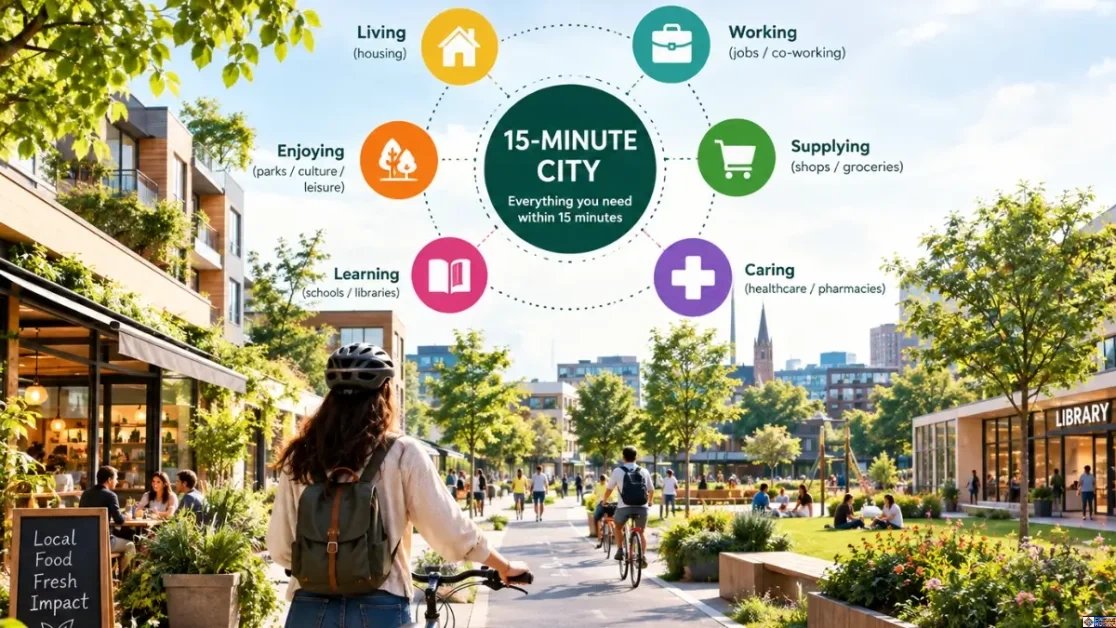
A 15-minute city is a neighbourhood designed — or redesigned — so that residents can reach the things they need for daily life within a 15-minute walk or bike ride from home, rather than a car journey across town. That’s the whole idea, stripped down. No car requirement, no commute measured in postcodes, no reliance on a single arterial road to reach a pharmacy.
The model usually gets broken into six categories of need, adapted from Carlos Moreno’s original framework: living (housing), working (jobs or co-working space), supplying (shops, groceries), caring (healthcare, pharmacies), learning (schools, libraries), and enjoying (parks, culture, leisure). A 15-minute neighbourhood doesn’t need to contain every single one of these at full scale — nobody expects a hospital on every corner — but it aims to put the everyday version of each within easy, unforced reach.
It’s worth being precise here, because so much of the 15-minute city controversy comes down to people arguing about a version of the idea that was never actually proposed. Defining the 15-minute city correctly matters more than almost anything else in this conversation.
Where Did the 15-Minute City Concept Come From?
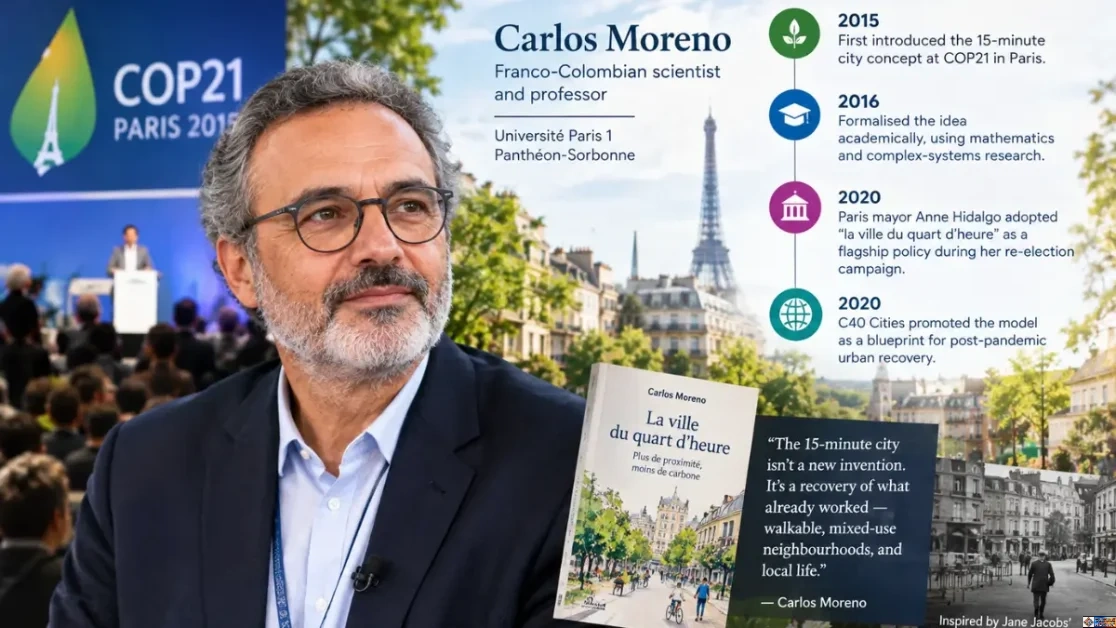
The 15-minute city concept origin traces to a specific person, a specific moment, and a specific piece of academic reasoning — it wasn’t dreamed up by a think tank or a supranational body, whatever the leaflets through Oxford letterboxes in early 2023 claimed.
Carlos Moreno, a Franco-Colombian scientist and professor at Université Paris 1 Panthéon-Sorbonne, first floated the idea at the COP21 climate conference in Paris in 2015, then formalised it academically in 2016. His argument was built on mathematics and complex-systems research as much as sociology: cities that force long commutes waste time, burn carbon, and hollow out local life, so redesigning around proximity should improve wellbeing, cut emissions, and strengthen local economies all at once.
Paris mayor Anne Hidalgo adopted “la ville du quart d’heure” as a flagship policy during her 2020 re-election campaign, and C40 Cities — the global network of climate-focused mayors — promoted the model in 2020 as a blueprint for post-pandemic urban recovery. That’s the entire origin story. A French academic, a mayoral campaign, and a pandemic that made people notice how far they actually had to travel for a loaf of bread.
Moreno himself has pointed out that most of this isn’t new. Neighbourhoods built before mass car ownership — the corner shop, the local school, the pub within stumbling distance — already had many of these characteristics. The 15-minute city borrows from the same lineage as Jane Jacobs’ mid-century arguments for mixed-use, walkable streets. It’s less an invention than a recovery project.
What Is the 15-Minute City Strategy and How Does It Work?
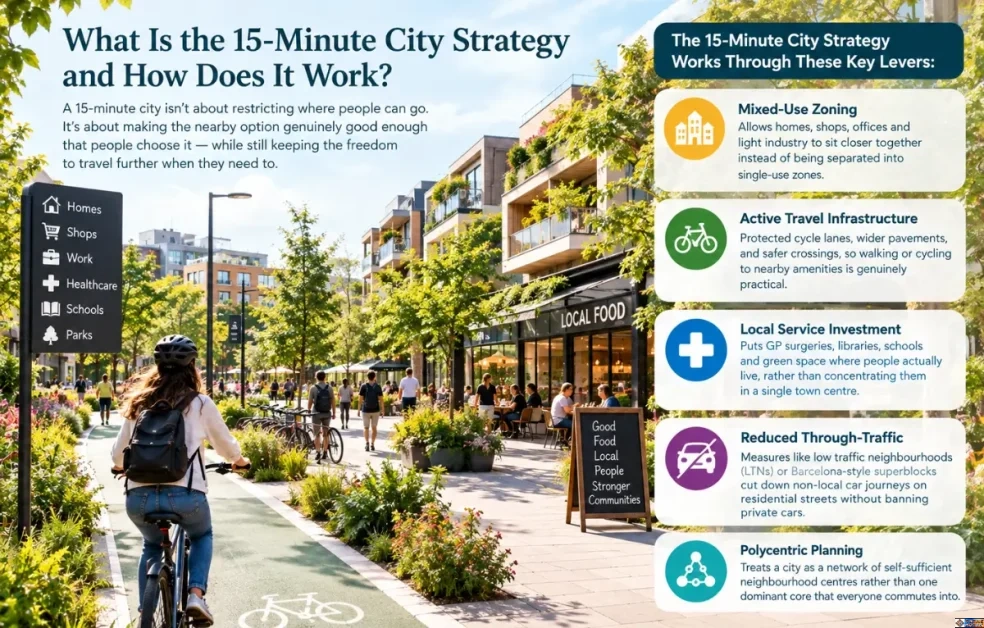
In practice, a council doesn’t flip a switch and declare a city “15-minute” overnight. The strategy tends to work through a handful of consistent planning levers:
- Mixed-use zoning — allowing homes, shops, offices and light industry to sit closer together instead of being separated into single-use zones, which is how most 20th-century planning worked.
- Active travel infrastructure — protected cycle lanes, wider pavements, and safer crossings, so walking or cycling to nearby amenities is genuinely practical, not just theoretically possible.
- Local service investment — putting GP surgeries, libraries, schools and green space where people actually live, rather than concentrating them in a single town centre.
- Reduced through-traffic — measures like low traffic neighbourhoods (LTNs) or Barcelona-style “superblocks,” which cut down non-local car journeys on residential streets without banning private cars from a city.
- Polycentric planning — treating a city as a network of self-sufficient neighbourhood centres rather than one dominant core that everyone commutes into.
None of that requires restricting where residents are allowed to go. A 15-minute city strategy is about making the nearby option genuinely good enough that people choose it — not about closing off the option to travel further when they need to.
Which Cities Have Built a 15-Minute City? Real Examples
The 15-minute city (and its close cousins, the “20-minute neighbourhood” and the “superblock”) has been tried, in different forms, in a genuinely wide range of places. Here’s how the best-known examples compare:
15-Minute City and 20-Minute Neighbourhood Examples
15-Minute City & Neighborhood Examples
| City | Model Name | Core Tool | Status |
|---|---|---|---|
| Paris, France | Ville du Quart d’Heure | Mixed-use zoning, cycle lanes, school-street closures | Flagship policy since 2020, still expanding |
| Melbourne, Australia | 20-Minute Neighbourhood | Local service hubs, walkability audits | Adopted city-wide in the Melbourne 2050 plan |
| Barcelona, Spain | Superblocks (Superilles) | Restricting through-traffic on a 3×3 block grid | Rolled out across multiple districts since 2016 |
| Portland, USA | Complete Neighborhoods | Zoning reform, local business support | Long-running strategy, part of the city’s 2035 plan |
| Edinburgh, Scotland | Living Well Locally | Public transport integration, local accessibility mapping | Adopted council-wide, phased delivery |
| Oxford, England | Local Plan 2040 / Traffic Filters | Traffic filters, LTNs, neighbourhood planning | Approved; filters triggered major public backlash |
A few things stand out from that table. First, nobody is building these from scratch — every example is a retrofit of an existing city, layered onto streets that already exist. Second, the “15-minute” label itself is somewhat flexible; Melbourne, Edinburgh and Portland all use different naming and slightly different mechanics, but they’re answering the same underlying question. And third, only one of these — Oxford — became a nationally reported flashpoint. That’s worth digging into on its own.
15-Minute City Pros and Cons
I’ll say plainly what I think the honest version of this debate looks like, because a lot of coverage flattens it into “supporters vs conspiracy theorists,” and that does a disservice to the real trade-offs.
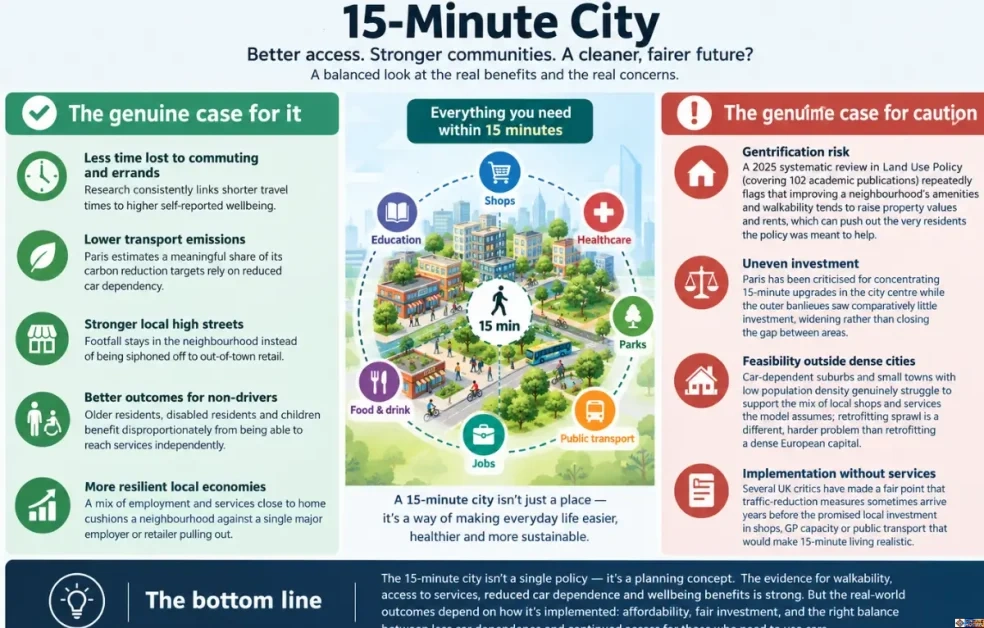
The genuine case for it:
- Less time lost to commuting and errands, which research consistently links to higher self-reported wellbeing.
- Lower transport emissions — Paris estimates a meaningful share of its carbon reduction targets rely on reduced car dependency.
- Stronger local high streets, because footfall stays in the neighbourhood instead of being siphoned off to out-of-town retail.
- Better outcomes for people who don’t or can’t drive — older residents, disabled residents, and children benefit disproportionately from being able to reach services independently.
- More resilient local economies, since a mix of employment and services close to home cushions a neighbourhood against a single major employer or retailer pulling out.
The genuine case for caution:
- Gentrification risk. Peer-reviewed research — including a 2025 systematic review in Land Use Policy covering 102 academic publications — repeatedly flags that improving a neighbourhood’s amenities and walkability tends to raise property values and rents, which can push out the very residents the policy was meant to help.
- Uneven investment. Paris has been criticised for concentrating 15-minute upgrades in the city centre while the outer banlieues saw comparatively little investment, widening rather than closing the gap between areas.
- Feasibility outside dense cities. Car-dependent suburbs and small towns with low population density genuinely struggle to support the mix of local shops and services the model assumes; retrofitting sprawl is a different, harder problem than retrofitting a dense European capital.
- Implementation without services. Several UK critics have made a fair point that traffic-reduction measures sometimes arrive years before the promised local investment in shops, GP capacity or public transport that would make 15-minute living realistic.
Those are the arguments worth taking seriously. What follows is a different conversation entirely.
Why Are People Against 15-Minute Cities? The Controversy Explained
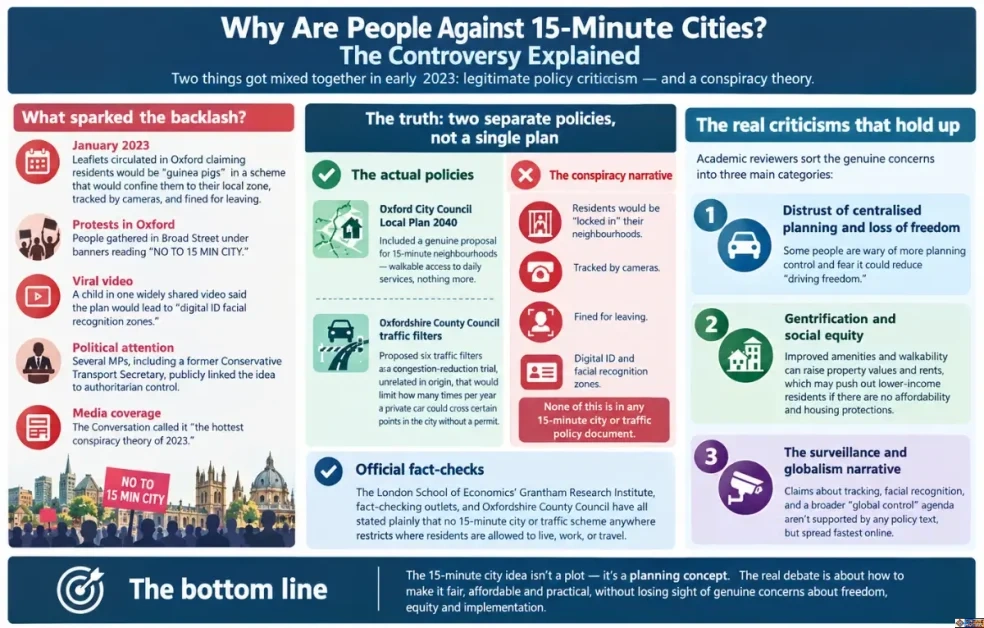
This is where I need to separate two things that got welded together in early 2023 and have stayed stuck ever since: legitimate policy criticism, and a conspiracy theory.
In January 2023, leaflets began circulating in Oxford claiming that residents would become “guinea pigs” in a scheme that would confine them to their local zone, tracked by cameras, and fined for leaving. Protesters gathered in Broad Street under banners reading “NO TO 15 MIN CITY” and, in one widely shared video, a child described the plan as leading to “digital ID facial recognition zones.” Several MPs, including a former Conservative Transport Secretary, publicly linked the idea to authoritarian control. The Conversation later called it “the hottest conspiracy theory of 2023.”
Here’s the problem with that version of events: it isn’t true, and the confusion had a specific, traceable cause. Oxford City Council’s Local Plan 2040 included a genuine proposal for 15-minute neighbourhoods — walkable access to daily services, nothing more. Separately, Oxfordshire County Council proposed six traffic filters as a congestion-reduction trial, unrelated in origin, that would limit how many times per year a private car could cross certain points in the city without a permit.
Critics and some commentators conflated the two, and the leap from “fewer through-journeys by car” to “residents will be locked in their neighbourhood” was never supported by either policy document. The London School of Economics’ Grantham Research Institute, fact-checking outlets, and Oxfordshire County Council itself have all stated plainly that no 15-minute city or traffic scheme anywhere restricts where residents are allowed to live, work, or travel.
So what are the main criticisms of the 15-minute city concept that actually hold up? Academic reviewers sort them into three rough categories: distrust of centralised planning and loss of perceived driving freedom; genuine social-equity concerns around gentrification, discussed above; and the surveillance-and-globalism narrative that isn’t supported by any policy text but spreads fastest online. It’s the third category that dominated headlines, and the first two that deserve the actual policy debate.
15-Minute City Debate: Conspiracy Claim vs. Documented Reality
| The Claim | What the Policy Documents Actually Say |
|---|---|
| “Residents will be locked into a 15-minute radius.” | No 15-minute city plan anywhere restricts travel beyond the neighbourhood; the model is about proximity, not confinement. |
| “Cameras will fine people for leaving their zone.” | Oxford’s traffic filters limit car journeys through six specific points using permits, unrelated to neighbourhood boundaries or foot/bike travel. |
| “It’s a UN or globalist ‘Agenda 2030’ mandate.” | The concept originated with one Sorbonne academic in 2015–16; UN-Habitat later referenced it favourably, but did not create or mandate it. |
| “It bans private cars from cities.” | No implementation reduces car ownership rights; several combine traffic reduction with permits, exemptions, and phased rollout. |
| “It’s a response to a real risk that gets ignored: gentrification.” | Documented in peer-reviewed research on Paris, Gothenburg and other cities; this is the one criticism with consistent academic support. |
Is the UK Building 15-Minute Cities? Rules, Plans and What’s Next
The UK’s own version of this debate predates the word “controversy” attaching to it. The Town and Country Planning Association has championed “20-minute neighbourhoods” — the UK’s preferred phrasing — pointing to results in Paris and Melbourne as a template, well before Oxford’s plans made headlines. A handful of other UK councils have floated similar proximity-based principles in their local plans, generally folded into everyday planning language like “walkable neighbourhoods” or “living well locally” rather than the more politically loaded phrase itself.
There is no UK-wide “15-minute city rule,” no national mandate, and no legal instrument that forces any council to adopt the model. What exists is a patchwork: individual local plans, drawn up through ordinary planning consultation, that lean on proximity-based principles to varying degrees. Given how combustible the framing became after 2023, several UK planning departments have quietly stopped using the term “15-minute city” in public documents altogether, even while keeping the underlying walkability principles intact.
How Residents Actually Shape These Plans
This is the part that gets lost in the shouting: 15-minute neighbourhoods, superblocks, and traffic filters are not handed down from on high. They go through the same local civic engagement machinery as any other planning decision — public consultations, council votes, and (increasingly) digital platforms built specifically for co-design in urban planning and civic engagement.
If you want a genuine say in whether your neighbourhood gets a 15-minute-style plan, why public consultation is important is worth understanding before the consultation window closes, not after. Councils are legally required to publish and respond to public commentary on local plans, and how public feedback shapes local policy is a matter of record in planning committee minutes, not guesswork. Some councils have gone further, using tools built for hyperlocal digital deliberation so residents can flag concerns about a specific street rather than a whole borough.
Beyond formal consultation, the model overlaps heavily with what I’d call street-level tactical urbanism in community civic engagement — the temporary parklets, pedestrianised trial streets, and pop-up cycle lanes that let a council test a 15-minute-style intervention before making it permanent. That approach lines up neatly with what some call micro-civic interventions: small, reversible changes that build local support (or reveal local objections) before anything becomes law. In the UK, schemes closely related to this thinking, like the Love Your Block Grant 2026, fund exactly this kind of small-scale, resident-led neighbourhood improvement.
None of this happens without people showing up. Understanding civic duty and knowing the value of civic participation are the difference between a plan shaped by the loudest objectors and one shaped by the whole neighbourhood. There’s no shortage of civic engagement opportunities tied to local planning specifically — resident associations, neighbourhood forums, and ward-level surgeries all feed into the same decisions that determine whether your street gets a protected cycle lane or a fourth petrol station.
If the process itself feels opaque, that’s a legitimate frustration, and it’s exactly what groups practising ethical grassroots advocacy and community activism strategies exist to fix — pushing councils toward genuine civic literacy rather than a box-ticking consultation. Whether you support or oppose a specific 15-minute proposal in your area, a community advocacy toolkit and a clear-eyed narrative advocacy strategy will get you further than a placard alone — and groups organising against Oxford’s traffic filters and groups organising in favour of expanded LTNs have both, at different points, used the same toolkit to make their case heard.
It’s also worth remembering who a 15-minute neighbourhood is actually meant to serve. Genuine diverse civic harmony depends on a mix of ages, incomes and backgrounds staying in place as an area improves — which loops straight back to the gentrification risk covered above. Councils serious about avoiding that tend to build in youth engagement strategy work alongside older-resident outreach, so the plan reflects people who’ll live with it for decades, not just those with the time to attend a Tuesday evening meeting.
Local identity matters here too, and it’s not incidental to the planning conversation. Projects like organising a neighbourhood mural, or the broader push behind grassroots murals UK civic engagement and community street murals, are often the most visible sign that a neighbourhood is being reshaped with residents rather than around them. I’ve laid out the fuller case for that kind of bottom-up placemaking in DIY placemaking community engagement, which sits right alongside the 15-minute city conversation even though it rarely gets mentioned in the same breath.
If any of this has made you want to actually do something with your evening instead of just having an opinion about it, there are practical starting points. How to get involved in local civic issues online is a reasonable first stop, and a wider set of civic participation tools covers everything from petition platforms to council meeting trackers. Because so much of this ultimately gets decided by who holds local office, it’s also worth knowing why voting is important in local elections, and, if you’re not currently registered, how to register to vote in the UK takes about five minutes.
Broader shifts in how people organise locally — what some are calling the 2026 civic agency movement or the move from hashtags to agency — are increasingly what determines whether a 15-minute proposal survives contact with a planning committee. None of it requires a civic leader’s playbook or a formal title. It mostly requires showing up, which remains the single most under-used civic engagement tool there is — and one that’s shaped by wider civic engagement trends far more than most residents realise.
Wildcard idea: if the formal consultation process bores you rigid, some UK neighbourhood groups have started running “walk audits” — literally timing how long it takes to reach a pharmacy, a park and a bus stop on foot, then submitting the stopwatch data as evidence to their council’s local plan review. It’s a strange little hack, but a spreadsheet of real walking times tends to land harder in a planning meeting than a general complaint ever does.
Frequently Asked Questions
What is the 15-minute city strategy and how does it work?
The strategy works by redesigning neighbourhoods around six categories of daily need — living, working, supplying, caring, learning and enjoying — so each is reachable within a 15-minute walk or bike ride. In practice, councils use mixed-use zoning, active travel infrastructure, local service investment, reduced through-traffic, and polycentric planning (treating a city as several self-sufficient neighbourhood hubs rather than one dominant centre) to get there. It doesn’t restrict travel beyond the neighbourhood; it just makes the local option genuinely usable.
Why are people against 15-minute cities?
Opposition splits into two very different camps. One is a debunked conspiracy theory, most visible in Oxford’s 2023 protests, claiming councils will confine residents to a 15-minute radius using cameras and fines — a claim that isn’t supported by any actual policy document and has been repeatedly fact-checked and rejected. The other is a legitimate academic critique focused on gentrification: improving a neighbourhood’s walkability and amenities can raise property values and rents, potentially displacing the residents the policy aimed to help, as several peer-reviewed studies on Paris and other cities have documented.
What are the main criticisms of the 15-minute city concept?
Setting the conspiracy theories aside, researchers point to four consistent issues: gentrification and rising local property values, uneven investment (where central neighbourhoods get upgraded faster than outer areas), difficulty applying the model to low-density suburbs and small towns, and traffic-reduction measures being introduced before the promised local services actually arrive.
Can you give me a list of 15-minute cities?
Paris (Ville du Quart d’Heure), Melbourne (20-Minute Neighbourhoods), Barcelona (Superblocks), Portland (Complete Neighborhoods), and Edinburgh (Living Well Locally) are the most-cited examples, each using a different name and slightly different tools for the same underlying goal. Oxford is the best-known UK case, though its plan became more famous for the traffic-filter controversy than for the neighbourhood-planning proposal itself.
Is the 15-minute city really a United Nations or “Agenda 2030” plan?
No. The concept originated with a single academic, Carlos Moreno, at Paris’ Sorbonne University in 2015–2016, and was popularised through Paris mayor Anne Hidalgo’s 2020 re-election campaign and the C40 Cities network. UN-Habitat later referenced the model favourably in a global cities report, but referencing an idea is not the same as mandating it — there is no UN or global “15-minute city” directive that any country or council is obliged to follow.
Sources
- Carlos Moreno (urbanist) — Wikipedia — https://en.wikipedia.org/wiki/Carlos_Moreno_(urbanist)
- 15-minute city — Wikipedia — https://en.wikipedia.org/wiki/15-minute_city
- C40 Knowledge Hub — Carlos Moreno: The 15-Minute City — https://www.c40knowledgehub.org/s/article/Carlos-Moreno-The-15-minute-city?language=en_US
- The Grantham Research Institute, LSE — The Telegraph misrepresents 15-minute cities — https://www.lse.ac.uk/granthaminstitute/news/the-telegraph-misrepresents-15-minute-cities/
- Cherwell — Oxford, the 15-Minute City, and the Birth of a Lie — https://www.cherwell.org/2023/03/01/oxford-the-15-minute-city-and-the-birth-of-a-lie/
- Forbes — Council Votes To Keep Oxford’s LTN Which Conspiracy Theorists Confuse With 15-Minute City Plans — https://www.forbes.com/sites/carltonreid/2023/10/17/council-votes-to-keep-oxfords-ltn-which-conspiracy-theorists-confuse-with-15-minute-city-plans/
- Euronews — What is the ‘climate lockdown’ conspiracy behind Oxford’s traffic protests? — https://www.euronews.com/green/2023/02/21/what-is-a-15-minute-city-the-eco-concept-that-has-been-jumped-on-by-conspiracy-theorists
- ScienceDirect — Critical debates on the 15-minute city: A systematic content analysis of the literature — https://www.sciencedirect.com/science/article/pii/S0264275125008790
- Rutgers New Jersey State Policy Lab — 15-Minute Neighborhoods: Lessons from Outside New Jersey — https://policylab.rutgers.edu/publication/15-minute-neighborhoods-lessons-from-outside-new-jersey/
- University of Bedfordshire — What is a 15-minute city? Concept explanation — https://www.ube.ac.uk/whats-happening/articles/15-minute-city/