
 By Dr. Marcus Hale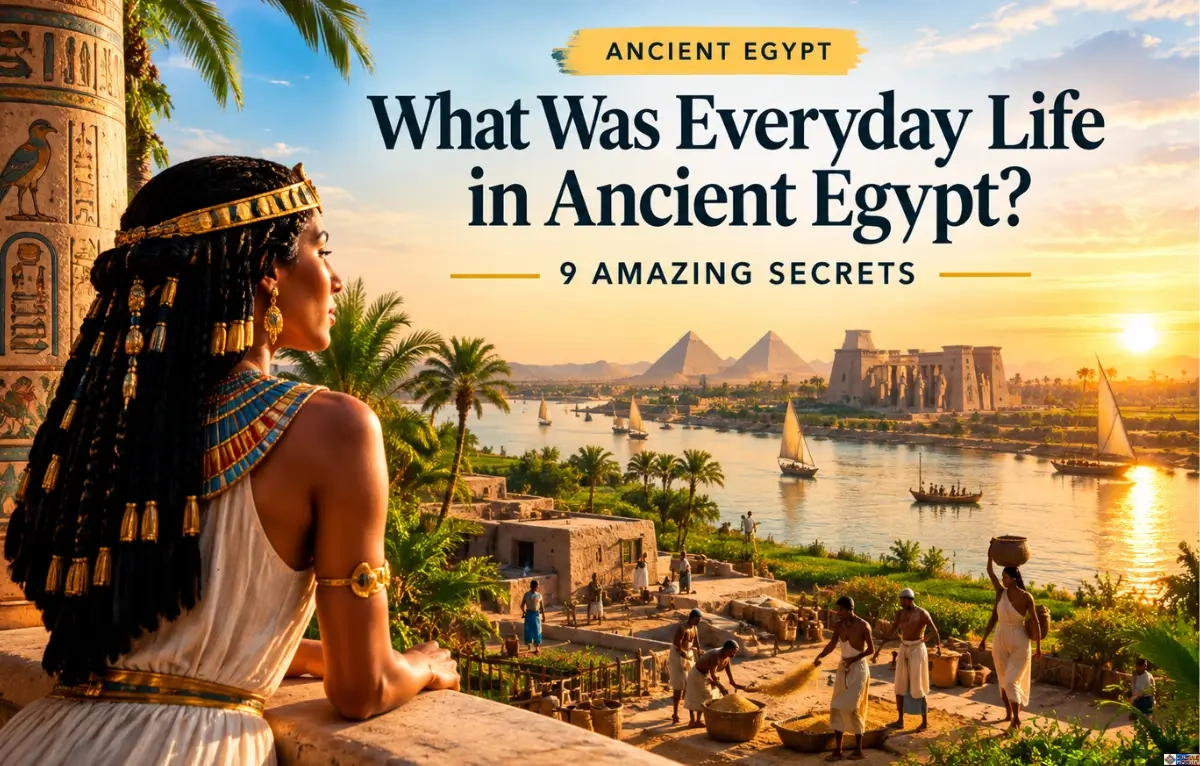
Beyond Pyramids and Pharaohs: What Was Everyday Life in Ancient Egypt Really Like?
Quick Summary
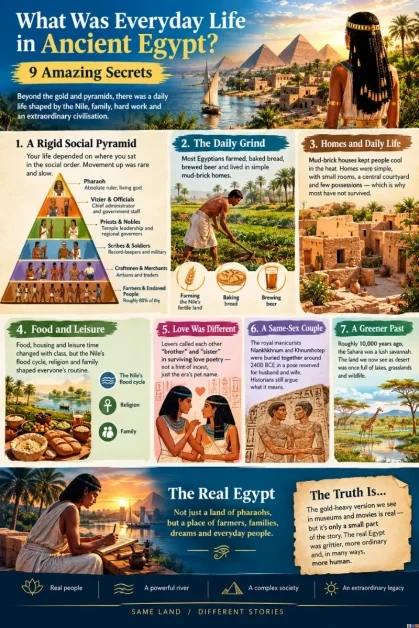
- Everyday life in ancient Egypt depended almost entirely on where you sat in a rigid social pyramid: pharaoh and nobles at the top, scribes and soldiers in the middle, farmers and labourers — roughly 80% of everyone alive — at the bottom.
- Most Egyptians farmed, baked bread, brewed beer, and lived in mud-brick homes that have not survived the centuries, which is exactly why the gold-heavy version of Egypt we see in museums skews rich.
- Housing, food, and leisure time all changed with class, but religion, family, and the Nile’s flood cycle shaped daily rhythm for everyone, rich or poor.
- Lovers called each other “brother” and “sister” in surviving love poetry — not a hint of incest, just the era’s pet name.
- At least one same-sex couple, the royal manicurists Niankhkhnum and Khnumhotep, was buried together around 2400 BCE in a pose reserved for husband and wife, and historians still argue over exactly what it means.
- Roughly 10,000 years ago, before any of this, the land now covered by the Sahara was green savannah — Egypt as we picture it didn’t exist yet.
The Myth We’ve All Bought Into
Here’s the problem. Ask someone what life was like in ancient Egypt and you’ll get gold sarcophagi, sweeping temples, and a pharaoh gliding down the Nile on a gilded barge. Hollywood built that image. So did a hundred years of museum displays stuffed with objects that were, by definition, rich enough to survive.
I get why the confusion sticks. If nearly everything we’ve dug up came from tombs built for people with money, of course the picture skews toward luxury. It’s not a lie, exactly. It’s a sampling problem, and it leaves out roughly four out of every five people who actually lived along the Nile.
This is a deep dive into ancient Egyptian lifestyle and culture as the evidence actually shows it, not as the movies sell it. The truth is grittier, more interesting, and — I’d argue — more human than the sanitised version. A farmer hauling water under the summer sun, a mother grinding grain until her back ached, a scribe copying tax records by lamplight: that’s what most of Egyptian life actually looked like, for roughly 3,000 years. This piece walks through it properly, class by class, room by room, using the objects, tomb paintings, and papyri that survived — plus the harder evidence from skeletons and settlement remains that tells the story the golden coffins don’t.
For a shorter, classroom-friendly version of what was everyday life in ancient Egypt, the BBC’s own explainer is a solid starting point before you go deeper here.
What Did Egypt Look Like 10,000 Years Ago?
Before we get to pyramids, it’s worth pausing on something most people never ask: what did Egypt look like 10,000 years ago? Not like Egypt at all, is the short answer.
Roughly 11,000 to 5,000 years ago, a phase climatologists call the African Humid Period turned the Sahara — the whole region, not just the Nile corridor — into open savannah. Lakes, grasslands, and seasonal rivers spread across territory that is now some of the driest land on Earth. Rock art at sites like the Cave of Swimmers in Egypt’s Western Desert, and the painted shelters of Tassili n’Ajjer further west, shows swimmers, cattle herds, giraffes, and hippos living in places where nothing grows today.
Then, starting around 5,500 years ago, the monsoon rains that fed all that greenery shifted south. The desertification wasn’t instant, but it was fast by geological standards — a few centuries, not tens of thousands of years. As the grasslands dried out, people who’d been scattered across a wide, wet Sahara had one obvious place left to go: the Nile. That squeeze is a big part of why a dense, organised civilisation coalesced in one narrow river valley right around the time Egypt’s Early Dynastic Period began. Drought pushed people together, and the people it pushed together built the state we now call ancient Egypt.
Daily Life in Ancient Egypt Rich and Poor
Egyptian society worked like a pyramid in more than just its architecture. Everyone had a fixed place, and moving up it — while not unheard of — was rare and slow.
| Tier | Who Was In It |
| 1. Pharaoh | Absolute ruler, treated as a living god, head of both state and religion |
| 2. Vizier & Officials | The pharaoh’s chief administrator and senior government staff |
| 3. Priests & Nobles | Temple leadership and regional governors (nomarchs) |
| 4. Scribes & Soldiers | Literate record-keepers and the military |
| 5. Craftsmen & Merchants | Skilled trades, artisans, and traders |
| 6. Farmers & Enslaved People | Roughly 80% of the population; farmers, labourers, and prisoners of war |
What actually changed as you moved between these tiers? Nearly everything about daily comfort.
| Aspect of Life | Wealthy Egyptians (Nobles, Officials, Priests) | Ordinary Egyptians (Farmers, Labourers) |
| Housing | Multi-room villas with gardens, painted walls, and separate servants’ quarters | One or two-room mud-brick houses near the fields, often shared with animals |
| Food | Wheat bread, wine, meat, honey, and imported delicacies | Barley bread, beer, onions, lentils, and fish — meat only on feast days |
| Clothing | Fine pleated linen, gold jewellery, elaborate wigs and cosmetics | Coarse plain linen, minimal jewellery, simple sandals or bare feet |
| Work | Administration, ritual, land ownership, and supervision | Farming, construction, brewing, and craft labour |
| Afterlife Preparation | Elaborate tombs, professional mummification, funerary goods | Simple pit burials in desert sand; mummification if resources allowed |
That last row matters more than people expect. Basic mummification wasn’t reserved for royalty in every period — a modest version existed for those who could scrape together the fee — but the dry desert sand itself preserved plenty of ordinary bodies without any embalming at all. If you’re curious how far even the humble version of this process could go, we’ve written separately about ancient Egyptian mummies preservation techniques and about how old are most Egyptian mummies that have actually been recovered.
A Day in the Life: Sunrise to Sunset
Strip away the class differences for a moment, and a few things were true for nearly everyone. Days started early, before the heat became unbearable. Bread and beer served as breakfast — beer here means something closer to thick, low-alcohol porridge than a modern pint, and it was safer to drink than untreated Nile water.
For most people, that meant a farmer’s day: tending fields during the growing season, hauling water via shaduf, or joining state building projects during the Nile’s flood months when the fields lay underwater and there was no planting to do. That detail surprises people — the pyramids likely weren’t built primarily by slaves, but by a rotating labour force of farmers with nothing else to do for a few months a year, paid in bread, beer, and grain.
A noble’s day looked entirely different: overseeing estate accounts, attending temple rituals, receiving guests for an evening meal with music and dancing. A scribe sat cross-legged with a wooden palette, mixing ink from soot and gum, copying letters and tax records that kept the whole machine running. Evenings, for those who could afford lamp oil, might stretch a little later; for everyone else, the day ended with the sun.
Home and Hearth: Housing in Ancient Egypt
Mud brick — Nile silt mixed with straw, shaped in wooden moulds, and baked hard in the sun — built almost every Egyptian home, rich or poor. The difference was scale and finish, not material.
A peasant’s house near the fields typically held one or two rooms, a flat roof used for sleeping on hot nights, and walls thick enough to keep interiors relatively cool during the day. Furniture was sparse: reed mats, low stools, storage jars sunk into the floor.
A noble’s villa, by contrast, could run to a dozen rooms arranged around a central courtyard, with a walled garden, a private well, painted plaster walls, and separate quarters for servants and kitchen staff. None of this mud brick survives especially well — it’s one reason we know so much more about the dead (whose stone tombs endured) than about the living (whose houses melted back into the riverbank centuries ago).
Clothing, Beauty, and Adornment
Linen, woven from flax grown along the Nile, clothed nearly the entire population — the heat made wool impractical for most of the year. What separated a farmer’s kilt from a noble’s gown was thread count and pleating, not the fabric itself.
Cosmetics crossed class lines more than clothing did. Kohl eyeliner, made from ground galena, served a genuine medical purpose: it cut glare from the sun and may have offered some protection against eye infections common along the river. Wigs, perfumed cones worn at parties (which slowly melted scented fat down over the hair through an evening — a detail tomb paintings show again and again), and jewellery scaled up dramatically with wealth, from simple beadwork to gold collars inlaid with lapis lazuli and carnelian.
Food and Drink: Bread, Beer, and the Nile’s Bounty
Bread and beer formed the backbone of the Egyptian diet at every income level, and both came from the same barley and emmer wheat the Nile’s floods made possible year after year. Beyond that staple pairing, what filled a plate depended heavily on class and location.
Ordinary households ate onions, garlic, leeks, lentils, and whatever fish they could pull from the Nile — a river that offered up an enormous, reliable protein supply to anyone with a net. Meat was a luxury saved for festivals for most people. Wealthier tables added roasted goose, beef, imported wine, honey-sweetened cakes, and dates. Beer, brewed by women in most households and taken seriously enough that workers on the Giza plateau received it as a wage three times a day, was the great equaliser: pharaoh and farmer both drank it, just from very different cups.
Ancient Egypt Lifestyle and Beliefs
Religion wasn’t a Sunday activity in ancient Egypt — it was the operating system underneath everything else. The concept of ma’at, a kind of cosmic and social balance, justified the entire hierarchy: the pharaoh kept ma’at in place by ruling correctly, and everyone else kept it in place by doing their job and honouring the gods properly.
Household worship mattered as much as temple worship, arguably more, for ordinary people who rarely entered a temple’s inner rooms at all — those were reserved for priests. Most families kept small shrines at home, prayed to household protectors like Bes and Taweret for safe childbirth, and marked festivals with public processions that doubled as some of the only real time off in the calendar.
Death sat inside this same belief system, not outside it. Preparing for the afterlife was, in a very real sense, part of everyday life — something people planned and saved for across decades, the way we might think about later years today. If you want the fuller picture of how that preparation actually worked and where it began, we’ve covered where were ancient Egyptian mummies first buried and unpacked what is a mummy in history more broadly. Even a pharaoh’s death could turn into a genuine mystery — our look at how King Tut died and why is a good example of how much we still don’t know for certain.
Love, Marriage, and Identity in Ancient Egypt
How Did Egyptians Say “I Love You”?
They didn’t say it quite the way we do — they wrote it, and what survives is genuinely lovely. Egyptian love poetry, preserved on papyri like the Chester Beatty I and Papyrus Harris 500 (both dated to the New Kingdom, roughly 1550–1080 BCE), calls lovers “brother” and “sister” as terms of endearment. No blood relation implied — it simply meant “my equal, my beloved.”
One New Kingdom poem has a young woman describe her heart racing out of control at the mere thought of her lover, so distracted she forgets to dress or do her makeup before running to him. Another poem lingers on a woman’s glowing skin, her glittering dark hair, and the fact that she never rambles or wastes a word. These aren’t temple hymns or royal propaganda. They’re private, funny, sometimes physical, and startlingly relatable across 3,000 years — proof that romantic love, not just arranged marriage for property and family stability, mattered deeply to ordinary Egyptians.
Marriages were typically arranged and functioned as economic and social partnerships first. That said, the poetry makes it hard to argue people didn’t also fall in love the way we understand it now, arrangement or not.
Was There LGBTQ in Ancient Egypt?
The honest answer is: probably, but the evidence is thin and historians genuinely disagree about how to read it.
The strongest case is the joint tomb of Niankhkhnum and Khnumhotep, two royal manicurists who served under Pharaoh Niuserre around 2400 BCE. Their tomb at Saqqara shows the two men embracing, holding hands, and touching noses — a pose Egyptian art of that period otherwise reserved for husband and wife. Both men had wives and children, and their families are barely depicted, while their bond to each other takes centre stage in the artwork. Some Egyptologists, including Greg Reeder, read this as evidence of a same-sex partnership formalised alongside conventional marriage. Others argue the men were brothers, possibly twins, and that the imagery reflects an unusually close sibling bond rather than romance.
Beyond that single, famous case, evidence is scattered and indirect: mythological episodes involving Horus and Seth that include sexual coercion between male gods, and later Middle Kingdom literary references to desire between men. None of it amounts to a clear legal or social framework the way we’d recognise one today — ancient Egypt simply didn’t categorise sexuality the way modern culture does. What we can say is that same-sex intimacy, in some form, existed and was recorded without obvious condemnation, which on its own tells us something worth taking seriously.
Leisure, Games, and Festivals
Work dominated most lives, but it didn’t consume them entirely. Board games were genuinely popular across classes — senet, played on a grid of thirty squares with carved pieces, turns up in tombs from servants’ burials right through to royal ones, including a set found with Tutankhamun. Children played with dolls, spinning tops, and balls stuffed with reeds; wrestling and stick-fencing shows up often enough in tomb art to suggest they were common pastimes for young men.
Music and dance accompanied nearly every celebration, with harps, lutes, and percussion instruments appearing constantly in banquet scenes. Religious festivals — and there were dozens through the year — gave ordinary Egyptians their main breaks from labour: public processions, free beer distributed by temples, and, for a few days, everyone from the vizier to the field hand watching the same parade go by.
What Is Everyday Life Like in Egypt Today?
It’s worth a brief pause here, because the question comes up constantly: what is everyday life like in Egypt today, compared with 3,000 years ago? Some threads run straight through. Egypt’s roughly 120 million residents still cluster overwhelmingly along the Nile, in some of the most densely populated farmland on Earth — much like their ancient counterparts did. Bread remains a genuine national staple; Egyptian hospitality, karam al-dayf, still shapes how guests are treated in almost every household.
Plenty has changed, obviously. Cairo is a sprawling modern megacity of malls, cinemas, and traffic rather than mud-brick villages. Islam and Coptic Christianity have replaced the old pantheon for the vast majority of the population. But the underlying rhythm — family-centred evenings, food as the centrepiece of social life, a strong sense of hospitality toward guests — has a thread running back further than most people realise.
Daily Life in Ancient Egypt for Kids: A Quick KS1/KS2 Guide
For younger learners tackling this topic at school, here’s the short version. Ancient Egyptians lived along the River Nile because it gave them water, fertile soil for farming, and a route for transport. Most families were farmers who grew wheat and barley, baked their own bread, and brewed their own beer. Houses were built from mud bricks dried in the sun. Children helped with chores and, if their family could afford it, some boys trained as scribes by learning hundreds of hieroglyphic signs. People believed in many gods, thought carefully about the afterlife, and celebrated festivals with food, music, and dancing.
The BBC’s what was everyday life in ancient Egypt guide pairs well with this section for KS1 and KS2 homework, and teachers looking for museum-object angles will find the British Museum’s own Nebamun tomb-painting resources a strong classroom companion.
Frequently Asked Questions
What was everyday life in ancient Egypt actually like?
It depended heavily on class. Most people were farmers who worked the land during the Nile’s flooding cycle, lived in simple mud-brick houses, ate barley bread and beer, and worshipped through small household shrines. Nobles and officials lived in larger homes, ate richer food, wore finer linen, and spent their days on administration, ritual, or land management. Religion, family, and the Nile’s yearly flood shaped daily rhythm for everyone regardless of class.
How did Egyptians say “I love you”?
They didn’t use that exact phrase — ancient Egyptian love poetry, found on papyri like Chester Beatty I, expressed devotion through calling a partner “brother” or “sister” as a term of endearment, and through vivid, physical descriptions of longing and attraction. Poems compare a lover’s hair to lapis lazuli, describe hearts that “flutter” at the thought of the beloved, and read remarkably close to how people describe infatuation today.
Was there LGBTQ in ancient Egypt?
The clearest evidence is the joint tomb of Niankhkhnum and Khnumhotep, two royal manicurists buried together around 2400 BCE in poses normally reserved for married couples. Historians are divided over whether this shows a same-sex relationship or an unusually close sibling bond, and ancient Egypt had no framework equivalent to modern categories of sexual orientation. What survives suggests same-sex intimacy existed and wasn’t automatically condemned, though the full picture remains genuinely debated among Egyptologists.
What did Egypt look like 10,000 years ago?
It looked nothing like the desert we picture today. During the African Humid Period, roughly 11,000 to 5,000 years ago, the Sahara region was green savannah with lakes, grasslands, and wildlife including hippos and giraffes, as rock art at sites like the Cave of Swimmers still shows. Only after the monsoon rains shifted south around 5,500 years ago did the region dry out, pushing scattered populations toward the Nile Valley and setting the stage for the civilisation we call ancient Egypt.
What is everyday life like in Egypt today?
Modern Egypt is home to roughly 120 million people, most living along the Nile in cities like Cairo or in farming communities that still depend on the river. Daily life blends tradition and modern city living: bread and family meals remain central, hospitality toward guests is a deeply held value, and religious life (mostly Sunni Islam, with a significant Coptic Christian minority) still structures the calendar the way ancient religious festivals once did.
Want more deep dives into the ancient world? Explore more history features at Culture Mosaic.
Sources
British Museum, “Egyptian life and death” and “Life in ancient Egypt” collection and schools resources, britishmuseum.org.
World History Encyclopedia, “Daily Life in Ancient Egypt” and “Love, Sex, and Marriage in Ancient Egypt,” worldhistory.org.
Smarthistory, “Egyptian social organization — from the pharaoh to the farmer,” smarthistory.org.
Wikipedia, “Homosexuality in ancient Egypt,” summarising Richard Parkinson, “Homosexual Desire and Middle Kingdom Literature,” Journal of Egyptian Archaeology, vol. 81 (1995), and Greg Reeder, “Same-Sex Desire, Conjugal Constructs, and the Tomb of Niankhkhnum and Khnumhotep,” World Archaeology 32:2 (2000).
Nile Scribes, “Hiddenness and Darkness in Ancient Egyptian Love Songs,” nilescribes.org; Papyrus Stories, Chester Beatty Library, papyrus-stories.com.
Nature Education (Scitable), “Green Sahara: African Humid Periods Paced by Earth’s Orbital Changes”; The Conversation, “The Sahara Desert used to be a green savannah — new research explains why” (2024).
Britannica, “Egypt — Population, Migration, Urbanization”; Worldometer, Egypt population estimates (2026).
BBC Bitesize, “What was it like to live in ancient Egypt?,” bbc.co.uk/bitesize.
 Culture Expert
  Marcus J. Holloway