
 By Culture Expert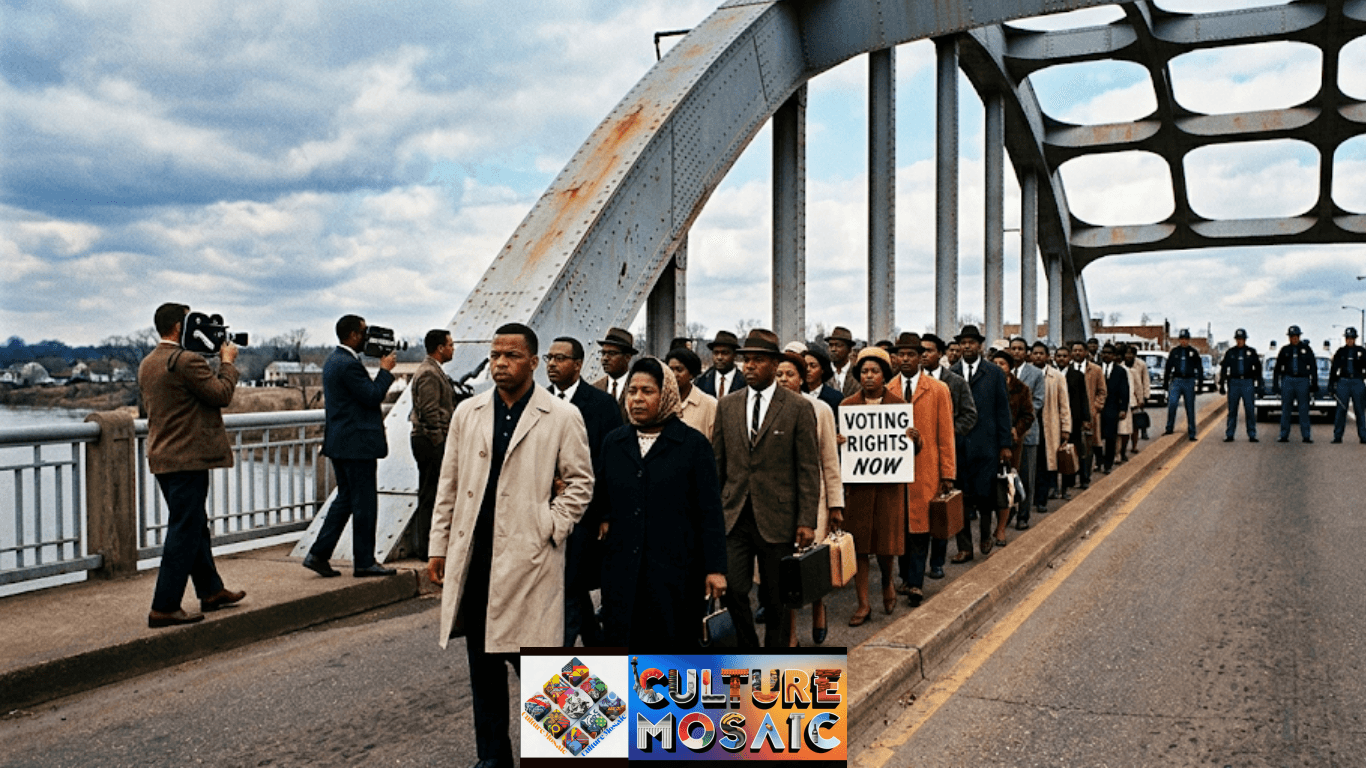
| Quick Summary The Voting Rights Act of 1965 is a federal law, signed by President Lyndon B. Johnson on August 6, 1965, that outlawed racial discrimination in voting across the United States.It banned literacy tests and similar barriers, and created federal oversight (preclearance) for states with a history of discrimination.The Supreme Court gutted the preclearance formula in Shelby County v. Holder (2013), and narrowed Section 2 protections further in Louisiana v. Callais (2026).The Act is technically still on the books and still in effect, but its enforcement power has been sharply reduced by the courts.It answers “what caused the Voting Rights Act of 1965,” not “who gave women the vote” — that was the 19th Amendment, 45 years earlier. |
I want to start with a scene, because I think it explains the What Was Voting Rights Act of 1965? better than any legal summary can.
March 7, 1965. Selma, Alabama. A line of Black marchers reaches the crest of the Edmund Pettus Bridge, and on the other side, state troopers are waiting with billy clubs and tear gas. Amelia Boynton is beaten unconscious. John Lewis, 25 years old, has his skull fractured. The cameras are rolling, and that night, the footage runs on national television. People watching from their living rooms in Ohio and Oregon — people who’d never given much thought to Alabama’s voter rolls — see it happen in real time.
That’s the moment I keep coming back to when someone asks me what was Voting Rights Act of 1965. It wasn’t drafted in a quiet committee room out of pure legislative tidiness. The Voting Rights Act of 1965 was written in response to blood on a bridge.
The Problem: A Right on Paper, Denied in Practice
Here’s the part that still makes me angry, honestly, nearly sixty years later. The 15th Amendment had already promised Black Americans the right to vote — back in 1870. On paper, the matter was settled. In practice, Southern states spent the next century building an entire architecture designed to keep that promise hollow.
Literacy tests that asked Black applicants to interpret obscure clauses of the state constitution, while white applicants got waved through. Poll taxes that priced poor families out of the ballot box. “Understanding clauses.” Grandfather clauses. Outright intimidation, economic retaliation, and violence for anyone who tried to register anyway.
By 1965, in some Alabama counties, Black voter registration sat below 5 percent — not because Black residents didn’t want to vote, but because the system was rigged, brick by brick, to stop them. This is the exact wound the Voting Rights Act of 1965 was built to close.
If you’ve ever felt the particular exhaustion of being told a door is open while someone quietly nails it shut, you understand the emotional core of this story.
What Caused the Voting Rights Act of 1965?
Selma was the spark, but it wasn’t isolated. It sat at the end of a long civil rights campaign — sit-ins, Freedom Summer, the March on Washington in 1963, the murder of voting rights organizers in Mississippi. By early 1965, Dr. Martin Luther King Jr. and local organizers in the Student Nonviolent Coordinating Committee had chosen Selma specifically because its voter suppression was so extreme, and so well documented, that it could not be waved away.
After the bridge, after the outrage, President Johnson went to Congress. On March 15, 1965, he gave a speech — “The American Promise” — and used words that stunned a lot of people in the room: “their cause must be our cause too… we shall overcome.” He didn’t just ask for a bill.
He borrowed the movement’s own anthem to describe it. Congress moved fast by its standards. The House passed the Voting Rights Act of 1965 by a vote of 333-85. The Senate passed it 79-18. Johnson signed the Voting Rights Act of 1965 into law that August, with King and Rosa Parks standing behind him.
Voting Rights Act of 1965: Simple Definition
If you need the one-sentence version: the Voting Rights Act of 1965 is a federal civil rights law that prohibits racial discrimination in voting, bans discriminatory devices like literacy tests, and — in its original form — required certain states and counties with histories of discrimination to get federal approval before changing their voting rules.
That’s the plain-English core of the Voting Rights Act of 1965. Everything else is detail.
What Does the Voting Rights Act of 1965 Do?
The Act works on two levels, and understanding the split matters more than most articles let on.
Nationwide, permanent protections. Section 2 applies everywhere in the country, forever. It bars any voting rule or practice that results in racial discrimination — not just laws written with obvious bad intent, but rules that function that way in practice. This is the section that still stands today, even after recent court rulings weakened it.
Targeted, geographic oversight. Sections 4 and 5 applied only to specific “covered jurisdictions” — mostly Southern states and counties with documented histories of suppression. Under Section 5, those places couldn’t change so much as a polling place location without getting “preclearance” from the Department of Justice or a federal court first. This was the muscle of the law. It stopped discrimination before it happened instead of forcing exhausted communities to sue after the damage was already done.
The Voting Rights Act of 1965 also banned literacy tests outright, authorized federal examiners to register voters directly in the most resistant counties, and — through later amendment — required bilingual ballots in areas with significant language-minority populations.
Why Was It Needed If the 15th Amendment Already Guaranteed Voting Rights?
I get asked this a lot, and it’s a fair question. The 15th Amendment says the right to vote “shall not be denied or abridged… on account of race.” Clean, simple, constitutional.
But a constitutional amendment doesn’t enforce itself. For nearly a century, states got away with facially neutral rules — a literacy test, a poll tax — that were race-neutral on paper and devastating in practice, because local officials applied them selectively and courts moved at a crawl. Fighting each discriminatory rule one lawsuit at a time, county by county, was like bailing out a flooding boat with a teaspoon. The Voting Rights Act of 1965 didn’t rewrite the 15th Amendment. It gave it teeth — a fast, federal enforcement mechanism the amendment had always lacked. That’s really the whole story in one paragraph.
Who Was Involved in the Voting Rights Act of 1965?
A few names deserve to be said plainly, because history has a habit of flattening a movement into a single face.
President Lyndon B. Johnson pushed the bill through Congress and signed it. Dr. Martin Luther King Jr. led the Selma campaign and the broader moral argument. John Lewis, then chairman of SNCC, marched at the front of the line on Bloody Sunday and carried the scars for the rest of his life — Congress would later name a proposed update to the law after him.
Amelia Boynton organized in Selma for years before the bridge made the cause national news, and her body, beaten on the pavement, became one of the defining images of the campaign. Attorney General Nicholas Katzenbach drafted the bill’s legal framework. And thousands of unnamed organizers, canvassers, and local Black Alabamians risked their jobs, homes, and safety to register to vote before the Voting Rights Act of 1965 gave them any federal backup at all.
I’d also point you toward Who Was the First Woman to Vote Legally in the US? if you want the earlier chapter of this story — the fight didn’t start in 1965, and it didn’t start with race alone.
What Is the Difference Between Section 2 and Section 5?
This trips people up constantly, so let me draw a clean line.
Section 2 is a sword. It’s permanent, it applies to all fifty states, and it lets voters or the Department of Justice sue after a discriminatory law or map has already been enacted. You have to prove, after the fact, that the rule harms minority voters.
Section 5 was a shield. It only applied to “covered” jurisdictions with proven histories of discrimination, and it worked before the harm happened — those places had to prove their voting changes were not discriminatory before they could take effect. No lawsuit required. No waiting for damage.
The shield is gone. In Shelby County v. Holder (2013), the Supreme Court struck down the formula that decided which places counted as “covered,” which made Section 5 unenforceable in practice — nobody could be required to preclear anything because nobody was formally covered anymore. The sword, Section 2, still exists. But as I’ll get to below, it’s been dulled considerably in 2026.
Did the Voting Rights Act Give Women the Right to Vote?
No — and I want to be direct about this because it’s one of the most common mix-ups I see in search results. Women won the right to vote nationally through the 19th Amendment in 1920, forty-five years before the Voting Rights Act existed.
Here’s the nuance that actually matters, though: the 19th Amendment’s promise was hollow for many Black women in the South. They were “allowed” to vote in theory and blocked by the same literacy tests and poll taxes used against Black men. The Voting Rights Act of 1965 is what finally made the 19th Amendment’s promise real for millions of Black women who’d been legally entitled to vote for four and a half decades and functionally locked out the entire time. For the fuller picture, our piece on Women’s Voting Rights USA walks through that whole timeline.
Why Is the Voting Rights Act of 1965 Important?
Numbers first, because they’re not subtle. In Mississippi, Black voter registration jumped from about 6.7 percent in 1965 to nearly 60 percent within a few years. Across the Deep South, hundreds of thousands of Black citizens registered within months of the law’s passage — many of them for the very first time in their lives, some of them grandparents who’d never once been allowed to cast a ballot. The number of Black elected officials in the South climbed from a small handful to thousands over the following decades.
That’s not an abstraction. That’s the measurable, documented result of a single piece of legislation forcing open a door that had been welded shut for a hundred years. Historians and legal scholars alike, including researchers at the Brennan Center for Justice, still call the Voting Rights Act of 1965 one of the most successful pieces of civil rights legislation ever enacted — and I don’t think that’s an overstatement.
Is the Voting Rights Act Still in Effect? Voting Rights Act 2026 Update
Yes, technically — but I’d be doing you a disservice if I stopped at “yes.”
Section 2 of the Voting Rights Act of 1965 remains federal law right now, in 2026. But it has taken two serious hits in recent years. First, Shelby County v. Holder (2013) killed the preclearance formula, so Section 5 has been dormant for over a decade. Then, on April 29, 2026, the Supreme Court decided Louisiana v. Callais, a 6-3 ruling that dramatically raised the bar for Section 2 challenges to discriminatory voting maps.
Voters now essentially have to prove a state acted with intentional racial motive — not just that a map produces a discriminatory result — before courts will step in. Justice Kagan, dissenting, warned the ruling made Section 2 “all but a dead letter” for redistricting cases. That’s about as blunt as a Supreme Court dissent gets.
Meanwhile, Congress has tried to respond. The John R. Lewis Voting Rights Advancement Act, reintroduced in 2025, would rebuild a modern preclearance system and restore some of what Shelby County removed. As of this writing, it remains stalled — introduced, debated, not yet passed. So here’s my honest read on whether the Voting Rights Act of 1965 is still in effect, and it’s an opinion, not a hedge: it’s still standing, but it’s standing on one leg instead of two. What’s left still matters. It’s just doing less work than it used to.
What You Can Actually Do About It
This is where I’d rather hand you a shovel than a history lesson.
Federal protections have weakened, which means state and local action matters more than it did a decade ago — not less. Register early. Check your polling place before election day, not the morning of. If you want a specific date to circle on the calendar, our guide to Vote Early Day 2026 Date is worth a bookmark. And don’t skip the “small” elections — school boards, city councils, county commissions are exactly where the fights over voting access play out first, long before they ever reach a courtroom. We wrote about that in Why Is Voting Important in Local Elections, and it’s not filler content — it’s the level of government where individual votes actually swing outcomes most often.
One slightly weird suggestion, if you want to go beyond voting yourself: request your county’s voter registration data — most states publish it — and just look at the demographics of who’s registered versus who lives there. It’s a strange, slow Saturday-afternoon project. But it will teach you more about where gaps in access still exist than any article, including this one.
FAQs About What Was Voting Rights Act of 1965?
1. What was the Voting Rights Act of 1965, in one sentence?
It was a federal law, signed August 6, 1965, that banned racial discrimination in voting nationwide and put certain states with histories of suppression under direct federal oversight before they could change voting rules.
2. What caused the Voting Rights Act of 1965?
Decades of Southern voter suppression through literacy tests, poll taxes, and intimidation, brought to a national breaking point by the violent response to the Selma to Montgomery march on “Bloody Sunday,” March 7, 1965.
3. Is the Voting Rights Act still in effect in 2026?
Yes, Section 2 remains law, but its power has been significantly reduced. Shelby County v. Holder (2013) disabled the preclearance system, and Louisiana v. Callais (April 2026) raised the burden of proof for challenging discriminatory voting maps under Section 2.
4. Did the Voting Rights Act of 1965 give women the right to vote?
No. The 19th Amendment secured women’s voting rights nationally in 1920. The Voting Rights Act of 1965 addressed racial barriers that had continued to block many Black women — and men — from voting even after 1920.
5. What’s the difference between Section 2 and Section 5 of the Act?
Section 2 is a permanent, nationwide ban on discriminatory voting practices, enforced after the fact through lawsuits. Section 5 required specific “covered” jurisdictions to get federal approval before changing voting rules — but it’s been unenforceable since Shelby County v. Holder in 2013.
About the Author
Dr. William White Chief Executive Officer @ The National Diversity Collaborative, Inc. | EdD
Washington, District of Columbia, United States
Sources
- National Archives, “Voting Rights Act (1965),” Milestone Documents in the National Archives
- U.S. Department of Justice, Civil Rights Division, “History of Federal Voting Rights Laws” and “Section 2 of the Voting Rights Act”
- Brennan Center for Justice, “The Voting Rights Act, Explained”
- Library of Congress, Congress.gov, “John R. Lewis Voting Rights Advancement Act of 2025” (H.R. 14 / S. 2523, 119th Congress)
- Congressional Research Service, “The Voting Rights Act of 1965: Background and Overview”
- Supreme Court of the United States, Shelby County v. Holder, 570 U.S. 529 (2013)
- Supreme Court of the United States, Louisiana v. Callais, 608 U.S. ___ (2026), opinion of the Court and dissent of Justice Kagan
- SCOTUSblog, case file for Louisiana v. Callais (24-109)
- Congress.gov / CRS Legal Sidebar, “Congressional Redistricting: High Court Narrows Voting Rights Act in Louisiana v. Callais”
 Marcus J. Holloway