
 By Culture Expert
Quick Summary
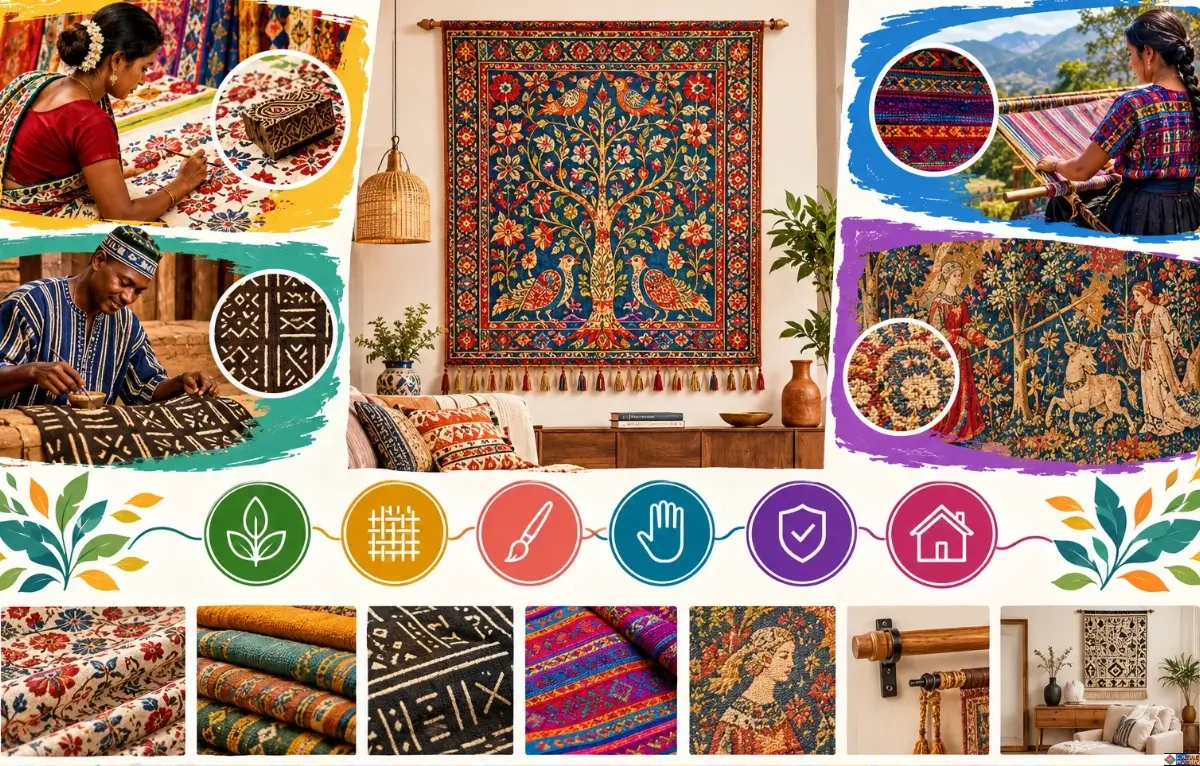
A cultural wall hanging fabric is a textile made inside a living heritage tradition (woven, dyed, printed or embroidered) and displayed on a wall as art. The pieces worth owning have a nameable place, a nameable method and, ideally, a nameable maker.
- Choose a tradition first, then a style. Kalamkari (India), Maya backstrap weaving (Guatemala), bògòlanfini mud cloth (Mali) and European tapestry each have different histories, fibres and rules of respect.
- Match fibre to the job. Cotton and wool are the workhorses; silk and heavily embellished pieces need gentler support.
- Hang it like a museum would. A Velcro-and-batten system or a sewn sleeve protects the cloth. A nail through the fabric does not.
- Credit the maker. Authenticity is a matter of documented origin, not a “tribal” label.
Below: the history, a materials comparison, four traditions side by side, a full design brief in the kalamkari tradition, a buying checklist, hanging methods, five FAQs and sources. Written by a textile-design voice drawing on museum and government records, with no invented anecdotes or testimonials.
Why So Many “Ethnic” Fabric Wall Hangings Feel Hollow
You want a wall that says something real. What most shoppers meet instead is a listing with a vague label, no place of origin and no maker. You are left guessing whether the pattern means anything, whether the cloth will survive a year of sunlight, and whether hanging it is respectful or careless.
That worry is justified, and the museum record backs it up. The Dallas Museum of Art notes that mud cloth designs now appear on products worldwide, often without credit to their Bamana origin. The Bowers Museum describes the mass-market version, bogolan, as carrying patterns that are essentially nonsense compared with the real visual language of bògòlanfini.
Three pains come up again and again:
- Authenticity: is it made by the community whose name is on the label?
- Appropriation: who is credited, who is paid, and which motifs are not decorative at all?
- Damage: how do you hang a heavy, hand-made cloth without ruining it?
The fix is a tradition-first approach: learn what the cloth is, who makes it and how it was meant to be used, then decorate around that knowledge. If you want the broader context, start with our guide to wall hanging fabric and the idea of heritage fashion on Culture Mosaic.
What Is Tapestry, and What Are Cultural Wall Hangings Called?
The V&A describes tapestry as one of the oldest forms of woven textile. The defining feature is a discontinuous weft: coloured threads run back and forth across only part of the warp, building blocks of colour into a picture. The weft is packed down so tightly that it hides the warp, which is why the design shows on both sides.
That is the strict meaning. In everyday shopping, “tapestry” gets used for any woven or printed wall cloth, so it helps to know the other names:
A useful honesty check: many of these were never made as wall art. The Met records that palampores typically served as a bedcover or wall hanging, but bògòlanfini was made as hunters’ tunics and women’s wrappers, and Maya backstrap pieces are worn as emblems of Maya identity. Hanging a garment-cloth on a wall is a new use, which is one reason to treat it with care.
Why Were Tapestries Hung on Walls Historically?
In Europe, the great age of tapestry ran from the second half of the 14th century to the end of the 18th. According to the V&A, hangings:
- added colour and kept out draughts;
- told stories from the Bible, mythology and fashionable life;
- displayed wealth, since they were extremely costly to produce (a square metre of coarse tapestry could take one weaver a month);
- travelled with their owners, rolled up and moved between residences. Henry VIII is recorded as owning around 2,000.
So the wall hanging began as warmth, status and storytelling in one object. Today the story-and-identity part is what we still want.
What Materials Are Traditionally Used? Cotton, Silk, Linen and Wool Compared
Fibre decides how a hanging looks, how heavy it is and how you can safely mount it. The records below show what each fibre has actually been used for.
A practical reading for modern homes: cotton gives you the widest choice of authentic heritage cloth, wool suits large, warm statement pieces, and silk is best kept framed or lightly displayed. The Colour of the Season guide on Culture Mosaic, Colour of the Season 2026, is a useful companion when matching fibre colour to a room, and our piece on Geographic Fingerprinting of Heritage Fibers explains how fibre origin is traced.
Four Cultural Textile Traditions Side by Side
Searching “fabric wall hanging ethnic” returns everything at once. Naming the tradition is the first step to finding the real thing.
Key facts behind the table:
- Maya weaving. The backstrap loom has been used for at least 2,000 years, and the loom’s parts carry body names in Tzutujil Maya, so the weaver is part of the machine.
- Kalamkari. Museums describe it as cloth painted and printed with a brush (the kalam), carved woodblocks and mordant dyes, with Indian artisans long holding the secret of colourfast printing. Srikalahasti and Machilipatnam styles both hold Geographical Indication registration, and the Andhra Pradesh government’s GI product list includes both.
- Mud cloth. The mud is fermented for a year until black, and the pattern is left white by painting the background.
- European tapestry. See the V&A account in the previous section.
These traditions overlap with the textile-symbol stories we cover in Ancient Ethnic Heritage Symbols and Regenerative Textile Traditions.
How to Design a Cultural Wall Hanging Fabric: A Kalamkari Brief
You asked for a culture of my choice, so this brief uses Indian kalamkari: well documented by museums, still produced by working artisans, and protected by Geographical Indication status. The same sequence works for any tradition.
Step 1: Pick the style, not just the country
Kalamkari has two main styles. Srikalahasti uses a pen (kalam) and brush for freehand painting, and its artisans historically made temple cloths hung behind the deity or on chariots. Machilipatnam (Pedana) uses hand-carved wooden blocks and is produced in workshops around Pedana. Decide which you want before you brief anyone.
Step 2: Choose motifs you can name
Documented museum examples give you a safe vocabulary:
- a central medallion with corner segments and borders, reminiscent of a Persian carpet (RISD);
- floral motifs inside cusped arches and arabesque decoration, typical of Burhanpur work (Met);
- a tree of life flanked by tigers and peacocks (MFAH, mid-19th century Machilipatnam).
Motif meaning is for the maker to explain. Ask them, and write the answer on the label.
Step 3: Build the palette around mordant dyes
Museum records describe kalamkari as painted, printed and resist-dyed using mordant dyes. As general craft knowledge (confirm with your artisan), earthy reds and deep indigo blues are the classic anchors. For a modern room, keep the heritage dyes for the motif and let the background cloth be calm. Our Colour of the Season 2026 piece helps with the surrounding scheme.
Step 4: Fabric and construction
The documented base is plain-weave cotton, painted or printed and resist-dyed. Do not swap in polyester and call it kalamkari. Commission from an artisan or cooperative rather than copying the design, and ask whether the cloth carries a GI registration.
Step 5: Balance authenticity and contemporary appeal
Step 6: Size and finish for display
Historic hangings were large. The Met lists a Golconda kalamkari wall hanging of about 1640 at 259 x 152 cm and a tent-lining panel at about 197 x 130 cm. A common interior-design rule of thumb is to size a wall piece to roughly two-thirds the width of the furniture below it (a general guideline, not a heritage rule). For finishing, hem the edges, sew an undyed cotton sleeve or Velcro strip to the top back, and plan the hanging method before the cloth is cut (see the hanging section below).
Step 7: Cultural sensitivities checklist
- Credit the community, region and, where possible, the individual maker.
- Pay for the work: commission, do not replicate.
- Ask what imagery is religious or ceremonial before using it.
- Do not translate one tradition’s symbols into another’s layout.
- Describe the piece accurately. If it is inspired by kalamkari rather than made by kalamkari artisans, say so.
For how clothing and cloth carry cultural meaning more broadly, see Culture and Fashion and Traditional Clothing Styles.
Buying Guide: Large, Luxury and UK Fabric Wall Hangings for Living Rooms and Bedrooms
If you are shopping rather than designing, the same logic applies. Here is how the common search terms translate into decisions.
Seven questions to ask any seller
- Which community or region made this, and by what technique?
- Who made it (a name or a cooperative)?
- What is the fibre, and what is the dye?
- Is there a Geographical Indication registration or equivalent where relevant?
- How are the makers paid?
- What does the motif mean, and was that meaning shared with the buyer?
- How is it meant to be hung?
Cooperative models exist. For example, Maya Traditions Foundation in Panajachel, Guatemala, describes itself as a non-profit social enterprise that supplies thread and tools to member weavers for each order. Reading how a seller explains its supply chain is one of the quickest authenticity tests available. For fibre-tracing ideas, see Geographic Fingerprinting of Heritage Fibers, and for a velvet example of cloth with deep cultural roots, The Cultural Significance of Red Velvet Fabric.
How to Style Textile Art Like an Interior Designer, and Hang It Without Damage
Styling principles
These are general interior-design practices, not heritage rules:
- One hero textile per wall. Let the cloth be the focal point and keep surrounding art quiet.
- Give it breathing room. Leave clear wall around a large piece so the border and negative space read.
- Echo, don’t match. Pick one dye colour from the textile and repeat it once or twice in cushions or ceramics.
- Keep it out of direct sun. The V&A notes that in old tapestries the original colours are often stronger on the back, which was shielded from light. That is a built-in fading warning.
How do you hang heavy cultural textiles without damaging them?
Pick the method by what the textile is made of and how strong it is. If you are unsure, ask a conservator first.
Extra rules from conservation guidance:
- Never nail or pin through the cloth. Support the whole top edge.
- Hang weft-faced weavings with the warp vertical for best support (Millicent Rogers Museum).
- Remove Velcro by prying the strips apart, never by pulling the textile (WA Museum).
- Rotate or rest the piece. The same manual advises against leaving mounted textiles on permanent display to limit light damage.
- Use only natural, undyed cotton and thread for sleeves, so nothing bleeds onto the cloth.
For how textiles relate to the body and space, you may also like Somatic Textiles.
Frequently Asked Questions: Cultural Wall Hanging Fabric
1. What is tapestry? +
Tapestry is a woven textile in which coloured weft threads cover only part of the warp, building blocks of colour into a picture. The weft is beaten down so firmly that the warp disappears, so the pattern shows on both faces. The V&A calls it one of the oldest forms of woven textile. It is different from printed or painted cloths such as kalamkari, which decorate a finished fabric.
2. What are cultural wall hangings called? +
There is no single name. Woven pictorial pieces are tapestries. Painted or printed Indian cloths are kalamkari, and those made as bedcovers or hangings are palampores. Malian mud-dyed cloth is bògòlanfini. Guatemalan backstrap pieces are usually named by garment type and village. Using the specific name when you search or buy also leads you to better-documented makers.
3. What is the purpose of hanging tapestries on walls historically? +
Practical warmth and showing off. According to the V&A, large tapestries kept out draughts, brought colour to rooms, told stories and demonstrated wealth because they were so costly to make. They were also portable, and could be rolled up and carried between palaces.
4. How do you hang heavy cultural textiles without damaging them? +
Spread the load across the full top edge. Conservators favour a Velcro strip sewn to an undyed cotton sleeve and mated with a sealed wooden batten on the wall, for sturdy textiles. Fragile silk or beaded work should be framed behind UV-filter glazing with a gap, or mounted on a support. Keep it out of direct light and do not nail through the cloth.
5. How do I avoid cultural appropriation when buying or designing a piece? +
Start from the tradition, not the trend. Credit the community and maker, commission work rather than copying it, pay fairly and ask which imagery is sacred or ceremonial before you use it. Describe your piece honestly: “inspired by” is not the same as “made by”. The Dallas Museum of Art’s exhibition on mud cloth is a good example of crediting origin properly while still celebrating wide use.
Bring a Real Story Home
A good cultural wall hanging fabric is a conversation you can see from across the room. It carries a place, a method and a maker’s hands. The craft behind it is also under pressure: an Indian current-affairs summary of recent reporting says kalamkari, once flourishing, is struggling against power looms and rising raw-material costs. Every time you commission or buy from a documented maker instead of a mass copy, you help keep a technique in use.
So here is your next step. Choose one tradition from the comparison table, write down the seven seller questions above you will ask, and look for a maker who can answer them. Then hang it properly so it lasts for decades.
Keep exploring on Culture Mosaic: Cultural Wedding Dress Motifs · Global Bridal Wear Traditions · Heritage Fashion · Wall Hanging Fabric · Taffeta Fabric
Sources
All pages below were opened or returned in search on 24 October 2026. Where sources differ, the article avoids the disputed detail (for example, the registration year of the Machilipatnam GI is given differently by different sources).
Museums and academic collections
- What is tapestry?, Victoria and Albert Museum (last updated 17 April 2024)
- Panel of a Tent Lining, kalamkari, 1700 to 1740, The Metropolitan Museum of Art
- Quilted palampore for the Dutch market, ca. 1720, The Metropolitan Museum of Art
- Kalamkari Wall Hanging, ca. 1640, Golconda, The Metropolitan Museum of Art (V&A loan)
- Mat (kalamkari), RISD Museum
- Kalamkari with tree of life flanked by tigers and peacocks, Museum of Fine Arts, Houston
- Guatemalan Textiles, RISD Museum
- Research Wednesday: Maya Weaving, Maxwell Museum of Anthropology, University of New Mexico (cites Prechtel and Carlsen 1988, RES: Anthropology and Aesthetics)
- Bogolanfini Woman’s Wrapper (Mali), Cooper Hewitt, Smithsonian Design Museum
- Bògòlanfini, Smarthistory (cites Rovine, Bogolan: Shaping Culture through Cloth in Contemporary Mali, Smithsonian Institution Press, 2001)
- Mud Cloth (Bogolanfini), Bowers Museum
- Bamana Mud Cloth: From Mali to the World, Dallas Museum of Art exhibition coverage; and HALI report quoting Christine Giuntini in HALI 204
Conservation and display guidance
- Displaying Textiles, The George Washington University Museum Conservation Institute
- Systems for Display, Western Australian Museum, Conservation and Care of Collections manual (2017)
- Textile Display Methods, Salazar Center blog, on Millicent Rogers Museum practice
- How to Display (Most) Textiles Without Damage, Part 1, Piecework magazine
- Mounting and Hanging Textile Art, Marla Mallett
Government and registry records (India)
- ODOP GI Tagged Products, Andhra Pradesh, Government of Andhra Pradesh, Handlooms and Textiles
- Pedana Block Kalamkari Fabrics, Krishna District, Government of Andhra Pradesh
- Kalamkari, Wikipedia (secondary; used only to confirm both styles hold GI registration)
Other
- Garland magazine, on Maya Traditions Foundation
- Kalamkari, Vajiram and Ravi, summarising reporting from The Hindu (secondary source)