
 By Marcus J. Holloway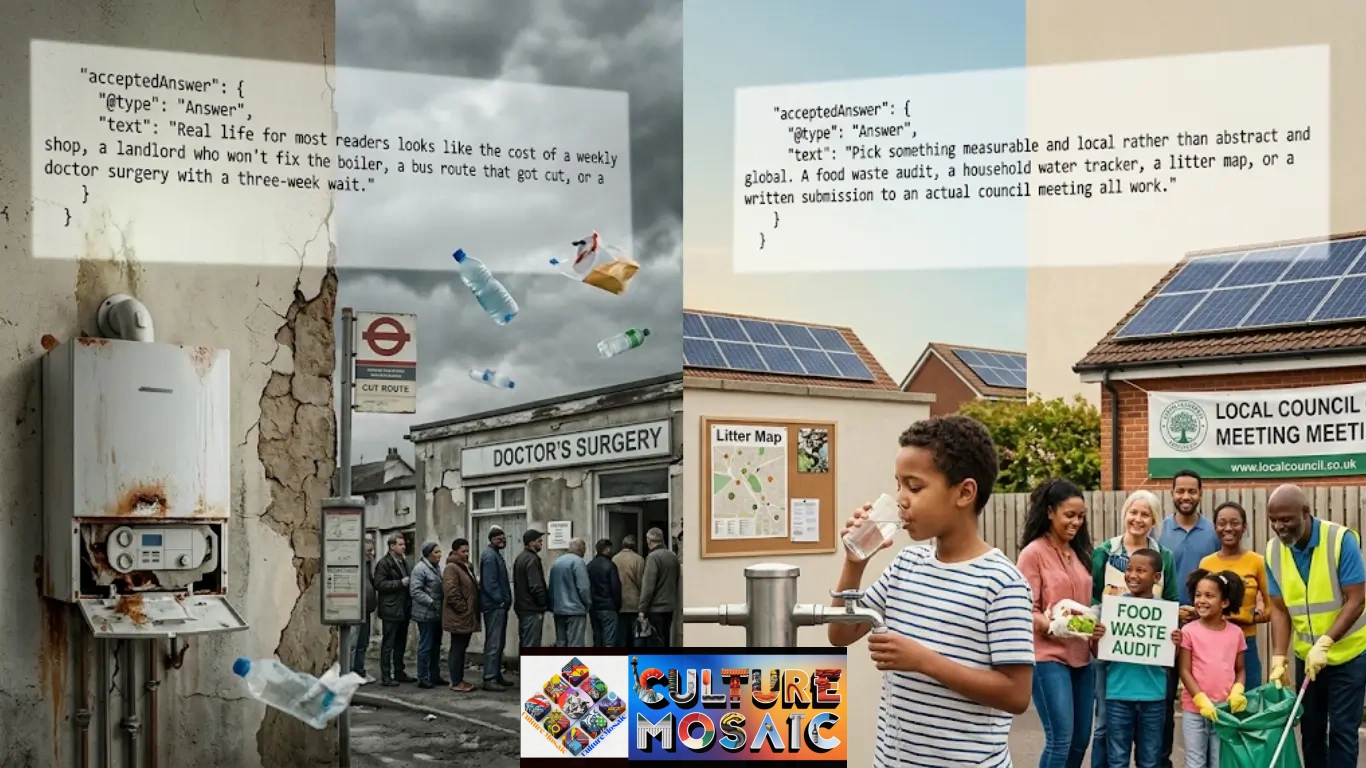
Quick Summary —These are the practical, high-stakes issues hitting actual people right now: poverty, hunger, water scarcity, climate change, conflict, and uneven access to school and healthcare. —Over 800 million people, nearly one in ten of us, still live in extreme poverty in 2025. Almost one in eleven face hunger. —For students, none of this is hypothetical. It shows up in math class, in science fairs, in the food waste bin behind the school canteen. —Some of the toughest problems on this list are, provably, problems in the world that can be solved. Extreme poverty has fallen from 28% of humanity to under 10% since 1999. Renewable power is now outpacing coal. —You don’t need a UN badge to move the needle. Voting, showing up to a public consultation, or picking up a course at your local community college does more than most people assume. |
What Do We Actually Mean by “Real World Problems”?
I’ve spent a good chunk of my career writing about civic life, and I’ll tell you the thing that trips people up first: the phrase sounds like a school assignment. A worksheet term. It isn’t. It describes the issues that shape whether a child eats breakfast, whether a family has clean water on a Tuesday morning, whether a town’s high street survives another decade.
The United Nations tracks these formally under what it calls Real World Problems — a working list that includes climate change, poverty, gender equality, peace and security, and public health, among others. What I like about the UN’s framing is that it refuses to treat these as separate boxes.
Pull on the thread of water scarcity and you find hunger. Pull on hunger and you find conflict. Pull on conflict and you’re back at poverty. These things braid together, whether we like it or not.
Real World Problems Examples: What’s Actually Breaking Right Now
People search “current issues in the world” or “what are 10 major problems in the world” because they want a straight answer, not a lecture. Fair enough. Here’s the list, built from the most current data I could verify.
- Extreme poverty. More than 800 million people, close to one in ten globally, still live below the extreme poverty line as of 2025. Only one in five countries is on track to halve its national poverty rate by 2030.
- Hunger and food insecurity. Nearly one in eleven people worldwide faced hunger in 2023, and more than 750 million go hungry today, with over 2 billion facing food insecurity in some form.
- Water scarcity. Roughly 2.1 billion people, about one in four of us, still lack safely managed drinking water in 2026, according to the WHO and UNICEF’s Joint Monitoring Programme. Some of them walk hours for it. Most of the people doing that walking are women and girls.
- Climate change. 2024 was the hottest year ever recorded, and it pushed past the 1.5°C warming threshold the Paris Agreement was built to avoid. Carbon dioxide levels are the highest they’ve been in more than two million years.
- Conflict and displacement. One in seven people on Earth now lives somewhere touched by armed conflict. The global refugee population reached 37.8 million by mid-2024, and it keeps climbing.
- Education gaps. In 2023, 272 million children and young people were out of school entirely. Not behind. Out.
- Work that doesn’t work. Gallup’s most recent workplace research puts global employee engagement at just 20%, with the rest either checked out or actively miserable in their jobs. Gallup estimates a fully engaged global workforce would add $9.6 trillion to the world economy. That’s not a rounding error.
- Housing insecurity. Over 1.12 billion people live in slums or informal settlements without secure housing, sanitation, or a fixed address to build a life around.
- The unpaid-work gap. Women perform two and a half times as much unpaid domestic and care work as men, globally. It’s invisible on a balance sheet and it shapes everything else on this list.
- Child deprivation. UNICEF’s 2025 report on the state of the world’s children found 417 million children severely deprived in at least two essential areas of wellbeing — health, nutrition, housing, sanitation, water, or education. Sanitation is the worst of it: 65% of children in low-income countries have no access to a toilet.
That’s the unglamorous version of the list. No wordplay, just weight.
Real-World Problems for Students to Solve (and Why Math Class Finally Makes Sense)
Here’s where I’ll push back on something. A lot of parents I talk to think “real world problems for kids” is a soft, feel-good add-on to the curriculum. I think it’s the opposite — I think it’s the part of school most likely to stick.
The OECD’s PISA framework, which tests 15-year-olds across dozens of countries, was built specifically around this idea. Its mathematics assessment doesn’t hand students the tidy, made-up story problems most of us remember.
It asks them to reason through actual situations: population growth, coastline erosion, energy use. The goal, in the OECD’s own words, is testing whether teenagers can use the maths they’ve been taught to make sense of the claims and counterclaims they’ll hear as adults. That’s real world problems math, not textbook math.
Project-based learning research backs this up. A study published in the Mathematics Education Research Journal looked at what actually helps secondary students begin “mathematising” a real-world problem — turning a messy situation into something they can calculate. The short version: students do better when the problem is genuinely theirs to wrestle with, not a template with the names changed.
The National Council of Teachers of Mathematics has built entire units around this, sending students to model things like the cost of buying a car or the physics of a kite in flight, because the numbers mean more when the stakes are real, even at a small scale.
If you’re a teacher or a parent hunting for real-world problems for projects, skip the generic “design a park” brief. Try something with a pulse:
- Audit food waste in the school canteen for a week and calculate the annual cost.
- Track household water use for ten days and compare it against the 2.1 billion figure above.
- Map litter density on three streets near school and pitch a fix to the local council.
And here’s my wildcard: instead of a poster, have the class write and deliver an actual public comment to a local council meeting. It’s unconventional, a bit nerve-wracking for a twelve-year-old, and it teaches a lesson no worksheet can — that a homework assignment can end with an adult in a suit actually changing their mind.
Problems in the World That Can Be Solved: The Hopeful Half of the Story
I don’t want to leave you sitting in the wreckage of that list above, because it isn’t the whole picture. Some of the grimmest numbers in human history have moved, hard, in the right direction — and recently.
Extreme poverty has fallen from 28% of the global population in 1999 to under 10% today. Renewable energy is now the fastest-growing power source on the planet and is projected to overtake coal.
Social protection — pensions, disability support, child benefits, the basic net under a family — now reaches more than half the world’s population, up from 42.8% in 2015. Fifty-four countries have eliminated at least one neglected tropical disease. Forty-five countries have reached universal electricity access.
None of that happened by accident. It happened because governments funded it, because citizens pushed for it, and because enough ordinary people decided a problem worth solving was worth the years it takes to actually solve it. That’s the part search engines don’t surface enough: progress is dull to report and thrilling to live through.
Where the Fix Actually Starts: Closer to Home Than You Think
Here’s my honest opinion, and I’ll own it: most people overestimate what it takes to move a global number and underestimate what it takes to move a local one. You are not going to end extreme poverty from your kitchen table. You might genuinely change whether your town gets a new bus route, a flood defence, or a youth centre.
At Culture Mosaic, we’ve spent a good deal of the past year writing about exactly this gap between the global and the local, because I think it’s where most people’s actual power lives.
If you want the mechanics of it, we’ve laid them out in detail: How Public Feedback Shapes Local Policy walks through what happens to your comment after you submit it, and Why Public Consultation Is Important makes the case for why councils bother asking in the first place. If the terminology has ever confused you, What Is Public Commentary? is the plain-English version.
Voting sits underneath all of it. If you’ve ever meant to register and then forgotten, we track the date every year: Vote Early Day 2026 Date. And if you’re the sort of person who wants to build actual skills toward fixing one of these problems, whether that’s social work, environmental science, or public health, your Local Community College is a cheaper, faster route in than most people realise.
None of this is glamorous. It’s a Tuesday evening in a community hall with bad coffee and folding chairs. But that room is where a shocking amount of real change gets decided, and most seats in it are empty.
Frequently Asked Questions
What are some current real-world issues?
Right now, the sharpest ones are climate change and extreme weather, hunger and food insecurity, water scarcity, armed conflict and displacement, and a widening education gap, with 272 million children out of school worldwide.
Layered underneath those are slower-burning issues like housing insecurity, unpaid care work, and the growing digital divide, which are getting harder to ignore as inequality between and within countries widens.
What are 10 major problems in the world?
Based on the most current data: extreme poverty, hunger and food insecurity, water scarcity, climate change, conflict and displacement, education gaps, unemployment and poor-quality work, housing insecurity and slum growth, the global unpaid-labour gap between men and women, and severe child deprivation.
Every one of them is measured, tracked, and reported on by international bodies every year, so the numbers aren’t guesswork.
What are the 5 biggest problems facing the world today?
If I had to rank them by scale and urgency, I’d put climate change first, because it multiplies nearly every other problem on this page. Then extreme poverty, hunger and food insecurity, conflict and forced displacement, and water and sanitation access.
Reasonable people order this list differently depending on where they live. Someone in a drought-hit region will rank water first every time, and they’d be right to.
What are some real-life issues people deal with daily, separate from these massive global crises?
This is the distinction I think gets lost the most. Global reports track extreme poverty and armed conflict. Real life, for most readers of this piece, looks more like the cost of a weekly shop, a landlord who won’t fix the boiler, a bus route that got cut, or a GP surgery with a three-week wait.
These smaller, closer issues are just as real, and they’re often the ones a single public comment or council meeting can actually shift.
How can real-world problems be turned into projects for students or kids?
Pick something measurable and local rather than abstract and global. A food waste audit, a household water tracker, a litter map, or a written submission to an actual council meeting all work because they end in a number or an action, not just an opinion.
The research on project-based learning is consistent on this point: students engage more, and retain more, when the problem is real and the outcome matters to someone besides their teacher.
Sources
- United Nations, Global Issues — un.org/en/global-issues
- United Nations Department of Economic and Social Affairs, The Sustainable Development Goals Report 2025 — un.org/en/desa
- UN Statistics Division, SDGs Report Key Findings 2025 — unstats.un.org/sdgs
- UN Secretary-General, SDG Progress Report 2025 — unstats.un.org/sdgs
- World Health Organization / UNICEF Joint Monitoring Programme, Global Water Crisis Facts 2026 — unicef.org
- UNICEF, State of the World’s Children 2025 — unwater.org
- The International Rescue Committee, 5 Urgent Problems the World Faces in 2026 — rescue.org
- Gallup, State of the Global Workplace and World’s Most Important Problem Report 2026 — gallup.com
- OECD, PISA Mathematical Literacy Framework — oecd.org
- Mathematics Education Research Journal (Springer), “Using mathematics to solve real world problems: the role of enablers” — link.springer.com
- National Council of Teachers of Mathematics, Rigor, Relevance, and Relationships: Making Mathematics Come Alive with Project-Based Learning — nctm.org