
 By Culture Expert
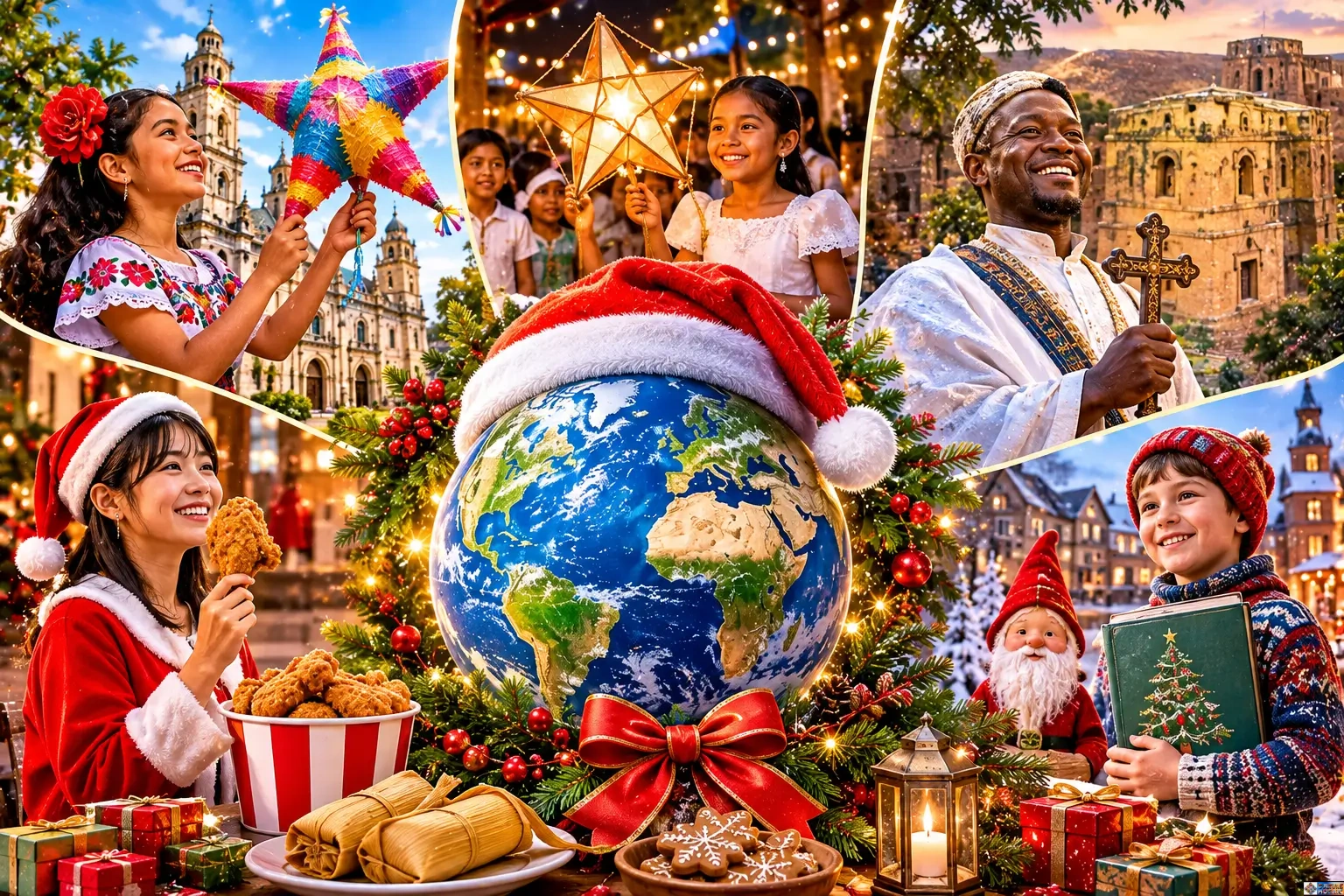
Multicultural Christmas traditions are the many ways people mark the season beyond tinsel and turkey. They include dawn masses in the Philippines, a January 7 feast in Ethiopia, a children’s book swap in Iceland and fried chicken in Japan. This guide covers 12 traditions, a comparison table, the British angle, and four ways to blend customs at home. It also answers the questions people actually search, including whether Muslims can celebrate Christmas.
The problem with the “default” Christmas
Here’s the thing about the default Christmas. It’s narrow.
Tree, turkey, Santa, a cracker joke nobody laughs at. Lovely, if it’s yours. But if your grandmother cooked something else on the 24th, or your partner’s family keeps a different calendar, or your office is full of people who observe nothing at all, that script can feel like a costume that doesn’t fit. I think a lot of people quietly feel this and say nothing.
The fix isn’t ditching what you love. It’s widening the table. That’s where multicultural Christmas traditions earn their place: they hand you a bigger menu of rituals, foods and stories to borrow from. They also show the holiday has never been one thing. Even the “traditional” British version is younger than most people assume. Much of it was assembled in the Victorian era, as our guide to when did modern Christmas traditions begin explains. The longer story of historic Christmas traditions UK goes further back still.
So what do multicultural Christmas traditions look like in practice? Heritage food, religious customs and secular rituals, blended or kept distinct, depending on who’s at the table. Let’s go and look.
Multicultural Christmas traditions around the world
Mexico: Las Posadas and the Night of the Radishes
From December 16 to 24, Mexican communities hold Las Posadas, a nine-night reenactment of Mary and Joseph searching for lodging. Neighbours walk door to door, singing, and are “refused” until the last house lets everyone in. Then comes the party: piñatas, tamales, and ponche, a warm fruit punch.
In Oaxaca, December 23 brings the Noche de Rábanos, or Night of the Radishes. Growers carve oversized radishes into nativity scenes and figures, a festival dating to the late 1800s. Picture a market square at dusk, rows of red-orange sculptures under the lights. It’s absurd and gorgeous.
This is one of the most widely loved Catholic Christmas traditions around the world, partly because it’s communal by design. You can’t do it alone.
The Philippines: the world’s longest Christmas
Filipinos start playing carols when the “-ber” months begin in September. That’s not a joke, and it’s not marketing alone. It’s cultural identity.
The core ritual is Simbang Gabi, nine dawn masses from December 16 to 24, often followed by street-side rice cakes like bibingka and puto bumbong. The icon is the parol, a star-shaped lantern. In San Fernando, Pampanga, called the “Christmas Capital of the Philippines,” giant lanterns light up in a famous annual competition.
Ask me which country has the coolest Christmas traditions and I’ll pick here. Five weeks of build-up gives the holiday a slow, glowing arc that a single December morning can’t match. That’s my opinion, and I’ll defend it.
Ethiopia: Genna on January 7
Ethiopian Orthodox Christians follow the Ethiopian calendar, which is based on the Julian system. Christmas, called Genna, therefore falls on January 7. People often fast for weeks beforehand, then dress in white cotton shamma wraps and attend long church services before feasting. Doro wat, a spicy chicken stew, is served with injera. The date puzzle isn’t unique to Ethiopia, and our guide to religious festivals in the world shows how many calendars shape the same story.
There’s also a hockey-like game traditionally associated with Genna. For readers hunting for Christmas traditions in Africa, Ethiopia is the deepest-rooted example, since its Christian heritage stretches back to antiquity. It’s not a copy of Western Christmas. It’s older than most of it.
Japan: fried chicken and strawberry cake
Roughly one percent of Japan’s population is Christian, yet Christmas Eve is a big night out. The signature move is KFC. A 1974 campaign by KFC Japan pushed the idea of chicken for Christmas, and it stuck so firmly that many families pre-order well ahead.
Dessert is a sponge cake layered with cream and strawberries. Christmas Eve also works a bit like Valentine’s Day, with couples booking dinners. It’s a clear example of a holiday that travels without its religion, and it’s one of the funny Christmas traditions that’s also sincere.
Iceland: the Christmas Book Flood
In Iceland, the big gift is a book. The custom, Jólabókaflóð, is usually traced to wartime import restrictions that left paper relatively available, and publishers release most new titles in the run-up to Christmas. Families open books on Christmas Eve and read through the night, often with chocolate.
Iceland also has thirteen mischievous Yule Lads who visit in the days before Christmas, and a Yule Cat said to punish anyone without new clothes. A shoe goes on the windowsill for treats. It’s folklore with teeth. I wish more cultures tied the holiday to quiet reading.
Poland: Wigilia and the empty chair
Polish Christmas Eve, Wigilia, starts when the first star appears. Families share opłatek, a thin wafer, wishing each other well. The meatless meal traditionally has twelve dishes, often including carp and pierogi. One extra place is set at the table for an unexpected guest or an absent loved one.
That empty chair is the most quietly moving custom I know of. It’s also part of British Christmas now. Polish is the most common main language in England and Wales after English, according to the 2021 census, and Wigilia is kept in homes from Glasgow to Bristol.
Venezuela: roller skates to Mass
In Caracas, tradition has meant skating to early morning Mass in the days before Christmas, with some streets closed to cars. Children reportedly tie a string to their toe and dangle it out of the window so skaters can tug it as they pass. It’s wonderfully odd, and it’s pure neighbourhood fun.
Jamaica and Nigeria: food as the heart
In Jamaica, a dark, rum-soaked black cake and the ruby-red hibiscus drink sorrel anchor the season. In Nigeria, many families travel home, and jollof rice sits at the centre of the table. More on what ends up on the plate in our pieces on Christmas celebration foods and the Christmas cooking list.
12 unique Christmas traditions: a quick comparison
If you only have thirty seconds, this table answers “What are 12 unique Christmas traditions from around the world?”
| Country | Tradition | When |
|---|---|---|
| Mexico | Las Posadas processions | Dec 16–24 |
| Mexico (Oaxaca) | Night of the Radishes | Dec 23 |
| Philippines | Simbang Gabi dawn masses and parol lanterns | Dec 16–24 |
| Ethiopia | Genna feast, white shamma | Jan 7 |
| Japan | KFC dinner and strawberry cake | Dec 24–25 |
| Iceland | Jólabókaflóð book gifting | Dec 24 |
| Poland | Wigilia and the empty chair | Dec 24 |
| Venezuela | Skating to Mass in Caracas | Dec 16–24 |
| Catalonia (Spain) | Caga Tió, the “pooping log” | From early Dec |
| Italy | La Befana, the gift-bringing witch | Jan 5–6 |
| Sweden | Gävle Goat, a giant straw goat (first built 1966) | Advent |
| Norway | Hiding the brooms on Christmas Eve | Dec 24 |
Four of those deserve more than a table cell.
Catalonia: Caga Tió. Children feed a hollow log with a smiling face from early December, cover it with a blanket, then hit it with sticks while singing until it “poops” small gifts. Weird? Absolutely. It’s also my wildcard pick, the tradition that sounds made up and isn’t. For more oddities, see our roundup of unusual Christmas traditions around the world.
Italy: La Befana. On the night of January 5, a kindly witch on a broomstick is said to fill children’s stockings with sweets, or coal for the naughty. She belongs to the Epiphany, so Italian gift-giving traditionally lands on January 6, not December 25.
Sweden: the Gävle Goat. Since 1966, the city of Gävle has erected a giant straw goat each Advent. It has a long, notorious history of being burned down, and every year locals watch it with a mix of pride and dread.
Norway: hiding the brooms. On Christmas Eve, many Norwegians tuck brooms out of sight. The custom comes from old beliefs that witches and spirits roamed that night looking for something to ride. Tidy, practical, and slightly spooky.
Multicultural Christmas traditions in the UK
You don’t have to book a flight. Britain already holds a good share of this list.
Jamaican sorrel and black cake are staples in many British-Caribbean households across London and Birmingham, often sitting beside the roast. Nigerian jollof turns up next to roast potatoes on plenty of UK Christmas tables. And while the older, church-and-market version of the season lives on in classic Christmas themed events, the newer one is being cooked in kitchens across the country. If you want the longer view on how these layers stacked up, our Christmas festival history piece is a good companion.
Can Muslims also celebrate Christmas?
It’s a real question, and the honest answer is that Muslims hold different views. Islam honours Jesus (Isa) as a prophet and Mary (Maryam) as a revered figure, and Mary has a chapter of the Quran named for her. Some scholars say joining Christmas worship or rituals isn’t permissible. Others accept sharing a meal, giving greetings or attending a neighbour’s gathering as good manners and good neighbourliness. Individual families draw their own lines, so ask rather than assume. If you’re hosting a mix of multicultural Christmas traditions, offer a dish everyone can share and a welcome that doesn’t require anyone to take part in worship.
How to blend multicultural Christmas traditions at home
You don’t need a grand plan. Four small moves:
- Host a heritage potluck. Everyone brings one dish from their family’s table, with a note about where it comes from.
- Borrow a ritual. Try Iceland’s book swap, or a Wigilia-style empty chair for someone absent.
- Share the story, not just the plate. Spend two minutes on why a dish matters. That’s where the connection happens.
- Make a mixed playlist. Mix carols with music from every heritage in the room.
Communities are already doing this at scale in Britain. Take a look at UK community Christmas initiatives and civic Christmas traditions for ideas. There’s also a useful BBC Travel feature on multicultural Christmas traditions that swap gifts for meaning.
One last thought
Somewhere tonight, someone is hanging a star-shaped lantern, someone else is setting an empty chair, and a child is hitting a log with a stick. None of it is the “real” Christmas. All of it is. The season isn’t a single story you inherit. It’s one you keep adding to, and this year you get to add a line.
Frequently asked questions
1. What are the top 5 Christmas traditions?
The most widespread are decorating a tree, exchanging gifts, a gift-bringing figure such as Santa Claus, carols and music, and a shared festive meal. Each shifts shape by region. The gift-bringer might be Santa, La Befana, or the Yule Lads.
2. What country has the coolest Christmas traditions?
It’s subjective. My pick is the Philippines for its months-long season, Simbang Gabi and glowing parols. Iceland’s book flood and Mexico’s Las Posadas are strong rivals.
3. Can Muslims also celebrate Christmas?
Views differ. Muslims honour Jesus and Mary, but scholars disagree on joining Christmas rituals. Many accept sharing meals or greetings as neighbourly courtesy, and individual families decide for themselves.
4. What are the Christmas traditions in Africa?
They vary widely. Ethiopia celebrates Genna on January 7 with white garments and shared stews. In Nigeria, families travel home for jollof-rich feasts. In South Africa, where it’s summer, many gather outdoors for a braai.
5. Why is Christmas on different dates in different countries?
Some Orthodox churches follow the Julian calendar. Ethiopian Christians therefore celebrate on January 7, as do many other Orthodox communities, while others observe December 25.