
 By Dr. Marcus Hale
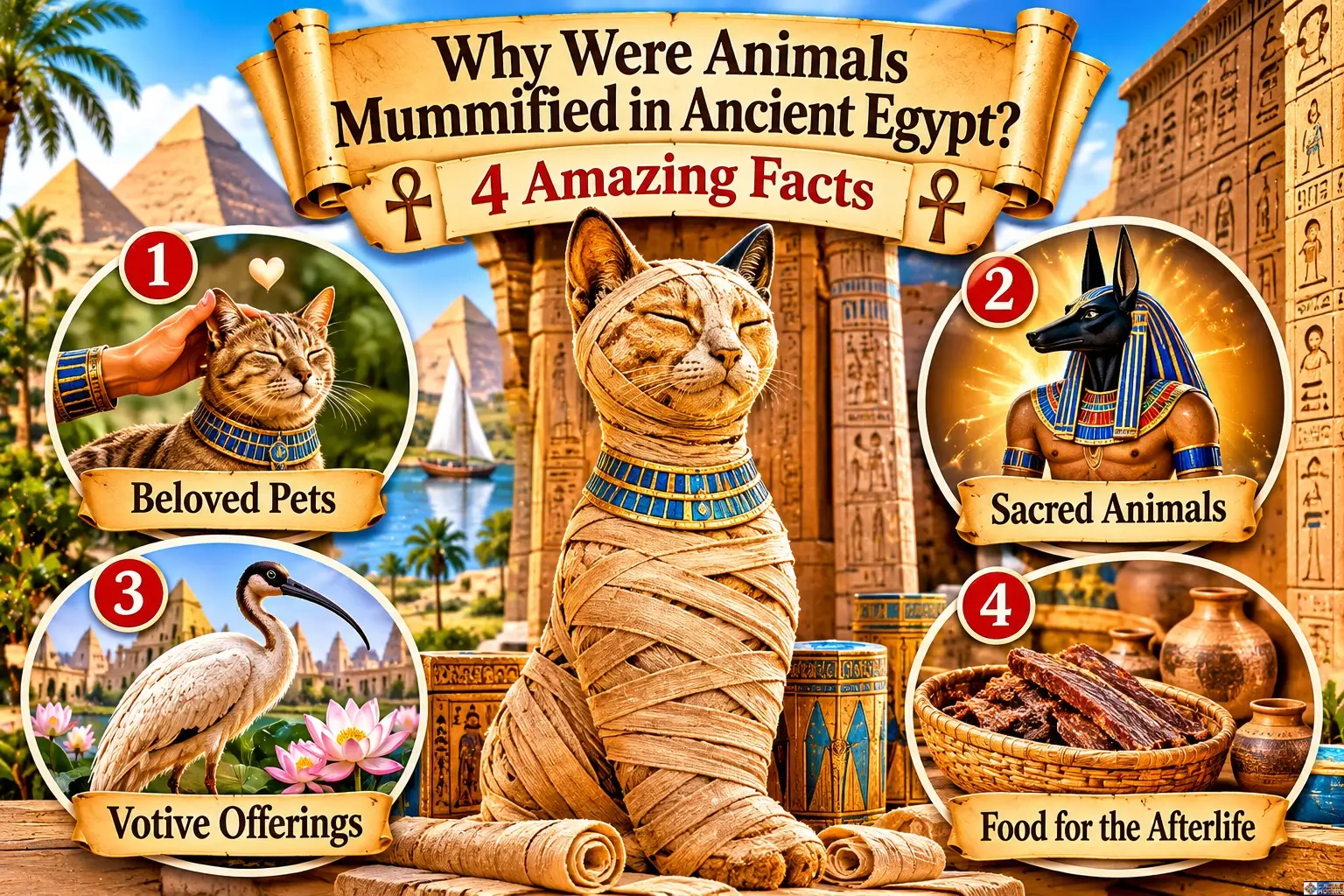
Quick Summary: Why Were Animals Mummified in Ancient Egypt?
Ancient Egyptians mummified animals for four core reasons: to keep beloved pets with their owners in the afterlife, to honor sacred cult animals believed to host a god on Earth, to deliver prayers to the gods as votive offerings, and to supply victual mummies (preserved meat) so the deceased never went hungry.
- Pets: Family cats, dogs, monkeys, and gazelles preserved for eternal companionship.
- Sacred Animals: Individual animals (like the Apis Bull) worshipped during life as divine avatars.
- Votive Offerings: Millions of wrapped animals sold to pilgrims as physical prayers to specific deities.
- Victual Mummies: Salted, dried meats (duck, geese, beef) packed into tombs as eternal food.
Picture a cat curled on a doorstep in the Nile Valley around 2,500 years ago. One morning she doesn’t wake up. According to the Greek historian Herodotus, the household would shave off their eyebrows in mourning before taking her to be embalmed.
That small act of grief sits at one end of a story that is much bigger than most people expect. Researchers estimate that up to 70 million animals were mummified in ancient Egypt, and tens of millions of them were never anyone’s pet. So what was going on? Why would a civilization wrap cats, birds, crocodiles and even beetles in linen and bury them by the million?
If you’ve ever looked at a mummified cat in a museum and wondered whether it was love, religion or business, the honest answer is all three. To understand how closely animals were woven into daily routines, explore our guide on everyday life in ancient Egypt.
The Puzzle: Why Mummify an Animal at All?
Mummification was expensive, slow and sacred work. Why spend it on a cat or an ibis? The puzzle is real, and for a long time scholars struggled to explain the sheer numbers.
The key is that Egyptians did not see animals the way we usually do. Animals could be companions, but they could also be living symbols, messengers or even a visible form of a god. Once you hold that idea in your head, the practice stops looking strange and starts looking logical.
Egyptologists generally sort animal mummies into four main types: pets, sacred animals, votive offerings and victual (food) mummies. A fifth group, often called false or pseudo-mummies, turns up in the research too. For a deeper catalogue, see our overview of ancient Egyptian animal mummies.
Reason 1: Beloved Pets Who Were Meant to Stay Family
Core Motive: Preserving an eternal bond between an owner and their cherished companion.
This is the motive that tugs hardest at modern hearts, and it’s well supported. Tomb scenes from as early as the Old Kingdom show owners with cats, dogs, monkeys and birds. Some of these animals were mummified and buried with, or near, their people:
- Hapymen’s dog: Cairo’s Egyptian Museum describes a man named Hapymen whose dog was mummified, wrapped in cloth and placed beside his coffin.
- A queen’s gazelle: A pet gazelle, preserved in fine blue-trimmed bandages with a custom wooden coffin, accompanied its owner to the grave around 945 BC.
- KV50: A mummified dog and baboon were found together in tomb KV50 in the Valley of the Kings, near the tomb of Amenhotep II.
More than seventy pet names have been deciphered from inscriptions on dog mummies, showing these were far from anonymous animals.
Why were cats mummified in ancient Egypt?
Cats protected grain stores from rodents and were admired for killing venomous snakes. They were also linked to the goddess Bastet, whose cult centre at Bubastis was among the richest in Egypt. Herodotus records that cats were taken to sacred buildings in Bubastis to be mummified and buried.
However, when researchers examined cat mummies in a Warsaw museum collection, they concluded that most were probably killed young and mass-produced for votive use. A mummified cat in a museum might be a cherished pet, a temple offering, or a product of the pilgrimage trade.
Where do pets fit on the scale?
Pet mummies were the rarest type—an act of personal love, not a mass industry. Notably, a pet cemetery at Berenike on the Red Sea (1st to 2nd century AD) held cats, dogs and monkeys that were carefully buried but not mummified, showing that embalming was a choice rather than an automatic rule.
Reason 2: Sacred Cult Animals, the Living Gods
Core Motive: Honoring a single, living animal chosen as the physical avatar of a deity on Earth.
Some animals were treated as a living manifestation of a god. The most famous is the Apis bull, regarded as an incarnation of Ptah, creator god of Memphis. When an Apis died, roughly 68 days of embalming were followed by massive funeral processions, with the entire ritual lasting around 70 days. The burial place was the Serapeum at Saqqara, whose underground corridors hold stone sarcophagi weighing tens of tonnes.
Other sacred animals were honored in similar ways: rams linked to Khnum, and local animals tied to regional deities. Discover how sacred burials connected to human rites in our guide to ancient Egyptian burial customs.
Reason 3: Votive Animal Mummies, Prayers You Could Buy
Core Motive: Serving as physical gifts purchased by pilgrims to deliver prayers to deities.
Votive mummies were by far the most common kind of animal mummy. Pilgrims visited a sanctuary during a festival, bought an animal mummy connected to the local god, and handed it to a priest who buried it in a catacomb. Egyptians believed the animal’s spirit carried the person’s request or thanks directly to the deity.
Animal Mummies at a Glance
Votive Mummies at Saqqara and Scale of Industry
Saqqara is the best-known home of these offerings. In November 2019, Egypt’s Ministry of Antiquities announced a cache containing mummified cats, cobras, crocodiles, scarab beetles and lion cubs dating to the Late Period (664–332 BC). To explore this necropolis further, see secrets of the mummy’s tomb.
Researchers from the University of Manchester estimate roughly 70 million mummified animals were produced over 1,200 years. To supply that demand, animals were systematically raised and bred, requiring vast supplies of fodder, oils, resins and linen. It was a thriving religious economy.
Reason 4: Victual Mummies, Meals for the Afterlife
Core Motive: Providing eternal food and sustenance for the spirit (Ka) of the deceased.
Egyptians believed the dead still needed to eat. Dr. Salima Ikram uses the term victual mummies to describe cuts of beef, duck, goose and pigeon that were salted with natron, dried, and wrapped in linen. Tutankhamun’s tomb contained wooden coffin-shaped boxes holding preserved meats, directly linking this practice to royal burials. For more on King Tut, read how did King Tut die and why.
The Twist: What CT Scans Found Inside
When researchers at the Manchester Museum and University of Manchester used CT scanning on over 800 animal mummies, they discovered a surprising breakdown:
- 1/3 contained a complete animal: Fully preserved intact skeletons.
- 1/3 held only partial remains: Single bones, feathers, or shell fragments.
- 1/3 held no animal material at all: Bundles filled with mud, reeds, or eggshells.
Dr. Lidija McKnight cautioned against judging ancient practice by modern ideas of fake goods. Organic items like feathers or eggshells carried sacred ties to the deity and acted as meaningful stand-ins when demand outstripped supply. Learn how non-invasive technology examines mummies in our guide to virtual unwrapping Egyptian mummies.
Mummification Process: How Were Animals Actually Preserved?
The process varied. Pets and cult animals received treatments echoing human embalming—natron drying, resin coatings, and intricate geometric linen wrapping. Votive animals were prepared much faster. For human embalming context, explore ancient Egyptian mummification process history, mummies preservation techniques, and what is mummy in history?.
Curious about timelines? See where ancient Egyptian mummies were first buried and how old most Egyptian mummies are.
Frequently Asked Questions
1. Did ancient Egyptians mummify pets?
Yes, though pet mummies were less common than votive offerings. Cats, dogs, monkeys, birds and gazelles were mummified and buried with or near their owners. Cairo’s Egyptian Museum describes a man named Hapymen whose dog was mummified and placed beside his coffin.
2. What were votive animal mummies?
Votive animal mummies were animals mummified and offered to a god as a prayer or thank-you. Pilgrims bought them at sanctuaries, and priests buried them in catacombs. Because the animal was linked to a deity (like a cat to Bastet or an ibis to Thoth), it carried messages to the god.
3. What are victual mummies?
Victual mummies are preserved cuts of meat or birds (duck, goose, beef) wrapped in linen and placed in tombs as food for the deceased’s spirit. Tutankhamun’s tomb contained wooden boxes holding preserved meats.
4. Were all animal mummies really animals inside?
No. A Manchester Museum CT scan study of over 800 animal mummies found that about a third held a complete animal, a third held partial remains, and a third held non-animal materials like feathers or mud acting as sacred stand-ins.
5. How many animals were mummified in ancient Egypt?
Estimates reach up to 70 million over roughly 1,200 years. Catacombs at sites like Saqqara, Tuna el-Gebel and Bubastis held vast numbers, with votive offerings forming the vast majority.
Keep Exploring
If you’re intrigued by how colors and rituals intersect with mummification, discover our analysis on green mummies and Egyptian afterlife facts or explore royal burial traditions in Seti I’s wife.
Sources and Further Reading
- University of Manchester. “BBC Horizon: Egypt’s dark secret.” manchester.ac.uk
- Pruitt, Sarah. “Scientists Reveal Inside Story of Ancient Egyptian Animal Mummies.” History.com. history.com
- National Geographic. “Animals Everlasting” (Williams, photographs by Richard Barnes). nationalgeographic.com
- McKnight, L., Bibb, R. et al. “Appearance and Reality in Ancient Egyptian Votive Animal Mummies.” Journal of Ancient Egyptian Interconnections 20 (2018): 52-57. jaei
- “The role of textiles in animal cults” (animal mummies in ancient Egypt). Archaeological Textiles Review. tidsskrift.dk
- Ejsmond, W. and Przewłocki, Ł. “Some remarks on cat mummies in light of the examination of artefacts from the National Museum in Warsaw collection.” journals.akademicka.pl
- Osypińska, M. et al. Animal burials at Berenike, Antiquity (2016). cambridge.org
- Linseele, V., Van Neer, W. and Hendrickx, S. (2007). “Evidence for early cat taming in Egypt.” Journal of Archaeological Science 34. doi.org
- Friedman, R. “Animal burials in the Predynastic: a view from Hierakonpolis,” in British Museum, Animal mummies: from beliefs to practice (abstracts). britishmuseum.org
- Herodotus, Histories 2.65-67 (translation by Robin Waterfield), as presented by World History Encyclopedia. worldhistory.org
- Diodorus Siculus, Library of History 1.83 (primary source), discussed at Laudator Temporis Acti. blog commentary
- Al Jazeera. “Egypt unveils animal mummies of lion cubs, crocodiles, cats” (24 Nov 2019). aljazeera.com
- Egyptian Museum, Cairo, via Egypt Museum. “The Mummified Dog.” egypt-museum.com
- Brooklyn Museum. “Mummified Dog.” brooklynmuseum.org
- Cosmos Magazine. “What do ancient Egyptian mummies smell like?” cosmosmagazine.com
- Al-Ahram Weekly. “The Apis tombs at Saqqara Necropolis back on Egypt’s tourist map.” ahram.org.eg
Note on dates and estimates: figures such as the 70 million total and the one-third scan results come from published research and press summaries and may be refined by future studies.