
 By Dr. Marcus Hale
Quick Summary
Seti I wife was Queen Tuya (also written Tuy, or Mut-Tuya), the mother of Ramesses II. She was born outside the royal family, the daughter of a chariotry officer named Raia, yet she became one of the most honoured women of the 19th Dynasty. She is best known as the mother of Ramesses the Great, was buried in tomb QV80 in the Valley of the Queens, and received a funerary chapel at her son’s temple, the Ramesseum. Her name is also attached to a famous modern myth: no Egyptian source connects her with Moses, whose historical existence is itself unproven.
Who Was Seti I Wife? Queen Tuya and 19th Dynasty Royal Lineage
Imagine searching for the woman behind one of Egypt’s most powerful pharaohs, and finding that most of her story was written after her husband’s death, by her son. That is the puzzle of Seti I’s wife.
Many readers type “Seti I wife” and get tangled, scattered answers: a cartoon queen here, a museum label there, a name spelled three different ways. This guide pulls it together in one place, using Egyptological sources, so you can tell what is documented from what is legend.
Tuya was the wife of Seti I (reigned about 1294–1279 BC) and the mother of Tia, Ramesses II, and possibly Henutmire. Her name appears in hieroglyphs as Twy or Twjȝ, and in some texts as Mut-Tuya. The Hittite diplomatic letters even preserve it in cuneiform. If you enjoy untangling Egypt’s royal families, you may also like our guide to Egyptian burial customs.
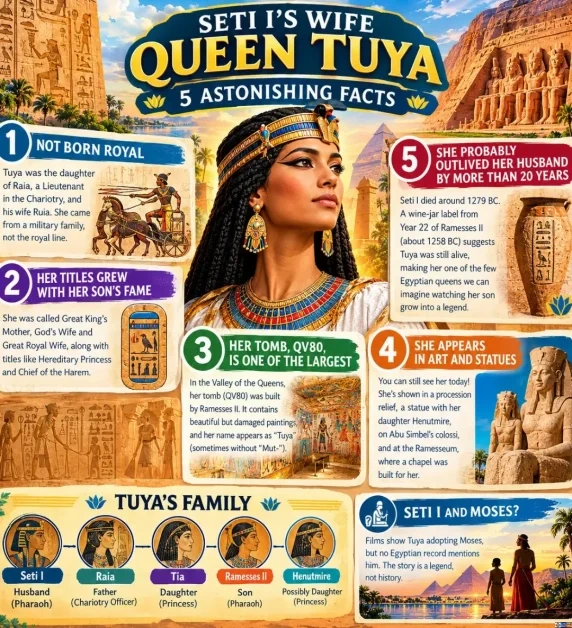
Queen Tuya: From a non-royal military family to Great Royal Seti I Wife and mother of Ramesses II.
Fact 1: Tuya Was Not Born Royal
Here is what surprises most readers. Tuya did not come from the old royal line. She was the daughter of Raia, a Lieutenant in the Chariotry, and his wife Ruia (the name is partly broken in the inscriptions). Wikipedia’s entry on Tuya and the Royal Ontario Museum relief description both record this.
That fits the 19th Dynasty’s own story. The family itself rose from the military. Seti I’s father, Ramesses I, was an army man who became king after Horemheb. So Tuya’s marriage tied two soldier families together at the moment the Ramessides were building a new dynasty.
Fact 2: Her Titles Grew with Her Son’s Fame
Tuya’s titles read like a ladder. In inscriptions from her son’s reign she is called Great King’s Mother, God’s Wife, and Great Royal Wife, along with titles such as Hereditary Princess and Chief of the Harem.
There is an important scholarly caveat. Most of the evidence naming her queen dates to the reign of Ramesses II, not Seti I. So we cannot be completely certain she held “Great Royal Wife” while her husband lived, though as mother of his only known son it is very likely. Seti I had at least one other spouse, the royal daughter Tanedjmet.
Fact 3: Her Tomb, QV80, Is One of the Largest in the Valley of the Queens
Ramesses II built his mother a new tomb in the Valley of the Queens. QV80 lies just west of Nefertari’s famous tomb QV66, and the Theban Mapping Project counts it among the largest tombs in that valley.
What survives is fragmentary. Later reuse (in the Third Intermediate Period and possibly later) damaged the paintings. Archaeologists found a canopic jar head, sarcophagus fragments, and ushabti pieces. One touching detail: in the tomb her cartouche appears to have lost the Mut- (“Mother”) prefix, leaving her simply “Tuya”. Scholars have read this as a sign that her death was treated as a step toward divine status, though that is an interpretation, not a certainty.
The tomb is currently closed to visitors. To understand why such tombs were built, see Secrets of the Mummy’s Tomb and Where Were Ancient Egyptian Mummies First Buried?.
Fact 4: Queen Tuya Leads a Procession, and Appears on Colossal Statues
You can still see Tuya today:
- Royal Ontario Museum (Toronto): a limestone relief, Queen Tuya Leads a Procession (955.79.2), shows her holding flowers and an incense burner, wearing a vulture headdress topped by a modius. Her hair is covered by this royal headdress rather than shown naturally.
- The Vatican Museums: a statue from the Ramesseum shows Tuya with the princess Henutmire at her side. The sculpture was originally made in the 18th Dynasty, with the features of Queen Tiye, and was reused by Ramesses II for his mother.
- Abu Simbel: Tuya appears on two of the colossi flanking the temple entrance.
- The Ramesseum: fragments of a chapel dedicated to Queen Mother Tuya were found at her son’s mortuary temple.
- Abydos, Deir el-Medina and Kafr el-Gebel: her name appears on statue fragments, a lintel, and a stela showing her with her daughter Tia and Tia’s husband.
Fact 5: She Probably Outlived Her Husband by More Than Twenty Years
Seti I died around 1279 BC. Tuya seems to have lived on as Queen Mother well into Ramesses II’s long reign. A wine-jar label dated to Year 22 of Ramesses II, found in her tomb, is the main basis for the estimate that she died around then (roughly 1258 BC). By the time Abu Simbel was inaugurated in Year 24, she appears to have been dead.
That makes her one of the few Egyptian queens whom we can imagine watching her son grow from crown prince into a legend.