
 By Dr. Marcus Hale
In 1996, a donkey stumbled into a trench near the village of Bawiti, in Egypt’s Western Desert, and accidentally pulled the lid off one of the most staggering archaeological discoveries of the twentieth century. The animal’s hoof had broken through into a subterranean burial shaft. What lay beneath was not stone, not pottery, and not sand. It was gold. The golden mummies of Egypt had been waiting, quietly, for two thousand years.
Forget the stone pharaohs of the New Kingdom. These are different. They belong to a later, stranger era, when Egypt had already been conquered twice over, first by Alexander the Great, then by Rome, and yet something of the old religion refused to die. The people buried in the Bahariya Oasis during the Graeco-Roman period, roughly 332 BC to AD 395, wanted the same thing their ancestors had always wanted: a body preserved well enough to carry the soul into eternity. They just had more money to spend on it.
The Valley of the Golden Mummies: A Chance Encounter
The excavation that followed the 1996 discovery was led by Dr. Zahi Hawass, then director of the Giza Pyramids and one of Egypt’s most recognisable archaeologists. What he found at Bahariya was not a single tomb but an entire necropolis, stretching beneath the desert floor across an area of several square kilometres. The site, which Hawass named the Valley of the Golden Mummies, contained burial shafts stacked with gilded cartonnage, painted terracotta coffins, and linen-wrapped bodies laid out in family groupings.
In the early seasons of excavation alone, his team uncovered more than 250 mummies. Conservative estimates suggest the full site holds several thousand more. That is not a burial ground. That is a city of the dead, and it operated continuously for several centuries. The settlement it served, ancient Bahariya, was a prosperous oasis town that grew fat on the wine trade, supplying the Roman legions and the emperor’s table with vintages considered among the finest in the ancient world.
The wealth that wine brought is visible in every gilded face. The most elaborate mummies, the ones that qualify as what we now call the golden mummies of Egypt, were found in the western section of the necropolis, in shafts that could hold a single family across multiple generations. These were not royal burials. They were merchant burials. And in some ways that makes them more fascinating than any pharaoh’s tomb.
A Meeting of Three Worlds: Face to Face with Graeco-Roman Egypt
There is a particular kind of cultural vertigo you feel when you look at these mummies up close. The face staring back at you might have a Roman hairstyle, the tight curls of the Julio-Claudian court, or the elaborate coiffure of a second-century Roman matron. But around the body, carved into the plastered cartonnage in low relief, you will find Anubis with his jackal head, or Osiris with his crook and flail, or Isis spreading her wings across the chest of the deceased.
Roman-Style Hairstyles and Egyptian Gods
This is not syncretism in the vague, hand-wavy sense the word sometimes gets used. It is something more specific and more deliberate. The Roman or Greek settler living in Bahariya during the first or second century AD had made a choice. They lived in a Roman province. They might have worn Roman dress, spoken Greek in the marketplace, paid taxes to a Roman governor. But when it came to the one thing that mattered most, the passage of the soul into whatever came next, they trusted Egyptian theology. They wanted Anubis at the door.
The painted portraits on these cartonnages have a directness that is almost unnerving. Many belong to the tradition of the Fayum portraits, encaustic or tempera paintings on wooden panels inserted into the wrappings at the face. The subjects look out at the viewer with wide, dark eyes and a faintly questioning expression. You get the sense they are not posing for posterity. They are simply looking at you, as they have been looking since the first century AD, and they are waiting for something.
The Spiritual Alchemy of Gold Leaf
The gilding on these mummies is not decorative in the way we tend to think of gold as decoration today. It is functional, in a theological sense. In ancient Egyptian religion, the gods were not made of flesh. They were made of gold. The hieroglyphic texts and the funerary literature of the New Kingdom are explicit on this point: the skin of Ra, the skin of Osiris, is gold. Bone is silver. Hair is lapis lazuli.
By covering the cartonnage in gold leaf, the embalmers were not making the deceased look wealthy. They were making them divine. The gold was a kind of spiritual technology, a means of effecting transformation. The deceased, lying in their gilded shell, was being dressed for a specific encounter: the weighing of the heart before Osiris in the Hall of Two Truths. They needed to arrive looking like a god because only a god could survive that judgment. For a deeper understanding of what awaited the soul in this belief system, the Egyptian Concept of Life After Death is worth reading in full.
Inside the Necropolis: How Wealth Dictated Eternity
The valley was not a democracy. The quality of a burial, and the amount of gold on the cartonnage, tracked almost exactly with the social and economic position of the deceased. Dr. Hawass and his colleagues identified a clear stratification across the site, and it tells us a great deal about how Bahariya society was structured during the Roman period.
Burial Tier Comparison
| Burial Tier | Primary Materials | Artistic Features | Social Class |
|---|---|---|---|
| Gilded Cartonnage | Real gold leaf, thick plaster, linen resin | Fully modelled faces, elaborate crowns, depictions of gods | High-net-worth merchants, governors, elite families |
| Painted Terracotta | Clay anthropoid coffins, pigments | Stylised faces, geometric patterns, regional folk art | Middle-class citizens, local tradespeople |
| Linen Wrap Layer | Plain linen, palm sticks, basic resin wrap | No facial modelling, highly minimalist presentation | Working-class labourers and agricultural families |
The table above makes one thing plain: gold was a finite resource in the necropolis, and it followed money. The wealthy merchant could afford real gold leaf applied over thick plaster cartonnage. The middling tradesperson received a painted terracotta coffin that imitated the form of the elite burials without the material cost. The labourer was wrapped in linen and placed in the shaft with little ceremony.
What is striking, though, is that all three tiers were buried together. The same necropolis, the same sacred ground, the same community of the dead. In the afterlife, at least, Bahariya’s social hierarchy was laid to rest in a shared space.
Shrouded in Splendour: Key Artifacts from the Valley
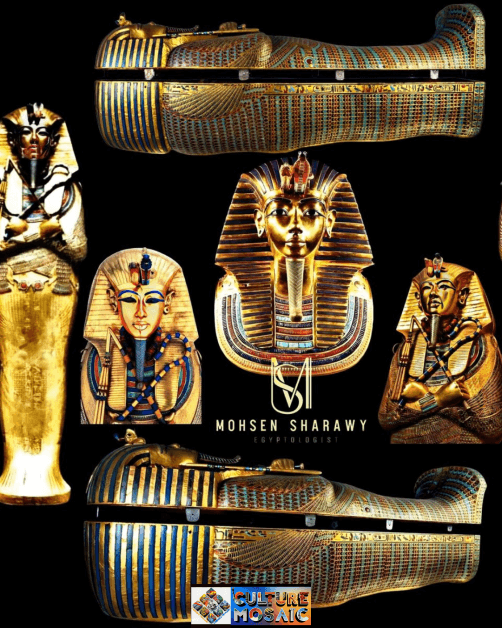
Among the hundreds of mummies excavated, a handful stand out for their craft, their preservation, or the stories they seem to carry.
The Lady with the Coin Hairdo
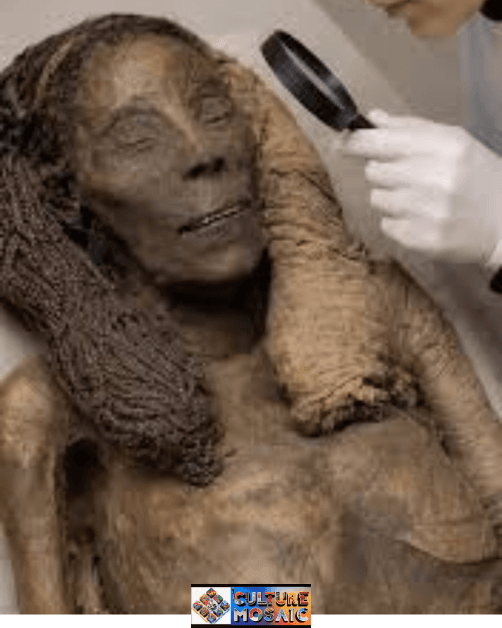
One of the most discussed mummies from the early excavations is a woman whose cartonnage mask depicts her with an elaborate Roman hairstyle arranged in tight ridged rows across the crown of her head, a style fashionable in Rome during the late first century AD. Her face is painted in warm ochre and red, with lips slightly parted and eyes rendered with the kind of close attention that suggests a real portrait rather than a type. Around her neck, painted in gold, she wears what appears to be a collar of Isis beads.
She was almost certainly from a prosperous family, possibly the wife or daughter of a wine merchant or a local administrator. The combination of Roman fashion and Egyptian funerary iconography on her cartonnage is a precise record of the world she inhabited: a world that was simultaneously Roman, Greek, and irreducibly Egyptian.
The Official with the Victory Crown
Another significant find is a male mummy whose gilded mask shows him wearing a wreath, possibly a Roman civic crown awarded for public service. Around his body, the cartonnage is decorated with panels showing Anubis performing the opening of the mouth ceremony, one of the most sacred rituals in Egyptian funerary practice, in which the mouth, eyes, and nostrils of the mummy were symbolically opened to allow the deceased to speak, see, and breathe in the afterlife.
The civic crown on a man’s portrait alongside the most ancient Egyptian funeral rite is not a contradiction. It is a summary of what the Graeco-Roman period actually was: a negotiation between cultures that was never fully resolved, and was never meant to be.
Where Are the Golden Mummies of Egypt Now?
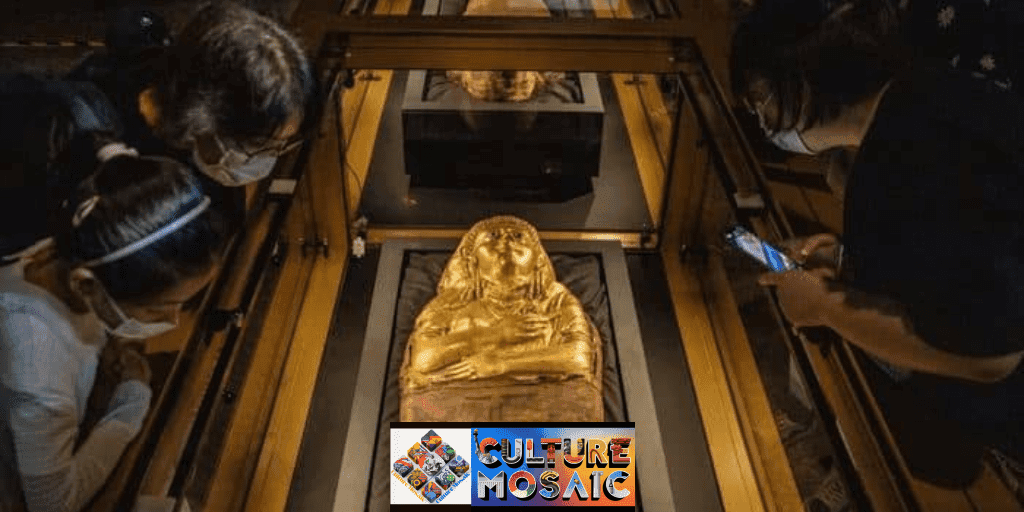
This is one of the first questions people ask, and it deserves a direct answer. The majority of the mummies excavated from Bahariya remain in Egypt, as they should. Most are held in controlled storage at the excavation site itself, given the logistical challenge of housing several hundred fragile artefacts. A selection of the finest examples are displayed in the Bawiti Museum in the Bahariya Oasis, a relatively modest facility that is nonetheless worth the journey from Cairo.
The National Museum of Egyptian Civilisation in Cairo, which opened its permanent galleries fully in 2021, holds additional pieces from the Graeco-Roman period and offers the best context for understanding where the Bahariya mummies sit within the broader sweep of Egyptian funerary history. If you are making a trip specifically to see Roman-period mummies, the NMEC is the place to start.
It is worth noting that the vast majority of the Bahariya site remains unexcavated. Current estimates suggest that fewer than ten percent of the mummies in the valley have been uncovered. The rest are still there, under the sand, waiting. That thought alone is enough to stop you mid-step.
Beyond Bahariya: The Golden Mummies of Egypt in a Wider Context
Bahariya is the most spectacular single site, but the phenomenon of Graeco-Roman gilded mummification was not confined to one oasis. Similar burials have been found across the Fayum region, in Alexandria, and in the Nile Delta. The Fayum portraits, already mentioned above, represent a related tradition in which naturalistic painted likenesses were inserted into the wrappings, producing objects that straddle the line between portraiture and religious artefact.
What connects all these finds is the same underlying impulse: the desire to preserve the body with the best available materials, to mark the face as individual and recognisable, and to surround the deceased with the iconographic vocabulary of Egyptian religion, no matter what language the dead person had spoken in life. The most famous Egyptian mummies from the pharaonic period get most of the attention, but the Graeco-Roman mummies are arguably more culturally complex, because they document a moment of genuine civilisational collision.
There is also the question of what these mummies reveal about the texts wrapped inside them. The discovery of mummies at Bahariya and across the Fayum that contained recycled papyrus has opened up a remarkable field of inquiry. Some of these papyri are literary texts, including fragments of Homer. For anyone interested in this intersection of mummification and manuscript survival, the story of the Egyptian mummy Iliad papyri is one of the stranger footnotes in the history of classical literature.
The Craft of Immortality: How the Golden Mummies Were Made
The mummification process that produced the Bahariya burials was a long way from the simplified version taught in school. It was a skilled trade, passed down through specialist families attached to the temple complexes. The process could take up to seventy days and involved a sequence of steps that were as much liturgical as physical.
Embalming and the Cartonnage Shell
After the internal organs were removed and stored in canopic jars, the body was packed in natron, a naturally occurring salt, for approximately forty days to desiccate the tissues. It was then washed, anointed with cedar oil and other resins, and wrapped in linen. Over the linen, the craftsmen built the cartonnage: layers of linen or papyrus soaked in plaster and moulded to the shape of the body, then decorated and, in the case of the wealthiest commissions, covered in gold leaf.
The gold leaf was applied in thin sheets over a layer of adhesive, and the surface was then painted to add details of colour to the face, the collar, the funerary scenes running down the sides of the body. The final product was not just a coffin. It was a sculpture. A portrait. A theological statement.
The Role of Anubis and Osiris
The two gods most consistently depicted on the Bahariya cartonnages are Anubis and Osiris. Anubis, the jackal-headed god of embalming, was understood as the divine patron of the embalmers themselves, and his image on the cartonnage was both a tribute to his craft and a practical statement: this body has been prepared correctly. Osiris, the ruler of the dead, was the goal. The deceased was not merely trying to reach the afterlife. They were trying to become Osiris, to merge with the god and achieve a kind of divine immortality.
The gold leaf served both gods simultaneously. It marked the body as incorruptible, like a god’s body, and it signalled readiness for the encounter in the Hall of Two Truths. In the weighing of the heart ceremony, the heart of the deceased was weighed against the feather of Ma’at, the principle of truth and cosmic order. A heart that was heavy with wrongdoing would be devoured by the monster Ammit. A heart that balanced the feather would proceed to eternal life.
Why the Golden Mummies Still Matter
There is a tendency to treat the Graeco-Roman period in Egypt as a kind of cultural afterthought, a long coda after the real story of the pharaohs. The golden mummies make that reading impossible to sustain. They are evidence of a living, funded, actively practised religious tradition that persisted through conquest after conquest, absorbing new influences without losing its essential character.
They also matter because they are human in a way that purely royal burials sometimes are not. We know these people were merchants, wine producers, local officials, family members buried alongside their parents and children. The woman with the Roman hairstyle. The man with the civic crown. They had names, even if most of those names have not survived. They worried about what came next. And they spent their savings on gold, not because they were vain, but because they believed it would help.
That is a kind of faith that is worth understanding on its own terms, without condescension and without the filter of modern rationalism. The golden mummies of Egypt are not curiosities. They are portraits of people who took the most important question in human experience seriously, and answered it with everything they had.
Frequently Asked Questions About the Golden Mummies of Egypt
1. Where are the golden mummies of Egypt located today?
Most of the mummies remain in Egypt. The primary display collection is housed at the Bawiti Museum in the Bahariya Oasis, where a selection of gilded cartonnages are on permanent display. Additional pieces and contextual material can be found at the National Museum of Egyptian Civilisation in Cairo. The majority of the excavated mummies are held in controlled storage at the Bahariya site itself, as the local museum lacks the capacity to display them all.
Best practices for visiting:
- •Book a guided tour through a reputable Egyptologist-led operator rather than arriving independently, as access policies can change.
- •Visit the NMEC in Cairo before Bahariya to build context for what you will see on site.
- •Allow a full day for the Bahariya trip from Cairo; the drive across the Western Desert takes approximately four hours each way.
- •Photography is usually permitted in the Bawiti Museum but confirm current rules before your visit, as restrictions are occasionally imposed.
- •If possible, combine the visit with the White Desert National Park, which is close to Bahariya and offers a surreal geological complement to the historical site.
2. How old are the golden mummies of Egypt?
The mummies in the Valley of the Golden Mummies date from the Graeco-Roman period, which in Egypt runs from the conquest of Alexander the Great in 332 BC to the end of Roman rule in approximately AD 395. The Bahariya burials are concentrated in the first and second centuries AD, making most of them roughly 1,800 to 2,000 years old. This places them considerably later than the New Kingdom pharaonic mummies, which tend to dominate popular imagination.
Best practices for understanding their age:
- •Use the Graeco-Roman period (332 BC to AD 395) as your chronological anchor when researching these mummies.
- •Cross-reference the hairstyles and artistic styles on the cartonnages with Roman imperial portraiture to help narrow down dates within the period.
- •Radiocarbon dating has been used on some Bahariya mummies; published results from Hawass’s excavation reports are the most reliable primary source.
- •Treat stylistic dating as indicative rather than definitive; fashion spread unevenly across Roman Egypt, and provincial styles sometimes lagged behind Rome.
- •The Fayum portraits, which overlap chronologically with the Bahariya burials, provide useful comparative dating evidence.
3. How many golden mummies have been found?
As of the most recent published excavation reports, over 250 mummies have been excavated from the Valley of the Golden Mummies at Bahariya. However, geophysical surveys of the site suggest that the total number of burials across the necropolis could run into the thousands. Dr. Hawass has estimated the figure could be as high as ten thousand, though this remains speculative until further systematic survey work is completed.
Best practices for citing these numbers:
- •Always distinguish between mummies excavated and mummies estimated; the two figures are very different.
- •Cite Dr. Zahi Hawass’s published excavation reports rather than secondary sources, which sometimes conflate or exaggerate the numbers.
- •Note that not all mummies in the valley are gilded; the gold-leaf burials represent the upper tier of a stratified cemetery.
- •Keep an eye on updates from the Egyptian Ministry of Tourism and Antiquities, which periodically announces new discoveries from the site.
- •The site is still active, and the total count will increase as excavation continues.
4. What does the gold on the mummies represent?
The gold is not purely decorative. In ancient Egyptian religious thought, gold was the flesh of the gods. The physical bodies of divine beings were believed to be made of gold, which explained their incorruptibility and their radiance. By covering the cartonnage in gold leaf, the embalmers were performing a theological act: transforming the body of the deceased into the body of a god, specifically prepared to enter the court of Osiris and survive the weighing of the heart ceremony.
Best practices for explaining this to others:
- •Lead with the theological point before the aesthetic one; the gold was functional before it was beautiful.
- •Reference the Amduat and the Book of the Dead when explaining the role of divine transformation in Egyptian funerary practice.
- •Avoid framing the gold as evidence of vanity or conspicuous consumption; that misses the religious logic entirely.
- •Use the phrase ‘spiritual technology’ if you want a contemporary shorthand; it captures the idea that the gold was a tool with a specific function.
- •Pair this explanation with a discussion of the weighing of the heart ceremony to give the gold its full ritual context.
5. What makes the Bahariya mummies different from pharaonic mummies?
The most significant difference is cultural. Pharaonic mummies were produced by and for people who lived entirely within the frame of Egyptian civilisation, using Egyptian materials, Egyptian religious texts, and Egyptian artistic conventions. The Bahariya mummies were produced by people who were living under Greek and Roman rule, who might have Greek or Roman names and Roman hairstyles, but who chose Egyptian methods for the most important ritual of their lives. That cultural layering makes them uniquely complex objects.
Best practices for understanding the difference:
- •Study the Fayum portrait tradition alongside the Bahariya finds; the two are closely related and mutually illuminating.
- •Read scholarship on religious syncretism in Roman Egypt, particularly the work of Roger Bagnall and Alan Bowman, both of whom offer essential context.
- •Pay attention to the inscriptions on the cartonnages when they survive; some are in Greek rather than hieroglyphic, which is itself a significant cultural marker.
- •Compare the iconography of the funerary deities depicted with earlier New Kingdom examples to see both continuity and change.
- •Remember that the embalmers themselves were Egyptian, operating within a continuous tradition; it is primarily the clients who brought the Graeco-Roman cultural elements.
The Permanent Twilight of the Pharaohs
The Valley of the Golden Mummies is not a monument to death. It is a monument to insistence. The people buried there, merchants and officials and the sons and daughters of wine growers, lived in an Egypt that had been remade by foreign powers not once but several times. They spoke Greek in the market and Latin in the courts. But when they died, they wrapped themselves in the oldest theology on earth and covered their faces in the flesh of the gods.
There is something in that which is worth sitting with for a moment. The golden mummies of Egypt are not a curiosity from a forgotten corner of the ancient world. They are evidence of what happens when a culture refuses to entirely give way, even under the weight of empire. The gold has not tarnished. The faces are still looking outward. And somewhere beneath the sand of the Western Desert, thousands more are still waiting.
Related Reading on Culture Mosaic
Egyptian Concept of Life After Death
| About the Author Dr. Marcus Hale | Archaeologist & Cultural Heritage Writer Dr. Marcus Hale holds a doctorate in Egyptology from University College London, with a research specialism in the New Kingdom and its long afterlife across the Graeco-Roman period. He has worked on excavations across the Nile Delta and the Western Desert, and his field notes from the Bahariya region span more than a decade. His writing balances the rigorous with the readable. When he is not on site, he contributes long-form cultural history to Culture Mosaic and lectures part-time on Mediterranean antiquity. Profile |
 Culture Expert