
 By Culture Expert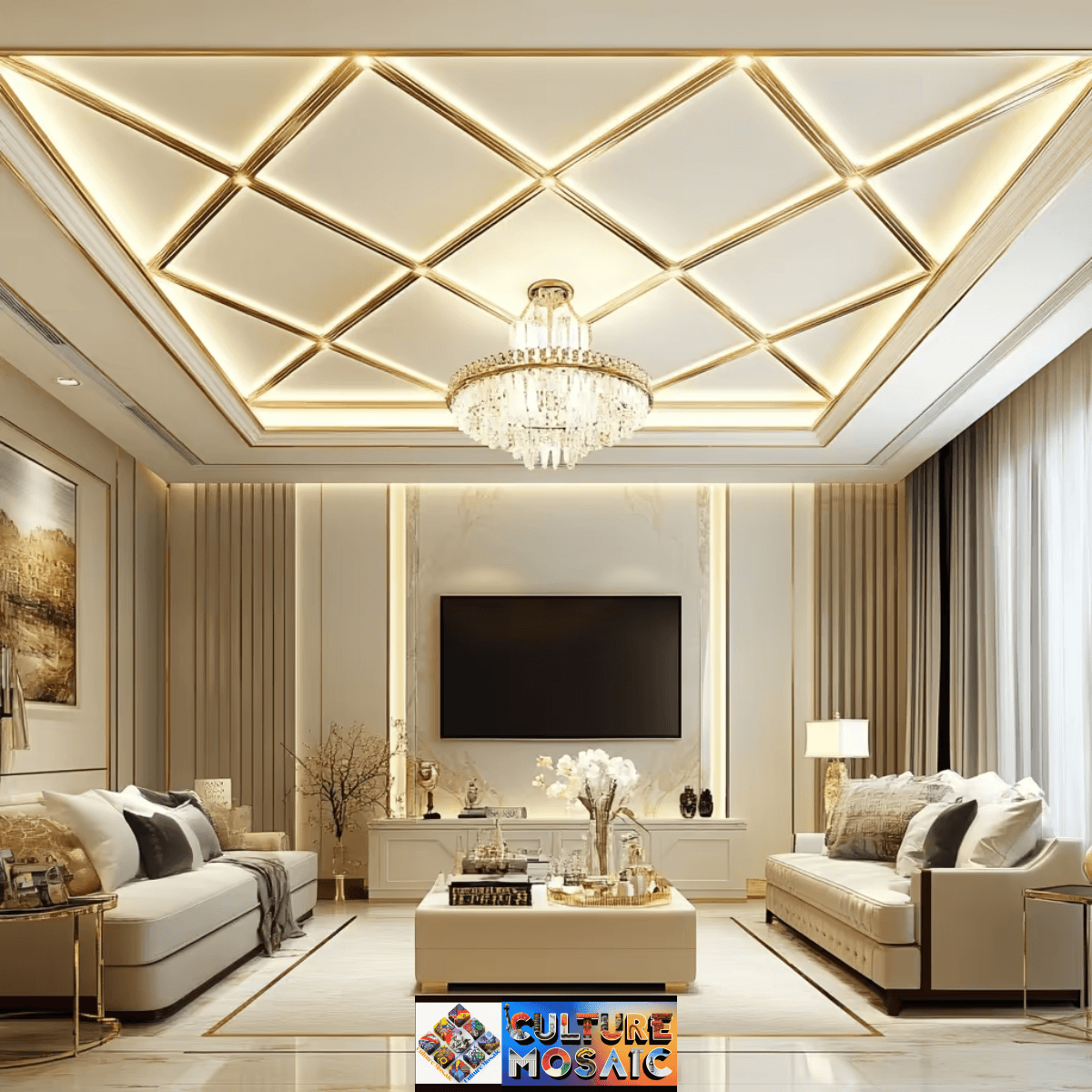
A design expert’s field notes on the fifth wall nobody plans for
The Problem: A Room That Looks Right But Feels Wrong
Modern Luxury Ceiling Design: I walked into a client’s newly furnished living room last spring and something felt off. The sofa was right. The rug was right. The art was hung at the correct height. But the room still read as flat, almost unfinished, like a stage set waiting for a final light cue. I looked up. Plain white plaster, one centred pendant, and that was it. The ceiling had been treated as an afterthought, and it was dragging the whole room down with it.
This happens constantly. People spend months choosing a sofa fabric and ten minutes deciding what happens on the fifth wall of the room—the one that’s actually the largest continuous surface in most spaces. A flat ceiling with a single bulb doesn’t just look unfinished; it makes a room feel cheaper than it is, no matter how much the furniture cost. Without a thoughtful approach to Modern Luxury Ceiling Design, even an expensive room can read as half done.
Why This Keeps Happening to Good Rooms
I get why. Ceilings feel technical. People assume you need an architect, a structural engineer, and a budget that rivals a kitchen renovation just to add a tray or a cove. There’s also a fear of getting it wrong: too much detail and a bedroom starts to look like a hotel lobby; too little and you’re back where you started.
I’ve sat with homeowners who genuinely didn’t know a false ceiling was even an option for a normal house, not just a showroom. That gap between what’s possible and what people think is possible is where most rooms quietly lose their potential. The truth is that elevated ceiling treatments are far more accessible, and far less disruptive, than most homeowners assume.
The Fix: A Layered, Considered Ceiling
Here’s what changed for that client, and for most of the rooms I’ve worked on since: a properly considered architectural plan. Not a single trick, but a layered approach: a shallow gypsum drop around the perimeter, cove lighting hidden in the recess, a slim linear fixture instead of a single bulb, and a soft tone on the ceiling paint that’s a half-shade off the walls rather than stark white.
The room changed completely. Guests started asking who did the renovation, when really, only the ceiling had moved. That’s the quiet power of executing a room from the top down.
Why the Ceiling Is the Most Underused Surface in the House
I’ve come to think of the ceiling as the most underused piece of real estate in residential design. Walls get wallpaper, feature paint, gallery walls, and shelving. Floors get rugs, herringbone oak, and heated stone. The ceiling gets ignored, and yet it’s the one surface every person in the room is guaranteed to see, whether they’re standing, sitting, or lying in bed.
A well-executed architectural detail does something walls can’t: it changes the perceived height, shape, and temperature of a room without moving a single piece of furniture.
There’s also a practical case for it. A dropped ceiling with integrated lighting hides wiring, conceals HVAC ducting, and gives you a place to tuck speakers and smoke detectors so they’re not just bolted to plain plaster. Good design solves a problem while it’s busy looking beautiful. That’s the whole trick, and it’s exactly why an intentional ceiling plan earns its keep long after the paint has dried.
Modern Luxury Ceiling Design for Bedroom
Bedrooms reward restraint more than any other room. Incorporating a modern luxury ceiling design for bedroom spaces usually works best when it’s quiet: a soft rectangular drop above the bed frame, warm dimmable cove lighting on a low colour temperature, maybe a subtle wood-tone panel insert directly over the headboard. I’ve seen homeowners try to bring a chandelier-level statement piece into a bedroom and it almost always fights with sleep.
The goal in a bedroom ceiling isn’t drama, it’s calm—the kind that pairs naturally with a Quiet Luxury Lifestyle Neutral Tones approach to the rest of the room, where everything is soft, warm, and a little muted.
One detail people miss: the light temperature matters more in a bedroom ceiling than anywhere else in the house. Anything above 3000K starts to feel clinical at 10pm. I always push clients toward warmer cove lighting here, even if the rest of the house runs cooler. This is where subtle ambient lighting earns its title as an actual sleep aid rather than just a cosmetic touch.
Modern Luxury Ceiling Design for Living Room
The living room is where you can actually push further. Selecting a modern luxury ceiling design for living room spaces tends to carry more visual weight because the room itself is doing more work: entertaining, movie nights, the occasional dinner party that spills out of the kitchen. Coffered ceilings, wide tray drops with double-tier lighting, or a textured plaster finish that catches light differently through the day all read as intentional rather than decorative for decoration’s sake.
I’d pair a statement ceiling with something grounding underneath it, and this is where the floor actually matters as much as the ceiling. A heavy textured rug does the same job downward that a coffered ceiling does upward: it gives the eye a place to land. If you’re rethinking the room as a whole, it’s worth looking at Modern Living Room Rugs Interior choices at the same time you’re planning the ceiling, because the two surfaces end up talking to each other whether you plan it or not. Done well, your ceiling and flooring choices should read as a single decision, not two separate ones.
Modern Luxury Ceiling Design for Hall
Halls get underestimated because people don’t linger in them, but implementing a modern luxury ceiling design for hall spaces sets the tone for every room that opens off it. It works especially well with a run of recessed spotlights along a shallow drop, or a single long linear cove that pulls the eye down the length of the corridor. In narrow halls, this trick makes the space feel wider than it is, purely through where the light lands.
If your hall has higher ceilings than the rest of the house, which happens more often than people expect in older builds, a slightly bolder tray detail here earns its keep, because you’ve got the vertical space to support it without it feeling heavy. Even in a transitional space, a refined overhead layout changes how the whole house feels the moment you walk in the front door.
New Ceiling Design Ideas Worth Knowing About
A new ceiling design doesn’t have to mean gypsum board and downlights anymore. I’ve been watching a handful of elevated concepts move from custom showrooms into actual homes over the past two years:
- Micro-cement ceilings: Applied with a slight sheen like a skin rather than a heavy panel system.
- Fabric-stretched ceilings: A technique borrowed from Scandinavian design that softens acoustics in open-plan spaces.
- Exposed timber beams: Left deliberately raw against a smooth plaster field, mixing old and new in the same sightline.
- Metallic leaf accents: Used sparingly in coves—usually just a subtle strip rather than the whole ceiling.
None of these need a full structural renovation. Most sit within a standard 4 to 6 inch drop, which is all a typical residential room needs. Whichever direction you take it, this is the layer where custom detailing stops being a buzzword and starts being a line item you can actually plan for.
Latest Ceiling Design for Bedroom: What’s Actually Trending
If you’re specifically hunting for the latest ceiling design for bedroom spaces right now, the pattern I keep seeing across finished projects is a move away from symmetry. Off-centre drops, a single curved edge instead of a hard rectangle, and lighting that follows the curve rather than a straight perimeter.
It reads as more considered, less builder-grade. Paired with a low, warm palette, it gives a bedroom the feel of somewhere you’d actually choose to sleep rather than somewhere that was simply built. It’s a small shift, but it’s the difference between a bedroom that merely has a ceiling and one built around holistic spatial design.
Materials and Lighting Techniques That Actually Hold Up
I’ll be direct about material choice because I’ve seen budgets wasted here. Gypsum board remains the workhorse for a reason: it’s forgiving, cheap relative to alternatives, and takes any paint finish. POP, or plaster of Paris, gives finer detail work for cornicing and can be hand-finished on site, but it’s less forgiving of humidity in coastal climates.
For anyone chasing a genuinely elevated result, high-end residential work increasingly blends both materials in a single room: gypsum for the main field and POP detailing at the border. That blend, more than any single material, is what separates bespoke craftsmanship from a basic gypsum box.
Lighting is where most projects either succeed or quietly fail. Cove lighting, tucked into the recess of a dropped edge, should always sit on a separate dimmer from any central fixture. I’ve walked into too many finished rooms where the electrician wired everything to one switch, which defeats the entire point of layering light. A ceiling with three light sources on three separate dimmers gives you an actual design tool, not just illumination.
The Results
Every client who’s added a proper ceiling treatment has told me some version of the same thing: visitors notice the room feels bigger, calmer, or more expensive, and can rarely say exactly why. That’s the tell. When a design choice works, people feel it before they can name it.
One family I worked with in a fairly standard three-bedroom semi added a simple coffered treatment to their living room and a soft cove drop to the main bedroom—a total spend well under what they’d budgeted for new furniture—and the change in how the house photographed for their own family albums was immediate. That’s the pattern I see over and over: adopting a modern luxury ceiling design tends to punch well above its actual cost.
Why Waiting Costs You More
Ceiling work is genuinely one of the few renovations that gets more disruptive the longer you wait, because it usually means moving out of a room for a few days regardless of when you do it. Doing it now, before you’ve bought furniture around a flat ceiling, before you’ve hung art at a height that assumes flat plaster above it, saves you from redoing decisions later.
Rooms finished around a ceiling plan simply cost less over their lifetime than rooms retrofitted around one. Planning your overhead details early, before the furniture van arrives, is the single easiest way to avoid paying for the same room twice.
Five Questions People Actually Ask
Is a false ceiling worth it in a small room, or does it make the space feel lower?
A false ceiling doesn’t have to lower a room noticeably. Most residential drops sit within 4 to 6 inches, which is barely perceptible in a room with standard 9 or 10 foot ceilings. Where it genuinely helps small rooms is by hiding wiring and adding recessed or cove lighting that makes the space feel brighter and more finished, which usually outweighs the small height loss. In rooms under 8 feet, I’d recommend a perimeter cove only rather than a full drop, which still counts as an elevated design choice even at that reduced scale.
What’s the actual cost difference between gypsum and POP ceiling work?
Gypsum board tends to run lower per square foot because installation is faster and more standardised. POP allows for finer hand-finished detail and curved work but takes longer to cure and apply, which adds labour cost. For a straightforward tray or cove, gypsum is usually the sensible choice. For ornate cornicing or curved edges, POP earns its higher price, and combining both is usually the fastest route to a luxury finish without blowing the budget.
How long does a typical ceiling renovation take?
A simple cove or tray drop with integrated lighting usually takes 3 to 5 days including drying and paint. More elaborate coffered or fabric-stretched ceilings can run 1 to 2 weeks depending on the size of the room and whether electrical rewiring is involved. Weather and humidity affect POP curing time more than gypsum, so plan your timeline around your local climate rather than a generic estimate.
Can I add modern ceiling features without a full renovation?
Yes. Many of the projects I’ve worked on were done room by room, starting with the bedroom or living room rather than the whole house at once. A single room with a dropped perimeter and cove lighting can usually be completed without touching adjoining rooms, plumbing, or structural walls, which keeps both cost and disruption contained.
What ceiling colour works best under cove or recessed lighting?
Pure white tends to read flat and slightly cold under warm cove lighting. I generally push clients toward a warm off-white or a tone a half-shade softer than the wall colour, which lets the lighting do more of the work and avoids the stark, clinical look that pure white can create at night. It’s a small choice, but it’s the kind of detail that separates a thoughtful room from a rushed one.
The Takeaway
I think most people underestimate what’s sitting above their heads until someone points it out, and then they can’t stop noticing it in every room they walk into afterward, including their own. A ceiling that’s been thought through properly doesn’t shout about it. It just makes the room work, quietly, every single day you’re in it. If your ceiling is still the one surface in your home that nobody’s touched, that’s usually the tell that it’s next—and giving it the attention it deserves is where I’d start.
 Dr. Julian Thorne