
 By Culture Expert
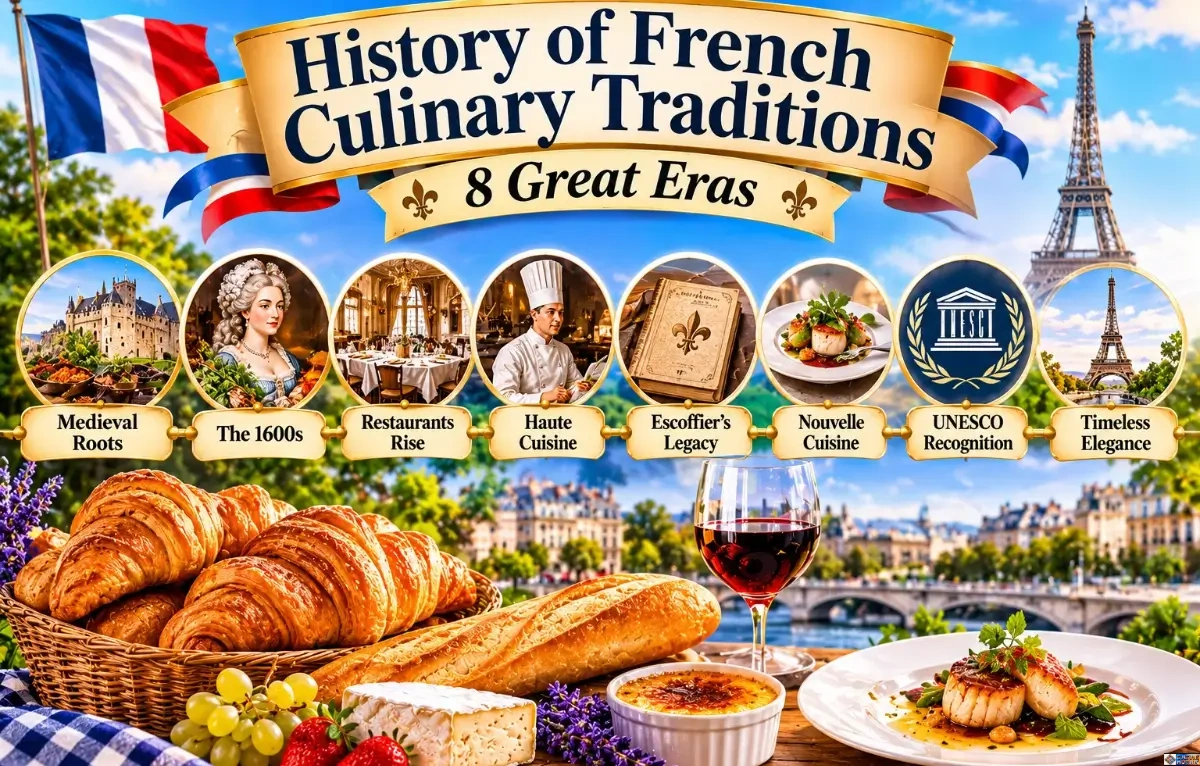
Quick Summary: The history of French culinary traditions spans about 700 years. Medieval cooks used heavy spices to show off wealth. In the 1600s, cookbooks shifted toward herbs, butter, and refined sauces. After the French Revolution, chefs opened public restaurants. In the 1800s and early 1900s, Antonin Carême and Auguste Escoffier codified techniques and organized the professional kitchen. Nouvelle cuisine lightened the style in the 1970s, and in 2010 UNESCO recognized the “gastronomic meal of the French” as intangible cultural heritage.
Why French Food History Feels Impossible to Pin Down
You taste a silky sauce or crack into a croissant and wonder where all this came from. Then you search and find a pile of competing stories: Catherine de’ Medici’s Italian cooks, a revolutionary mob, a lone genius in a Paris kitchen. It’s frustrating, because most of those stories are partly true and mostly oversimplified.
Here is the documented version, in order. If you enjoy tracing food across borders, the Culture mosaic library follows how heritage cooking techniques moved between cultures.
French Cuisine History Timeline
Medieval Roots: When Spice Meant Status
Medieval noble tables were about display. Manuscripts such as Le Viandier and Le Ménagier de Paris show dishes seasoned with ginger, cinnamon, saffron, and other costly spices, often sweet-sour and thickened with bread. Spices signaled wealth, a story that echoes in the Silk Road spices in British food. Most people ate far more simply: grain porridges, vegetables, and pottages cooked in one pot, a tradition tied to ancestral cookware history.
Did Italian Cuisine Create French Cuisine?
Not by itself. The popular story says Catherine de’ Medici, who married the future Henri II in 1533, brought Italian cooks who transformed French cooking. Food historians, including Barbara Ketcham Wheaton, treat that as largely legend. Italian influence was real, through trade, banking, and Renaissance cookbooks, but it was gradual and ran in both directions. To compare, see the history of Italian cuisine and Italian culinary traditions.
The 1600s: A Break With the Spice Cabinet
In 1651, François Pierre de La Varenne published Le Cuisinier françois. It is widely seen as a turning point. It favored herbs and stocks over heavy spice and treated roux and reductions as the base for sauces. Butter became central to French cooking, and you can explore what that means in heritage European butter varieties.
How Did the French Revolution Change the Food Industry?
Before 1789, elite chefs worked inside aristocratic households. As noble houses fell or fled, skilled cooks needed new work. Historian Rebecca Spang argues in The Invention of the Restaurant that the restaurant as a public, menu-driven place to dine took shape in Paris in the late 1700s. It grew partly from earlier establishments serving restorative broths, called “restaurants.” The Revolution didn’t invent the restaurant overnight, but it widened the audience and helped turn fine cooking into a public trade.
Who Is the Real Founder of Modern French Cuisine?
There isn’t one. Credit is shared:
- La Varenne reset the flavor logic in the 1600s.
- Antonin Carême (1784–1833) cooked for diplomats and royalty, organized sauces into families, and built elaborate pâtisserie.
- Auguste Escoffier (1846–1935) introduced the brigade system, streamlined service, and published Le Guide culinaire in 1903. His methods still shape professional kitchens, so many historians name him the founder of modern professional cooking.
Technology Joins the Table
In the early 1800s, Nicolas Appert showed that food sealed in containers and heated could be preserved, which led to canning. Later in the century, mechanical refrigeration, developed by inventors such as Ferdinand Carré and Carl von Linde, extended the life of dairy, fish, and meat. Railways moved regional produce into Paris. Together these changes made consistent restaurant service possible at scale.
Nouvelle Cuisine: The Lighter Revolution
In the early 1970s, critics Henri Gault and Christian Millau championed a movement toward shorter cooking times, fresher market ingredients, smaller portions, and lighter sauces. Chefs such as Paul Bocuse became its public face. Critics later felt some of it favored style over substance, yet its seasonal, ingredient-led approach still shapes French restaurants.
Regional Identity and the Ritual of the Meal
France is many cuisines. Butter and cream mark Normandy, olive oil and herbs mark Provence, and duck and goose mark the southwest. What connects them is ritual: courses in sequence, shared time, and conversation. In 2010, UNESCO inscribed “the gastronomic meal of the French” on its intangible heritage list, honoring the social practice and not just the dishes. For more, see dining rituals and food rituals in different cultures.
What Is French Cuisine Famous For? Top 10 French Foods
- Baguette
- Croissant
- Coq au vin
- Boeuf bourguignon
- Ratatouille
- Cassoulet
- Quiche Lorraine
- Crêpes
- French onion soup
- Crème brûlée
Many began as regional home cooking, not restaurant food, which is part of why they feel so rooted.
What Is the “French Paradox”?
It describes the observation that French populations had relatively low rates of heart disease despite diets rich in saturated fat. A 1992 paper by Renaud and de Lorgeril in The Lancet helped bring it to wide attention. Researchers have debated explanations, including under-reporting, meal patterns, portion sizes, and wine, so it remains an open question rather than proof of one cause.
Frequently Asked Questions
What is the short history of French culinary traditions?
Medieval cooks favored heavy spices. In the 1600s, herbs, butter, and sauces took over. After the Revolution, restaurants spread. Carême and Escoffier then codified techniques, nouvelle cuisine lightened the style in the 1970s, and UNESCO recognized the French meal in 2010.
Did Catherine de’ Medici bring fine cooking to France?
Probably not in the way the legend claims. Italian culinary ideas did reach France, but historians regard her single-handed role as exaggerated.
What did Escoffier change?
He organized kitchens into specialized stations (the brigade system), simplified service into sequential courses, and recorded classic preparations in his 1903 guide.
What is French cuisine most famous for?
Sauces, bread and pastry, regional classics such as cassoulet and coq au vin, and a dining culture centered on shared, multi-course meals.
Why did UNESCO recognize French cuisine?
UNESCO inscribed the “gastronomic meal of the French” in 2010 as a social custom that marks important moments, stressing togetherness, the pairing of food and drink, and a structured meal.
Keep Exploring
Curious how other food cultures built their traditions? Try traditional recipes from around the world, or read about African diaspora food culture for another story of food moving with people. For a general overview, see this History of French Culinary Traditions reference page.
Sources
- La Varenne, F. P. de. Le Cuisinier françois (1651).
- Escoffier, A. Le Guide culinaire (1903).
- Spang, R. The Invention of the Restaurant: Paris and Modern Gastronomic Culture (Harvard University Press, 2000).
- Wheaton, B. K. Savoring the Past: The French Kitchen and Table from 1300 to 1789 (1983).
- Ferguson, P. P. Accounting for Taste: The Triumph of French Cuisine (University of Chicago Press, 2004).
- Flandrin, J.-L., and Montanari, M. (eds.). Food: A Culinary History (Columbia University Press, 1999).
- Renaud, S., and de Lorgeril, M. “Wine, alcohol, platelets, and the French paradox for coronary heart disease.” The Lancet (1992).
- UNESCO. “Gastronomic meal of the French,” Representative List of the Intangible Cultural Heritage of Humanity (2010): ich.unesco.org