
 By Culture Expert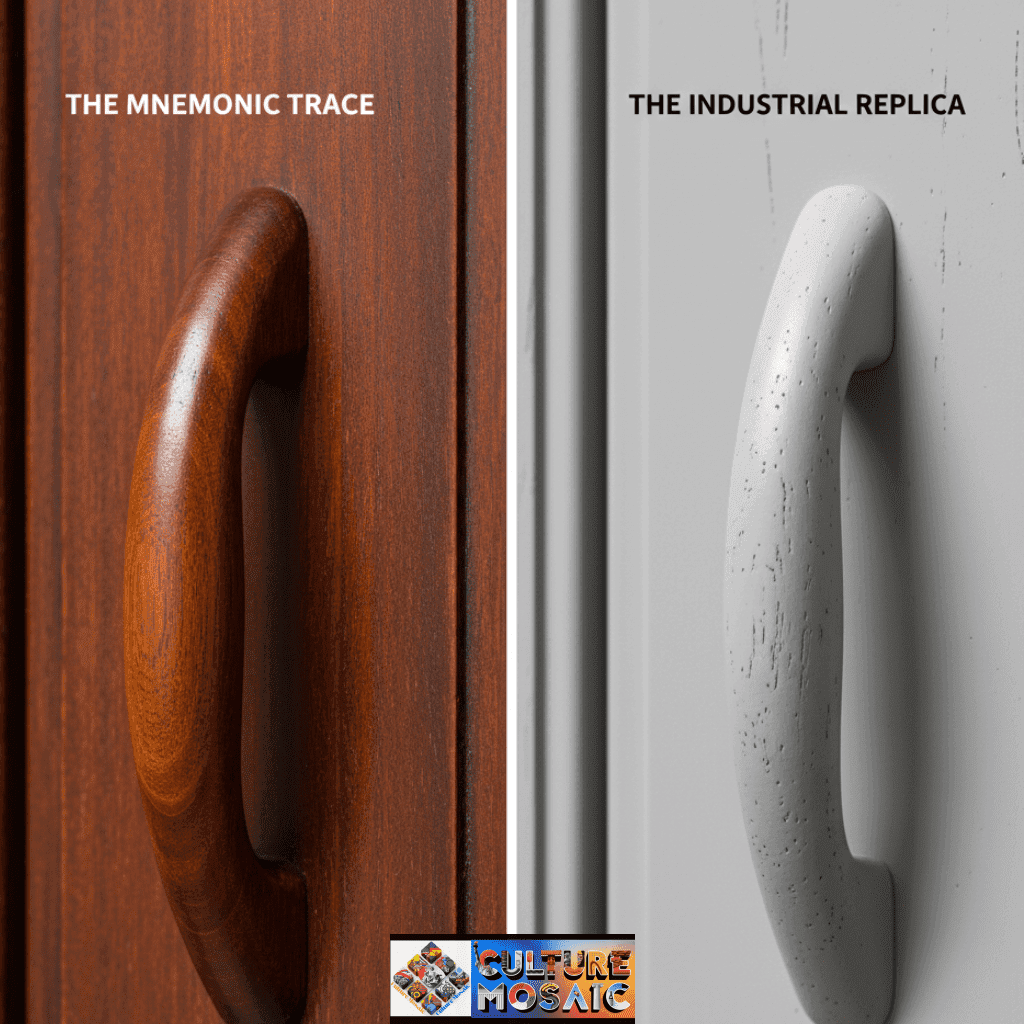
There is a moment every experienced conservator knows. You pick up an object that has been sitting in a storage crate for years, and something shifts. Not emotionally, though that happens too. Physically. The weight distribution is specific in a way that a reproduction never quite achieves.
The surface has a quality of depth that no applied patina can fake. The object communicates, through every sense simultaneously, that it has a history. That history is not merely sentimental. It is structural. It is the mnemonic trace of heirloom objects, and learning to read it changes the way you understand everything you inherit.
This guide is written for people who are ready to move beyond ‘collector’ and into the role of steward. It is for anyone who has ever held an old object and felt something they could not name. Here, we name it. We map it. We give it a forensic vocabulary that makes it legible, repeatable, and teachable.
What Is the Mnemonic Trace of Heirloom Objects?
The term ‘mnemonic’ comes from the Greek mnemon, meaning one who remembers. But the mnemonic trace of heirloom objects is not a figure of speech. It is not a poetic way of saying that old things feel nostalgic.
It refers to the actual, measurable, physical transformation an object undergoes through sustained human use: the compression of fibers, the re-crystallization of metal surfaces, the chemical alteration of organic materials by skin oils and environmental exposure. These are changes that a forensic materials analyst can detect and, in many cases, date.
When we inherit an object, we inherit this record. We inherit the data of how it was held, where it was kept, how often it was repaired, and what environment it lived in. The mnemonic trace of heirloom objects is therefore the physical biography of the relationship between a human body and a material form across time. It is the most honest record we have of how our ancestors actually lived, as opposed to how they claimed to live or how we wish they had lived.
Understanding this changes the question we ask when we pick up an heirloom. The question is no longer ‘What is this worth?’ It is ‘What does this remember?’
Why Heirloom Objects Function as Memory Devices
The Neuroscience of Object-Based Memory
Cognitive science distinguishes between declarative memory, the conscious recall of facts and events, and non-declarative memory, the embodied knowledge that lives in motor patterns, sensory associations, and emotional responses that operate largely below the level of conscious thought. Heirloom objects engage both systems simultaneously, and this dual engagement is precisely what makes them so much more powerful than photographs or written accounts.
When you hold a piece of furniture your great-grandmother used daily, your brain does not simply retrieve information about her. It activates motor memories, olfactory associations, and spatial orientation cues that no verbal account can reproduce.
The object is doing cognitive work. It is serving as what memory researchers call an external memory store: a repository of information that exists outside the brain and can be accessed through direct physical engagement. The mnemonic trace of heirloom objects operates at this level. It is not symbolic. It is somatic.
This is also why the loss of culturally significant objects is experienced so acutely. When an object that carries collective memory is destroyed or removed from its community, the loss is not merely aesthetic or monetary. A specific, irreproducible form of knowing is extinguished with it. Words and photographs survive, but the embodied knowledge encoded in the object’s physical form does not.
Sign 01: The Patina of Use — Biological Friction as Biography
Asymmetry Is the Signature
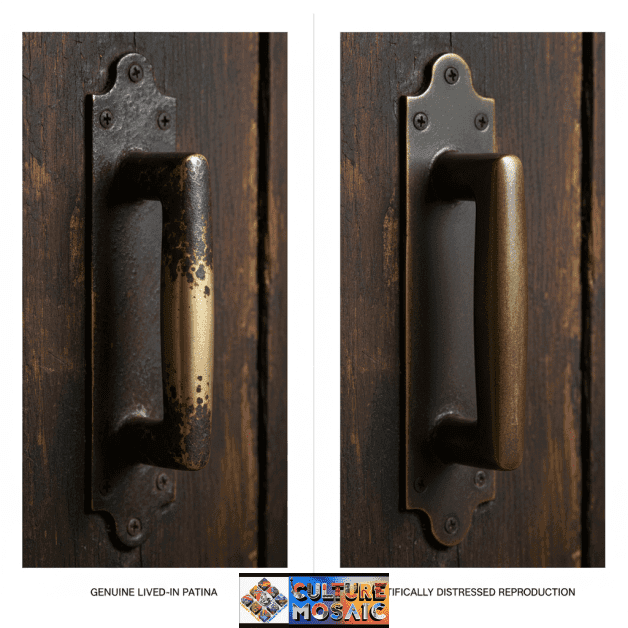
Patina is one of those words that gets used loosely, applied to anything that looks old or worn. In the context of the mnemonic trace of heirloom objects, it means something specific: the directional, asymmetrical surface transformation caused by thousands of micro-interactions between a human body and a material surface. The critical word is asymmetrical. Genuine use-wear is never uniform. It concentrates at points of actual contact, in patterns that reflect specific habits, specific bodies, and specific techniques.
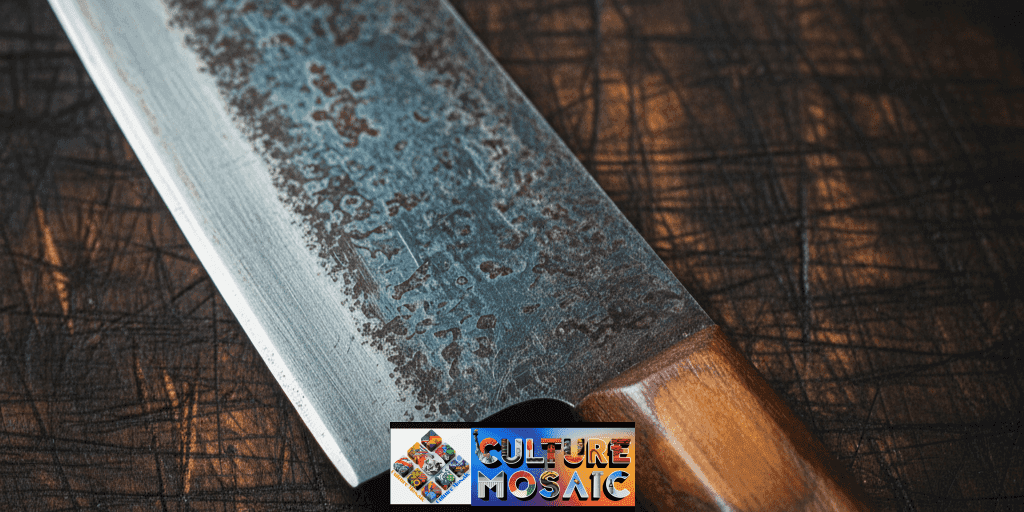
Look at the handle of an old tool, a plane, a saw, a drawknife. The wear will favor one side. It will show where the thumb rested, where the palm pressed, where the fingers wrapped. On a well-used kitchen knife, the handle may show a notch where a particular cook’s index finger always landed. These patterns are not decorative accidents. They are forensic data. They tell you how many hands held this object, whether they were right- or left-handed, whether they worked with precision or with force.
Natural materials make this legible in a way that synthetic materials do not. Brass, dense hardwood, and vegetable-tanned leather all undergo genuine chemical transformation through sustained skin contact. The oils and salts in human perspiration react with the material at the molecular level, creating a surface that has a specific luminosity: denser, warmer, and more optically complex than any applied finish.
When you see that quality, you are seeing the accumulated evidence of a long-term human relationship. You are seeing the mnemonic trace of heirloom objects in its most immediate and visually readable form.
Sign 02: Procedural Memory — The Motor Dance Across Generations
When the Object Teaches the Hand
This is the most philosophically rich of the five signs, and in many ways the most radical claim. A well-made heirloom object does not merely record how it was used. It actively transmits that knowledge to anyone who uses it correctly. This is not metaphor. It is the result of what psychologists call procedural memory encoding: the way motor skills and physical techniques are stored in muscle memory and neural pathways rather than in conscious recall.
A heavy cast iron pot demands that you approach it with two hands and a specific posture. A balanced carving knife rewards a precise grip and penalizes the wrong one. A well-tempered straight razor requires a specific angle of attack, held with a particular lightness of hand. These requirements were not arbitrary decisions made by their makers.
They are the physical distillation of generations of refinement, the accumulated knowledge of what works, encoded into the ergonomics of the object itself. When you learn to use one of these objects correctly, you adopt the motor pathways of every person who used it before you. The object teaches you how they moved.
This motor coordination mirrors what we examine in [The Commensal Architecture of Shared Vessels], where the object itself dictates the social choreography of a shared table. In both cases, the material form organizes human behavior without any explicit instruction.
This is why traditional craft knowledge is so difficult to transmit through books or video. The knowledge does not live in text or image. It lives in the relationship between a specific tool and a trained hand. When the tool is lost, the knowledge embedded in its ergonomics is lost with it. When the tool survives, the knowledge remains accessible to anyone willing to learn from it. The mnemonic trace of heirloom objects in this sense is a form of pedagogy: a standing instruction from the past, written in the physical form of the thing itself.
Sign 03: Material Resonance — The Thermal Battery and the Acoustic Signature
Active Materials in an Inert World
Most modern objects are made from materials engineered for consistency, durability, and ease of manufacture. They are designed to be stable, to resist the environment, to remain unchanged by use. This is, from a manufacturing standpoint, entirely rational. From the perspective of the mnemonic trace of heirloom objects, it is also why modern objects feel so different from old ones in a way that is hard to articulate but impossible to miss.
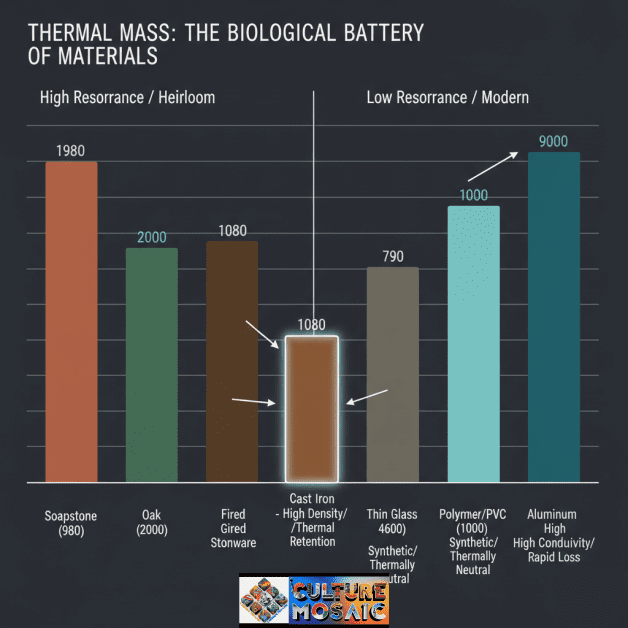
Genuinely old, well-made heirloom objects are typically made from what materials scientists call thermally active substances. Dense hardwood, fired stoneware, forged iron, thick soapstone: these materials have high thermal mass. They absorb heat slowly and release it slowly. In practical terms, this means they behave differently at different times of day, in different seasons, in different hands. They are in continuous thermal dialogue with their environment.
When you place your hand on an old stone bowl that has been sitting in a warm room, it responds to your touch in a way that a thin polymer bowl never can. The environmental psychology research on this is substantial: the nervous system reads thermal cues as signals of environmental reliability, and materials with high thermal mass communicate stability at a register below conscious thought.
There is also the acoustic dimension, and this one is underappreciated. Tap an old ceramic bowl and a new one. The difference in sound is not merely pleasing to the ear. It reflects genuine differences in density, crystalline structure, and firing history. Dense, well-fired stoneware resonates at a lower, richer frequency than thin modern ceramics. Forged iron has a sound signature that cast iron lacks. Old glass rings differently from new glass. Each of these differences is a form of information, part of the mnemonic trace of heirloom objects as it communicates through the auditory sense.
Sign 04: The Grammar of Repair — Visible Mending as Visible Punctuation
Scars That Tell Time
The most powerful mnemonic traces are often not the places where an object has remained unchanged, but the places where it was broken and someone decided it was worth fixing. Repair is a decision. It requires the assessment that the object has enough value, functional, emotional, or social, to justify the expenditure of time and skill. When you inherit an object with a visible repair history, you inherit not just the object but the record of those decisions.
A darned sock carries the story of the night it was darned. A stapled ceramic bowl carries the moment someone chose adhesive over the dustbin. A patched leather bag carries the judgment of the person who sat down with needle and thread rather than replacing it. These are acts of loyalty to a material form, and they leave a specific kind of mnemonic trace: the trace of care, considered and deliberate.
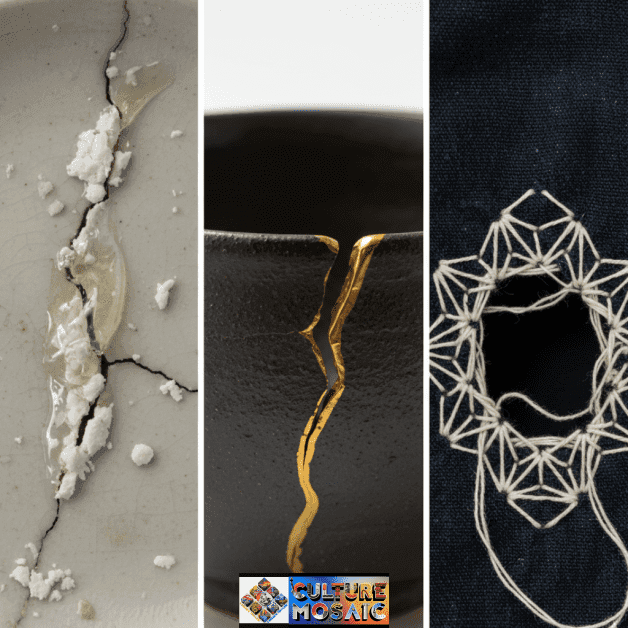
Different traditions have developed radically different approaches to this question, and each approach reveals something specific about the culture‘s relationship to objects and to time. The Japanese practice of kintsugi repairs broken ceramics with gold or silver lacquer, making the fracture not only visible but beautiful, and elevated. The philosophy underlying this is direct: the break is part of the object’s history, and hiding it would be a form of dishonesty.
Sashiko stitching, developed in rural Japan as a reinforcement technique for worn fabric, transformed functional repair into geometric embroidery. The repair became an aesthetic statement. In European folk traditions, visible mending was similarly elevated: a finely darned stocking was a demonstration of skill, not a mark of poverty. The mnemonic trace of heirloom objects in these traditions is explicitly celebratory of damage survived.
For a deeper exploration of the linguistics of repair as a semantic system, see [The Textile Lexicon Field Guide], which maps the full grammar of mending traditions across seventeen regional textile cultures.
Sign 05: The Geographic Isotope — Provenance as Chemical Identity
Where an Object Comes from Is Part of What It Is
Every material object is rooted in a specific geography, and that geography leaves a measurable chemical signature in the object’s physical composition. The alkalinity of a particular regional clay determines the firing behavior and the finished surface quality of the ceramics made from it. The mineral composition of the water used to process natural fibers affects the hand and drape of the finished cloth. The specific tannins present in the oak bark of one region produce a different leather quality than the bark of another. These are not aesthetic preferences or romantic associations. They are measurable chemical facts.
Forensic archaeologists use isotopic analysis to trace the geographic origin of ancient objects with considerable precision. The ratios of strontium, oxygen, and lead isotopes in clay bodies, metal alloys, and organic materials act as geographic fingerprints, linking the object to the specific geology of its place of origin. This is what we mean by the geographic isotope: the chemical record of origin that the object carries within its physical structure, independently of any documentation or provenance label.
Synthetic materials, by contrast, are manufactured to be chemically uniform across production runs. They carry no provenance data. A polymer bowl made in one factory is chemically identical to one made in another on a different continent. This chemical anonymity is part of why the mnemonic trace of heirloom objects made from synthetic materials is so much thinner than that of objects made from locally sourced natural materials. The material itself has no memory of place.
Collective Memory and the Social Architecture of Heirlooms
Everything discussed so far has focused on what heirloom objects communicate to individuals. But the mnemonic trace of heirloom objects operates at a collective level with equal force, and this collective dimension is arguably the more culturally significant one. Objects passed down through families, communities, religious institutions, and craft guilds function as what the sociologist Paul Connerton called commemorative forms in material: they anchor shared identity across time in a way that verbal tradition alone cannot.
Consider the ceremonial objects used in religious communities across every tradition. The patina on a menorah used by a synagogue for generations. The wear on the pews of an old church. The surface of a communal drum used for decades in a ritual context. These objects are maintained and passed on not because they are functionally superior to new equivalents but because they carry the weight of collective participation. Every hand that has touched them has added to the mnemonic trace. The object becomes a shared memory in material form.
This is also why the destruction or forced removal of culturally significant objects is experienced as such a profound and specific harm. It is not merely property that has been taken. The mnemonic traces stored in those objects, the physical records of collective use, care, and meaning, are irretrievably gone. No reproduction, however accurate, carries the same trace. When indigenous and traditional communities seek the repatriation of ancestral objects, they are making precisely this argument: the object is the memory, and the memory cannot be returned by any other means.
How to Read the Mnemonic Trace: A Forensic Method for the Non-Specialist
Slow Down and Use All Five Senses
Reading the mnemonic trace of heirloom objects is a practice, not a talent. It requires deliberate slowing down and the temporary suspension of the evaluative mindset that wants to assign monetary category, decorative style, or period attribution. Before you ask what an object is worth, or what period it belongs to, or whether it will look good on a particular shelf, you need to ask what it remembers.
Begin with the visual, but take your time with it. Examine the object in raking light, held at a low angle to the surface, which reveals surface texture and topography that direct overhead light conceals. Look for wear that concentrates at points of actual physical contact. Look for the direction of the wear: does it follow a consistent motion? Does it favor one side? Where is the patina deepest, and what does that tell you about how the object was held or stored?
Move to the tactile. Handle the object as it was designed to be handled. Where does your hand fall naturally? What grip does the ergonomics of the form invite? If there are repairs, run your fingers across them slowly. Feel the quality of the mending: is it competent, rushed, loving, utilitarian? Each quality tells you something about the moment of the repair and the person who made it.
Then attend to the acoustic and the thermal. Tap the object gently. Listen to the resonance. Hold it for thirty seconds and notice whether it warms, how quickly it responds to your body heat, and whether it feels dense or hollow in the hand. These are not subjective impressions. They are sensory data about the material’s physical composition, part of the mnemonic trace of heirloom objects as it communicates through the body rather than through the mind.
The Cultural Stakes: Why This Matters in an Era of Mass Production
We live in an economic system that is organized around the replacement of objects rather than their maintenance. Planned obsolescence is not an accident or a side effect. It is a design principle. Objects are engineered to become unfashionable, to break in ways that are expensive to repair, and to be made from materials that do not age gracefully. In this context, learning to recognize and value the mnemonic trace of heirloom objects is not mere nostalgia or aesthetic conservatism. It is a direct challenge to a consumption model that depends on our inability to perceive the difference between something with memory and something without it.
When we choose to maintain, repair, and pass on objects that carry genuine memory density, we are making a series of connected claims. We are claiming that continuity matters more than novelty. That depth matters more than newness. That the specific, irreplaceable, and biographically dense matters more than the generic, replaceable, and conveniently cheap. These are not small claims. They have implications for how we shop, how we design our homes, how we think about craft and production, and how we understand our own relationship to the past and the future.
The mnemonic trace of heirloom objects is, from this perspective, an endangered form of cultural heritage. Not in the sense that old objects are disappearing (they are, but that is a separate problem). In the sense that the capacity to read them, to perceive and value what they carry, is being eroded by a material culture that has no interest in producing objects capable of carrying anything at all.
Auditing Your Material Legacy: A Summary Checklist
The five power signs of the mnemonic trace of heirloom objects can be applied as a practical audit of any inherited or acquired object. The more signs present, and the more richly developed each sign, the higher the object’s memory density and its value as a stewardship object rather than a mere decorative possession.
Sign 01: Patina of Use. Is the wear asymmetrical and directional? Does it concentrate at points of actual physical contact in patterns that reveal specific habits? Is the surface transformation the result of genuine biological friction rather than applied aging?
Sign 02: Procedural Memory. Does the object’s ergonomics invite a specific grip or body posture? Does handling it correctly produce a felt sense of alignment with a historical technique? Does it teach the hand something that a modern equivalent does not?
Sign 03: Material Resonance. Is it made from a thermally active material with high thermal mass? Does it have a distinctive acoustic signature? Does it behave differently across time and environmental conditions?
Sign 04: Repair History Grammar. Does the item show inspiring evidence of deliberate fixing? Is it obvious that the item was repaired in a skillful manner that required a lot of effort? Does the history of the item’s repairs demonstrate that the item had value and was worth being repaired?
Sign 05: Geographic Isotope. Is it made from locally sourced natural materials? Does the material carry regional or cultural specificity in its chemical composition, visual quality, or manufacturing technique? Could its origin be traced through its material properties?
A high-scoring object on all five signs is not merely an heirloom. It is a primary source. It is evidence. And choosing to steward it well is an act with consequences that extend well beyond the walls of your own home.
Frequently Asked Questions
Q1: What exactly is the mnemonic trace of heirloom objects, and how is it different from sentimental value?
Sentimental value is entirely subjective: it depends on the feelings and memories of the current owner. The mnemonic trace is an objective, material record embedded in the physical structure of the object itself. It exists and is readable regardless of whether the current owner knows or cares about the object’s history. A forensic materials analyst could identify the mnemonic trace of heirloom objects in a piece with no known provenance, using only the physical evidence of its surface, structure, and composition.
Q2: Can modern objects develop a mnemonic trace over time?
Yes, but with significant limitations. Only objects made from thermally and chemically active natural materials, dense hardwood, forged metal, fired stoneware, organic textiles, can develop the kind of rich, multi-layered mnemonic trace described here. Most modern mass-produced objects, made from synthetic polymers and composites engineered for chemical stability, have a limited capacity for the surface transformation and provenance encoding that constitutes a high-density mnemonic trace. They can accumulate wear, but they rarely accumulate memory in the same depth.
Q3: How do I distinguish genuine patina from artificially applied aging?
Genuine patina is asymmetrical and directional. It concentrates at points of actual physical contact in patterns that correspond to specific use gestures. Artificial aging is typically uniform and non-directional, applied to surfaces without regard for the functional logic of the object. Genuine wear also often involves the polishing of high-contact areas alongside the accumulation of material, dust, wax, and oil, in low-contact recesses. Artificial distressing rarely captures this complementary relationship between polish and accumulation.
Q4: Why do some communities place such high value on the return of ancestral objects?
Because the mnemonic trace of heirloom objects stores forms of collective memory, embodied knowledge, and cultural identity that cannot be transmitted by any other means. A reproduction of an ancestral object, however technically accurate, does not carry the same physical biography. It has not been touched by the same hands, kept in the same environments, or repaired by the same community. For cultures in which the object is the primary carrier of specific historical and spiritual knowledge, its return is not a symbolic gesture. It is the return of an irreplaceable archive.
Q5: What practical steps can I take to preserve the mnemonic trace of objects in my own care?
Use them. The single greatest threat to the mnemonic trace of heirloom objects is storage. An object kept in a box does not accumulate memory: it stagnates. Use inherited objects in the context for which they were designed. When repair is needed, choose visible mending over replacement where possible. Document the repair with a date and a brief description of what was done. Over time, this documentation becomes a companion record to the physical mnemonic trace, a written biography alongside the material one.
About the Author
Dr. Elena Hartwell is a cultural heritage scholar and material memory researcher with fifteen years of fieldwork across European and North American conservation contexts. Her practice sits at the intersection of forensic materials analysis, embodied cognition research, and intergenerational knowledge transmission. She has contributed to preservation frameworks for regional craft institutions, community archive projects, and museum acquisition policy, and writes regularly on the forensic reading of inherited objects and their role in sustaining cultural continuity across generations. The Institute for Heritage and Memory Studies is where she teaches.
Read more of her work: www.elenahartwell.com/heritage-research
 Dr. Marcus Hale