Haptic Sculpting Rituals: 3 Ways to Shape Your Internal Landscape
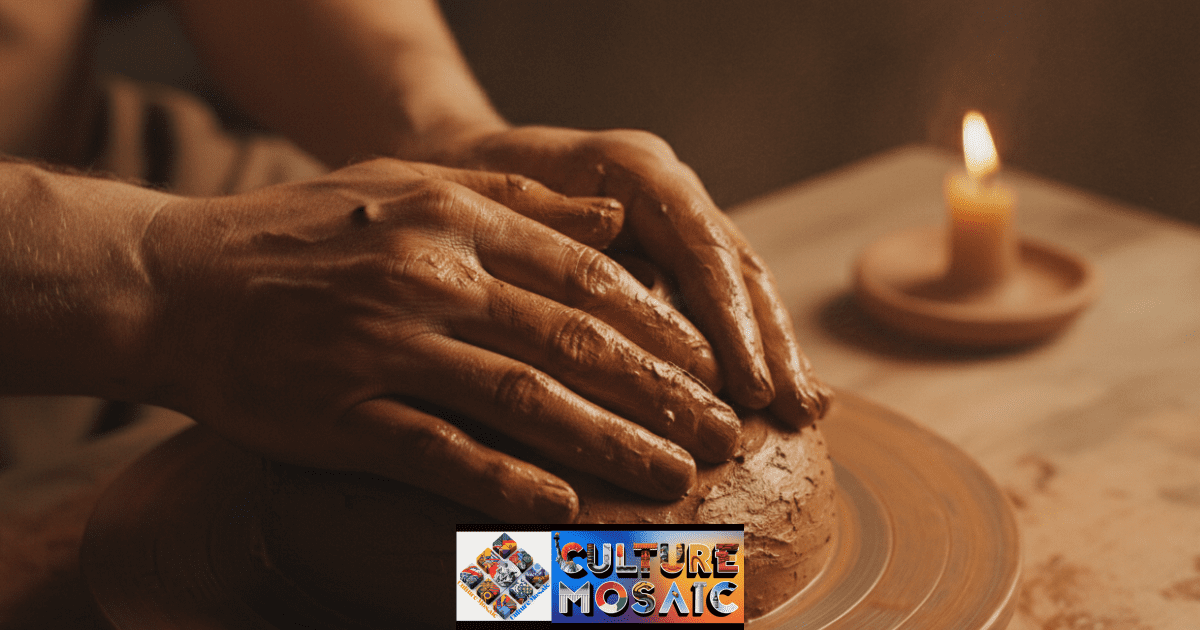
Close-up of hands performing haptic sculpting rituals with raw terracotta clay for nervous system regulation and healing.
Haptic Sculpting Rituals: 3 Ways to Shape Your Internal Landscape

Haptic Sculpting Rituals: 3 Ways to Shape Your Internal Landscape

Haptic Sculpting Rituals

“We spend our days touching glass and plastic — surfaces that never change. Haptic sculpting isn’t about making a vase. It’s about the biological relief of material that yields to your touch.”

Transformative Raw Tactile

What Are Haptic Sculpting Rituals?

Haptic sculpting rituals are intentional, touch-led practices in which the hands engage with malleable earth — most commonly clay — not to produce an object, but to produce an internal state. The word haptic comes from the Greek haptesthai, meaning “to touch.” And yet modern life has quietly impoverished that sense. We tap, swipe, scroll. Nothing ever pushes back.

That absence is not trivial. It is a biological mismatch. Our hands evolved over hundreds of thousands of years in constant negotiation with the physical world — with wood, stone, soil, water. The mechanoreceptors beneath our skin are calibrated for resistance, texture, and temperature change. When that calibration goes unmet for long enough, the nervous system begins to signal something like a deficit. Not loudly, and not all at once. But it shows up in restlessness, in a low-grade sense of disconnection that no amount of screen time seems to resolve.

This is where haptic sculpting rituals come in. These practices work precisely because clay resists. It yields, but on its own terms. It warms under the palm. It records pressure like a slow, silent diary. That conversation between skin and material does something measurable in your nervous system — something digital interaction genuinely cannot replicate.


The Science of the Hand-Brain Loop

Why Your Nervous System Craves Resistance

Your hands contain over 30,000 mechanoreceptors — microscopic sensory cells tuned to detect pressure, vibration, texture, and temperature. When you press your fingers into wet terracotta, you are activating a dense neural network that feeds directly into the motor cortex, the region of the brain governing purposeful physical movement.

Sustained tactile engagement with variable-resistance materials promotes what researchers in sensorimotor integration call a grounding effect — a measurable shift toward parasympathetic nervous system dominance, and a concurrent reduction in ambient anxiety. In plain terms: working with clay genuinely calms the body down. The effect is neurochemical, not merely psychological.

The mechanoreceptors in your palms are not passive receivers. They are active participants in regulating your internal state.

Digital scrolling fires visual cortex pathways but leaves the motor and somatosensory systems largely inert. Haptic sculpting rituals close this loop. The hands move with intention. The brain responds. The body recalibrates.

The Mosaic Connection: Clay as Universal Human Heritage

What makes these rituals particularly resonant is that they are not invented — they are remembered. Working with earth is among the oldest documented human behaviors. From the fired terracotta figurines of the Indus Valley Civilization (circa 3000 BCE) to the hand-coiled pots of the Andean Tiwanaku culture, from Japanese yakimono traditions to the earthenware of sub-Saharan Africa — clay appears in every continuous human culture without exception.

When you sit down and press your hands into raw clay, you are performing the same physical gesture your ancestors performed. That continuity is not sentimental. It appears to have a genuine, calming, identity-anchoring effect that researchers studying culture mosaic practices and somatic heritage are only beginning to quantify.

Olfactory note: In the Indian subcontinent, this connection takes a particularly beautiful form. Mitti Attar — a traditional perfume distilled from baked earth, produced in Kannauj, Uttar Pradesh since at least the 16th century — was created specifically to capture the scent of rain on dry soil, known as petrichor. The limbic system responds to this compound smell with something that feels, to most people, like coming home. That response is not poetic. It is physiological. Your nose remembers the earth even when your hands have forgotten it.

A Quick Haptic Check-In Before You Begin

3 quick questions to find your right ritual

The 3 Core Haptic Sculpting Rituals

Each ritual is designed for 15 to 30 minutes of practice, with no prior clay experience required.

I
Ritual One
The Blind Contour Sculpt

Close your eyes. Sculpt the shape of your current mood — not literally, but intuitively. Let your hands decide the form without interference from your eyes.

Focus: temperature and moisture of the clay, not the form itself
II
Ritual Two
Rhythmic Impressing

Using found objects — a stone, a shell, a piece of bark — press textures rhythmically into a flat clay slab. No pattern is required or expected.

Focus: the distinct “click” and “thud” of different densities meeting earth
III
Ritual Three
The Erasure and Release

Build a form with full attention, then slowly smooth it back into a featureless sphere. Sit with the completion. Feel what remains after the form is gone.

Focus: accepting impermanence — the smoothing is the practice, not a loss

Ritual I in Depth: The Blind Contour Sculpt

Dr. Mara Solano

I want you to set down the part of your brain that wants to make something good. That’s the part we’re resting today.

Sit with your clay in both hands. Take one breath — just one, and actually take it. Notice the clay is cooler than your palms. Give it a moment. It will begin to warm and yield.

Now close your eyes. I don’t want you thinking about shape at all. I want you to think about weight. Is what you’re carrying right now — in your chest, your shoulders, your throat — heavy or light? Dense or diffuse? Does it have edges, or does it blur at its margins?

Let your thumbs respond. Not to an idea of the answer, but to the actual sensation of the question. Your hands know things your vocabulary hasn’t caught up with yet. This is the whole premise of haptic sculpting rituals: the nervous system has its own fluency, and clay is one of the few materials that speaks it back to you without translation.

Stay in the dark behind your eyes for at least five minutes. Don’t rush toward form. The most important part of this ritual isn’t what emerges from the clay. It’s the quality of attention you bring to the not-knowing — that deliberate, unhurried willingness to find out.

Ritual II in Depth: Rhythmic Impressing

Flatten your clay into a rough slab about two centimetres thick. Then look around you — or step outside briefly — for objects with interesting texture: a ridged stone, a twist of bark, a dried seed pod, a corrugated piece of driftwood. You are not selecting by aesthetics. You are selecting by how they feel in the hand before they ever touch the clay.

Begin pressing your objects into the clay with a rhythmic, almost meditative tempo. The ritual here lives in the repetition. The slight resistance of a dense pebble meeting wet clay produces a micro-vibration that travels up through your wrist. A lighter shell makes a softer sound, a drier knock. These distinctions are not trivial — they are the entire content of the practice. The ear and the hand are collaborating.

This ritual is particularly well-suited to people who carry chronic tension in their hands, wrists, or forearms. Occupational therapists have begun incorporating haptic sculpting rituals into recovery protocols for repetitive strain injury — not despite the tactile demand, but because of it. Purposeful, varied touch rehabilitates the hand-brain relationship rather than depleting it further.

For a deeper understanding of why different materials produce such distinct somatic responses, the research on The Haptic Resonance of Raw Materials offers a thorough and beautifully argued foundation.

Hands pressing into wet terracotta — the starting point of every haptic sculpting ritual. No tools. No intention. Just contact.

Ritual III in Depth: The Erasure and Release

Build something. It doesn’t need to be much. A tower. A hollow. A rough human figure composed of spheres and cylinders. Give it between five and ten minutes of genuine attention — not performance, just honest engagement with the material in front of you.

Then begin erasing it.

This is, for many practitioners, the hardest part of all haptic sculpting rituals. We are culturally conditioned to preserve what we make — to photograph it, share it, keep it. The deliberate, unhurried return of form to formlessness confronts that conditioning directly. But the tactile experience of smoothing is physiologically distinct from destruction. The long, sweeping passes of the palm, the gradual disappearance of all edges — it is closer to resolution than to loss.

The sphere you end with is not empty. It holds the pressure history of everything you built inside it. You just can’t see it anymore. There is, for many people, something genuinely clarifying about that.


The Haptic Toolkit: Choosing Your Ancestral Earth

Not all clays offer the same haptic experience. Here is a quick reference for practitioners at any level.

Earth Type Haptic Character Primary Ritual Benefit
Terracotta Gritty, porous, cools quickly against the skin High grounding effect, immediate sensory focus
Porcelain Silky, dense, highly responsive to pressure gradients Delicacy and precision; nervous system fine-tuning
Wild Clay Variable texture, organic mineral scent, gritty inclusions Deep heritage connection, raw calm, sensory unpredictability

Haptic Sculpting Rituals in Therapeutic Contexts

From Studio Practice to Clinical Setting

Clay-based haptic practices have moved steadily from art studios into clinical and therapeutic environments over the past two decades. Art therapists, occupational therapists, and somatic practitioners now incorporate haptic sculpting rituals into treatment plans for generalized anxiety, trauma recovery, chronic pain management, and sensory regulation in autistic adults and children.

The mechanism is well-established: sustained, varied tactile input — particularly input that requires active motor problem-solving — activates bilateral cortical regions and promotes what psychologists call embodied presence. Simply put, it brings you into your body rather than into the narrative about your body. For people whose trauma responses include dissociation, or whose anxiety runs in cognitive circles, haptic sculpting rituals offer a somatic interruption that is both gentle and genuinely effective.

Artists working with body-based themes have also begun Somatic Art Documentation — recording the physiological and emotional arcs of clay sessions as data in themselves, not merely as records of the finished object. The process becomes the artifact.

Where Haptic Rituals Meet the Walls We Live In

The Sensory Environment Beyond the Studio

If haptic sculpting rituals work because they restore a specific quality of sensory engagement, it’s worth asking: what does the space around us contribute to — or subtract from — that restoration? The field of Neuro-Aesthetic Wall Art addresses exactly this question, exploring how texture, pattern, and material in a room’s visual field affect nervous system states before the hands even touch anything.

The environments in which we practice our rituals are not neutral. A room with organic textures, earthy tones, and natural material references appears to lower the arousal threshold — meaning the nervous system reaches its calm, grounded state more quickly when the surrounding space reinforces rather than contradicts the somatic work being done. This is not interior design philosophy; it is measurable psychophysiology.

Recent Advancements: Digital Haptics and What They Reveal

It would be a strange omission not to acknowledge the rapidly growing field of digital haptics — force-feedback gloves, haptic actuators, and virtual sculpting interfaces designed to replicate the hand-material dialogue in digital space. Research labs are developing systems capable of simulating the resistance and texture of clay with remarkable precision.

But here is what the technology reveals by comparison: the biological effect of genuine clay appears to depend not only on mechanical resistance, but on temperature transfer, moisture dynamics, and what researchers call the olfactory-tactile compound — the combined sensory input of how something smells, feels, and sounds simultaneously. The mineral, organic scent of wild clay appears to trigger limbic system responses associated with safety and belonging. No haptic actuator has replicated that compound yet.

The two fields need not compete. Digital haptic tools offer genuine accessibility for people who cannot work with physical clay due to mobility or environmental constraints. But for those who can access raw material, the original ritual remains — by current evidence — the richer somatic intervention.

How to Begin Your Own Practice

A Simple Starting Framework

You need no studio, no kiln, no training. You need approximately 500 grams of moist clay, a flat surface that can get dirty, and fifteen uninterrupted minutes. For sourcing, look for clays described as natural, mineral-rich, or air-dry from pottery suppliers or ethical craft sources. Avoid polymer clays for somatic practice — they do not have the same thermal or moisture properties that appear to drive the haptic grounding effect.

Begin with Ritual I. Set no intention for the outcome. Sit down with the clay in your hands and simply notice what happens over the first three minutes. Most practitioners report a marked reduction in mental noise within that window. That is the hand-brain loop engaging. That is your nervous system remembering something it has always known how to do.


Ready to feel the resistance?

Download our Somatic Clay Guide to find the best ethical clay sources near you — and receive step-by-step instructions for all three haptic sculpting rituals, including a timed audio guide for the Blind Contour Sculpt.

Frequently Asked Questions About Haptic Sculpting Rituals

Do I need any artistic skill to practice haptic sculpting rituals?
None at all. Haptic sculpting rituals are not about producing art. They are about using the physical act of engaging with clay to create specific nervous system states. Whether the resulting object looks like anything is entirely beside the point — and in most cases, it shouldn’t.
How often should I practice to notice lasting benefits?
Most practitioners notice a grounding effect within a single session of fifteen minutes or more. For sustained benefits — particularly in anxiety reduction and embodied presence — a two to three times per week practice appears to be effective, based on current somatic therapy literature and clinical observation.
What type of clay is best for haptic sculpting rituals?
For beginners, terracotta is recommended for its immediate sensory feedback and accessibility. Porcelain suits practitioners seeking subtlety and fine motor precision. Wild or natural clay offers the deepest heritage connection and the most complex sensory profile — including mineral scent — but requires more preparation time before a session.
Can haptic sculpting rituals support trauma recovery?
Yes, and increasingly they are used this way clinically. Somatic therapists and art therapists use clay-based haptic practices for trauma recovery because the physical engagement bypasses verbal processing, which can sometimes reactivate rather than resolve distress. For individuals with active trauma presentations, working with a trained somatic or art therapist is strongly recommended rather than self-directed practice alone.
How do haptic sculpting rituals compare to meditation?
They are not in competition. Meditation and haptic sculpting rituals work through different neurological pathways. Meditation primarily downregulates cognitive activity. Haptic sculpting activates sensorimotor processing while simultaneously promoting calm. For people who find stillness-based meditation difficult — particularly those with hyperactive nervous systems or attention differences — haptic sculpting rituals can be a more accessible and equally effective entry point into somatic regulation.

MS
Dr. Mara Solano
Sensorimotor Researcher · Haptic Design Specialist

Dr. Mara Solano holds a doctorate in sensorimotor neuroscience and has spent fifteen years at the intersection of tactile practice, psychophysiology, and cultural heritage. Her research explores how ancestral somatic practices — particularly those rooted in earth and material — continue to regulate the nervous system in ways that modern environments consistently underestimate. She consults with therapeutic studios, ceramic arts programs, and wellness institutions across three continents. Her writing bridges rigorous science and lived somatic experience, because she believes the two should never have been separated in the first place.

View Dr. Solano’s full profile at Culture Mosaic

Leave a Reply

Your email address will not be published. Required fields are marked *