
 By Culture Expert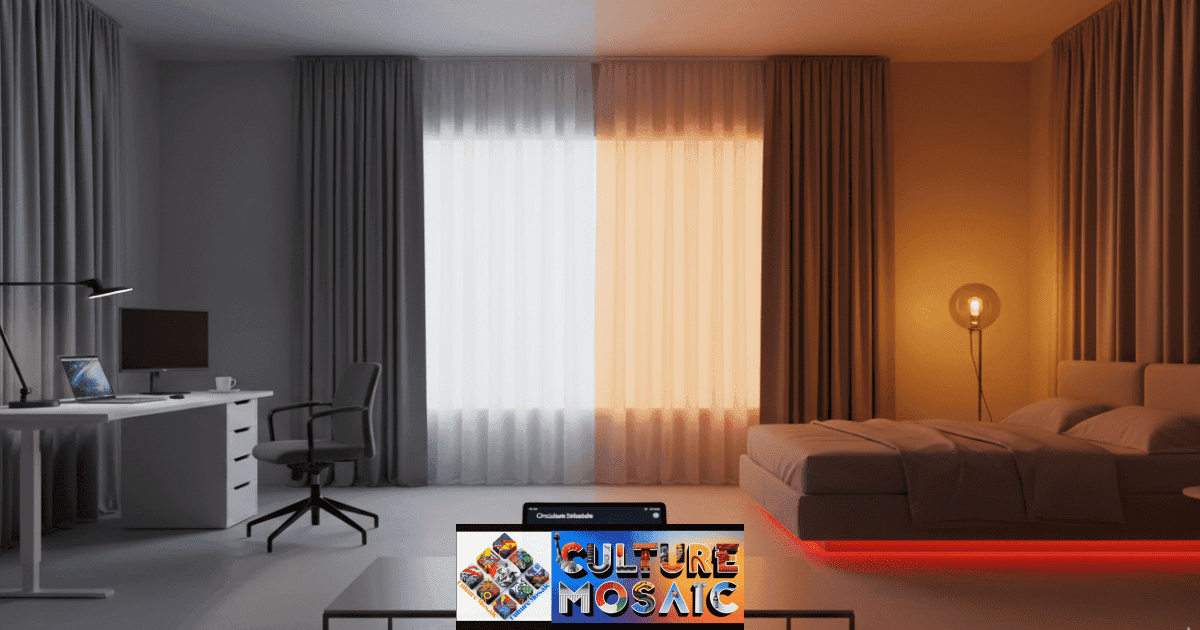
Your 450-square-foot apartment is doing something quietly cruel to you. It is asking your brain to wake up, focus deeply, cook dinner, wind down, and fall asleep in the exact same square footage under the exact same overhead light. Your biology was never built for that. But with the right approach to circadian lighting for small modern apartments, you can reprogram your space to follow your body’s 24-hour rhythm instead of disrupting it. This is precisely what practitioners at Culture Mosaic identify as the most overlooked lever in urban interior design: the quality of artificial light at every hour of the day.
This is not about expensive gadgets. It is about one fundamental truth: light is your body’s most powerful environmental time-cue, and you can direct it deliberately, even inside 400 square feet.
The Blue Light Trap: Why Small Apartments Quietly Wreck Your Sleep
When you live, work, and sleep in one room, your brain never receives a clear signal that the day is finished. Lighting designers call this Eternal Afternoon Syndrome. Your overhead LED blasts the same cold, blue-rich light at 9 AM when you need to perform and at 9 PM when your nervous system is supposed to be winding down. The result is a confused suprachiasmatic nucleus (SCN), which is the brain’s master circadian clock, sitting in the hypothalamus.
The deeper issue is what researchers studying spatial decoupling for home environments have documented clearly: in a well-designed multi-room home, physical zones naturally cue different behavioral states. A studio apartment collapses those zones entirely. Without deliberate lighting design, your nervous system cannot fully complete the daily cortisol-to-melatonin transition that restorative sleep depends on.
Cortisol Response
Triggered by blue-rich light above 5000 K. Signals alertness, focus, and readiness. Peaks between 8 AM and noon. Must taper by evening for the sleep cycle to begin cleanly.
Melatonin Release
Triggered by warm amber-spectrum light below 3000 K. Signals sleep readiness. Rises naturally about 2 hours before bed, but only if blue light is removed from the environment first.
In a studio without a dedicated bedroom, there is no physical transition between your work zone and your sleep zone. Circadian lighting for small modern apartments creates that transition using the one variable you can control completely: the colour temperature and intensity of your light at each hour of the day.
The Strategy: The Three-Layer Lighting Rule for Small Spaces
Every serious lighting designer works in layers. For compact apartments, three are all you need. Each one targets a distinct stage of your biological day, and together they replicate the arc of natural daylight without requiring structural changes to your home. This layered thinking sits at the heart of somatic interior design principles, which treat the body’s nervous system as the primary occupant that any interior must serve.
Layer 1: Task Lighting (The Focus Zone)
Task Lighting — The Focus Zone
5000 K–6500 K • 300–500 lux at the work surface
Position a concentrated, blue-rich light source directly above your desk or kitchen island. This layer mimics the overhead midday sun, and it is the light stimulus your cortisol system responds to most strongly. The key is directionality: you want it pointed down and focused, not diffused across the entire room. A tight beam over your work surface gives you genuine cognitive sharpness at the spot where you need it, without contaminating the warmer ambient environment two metres away.
Popular 2026 products for this layer:
Layer 2: Ambient Lighting (The Transition)
Ambient Lighting — The Transition
4000 K midday → 2700 K at 8 PM • Location-aware auto-scheduling
This is your room’s foundational light layer. Smart bulbs with dynamic Kelvin tuning automatically shift from a cool neutral midday tone down to a warm incandescent warmth as the sun sets. In 2026, Matter-certified and Thread-enabled bulbs handle this with zero manual intervention because they pull your local sunrise and sunset times directly and adjust on a rolling daily schedule. This is where circadian lighting for small modern apartments becomes genuinely effortless: you configure it once and your apartment begins behaving like a living environment that follows the sun through all four seasons.
Layer 3: Accent and Safety Lighting (The Midnight Glow)
Accent and Safety Lighting — The Midnight Glow
Under 1800 K • Red or deep amber spectrum only • Under 10 lux
This layer exists so you can navigate your apartment at 2 AM without shocking your brain back into a state of alertness. Low-level, red-spectrum LED strips tucked under the bed frame, along cabinet toe-kicks, or behind the television give you enough light to move safely without triggering the SCN. Red wavelengths fall at the far end of the visible spectrum and carry the lowest melatonin-suppression impact of any colour of light. This is why neonatologists and astronomers rely on red light in settings where dark adaptation must be preserved at all costs.
Five Radiant Wins: Why Circadian Lighting for Small Modern Apartments Changes Everything
Here is exactly what happens when this system is working correctly. These are not vague lifestyle promises. They are physiological outcomes documented in human light-biology research.
Deeper, Faster Sleep
Removing blue light after 7 PM allows melatonin to rise on its natural schedule, cutting average sleep-onset latency by 15 to 30 minutes. For studio dwellers who stare at lit screens in the same room where they sleep, the improvement is often dramatic within the first week.
Sharper Morning Focus
Bright, cool task light at your desk reinforces the morning cortisol peak at precisely the right time, replacing the habitual mid-morning slump with genuine cognitive readiness. You stop fighting your biology and start using it as a tool.
Mood Regulation
Consistent light-dark cycling supports serotonin synthesis during daylight hours and melatonin synthesis at night. Together, these form the neurochemical backbone of stable daily mood, which is particularly relevant for north-facing apartments that receive very little natural daylight in winter months.
Energy Efficiency
Automated schedules ensure your lights are never running at higher intensity or cooler temperature than the current hour requires. Most users transitioning from static LEDs to circadian scheduling report a 20 to 35 percent reduction in their residential lighting energy draw.
Spatial Illusion
Layered lighting creates visual depth and perceived volume in a compact room. Warm accent light pooling in corners makes the same 400 square feet feel considerably more generous and deliberately designed. This principle is explored in careful detail in the guide to modern heritage living room design, where layered light is the single most effective tool for spatial expansion without any structural alteration.
Small Space Hacks: Zero-Footprint Implementation
Studio and compact apartment constraints mean you often cannot position floor lamps exactly where theory demands, or add circuit-connected ceiling fixtures without a landlord’s permission. These three strategies solve that entirely. They also connect to the broader discipline of functional biophilic decor for circadian health, which frames your lighting as one component of a complete sensory environment designed around human biological rhythms rather than architectural convention.
Use Verticality
Tall arc floor lamps aimed upward at a pale ceiling distribute light as a large, diffused reflection that closely resembles the quality of overcast natural daylight. This uplighting technique fills a room without creating the harsh downward shadows of a conventional pendant, and because the source itself is never directly visible from a seated position, there is no glare. Your eyes stay relaxed throughout the working day.
Smart Integration with Matter and Thread in 2026
The Matter 1.3 protocol and Thread mesh networking mean your bulbs communicate with each other and with your phone entirely locally, without any proprietary hub. A five-minute setup inside Apple Home, Google Home, or Amazon Alexa creates a location-aware sunrise and sunset schedule that self-corrects daily for your latitude through every season. The reasoning behind why automated environmental transitions matter so deeply is explored in the research on socially restorative architecture, which documents how predictable environmental cues reduce background physiological stress in dense urban living conditions.
Mirror Magic for North-Facing Units
If your apartment faces north and receives minimal direct sunlight, place a large mirror on the wall directly opposite your primary window at a height matching the window’s midpoint. A properly positioned full-length or leaner mirror can redirect and amplify incoming morning light by up to 30 percent, strengthening the natural dawn signal before your smart bulbs have even begun their morning ramp. It costs nothing to buy secondhand, requires no wiring, and adds a visual depth-of-field effect that makes a compact room read as larger.
Tech vs. Tradition: A Clear Comparison for Smart Buyers
Not yet convinced that the investment in tunable smart lighting is warranted over standard replaceable bulbs? This table addresses the honest trade-offs. There is a real entry cost, but the return in restorative sleep and sustained daytime energy is extremely difficult to dismiss once you have experienced a properly tuned circadian environment for two weeks.
| Feature | Traditional Bulbs | Circadian Smart Bulbs |
|---|---|---|
| Colour Control | Fixed warm or cool, no adjustment | Dynamic Kelvin scale from 1800 K to 6500 K |
| Biological Impact | Static output, potentially disruptive to sleep | Mirrors the full arc of the natural solar day |
| Small Space Advantage | Low cost, no learning curve | Eliminates mental overhead via complete automation |
| Sleep Quality Impact | Neutral at best, actively disruptive at worst | Clinically supported melatonin onset improvement |
| 2026 Setup Time | Instant, screw in and done | 15 to 30 minutes one-time setup, then fully automatic |
| Hub Required | N/A | None needed for Matter and Thread certified devices |
| Cost to Start | $5 to $15 per bulb | $15 to $35 per bulb, with genuine quality-of-life payback |
FAQ: Your Circadian Lighting Questions Answered
These are the questions that come up most consistently from clients setting up their first circadian system in a compact apartment. Honest answers, without any padding.
Find Your Kelvin: Get Your Personal Lighting Schedule
Join 50,000 urban dwellers optimising their modern living spaces. Enter your email and we will send you a complete circadian lighting schedule built around your wake-up time and apartment orientation.
No spam. Unsubscribe any time.