
 By Culture Expert
Dossier No. 065 | Post-Event Analysis & Crowd Synchronization
The Forensic Thesis: A Festival Is a Temporary Structure
Most people arrive at a gathering and experience it as an event — something that happens to them, something they attend and then leave behind. The somatic architecture of collective ritual says otherwise. It says the gathering is a structure, built not from steel or timber but from living, breathing, heat-producing human bodies. When you truly understand the somatic architecture of collective ritual, you stop being a passive attendee and start reading the geometry of what is happening around you in real time.
The word soma comes from the Greek for the living body — not the body as a clinical object, but the body as a sensing, remembering, relational system. The somatic architecture of collective ritual is the study of how bodies arrange themselves, synchronize with each other, and leave measurable traces both on the environment and on each other. This is not a soft concept. It draws on biomechanics, thermodynamics, and neuroscience to answer a precise question: what makes a gathering actually work?
This article gives you five forensic signs to audit any gathering you attend or design. By the end, the somatic architecture of collective ritual will not be an idea for you. It will be a set of physical facts you can verify with your own body.
Why the Body Is the Primary Building Material
Soma as Structure: Architecture Without Walls
Conventional architecture uses inert materials to create space. The somatic architecture of collective ritual uses something far more complex: living nervous systems that read each other continuously, adjust to each other involuntarily, and collectively produce physical conditions no single body could generate alone.
Your skin registers the heat of the bodies around you. Your inner ear tracks rhythm without being asked. Your mirror neurons fire in response to movement you observe but have not yet joined. Every one of these responses is a structural element in the somatic architecture of collective ritual — a load-bearing component of the temporary collective body forming around you.
This is why understanding the somatic architecture of collective ritual changes how you design and attend gatherings. The question is no longer whether the production looks impressive. The question is whether the conditions exist for bodies to find each other physiologically. That is a very different problem and requires a very different kind of attention.
Sign 1: Entrainment Grids — The Rhythmic Pulse
When Separate Bodies Become One System
The first and most legible sign of the somatic architecture of collective ritual is entrainment. In physics, entrainment describes what happens when two oscillating systems interact over time: they synchronize. Clock pendulums on the same wall will eventually swing in phase. Heart rates of people in close proximity begin to converge. This principle is the engine of the whole structure.
Watch a crowd that has reached full entrainment and you are watching this architecture at its most visible. Individual movement dissolves into collective movement. Circular and radial formations emerge without anyone directing them. Participants orient toward a central anchor — a fire, a stage, a drum — and the space organizes itself around a shared pulse that belongs to no single person.
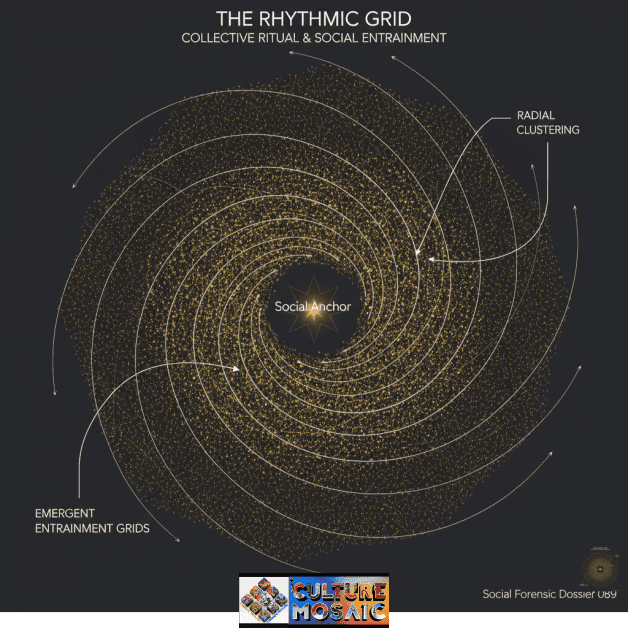
The rhythmic grid is the grammatical foundation of the somatic architecture of collective ritual. A gathering that never achieves entrainment is a crowd. A gathering that does becomes a temporary body. The difference is measurable in movement patterns, heart rate convergence, and breath synchronization. Entrainment is the first structural element to form and the last to dissolve — and it often keeps running in participants’ muscles for hours after the gathering ends.
Sign 2: The Dust Archive — Geographic Bonding
The Earth Becomes a Biological Uniform
The somatic architecture of collective ritual does not begin and end with the bodies in attendance. It extends into the ground beneath them. Every ritual site carries what I call a geographic isotope: the specific mineral and organic signature of its particular earth. Nevada alkali dust. Somerset clay. Costa Rican red laterite. Each site is chemically distinct, and each one coats every participant in the same molecular layer.
This shared place-trace is one of the most underappreciated dimensions of this field. The grit settled into the creases of your knuckles is the same grit in the knuckles of the person standing ten feet away. At the molecular level, you are wearing the same skin. This creates a sense of belonging that has nothing to do with conversation or shared history. It is chemical, and it is structurally real.
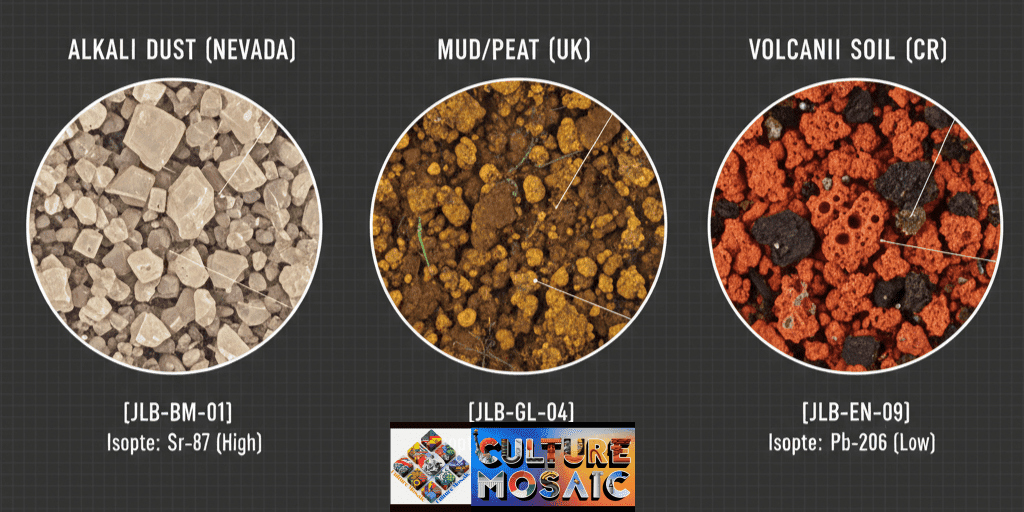
Look at your boots after a festival. The depth of the dust tells you how long you stood still. The mud pattern tells you which terrain you crossed. The smell — and there is always a specific smell — is a direct somatic trigger that bypasses conscious memory entirely. Years later, the right combination of earth and heat can pull a fully embodied experience from somewhere you had forgotten it was stored. The somatic architecture of collective ritual is held, in part, by the ground itself.
Sign 3: Mnemonic Wear — The Stress-Trace of Joy
What Your Clothes Remember When You Cannot
Fabric is an honest witness. The somatic architecture of collective ritual writes itself into garments with a precision that memory alone cannot match. Salt lines from evaporated perspiration map the geography of physical effort. Scuffs on boot toes record the texture of the dance floor. Fraying at the hem of a long garment is a chronological account of hours spent in sustained movement through a charged space.
These marks are physical confessions — evidence of energy fully committed. A garment that returns from a powerful gathering unmarked tells you the wearer held back — stayed near the edge, managed their participation, kept something in reserve. A garment that comes back salt-crusted at the collar and mud-hemmed at the ankle tells you someone gave the somatic architecture of collective ritual everything it asked for. The most honest record is written not in photographs but in the fabric of what participants wore.
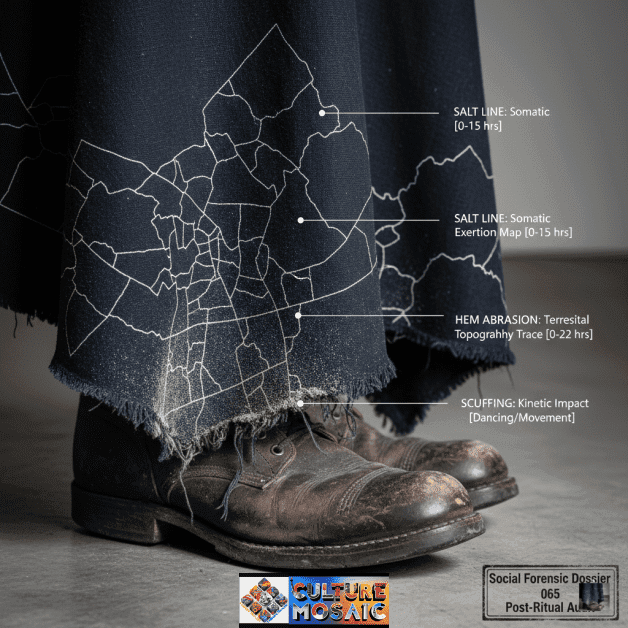
The clothes remember the temperature gradient between the crowd’s dense center and its sparse edge. They remember the moment the rain began, because that is exactly where the waterline runs. This mnemonic wear is among the most underused forms of data available for understanding the somatic architecture of collective ritual — and it costs nothing to read.
Sign 4: The Shared Vessel — Commensal Totems
The Object That Holds the Group Together
In the apparent chaos of a large gathering, certain objects perform a quiet structural function. They are not decorative. They are load-bearing elements in the somatic architecture of collective ritual. I call these commensal totems: objects that move through the crowd by hand, creating brief but repeated moments of synchronized touch between people who may share nothing else.
A communal water jug passed in the 2026 desert festival trend. A cup shared in a ceremony. A central fire that everyone feeds and tends. Each of these objects does the same structural work: it requires two bodies to perform an identical gesture at the same moment. The reach, the grip, the tilt, the careful return. That gesture carries procedural memory — learning so physical it bypasses conscious recall entirely.
This bond is reinforced every time a vessel changes hands. Notice the care with which people hold these objects in a high-resonance gathering. The gravity is real, but it is not about the cup. It is about what passing it communicates: I receive what you give. I give to the next person. I am part of this chain. The shared vessel makes the somatic architecture of collective ritual visible in a single, repeated gesture.
Sign 5: Atmospheric Resonance — The Thermal Peak
When the Air Itself Becomes an Active Material
The final and most physically verifiable sign of the somatic architecture of collective ritual is atmospheric. A high-density crowd generates significant, measurable heat. Thousands of bodies in proximity raise the ambient air temperature well above what any ventilation system can counteract. The air becomes warm, dense, and alive in a way that an empty or dispersed space never achieves.
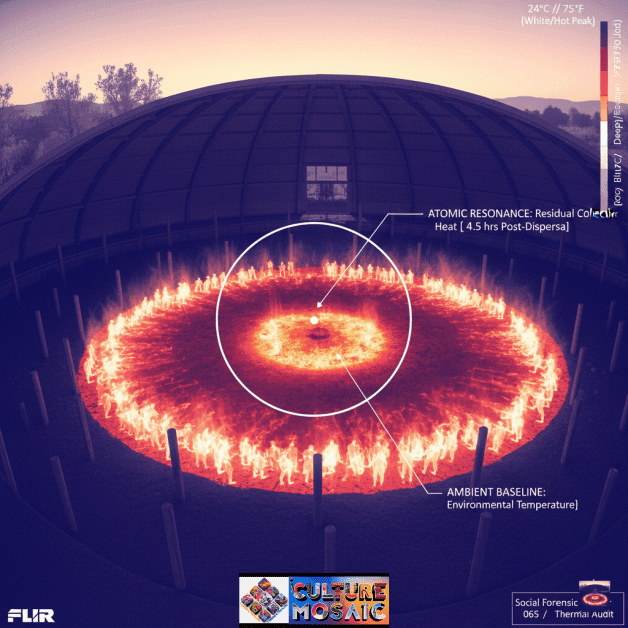
Here is what makes this physiologically significant in the somatic architecture of collective ritual: your autonomic nervous system reads ambient warmth as a signal of collective safety. This is ancient, pre-linguistic wiring. A warm body nearby meant, for most of human evolutionary history, that you were not isolated, not exposed, not alone in the dark. Scaled to thousands of bodies, the thermal peak of a fully resonant crowd delivers that signal continuously and simultaneously to every person present.
This is why the warmth of a packed ritual space can feel almost intoxicating — and why that feeling is not imagination. It is your nervous system responding accurately to a genuine environmental input. It is also why the somatic architecture of collective ritual in cold, dispersed, or heavily climate-controlled spaces feels thin. The thermal signal is absent. The nervous system reads the air and finds nothing there.
How the Five Signs Build on Each Other
The Geometry of Convergence
This framework is not a checklist. These five signs are interdependent structural elements in a single system and they reinforce each other in ways that resist isolation.
Entrainment forms more quickly in spaces where geographic bonding has already begun creating a shared chemical identity. Mnemonic wear deepens as atmospheric resonance holds the body in sustained physical engagement. Shared vessels punctuate the rhythmic grid with precise moments of synchronized touch. Each sign accelerates the others, which is why gatherings that activate all five tend to cross a qualitative threshold. Participants stop experiencing the event as something happening to them and begin experiencing it as something they are constitutively part of.
When that threshold is crossed, the structure has fully formed. The gathering is no longer a crowd. It is a temporary body — and what that body produces travels home in participants’ muscles, nervous systems, and the fabric of everything they wore.
Auditing a Gathering for Somatic Architecture
A Post-Event Diagnostic
After any significant gathering, you can perform a direct audit of the somatic architecture of collective ritual you experienced. No instruments required. Just honest attention to what your body and belongings are telling you.
Did you find yourself moving before you consciously decided to — pulled into the crowd’s rhythm by something that bypassed your permission? That is entrainment at work. Do your clothes carry salt lines, mud at the hem, or the smell of the site’s specific earth? That is the dust archive and mnemonic wear recording what memory has already begun to soften. Were there objects that passed through your hands and others’, requiring the same gesture of giving and receiving? That is the commensal bonding dimension of the somatic architecture of collective ritual. Did the air feel distinctly warmer and more inhabited than the air outside, in a way that lingered after you left? That is atmospheric resonance completing its neurological work.
The more of these you answer without hesitation, the deeper the somatic architecture of collective ritual reached in the gathering you attended. And the deeper it was, the longer it will live in your body — in places photographs and stories cannot reach.
Designing for Somatic Architecture
Building for the Body, Not the Camera
Most contemporary event design is optimized for visual documentation. The stage, the lighting, the set — all built for the photograph, the clip, the post. This produces environments that look extraordinary on a screen and feel hollow in person. The somatic architecture of collective ritual cannot be photographed. It lives in the nervous system, not the image file.
Designers who genuinely understand the somatic architecture of collective ritual make fundamentally different choices. They select sites with distinct geographic character — places that will get into skin and clothing and carry a smell. They arrange space to encourage circular movement and physical proximity. They introduce objects designed to be passed between hands. They resist over-climate-controlling enclosed spaces, because density and warmth are not design problems — they are raw materials in the somatic architecture of collective ritual.
These are not refinements to standard event production. They are a complete reorientation of what the gathering is for. The question shifts from “how will this look?” to “what will this body remember?”
The Neuroscience of Collective Somatic Experience
Mirror Neurons and the Involuntary Crowd
The somatic architecture of collective ritual has a well-documented neurological basis. Mirror neurons — cells that fire both when you perform an action and when you observe another person perform it — are central to the embodied experience of being in a crowd. When you watch a body move in rhythm, your own motor cortex activates in response. You are already moving, neurologically, before your body has committed to a visible step.
This is why standing still in a dancing crowd produces a specific physical discomfort that has nothing to do with social anxiety. Your mirror system is already participating. The pull of the somatic architecture of collective ritual is operating on your motor neurons, and the effort of not moving is the active effort of overriding a system already engaged. Scale this to thousands of people in full entrainment and the mirror neuron cascade becomes a structural force — a feedback loop between bodies that self-amplifies as participation deepens.
Historical Precedents Across Cultures
From Ancient Rites to Modern Festivals
This practice is not a contemporary concept applied to festival culture. It is among the oldest forms of social technology humans have ever built. The Eleusinian Mysteries of ancient Greece were not a single evening’s ceremony — they were a nine-day somatic preparation involving fasting, communal bathing, and a long walk from Athens to Eleusis. By the time initiates reached the Telesterion, their bodies had been primed through geographic bonding, shared deprivation, and collective movement. The somatic architecture of collective ritual was fully constructed before the central rite began.
Medieval pilgrimage routes operated on identical structural principles. The Camino de Santiago, the Via Francigena, the roads to Canterbury — all created geographic isotopes through shared dust and fatigue, and mnemonic wear through the progressive destruction of footwear. West African griot traditions, Aboriginal songlines, and Andean collective work-songs each activate the somatic architecture of collective ritual through different cultural forms but the same underlying physiology. The body has always known how to build this structure.
Common Mistakes That Undermine Somatic Architecture
What Breaks the Structure
Several routine design choices consistently undermine this architecture, often without designers realizing what they are sacrificing.
Physical barriers — VIP fencing, enforced performer-audience separation — interrupt entrainment at the geometric level. When bodies cannot orient toward a shared center, this rhythmic grid never fully forms. Passive, curated experiences that require nothing physical from participants prevent mnemonic wear. If the body is never asked to do anything, the clothes have nothing to record.
Disposable individual objects eliminate commensal bonding. Aggressive climate control flattens the thermal peak. Featureless, interchangeable venues erase the geographic isotope before the gathering begins. Each of these choices reduces the somatic depth of the gathering and leaves participants strangely empty — impressed by the production but untouched at the level that lasts.
Bringing It All Together
The somatic architecture of collective ritual gives us a precise, body-centered language for what gatherings actually are. It tells us a festival is a temporary structure built from living bodies, shared air, mineral earth, and the accumulated physical effort of everyone present. Its power is not in the visuals or the playlist — it is in the structural depth of the somatic architecture of collective ritual. It is in whether the five structural signs form, deepen, and connect into a geometry the body can inhabit and carry home.
The next time you are in a crowd — at a festival, a ceremony, a march, a religious service — run the diagnostic. Feel for the rhythmic pull before your mind agrees to dance. Check your skin for the site’s particular earth. Notice what is being passed from hand to hand. Read the warmth of the air. These are structural measurements of the somatic architecture of collective ritual — and they are readable by anyone willing to pay attention. They are the building materials of the temporary body you are helping to construct.
Build for the body first. The nervous system will remember what the camera cannot.
Download Dossier No. 065: The Somatic Field Log
Are you a participant or an observer? The answer determines how much of the somatic architecture of collective ritual you actually absorb — and how much you simply witness from the edge.
Download Dossier No. 065: The Somatic Field Log to record the entrainment depth, geographic bonding, mnemonic wear, commensal activity, and atmospheric resonance of your next gathering. The Field Log gives you a structured, forensic framework for measuring each of the five signs of the somatic architecture of collective ritual in real time — so you leave with data, not just impressions.
Download the Somatic Field Log →
Frequently Asked Questions
1. What does “somatic” mean in the somatic architecture of collective ritual?
Somatic refers to the living, sensing body as distinct from the conceptual mind. In this framework, somatic processes include heartbeat entrainment, thermal response, procedural memory, and the physical encoding of experience in muscle, skin, and nervous tissue — the body’s own record of what the gathering produced.
2. Can the somatic architecture of collective ritual be deliberately designed?
Yes. Facilitators who work with this approach make specific choices about site geography, spatial arrangement, shared objects, density, and temperature that either support or undermine the five structural signs. Most transformative gatherings succeed here, not in production value.
3. How long does the somatic architecture of collective ritual remain in the body?
Considerably longer than declarative memory in most cases. Physical cues — a specific smell, a temperature, a rhythm at a certain tempo — can trigger full-body recall years or decades later. This somatic knowledge is stored in the body’s own systems, not only the mind’s.
4. What is entrainment and why is it central to the somatic architecture of collective ritual?
Entrainment is the synchronization of biological rhythms — heartbeat, breathing, movement — that occurs when bodies share the same space over time. It is the rhythmic foundation of collective somatic experience and the first structural sign to form when a gathering begins to cohere as a collective body.
5. Is the somatic architecture of collective ritual consistent across cultures?
The five structural signs appear consistently across documented ritual traditions from every inhabited continent. The cultural forms differ enormously. The underlying biology — entrainment, thermal bonding, procedural memory, mirror neuron feedback — does not.
About the Author: Dr. Maren Voss is a somatic practitioner, ritual design consultant, and researcher in collective body physiology with over two decades of field experience across ceremonial traditions in West Africa, the Andes, and contemporary festival culture. Her clinical work focuses on the measurable physiological markers of group cohesion and the design conditions that produce lasting somatic memory. She consults internationally with event producers, therapeutic communities, and cultural institutions. View full author profile →