
 By Culture Expert
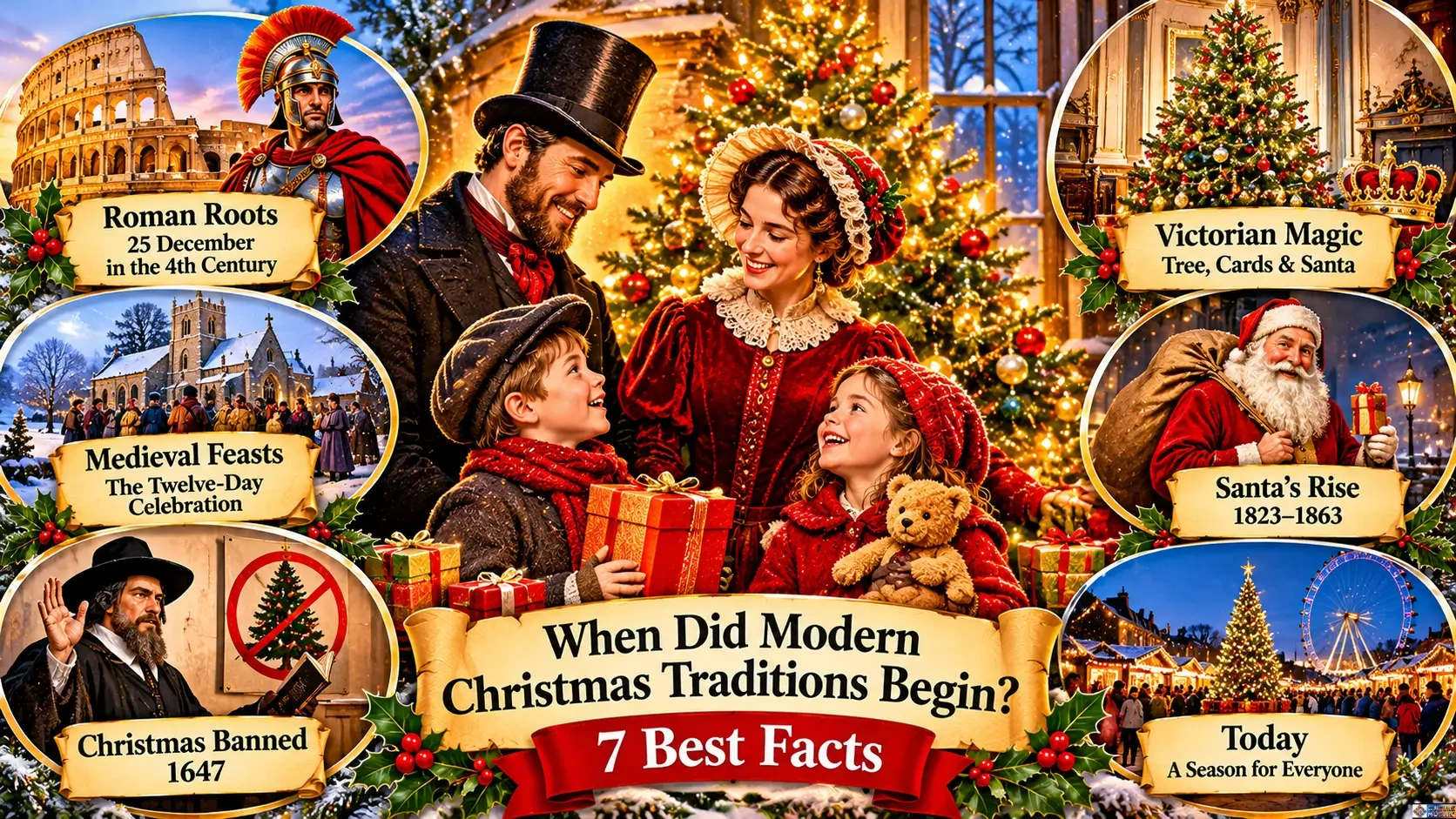
Mostly in the Victorian era, between about 1840 and 1870. Midwinter feasting is far older, and Rome had fixed 25 December by the 330s. But the decorated tree, the Christmas card, the family dinner, and the pile of presents took their modern shape in the mid-1800s.
Henry Cole’s card and Dickens’s A Christmas Carol both appeared in 1843, and the royal tree reached the public in 1848. Santa Claus was assembled in America between 1823 and 1863, and 20th-century advertising polished him.
★ Core Takeaway: Pre-Christian winter festivals supplied the timing, the evergreens, and the appetite. The Victorians supplied the rest.
Every December, somebody at the table announces that this is how it has always been done. The tree goes up on a particular date. Presents are opened in a particular order. Someone sulks when the sprouts go missing.
I think that quiet pressure is why the season wears so many of us out. You aren’t only hosting a meal. You’re guarding a tradition nobody ever told you the origin of, and the guilt of getting it wrong arrives right on schedule. Victorian diaries and letters are full of the same strain, which tells you something. The pressure is part of the tradition.
The fix is cheap. Learn the timeline. Once you know when each custom arrived, who sold it, who banned it and who rescued it, the obligation loosens and the choosing begins. The Hershey Story Museum in Pennsylvania answers when did modern Christmas traditions begin in one blunt line: the 1800s. I mostly agree. The fuller answer is messier at the start and more commercial at the end, so we’ll take it in order. I wrote it for Culture mosaic because this question deserves better than a bullet list.
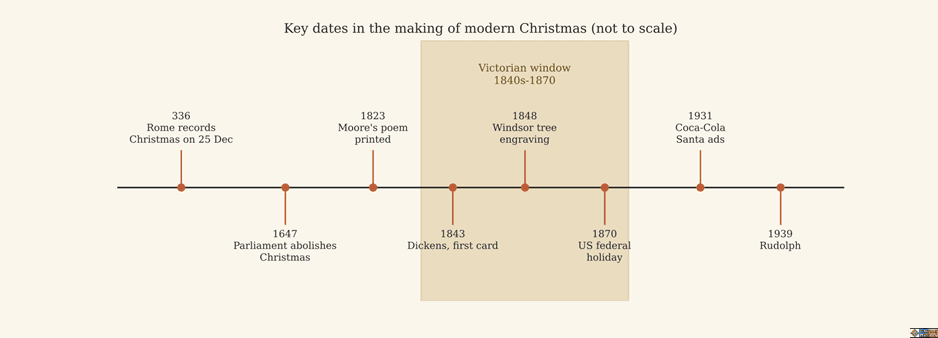
Figure 1: The dates that made modern Christmas. Original chart for Culture Mosaic.
1. Christmas Origin Country? A Roman Date and a Northern Appetite
Start with the awkward fact: no single country invented Christmas. Rome supplied the date. Bethlehem supplied the story. Northern Europe supplied the appetite. The Gospels never say when Jesus was born, and the earliest firm record of Christmas kept on 25 December comes from Rome in the 330s. So if you ask when did Christmas start, the fourth century is the honest answer for the festival itself.
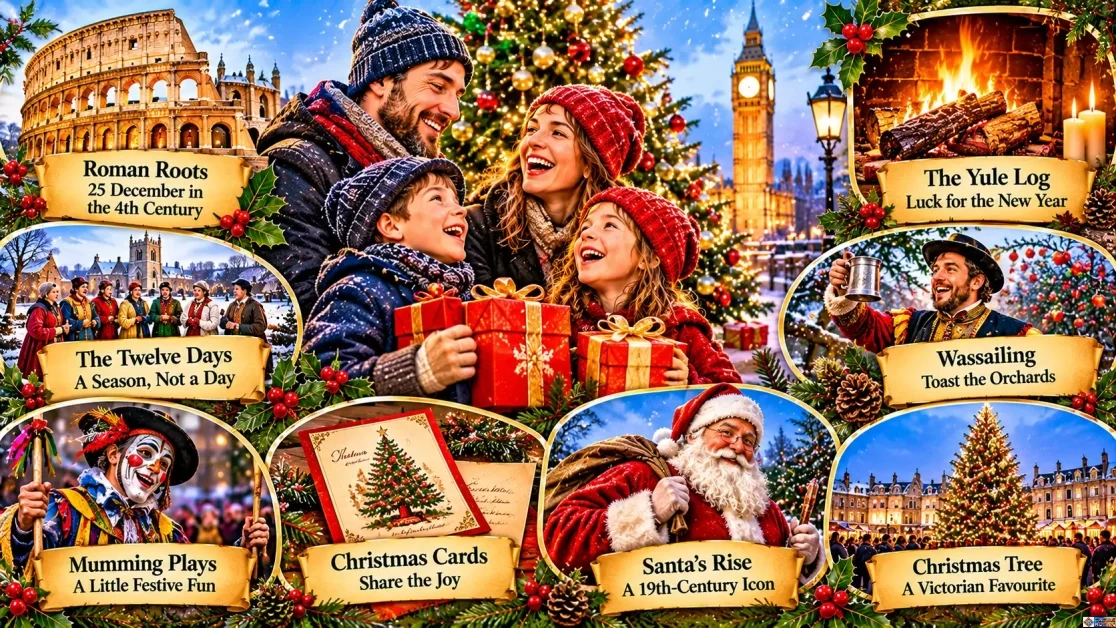
Winter parties were ancient by then. Romans held Saturnalia in mid-December, a week of gambling, role reversal and small gifts such as candles and figurines. Germanic and Norse peoples kept Yule, and the Anglo-Saxon monk Bede mentions a month called Giuli in the early 700s. Evergreens, fire and feasting made practical sense when stores ran thin and the nights ran long.
Did the church simply take over a pagan festival? That’s the popular line, and I distrust it a little. Historians such as Ronald Hutton have pointed out how thin the evidence for detailed pagan midwinter ritual really is, and the date can be explained in more than one way, including a calculation from 25 March, the traditional date of the Annunciation. Safer to say this: the timing, the greenery and the licence to overeat have pre-Christian echoes. The nativity story is Christian. Our guides to Christmas Religious Stories and Religious Festivals in the World show how other winter feasts sit beside it.
2. When Did Christmas Become a Tradition in England? The Twelve-Day Feast
By the early Middle Ages, Christmas Day was a date kings wanted for their coronations. Charlemagne took the imperial crown on 25 December 800, and William the Conqueror chose the same day in 1066 at Westminster Abbey. In England the festival soon stretched into a season running to Epiphany on 6 January: feasting, wassail, carols, and a mock ruler called the Lord of Misrule.
So yes, Christmas was an English tradition long before Victoria. But look at what was missing. No tree. No Santa. No cards. Gifts were mostly swapped at New Year. Medieval Christmas was communal and rowdy, while the modern one is domestic and child-centred. Those are two different festivals wearing the same name. Our guide to historic Christmas traditions UK maps the older folk customs, and Christmas Festival History fills in the wider timeline. Carols grew partly out of wassail songs, a thread picked up in Glad Voices of Christmas.
3. Why Was Christmas Banned in 1647?
Because Puritans in Parliament thought it was unbiblical and badly behaved. In 1644 they ordered a monthly fast that happened to land on 25 December. In June 1647 an ordinance abolished Christmas, Easter and Whitsun as festivals and gave apprentices and servants the second Tuesday of each month as a substitute holiday. Ministers who preached Christmas sermons were arrested. That December, crowds rioted in Canterbury, Bury St Edmunds, Norwich and Ipswich.
Cromwell takes the blame, but the ordinance predates his Protectorate by years, so the idea that he personally cancelled Christmas is a convenient simplification. The ban ended with the Restoration in 1660. The Scottish Kirk had objected to the feast since the 1560s, and Massachusetts fined anyone caught observing it five shillings between 1659 and 1681.
I think the ban matters for a reason people rarely mention. It cut the thread. Christmas came back in 1660, but as something people chose to keep rather than a rule of the calendar, and by the early 1800s it was fading in industrial towns where plenty of workers still clocked in on the day. Dickens’s clerk Bob Cratchit has to plead for his Christmas Day. He’s fiction, but readers recognised the scene.
4. When Did Modern Christmas Traditions Begin in England? The Tree, 1848
If you want a single year for England, I’d nominate 1848. That December the Illustrated London News printed an engraving of Queen Victoria, Prince Albert and their children gathered around a candlelit fir at Windsor Castle. It spread like gossip. The Royal Collection Trust credits the image with inspiring households across the country.
The tree itself is older, and German. A written account from Strasbourg in 1605 describes fir trees in homes hung with paper roses, apples and sweets. The story that Martin Luther added candles after walking beneath the stars is a charming legend with no early evidence, and I’d let it go. Queen Charlotte, George III’s German-born wife, set up a tree at Windsor in 1800, yet the custom stayed courtly until the 1848 print made it respectable and fashionable. America followed within two years. Godey’s Lady’s Book ran a version of the royal picture in 1850, and the Hershey Story notes the tree took hold across the States over the next few years.
Imagine the smell: resin, warm wax, a little scorched needle. Real candles clipped to dry branches were a genuine fire hazard, which says something about how badly Victorian families wanted the thing.
5. 1843: Dickens, the First Card and the Gift Pile
Back up five years. In 1843 three things collided. Henry Cole, a civil servant and later the first director of what became the V&A, was drowning in correspondence. He commissioned the artist John Callcott Horsley to design a card he could simply sign. Cole’s diary for 17 December records Horsley bringing the design. About a thousand copies were printed, hand-coloured and sold at a shilling, which was dear. Two days later, on 19 December, Dickens published A Christmas Carol. The Penny Post, begun in 1840, had already made greetings by mail cheap, so cards had somewhere to go. The original card now sits in museum collections, and its visual descendants fill our piece on Famous Christmas Artwork.
Gifts moved too. Tudor courts and many households had swapped presents at New Year. Victorian families shifted them to Christmas and aimed them at children, in an age that had newly decided childhood deserved care and play. London confectioner Tom Smith added the cracker in the 1840s. The Bank Holidays Act 1871 later wrote the break around Christmas into law.
Dickens also tied the season to charity, a thread still visible in UK community Christmas initiatives. Public life took its share as well, and our look at civic Christmas traditions follows how trees, lights and carols moved from parlour to town square.
6. When Did Modern Christmas Traditions Begin in America? Santa, Nast and the Federal Holiday
Americans came to the party late. Puritan colonies treated Christmas with suspicion, and the first states recognised it as a legal holiday only in the 1830s. Congress made it a federal holiday in 1870. The Hershey Story dates the real rise of gift-giving to the 1870s and 1880s.
Santa Claus was built in layers. Saint Nicholas, a bishop of Myra in what is now Turkey, supplied the generosity. Dutch Sinterklaas, German gift-bringers and the English Father Christmas supplied costume and mood. Washington Irving’s satirical 1809 history of New York played with a Dutch St Nicholas, and historians such as Stephen Nissenbaum argue that early-1800s New Yorkers polished that pedigree to suit a gentler Christmas. Then Clement Clarke Moore’s poem, printed anonymously in the Troy Sentinel in December 1823, handed Santa a sleigh, reindeer and a chimney. Thomas Nast drew him for Harper’s Weekly from 1863 for two decades, fixing the look and the name.
Cards crossed the Atlantic in the 1870s, when Louis Prang’s firm began selling them. For the American table and the parades, see Top US Christmas Foods and Best Christmas Celebrations in US.
Table 1: Britain and America compared
7. How Christmas Evolved Over Centuries: Lights, Radio and a Reindeer
The 20th century added gloss and, honestly, a lot of marketing. Edward Johnson, an associate of Thomas Edison, lit a tree with electric bulbs in New York in 1882, and the habit spread over the following decades as electricity reached ordinary homes. Folded cards returned to fashion in the 1920s after Hallmark’s rise. King’s College, Cambridge, held its first Nine Lessons and Carols in 1918, and George V’s first Christmas radio broadcast followed in 1932.
Then came the fizzy myth. Coca-Cola did not invent Santa, and its own FAQ says so. What its adverts did, in Haddon Sundblom’s paintings from 1931, was standardise the rosy, laughing grandfather and then repeat him for decades. In 1939 the department store Montgomery Ward gave away a booklet about a red-nosed reindeer. Retail wrote that one outright.
Table 2: What are some modern Christmas traditions, and where did each come from?
Modern Living: Choosing Your Own Layer of Christmas
Once you can see the layers, a modern household gets a freedom it didn’t know it had. A blended family can stack a German-style tree, a Caribbean black cake and a Boxing Day walk without any of it being wrong, because every one of those customs arrived from somewhere, and most of them recently. The Victorians borrowed from Germany without apology. You’re allowed to borrow from your neighbours.
The slow-living version is older than it looks. Paper chains, clove-studded oranges, evergreen boughs and handmade cards echo the 1840s parlour more closely than any shop window does. The eco-minded choices, a potted tree, a wreath you reuse, wrapping you fold and keep, sit nearer to the old habit of carrying living greenery indoors than to disposable decor. Our Modern Living section follows those choices into the home.
So what do you do with all this? Here’s my short list. Keep one custom you truly love, whatever its age. Drop one you only keep out of fear. Go and see one of the Classic Christmas Themed Events in person, because history lands harder with cold hands and a hot drink. Then try the odd one: hang a kissing bough, the hoop of evergreens, apples and candles that hung in English homes before the fir took over. Stuck for food? Christmas Celebration Foods and the Christmas Cooking List cover the table, Christmas Culture Traditions widens the lens, and if you want the weird corners, try Unusual Christmas traditions around the world and Global Christmas Customs.
The honest answer to when did modern Christmas traditions begin is that nobody has switched them off yet. Christmas has never stood still. The only live question each year is who gets to edit it, and I think that should be you.
Frequently Asked Questions
1. When did modern Christmas traditions begin?
Mostly in the Victorian era, between roughly 1840 and 1870. Henry Cole’s first commercial card and Dickens’s A Christmas Carol both appeared in 1843, and the royal Christmas tree engraving in the Illustrated London News followed in 1848. Older layers exist: Rome fixed 25 December in the 330s, and winter feasting predates Christianity. Santa Claus took shape in America between 1823 and 1863, and 20th-century advertising and retail added the polish.
2. Why was Christmas banned in 1647?
Puritans in Parliament saw Christmas as unscriptural and tied to drunkenness and misrule. In June 1647 an ordinance abolished Christmas, Easter and Whitsun as festivals and substituted a monthly holiday for servants and apprentices. Cromwell did not personally issue it, since he was not yet Lord Protector. People rioted in several towns that December, and the ban ended with the Restoration in 1660.
3. When did modern Christmas traditions begin in the UK?
The key moment came in the 1840s. Cole’s card and Dickens’s story arrived in 1843, Queen Charlotte’s earlier tree at Windsor in 1800 became a national fashion after the 1848 Illustrated London News engraving, and Victorian families moved gift-giving from New Year to Christmas and aimed it at children. Crackers appeared in the same decade, and the Bank Holidays Act 1871 fixed the post-Christmas break in law.
4. When did modern Christmas traditions begin in America?
Later than in Britain, mostly between the 1820s and the 1880s. Clement Clarke Moore’s poem appeared in 1823, Thomas Nast’s Santa drawings began in 1863, Congress made Christmas a federal holiday in 1870, and gift-giving grew through the 1870s and 1880s. The Christmas tree spread after an 1850 magazine picture of the British royal family, and Coca-Cola’s ads standardised Santa’s look from 1931.
5. Which Christmas traditions come from pre-Christian winter festivals?
The timing, the evergreen decorations and the big feast have pre-Christian echoes in Roman Saturnalia and Germanic Yule, though historians debate how much ritual detail can actually be proven. Gift-giving also has Saturnalia parallels. The tree, the card, the cracker, Santa as we know him and Rudolph are later: Victorian or 20th-century inventions.
Sources
- Hutton, Ronald. The Stations of the Sun: A History of the Ritual Year in Britain. Oxford University Press, 1996.
- Hutton, Ronald. The Rise and Fall of Merry England: The Ritual Year 1400–1700. Oxford University Press, 1994.
- Nissenbaum, Stephen. The Battle for Christmas. Alfred A. Knopf, 1996.
- Flanders, Judith. Christmas: A Biography. Picador, 2017.
- Bede. De Temporum Ratione (The Reckoning of Time), ch. 15.
- Firth, C. H. and Rait, R. S. (eds). Acts and Ordinances of the Interregnum, 1642–1660. HMSO, 1911 (ordinance of June 1647 abolishing festivals).
- Dickens, Charles. A Christmas Carol. Chapman & Hall, 1843.
- Moore, Clement Clarke. “A Visit from St. Nicholas.” Troy Sentinel, 23 December 1823.
- Harper’s Weekly, Thomas Nast Santa Claus illustrations, from 1863.
- Illustrated London News, Christmas supplement, December 1848 (royal Christmas tree engraving).
- Bank Holidays Act 1871 (34 & 35 Vict. c. 17), UK legislation.
- Act of 28 June 1870 (16 Stat. 168), United States Statutes at Large.
- The Hershey Story Museum. “The Development of the Modern Christmas.” https://hersheystory.org/the-development-of-the-modern-christmas/
- Victoria and Albert Museum. “Christmas with the Coles.” https://www.vam.ac.uk/blog/caring-for-our-collections/christmas-with-the-coles (and the V&A collection record for the 1843 Cole/Horsley card).
- The Postal Museum. “The first commercially produced Christmas card” (BPMA 2003.0476). https://artsandculture.google.com/asset/the-first-commercially-produced-christmas-card-horsley-john-c/SgHtjUfdqg4UoA
- Royal Collection Trust. “A Royal Christmas.” https://www.rct.uk/collection/stories/a-royal-christmas
- BBC History Revealed. “No Christmas under Cromwell? The Puritan assault on Christmas during the 1640s and 1650s.” https://historyrevealed.com/period/stuart/no-christmas-under-cromwell-the-puritan-assault-on-christmas-during-the-1640s-and-1650s
- History.co.uk. “Why did the Puritans cancel Christmas?” https://www.history.co.uk/articles/why-did-the-puritans-cancel-christmas
- The Coca-Cola Company. “Did Coca-Cola create Santa Claus?” https://www.coca-cola.com/us/en/about-us/faq/did-coca-cola-create-santa-claus
 Marcus J. Holloway